
Janina Domanska
Author of If All The Seas Were One Sea
About the Author
Works by Janina Domanska
Associated Works
Tagged
Common Knowledge
- Gender
- female
Members
Reviews

When Olek the fox suggests to his neighbor, Hugo the hedgehog, that they share the burden of labor, and pool their produce, in this retelling of a traditional Polish folktale, he finds himself continually on the losing side of the proposition. Choosing the "upper half" of Hugo's crop the first year, when potatoes are planted, Olek finds he has gained nothing for his trouble, but must still share half of his apple harvest. Determined not to be tricked again, Olek opts for the "lower half" of show more Hugo's crop the second year, when wheat is planted, only to find himself in the same difficulty. Taking their dispute to a local judge, the two neighbors are instructed to resolve matters by means of a race, in which (predictably) Olek does not come first...
An engaging story from Janina Domanska, whose King Krakus and the Dragon is also taken from Polish folklore, The Best of the Bargain combines the classic "crop division" tale type - number 1030 in the Aarne–Thompson folklore classification system, which can be found in many folk traditions (see Conger's Tops and Bottoms for an English example) - with a "Tortoise and the Hare" style conclusion, in which Hugo once again outwits Olek, with the help of a number of look-alike cousins. It was interesting to see the fox, usually a figure of cunning, being tricked, although I liked the conclusion, in which our vulpine hero finally learns his lesson. The artwork here is colorful (vividly so!), with a simple, folk-art style that is appealing. All in all, this was a sweet little folkloric retelling, one I recommend to all young folklore enthusiasts, particularly those with an interest in Polish tales. show less
An engaging story from Janina Domanska, whose King Krakus and the Dragon is also taken from Polish folklore, The Best of the Bargain combines the classic "crop division" tale type - number 1030 in the Aarne–Thompson folklore classification system, which can be found in many folk traditions (see Conger's Tops and Bottoms for an English example) - with a "Tortoise and the Hare" style conclusion, in which Hugo once again outwits Olek, with the help of a number of look-alike cousins. It was interesting to see the fox, usually a figure of cunning, being tricked, although I liked the conclusion, in which our vulpine hero finally learns his lesson. The artwork here is colorful (vividly so!), with a simple, folk-art style that is appealing. All in all, this was a sweet little folkloric retelling, one I recommend to all young folklore enthusiasts, particularly those with an interest in Polish tales. show less

Polish-born illustrator Janina Domanska, who was awarded a Caldecott Honor in 1971 for her If All the Seas Were One Sea, turns her attention to the traditional English Christmas carol, The First Noel, in this holiday picture-book. Each two-page spread features either a verse of the carol or its refrain along the bottom of the page, and full-color artwork depicting the Christmas story above. A musical arrangement of the carol, done by John Krumich, is included at the rear.
Although I have show more enjoyed many of Domansk'a folkloric retellings, from King Krakus and the Dragon to The Best of the Bargain, as well as the illustrations she contributed to Eric P. Kelly's Newbery Medal-winning novel, The Trumpeter of Krakow, I found that my reaction to The First Noel was at best lukewarm. The artwork, created using watercolor paints, colored dyes and black ink, was not always to my taste here. Her palette is vivid, and I liked her patterned backgrounds and stylized heavenly figures, from stars to angels, but her human characters were far less appealing. Her shepherds wore garish cloaks and odd-looking hats (one reminded me of an old-fashioned bathing cap), and had faces that looked a little "scribbly." I liked her elongated Three Magic better, but her Holy Family also didn't appeal. There's nothing to argue with in the text, of course (unless one dislikes the carol), but I was disappointed to see that Domanska used the five-verse version, as I grew up singing the six-verse one. I haven't come across many picture-books based on The First Noel, so if the reader is interested, it might still be worth seeking this one out, but I don't really recommend it that highly. show less
Although I have show more enjoyed many of Domansk'a folkloric retellings, from King Krakus and the Dragon to The Best of the Bargain, as well as the illustrations she contributed to Eric P. Kelly's Newbery Medal-winning novel, The Trumpeter of Krakow, I found that my reaction to The First Noel was at best lukewarm. The artwork, created using watercolor paints, colored dyes and black ink, was not always to my taste here. Her palette is vivid, and I liked her patterned backgrounds and stylized heavenly figures, from stars to angels, but her human characters were far less appealing. Her shepherds wore garish cloaks and odd-looking hats (one reminded me of an old-fashioned bathing cap), and had faces that looked a little "scribbly." I liked her elongated Three Magic better, but her Holy Family also didn't appeal. There's nothing to argue with in the text, of course (unless one dislikes the carol), but I was disappointed to see that Domanska used the five-verse version, as I grew up singing the six-verse one. I haven't come across many picture-books based on The First Noel, so if the reader is interested, it might still be worth seeking this one out, but I don't really recommend it that highly. show less
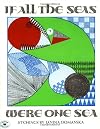
“If All the Seas were One Sea” by Janina Domanska was given the Caldecott Honor in 1972. It is a classic poem that, in the simplest of terms, discusses what the world would be like if everything was all together in one sea. The illustrations are very original with a strong emphasis on geometric shape, yet are abstract as well, and were created using etchings on zinc plates for the black and blue and brush and ink overlays for the red and green. The text is very easy to read and the show more illustrations give a visual component to the poem, but I found that it left me very confused. The words themselves make perfect sense and leave me thinking that if everything was all together then it would be “good,” but the illustrations seem to take a different route. There is a giant green whale with sharp teeth that appears to be eating everything, which leaves me thinking that Domanska is hinting that the world would be chaos if such an event were to occur and that everything is just fine the way it is, but I am still skeptical as to whether or not that is the case. “If All the Seas were One Sea” was by far my least favorite book. I was left feeling confused and frustrated. I do not see myself reading it to a class. show less

Great little story about a famine in the land and the only way to survive is to go and receive, learn, and retain the name then speak it to the tree that once spoken will yield her strength and produce fruit for all. The key is not to get distracted and thus forgetting the name. The character are all animals and of course the tortoise has a reputation for wisdom. Each time there was a distraction the bell rung and he was reminded to not look back and be distracted. He was the hero and was show more much unappreciated, so much so that once he arrive to the tree, spoke the name, and the tree yielded her strength all the animals trampled the poor hero and crushed him. I did appreciate some parts of the story other parts I did not. I like the message. For me the take away would be summed up in an old saying, " The beginning of wisdom is to shrug your shoulders." That simply means that at every distraction say I don't care and I will ignore it because I have important matters on my mind.
Love the colorful illustrations I consider them different and brilliant. show less
Love the colorful illustrations I consider them different and brilliant. show less
Lists
Awards


You May Also Like


Associated Authors
Statistics
- Works
- 25
- Also by
- 13
- Members
- 590
- Popularity
- #42,529
- Rating
- 3.7
- Reviews
- 19
- ISBNs
- 49