
Pat Hutchins (1942–2017)
Author of The Doorbell Rang (Math Reader)
About the Author
Pat Hutchins was born Patricia Goundry on June 18, 1942 in Yorkshire, England. In 1958 at the age sixteen, she won a scholarship to attend the Darlington School of Art, where she studied for three years. Then she attended the Leeds College of Art, where studied illustration. After graduating in show more 1962, she moved to London. She worked as a junior art director at the J. Walter Thompson advertising agency. She met her husband there and after they were married, her husband was transferred by the advertising company to head up its New York office. While in New York, she met the editor-in-chief of the children's department at Macmillan, who encouraged her to write and illustrate her own story. Her first book, Rosie's Walk, was published in 1968 and was a 1968 ALA Notable Book. She wrote more than 40 books for young readers including Titch, Don't Forget the Bacon!, 1 Hunter, Good-Night, Owl!, and The Doorbell Rang. In 1974, The Wind Blew won the Kate Greenaway Medal. She died on November 7, 2017 at the age of 75. (Bowker Author Biography) show less
Disambiguation Notice:
Pat Hutchins, children's book author and illustrator, is not the same person as literary scholar Patricia Hutchins.
Image credit: Pat Hutchins
Series
Works by Pat Hutchins
Rosie's Walk [1970 film] 16 copies
White Horse, The 1 copy
Titch big book 1 copy
Rosie's Walk 1 copy
Tsala Ya Me Ya Botlhokwa (My Beste Maat) (Macmillan Children's Books. My Best Friend Tr) (1996) 1 copy
Totem Pole 1 copy
Titch the Chick 1 copy
Suprise Party 1 copy
Associated Works
The 20th-Century Children's Book Treasury: Picture Books and Stories to Read Aloud (1998) — Contributor — 1,838 copies, 14 reviews
Tagged
Common Knowledge
- Legal name
- Hutchins, Patricia Evelyn
- Other names
- Goundry, Patricia Evelyn (maiden name)
- Birthdate
- 1942-06-18
- Date of death
- 2017-11-07
- Gender
- female
- Education
- Leeds College of Art
- Occupations
- illustrator
children's book author - Nationality
- UK
- Birthplace
- Yorkshire, England, UK
- Map Location
- England, UK
- Disambiguation notice
- Pat Hutchins, children's book author and illustrator, is not the same person as literary scholar Patricia Hutchins.
Members
Reviews

How does one start out with "Rabbit is having a party tomorrow," and end up with "Rabbit is reading his poetry tomorrow?" Simple! Pass the message from person to person (or animal to animal, as is the case here), and it will become progressively more garbled as it travels along from one to the next. This certainly proves to be the case with Rabbit's "surprise" news, creating a series of misunderstandings that make it difficult for him to get his friends to come to his party...
Another basic show more concept-book from English children's author Pat Hutchins, The Surprise Party addresses itself, with amusing results, to the errors that accumulate in the course of spoken communication - what we call "the game of telephone," here in the states. I picked it up, initially, because I'm planning to read The Silver Christmas Tree, and the characters from that book were apparently first introduced here. As is proving to be the case with many of this author's titles (Rosie's Walk, Which Witch Is Which?), I found it far more appealing, than I had expected to, enjoying both the idea and the execution. A great, non-didactic way of introducing the idea of errors of transmission, this is also just a fun animal story, with colorful and appealing artwork. show less
Another basic show more concept-book from English children's author Pat Hutchins, The Surprise Party addresses itself, with amusing results, to the errors that accumulate in the course of spoken communication - what we call "the game of telephone," here in the states. I picked it up, initially, because I'm planning to read The Silver Christmas Tree, and the characters from that book were apparently first introduced here. As is proving to be the case with many of this author's titles (Rosie's Walk, Which Witch Is Which?), I found it far more appealing, than I had expected to, enjoying both the idea and the execution. A great, non-didactic way of introducing the idea of errors of transmission, this is also just a fun animal story, with colorful and appealing artwork. show less
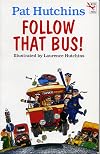
Follow That Bus! Is a great adventure story for kids. It has bank robbers, mistaken identity, kidnapping, baddies in (bad) disguise, a car/tractor chase, a hilarious policeman and a pack of dogs. And aniseed balls. The story takes place on a school trip to the farm, when the class unwittingly becomes embroiled in a bank robbery, which of course, they eventually foil to become the heroes of the day.
It's genuinely funny. There are some great characters amongst the children - particularly the show more determined Avril and the fanciful Jessica, who will make kids chuckle as well as working well to move the story along. The best character by far is the bumbling community policeman - I can vividly remember reading this part to my younger sister when she was probably 6 and I was 12, and us both being doubled up with laughter.
And of course, one of the best things about the book are the great illustrations by Laurence Hutchins (Pat's husband). The front cover alone is enough to make you pick up the book, but the black and white pictures are full of humour and energy and have an almost comic book feel to them, matching the story perfectly.
Follow That Bus! remains in print, 41 years after it was first written in 1977. This is probably because (with the exception of aniseed balls - what happened to those?!) there is very little in the story to suggest the era. It reads pretty much like a book that was written recently. Even the drawings hold up. Great stuff all round. show less
It's genuinely funny. There are some great characters amongst the children - particularly the show more determined Avril and the fanciful Jessica, who will make kids chuckle as well as working well to move the story along. The best character by far is the bumbling community policeman - I can vividly remember reading this part to my younger sister when she was probably 6 and I was 12, and us both being doubled up with laughter.
And of course, one of the best things about the book are the great illustrations by Laurence Hutchins (Pat's husband). The front cover alone is enough to make you pick up the book, but the black and white pictures are full of humour and energy and have an almost comic book feel to them, matching the story perfectly.
Follow That Bus! remains in print, 41 years after it was first written in 1977. This is probably because (with the exception of aniseed balls - what happened to those?!) there is very little in the story to suggest the era. It reads pretty much like a book that was written recently. Even the drawings hold up. Great stuff all round. show less

This humorous little picture-book, which relies on the contrast between text and image to produce its effect, follows Rosie the red hen as she sets out for a walk around the farm. The extremely brief narrative - the entire story is told in a single sentence - is calm and matter-of-fact, little more than a recitation of Rosie's itinerary. The illustrations, on the other hand, are colorful and exciting, depicting a sly fox on the hunt - for Rosie! Unfortunately, or fortunately (as the case may show more be), he keeps running into trouble, as Rosie walks heedlessly along. I'm glad my friend Kathryn recommended this - I never would have picked it up otherwise, and it really is a wonderful book. Rosie's Walk is one I highly recommend to younger preschool children who enjoy a funny story! show less
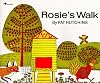
A Chicken, a fox, a handful of prepositions... and a lot more story than what's in the text!
It might be fun to try and review a picture book using as many words as are in the text. To do that, I would have to stop the review right here.
Some other time perhaps.
Rosie the end leaves her protected hutch and goes for a walk, unaware of a fox who has his eyes set on an easy lunch. In a single opening spread we are introduced to a protagonist, an antagonist, a plot and a subplot, a location, and show more already a rising tension. Will Rosie make it home safely? How will the fox be foiled? So much tension!
As the fox follows Rosie narrowly escape through a series of actions worthy of great Warner Brothers cartoons. The fox steps on a rake and is smashed in the face. He leaps and lands in a pond. As he lurks near the mill Rosie unknowingly sends a sack of flour onto the fox. Finally, due to a culmination of events, the fox has angered several hives worth of bees who run him off while Rosie happily, obliviously, returns home in time for dinner.
Or was she really that oblivious?
First, a little bit about the mechanics. Technically the book is one long sentence:
Rosie the hen went for a walk, across the yard, around the pond, over the haystack, past the mill, through the fence, under the beehives, and got back in time for dinner.
I've added the commas for reading clarity and to indicate page breaks, but the text does include only one capital letter and one period. And going by text alone you wouldn't think there was much of a story there, but this is what picture books are all about. The intermarriage of word and picture is what brings about the subplot, the unnamed and unmentioned fox who is stalking Rosie. The tension between the word and picture is echoed in the tension between what Rosie knows and what the reader knows. Really, this is more sophisticated than it appears on the surface.
Now, as for Rosie, she spends the entire book strutting across the page with her head up and a carefree look on her face.... or is it? Could it be that Rosie is aware of the fox and is deliberately taking him for the walk? This is where a clever book rewards rereaders with a different experience. On the first pass readers worry about Rosie by completing or recombining the narrative to gain meaning; on the second pass the reader already knows what to expect from the story and they use the visual cues to recombine the narrative into a totally new meaning. Even if after ever page turn the young reader turns back to look for the clues they missed that lead to the action they've just experienced they are composing new meaning. The first time it's "Look out, Rosie!" and the next time it's "Look out, fox!"
It would seem difficult to find fault with a picture book that does so much with so little, and yet, is it possible that the text is too long? Okay, so maybe we're entering crazyville here, but given that we don't need to be told she is being followed by a fox, do we need to know that Rosie is a hen? Look at the text above. If we remove "the hen" from the text nothing changes, and from the interplay between word and image it would still be clear which character the story was about. I'll grant, it's picking nits, but those two words constitute 1/16 of the text, so I want to be sure I understand their point and purpose.
The answer is as easy as reading the book both ways out loud. The answer is flow. Grammatically the sentence-text if fine without "the hen" but reading it aloud gives the opening a clipped hiccup that utterly destroys the narrative flow. So while far too often it can seem like a simple text could be shortened (and sometimes by as much as 50%) here the two "extraneous" words satisfy our ear and allow us to feel the rhythm of the story just as quickly as the images and their interplay with the text gives us all the information we need to know about the story.
So it is, that Rosie the hen leaves home and takes a heroes journey, facing (away from) trials and tribulations, to return home triumphantly in time for dinner. And as Sendak's Max has taught us, no doubt Rosie's dinner is still hot. show less
It might be fun to try and review a picture book using as many words as are in the text. To do that, I would have to stop the review right here.
Some other time perhaps.
Rosie the end leaves her protected hutch and goes for a walk, unaware of a fox who has his eyes set on an easy lunch. In a single opening spread we are introduced to a protagonist, an antagonist, a plot and a subplot, a location, and show more already a rising tension. Will Rosie make it home safely? How will the fox be foiled? So much tension!
As the fox follows Rosie narrowly escape through a series of actions worthy of great Warner Brothers cartoons. The fox steps on a rake and is smashed in the face. He leaps and lands in a pond. As he lurks near the mill Rosie unknowingly sends a sack of flour onto the fox. Finally, due to a culmination of events, the fox has angered several hives worth of bees who run him off while Rosie happily, obliviously, returns home in time for dinner.
Or was she really that oblivious?
First, a little bit about the mechanics. Technically the book is one long sentence:
Rosie the hen went for a walk, across the yard, around the pond, over the haystack, past the mill, through the fence, under the beehives, and got back in time for dinner.
I've added the commas for reading clarity and to indicate page breaks, but the text does include only one capital letter and one period. And going by text alone you wouldn't think there was much of a story there, but this is what picture books are all about. The intermarriage of word and picture is what brings about the subplot, the unnamed and unmentioned fox who is stalking Rosie. The tension between the word and picture is echoed in the tension between what Rosie knows and what the reader knows. Really, this is more sophisticated than it appears on the surface.
Now, as for Rosie, she spends the entire book strutting across the page with her head up and a carefree look on her face.... or is it? Could it be that Rosie is aware of the fox and is deliberately taking him for the walk? This is where a clever book rewards rereaders with a different experience. On the first pass readers worry about Rosie by completing or recombining the narrative to gain meaning; on the second pass the reader already knows what to expect from the story and they use the visual cues to recombine the narrative into a totally new meaning. Even if after ever page turn the young reader turns back to look for the clues they missed that lead to the action they've just experienced they are composing new meaning. The first time it's "Look out, Rosie!" and the next time it's "Look out, fox!"
It would seem difficult to find fault with a picture book that does so much with so little, and yet, is it possible that the text is too long? Okay, so maybe we're entering crazyville here, but given that we don't need to be told she is being followed by a fox, do we need to know that Rosie is a hen? Look at the text above. If we remove "the hen" from the text nothing changes, and from the interplay between word and image it would still be clear which character the story was about. I'll grant, it's picking nits, but those two words constitute 1/16 of the text, so I want to be sure I understand their point and purpose.
The answer is as easy as reading the book both ways out loud. The answer is flow. Grammatically the sentence-text if fine without "the hen" but reading it aloud gives the opening a clipped hiccup that utterly destroys the narrative flow. So while far too often it can seem like a simple text could be shortened (and sometimes by as much as 50%) here the two "extraneous" words satisfy our ear and allow us to feel the rhythm of the story just as quickly as the images and their interplay with the text gives us all the information we need to know about the story.
So it is, that Rosie the hen leaves home and takes a heroes journey, facing (away from) trials and tribulations, to return home triumphantly in time for dinner. And as Sendak's Max has taught us, no doubt Rosie's dinner is still hot. show less
Lists
Awards


You May Also Like


Associated Authors
Statistics
- Works
- 83
- Also by
- 1
- Members
- 22,246
- Popularity
- #957
- Rating
- 3.9
- Reviews
- 783
- ISBNs
- 575
- Languages
- 16
- Favorited
- 7