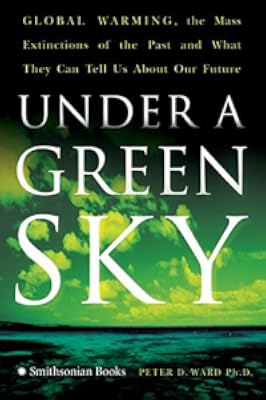
Under a Green Sky: Global Warming, the Mass Extinctions of the Past, and What They Can Tell Us About Our Future
by Peter D. Ward
On This Page
Description
More than 200 million years ago, a cataclysm known as the Permian extinction destroyed nearly 97 percent of all living things. Its origins have long been a puzzle. Paleontologist Ward, fresh from helping prove that an asteroid had killed the dinosaurs, turned to the Permian problem, and he has come to a stunning conclusion: that the near-total devastation at the end of the Permian period was caused by rising levels of carbon dioxide leading to climate change. The story of the discovery makes show more for a globe-spanning adventure. Here, Ward explains how the Permian extinction as well as four others happened, and describes the freakish oceans--belching poisonous gas--and sky--slightly green and always hazy--that would have attended them. Those ancient upheavals demonstrate that the threat of climate change cannot be ignored, lest the world's life today--ourselves included--face the same dire fate.--From publisher description. show lessTags
Recommendations





Member Reviews
This is probably the clearest writing you will find on the subject of past extinctions and paleo climate changes. The title comes from the authors interpretation of what the earth would look like during the height of the Permian-Triasic extinction. This is the largest and one of the most difficult to understand die-offs ever to occur on the earth. Ward's field work provides compelling hard evidence to his interpretations and will scare the pants off you.
An interesting and informative book in which the author investigates the mystery of what caused the various great extinctions in the past, and how this relates to the current environmental situation today. This scientific mystery story involves everything from squabbling scientist, volcanoes, "evil" bacteria, poisonous gases and asteroids to oceanic convection currents and ice core data.
The book was published in 2007. I'm not certain how outdated and thus accurate the data is in light of any new evidence. However, I found the book to be an interesting and entertaining reading experience, with food for thought and things to look up.
Other, Related Recommended Books:
The Emerald Planet: How Plants Changed History by David Beerling
Out of show more Thin Air: Dinosaurs, Birds, and Earth's Ancient Atmosphere by Peter D. Ward
Oxygen: The Molecule That Made the World by Nick Lane show less
The book was published in 2007. I'm not certain how outdated and thus accurate the data is in light of any new evidence. However, I found the book to be an interesting and entertaining reading experience, with food for thought and things to look up.
Other, Related Recommended Books:
The Emerald Planet: How Plants Changed History by David Beerling
Out of show more Thin Air: Dinosaurs, Birds, and Earth's Ancient Atmosphere by Peter D. Ward
Oxygen: The Molecule That Made the World by Nick Lane show less
I liked this book. The theory of mass extinctions could have just been presented at the outset, probably in a paragraph or a chapter, but Ward tells it as a story of the search for truth, so we get both the science angle and the politics of science angle. It's a good book to read if you're interested in global warming, mass extinctions, and how science works. I found his discussion of the politics and personal interactions surrounding the impact hypothesis for the dinosaurs' extinction intriguing and a bit sad, too. It's odd that the scientists can't all just sit down and discuss the science. Some of them, I suppose, did, and Ward tries to present himself in that role. Ward is certainly in a position to address all of this in an show more authoritative way. It was interesting that some of the points made by the anti-impact people in the case of the dinosaurs' extinction, even though they turned out to be wrong, were helpful in addressing the problems relating to the other extinctions. I found some of his descriptions of his trips to sites to study the fossils a bit confusing. His descriptions seemed careful enough, and I picked up most of what it was like "working" the sites, but for some reason it was often hard to picture what exactly the site looked like physically and what he did physically. Perhaps some pictures or photos of the sites might have helped. Also, I'd be interested in knowing what his reaction to the "runaway greenhouse" possibility invoked in James Hansen's more recent book "Storms of my Grandchildren" would be. But his point that climate scientists and scientists investigating the mass extinctions should work together is very well taken. It's important for us to consider the human side of the science story because "how science works" is an issue for a lot of people, who still don't trust science. If you don't trust science, you'll be reluctant to accept the fact of climate change. Ward's discussion leaves the impression that the discipline of science can overcome some pretty strong personal feelings, and in balance leaves us with a good feeling about science even when individual scientists can sometimes be pretty strange. show less
One of the most provocative books I've read. Talks about global warming in the past. Offers proof on a different theory re the disappearance of dinosaurs.
Ratings
Members
- Recently Added By
Author Information

20 Works 2,413 Members
Peter D. Ward is Professor of Geological Sciences at the University of Washington in Seattle.
Common Knowledge
- Original publication date
- 2007
- Epigraph
- The climate is like a wild beast, and we're poking at it with sticks. [Climatologist Wally Broecker]
- First words
- A warm but wet wind from the sea, a wind pushing gray scudding clouds onshore from the squall-torn Bay of Biscay greeted the two geologists as they slowly drove through the narrow, building-lined streets of a small, tiled Bas... (show all)que town named Zumaya, in the quiet of an early Sunday morning.
Classifications
Statistics
- Members
- 210
- Popularity
- 155,770
- Reviews
- 4
- Rating
- (3.96)
- Languages
- English
- Media
- Paper, Ebook
- ISBNs
- 6
- ASINs
- 2