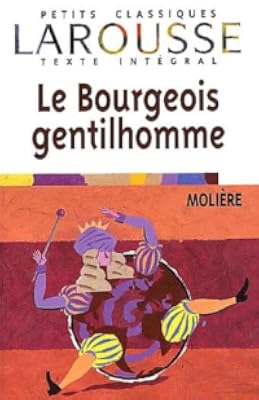
The Bourgeois Gentleman
by Molière, Yves Bomati (Editor), Danièle Danièle (Editor)
On This Page
Description
The play takes place at Mr. Jourdain's house in Paris. Jourdain is a middle-aged 'bourgeois' whose father grew rich as a cloth merchant. The foolish Jourdain now has one aim in life, which is to rise above this middle-class background and be accepted as an aristocrat. To this end, he orders splendid new clothes and is very happy when the tailor's boy mockingly addresses him as 'my Lord'.Tags
Recommendations






























Member Reviews
Le Bourgeois gentilhomme est une comédie-ballet en cinq actes en prose de Molière, représentée pour la première fois le 14 octobre 1670, devant la cour de Louis XIV, au château de Chambord par la troupe de Molière. La musique est de Jean-Baptiste Lully, les ballets de Pierre Beauchamp, les décors de Carlo Vigarani et les costumes turcs du chevalier d'Arvieux.
Nov 12, 2010French
1
Opera letteraria del XVII secolo in lingua originale
Aug 19, 2015Italian
Members
- Recently Added By
Lists

Books translated from Romance Languages into English
102 works; 6 members

Harold Bloom - The Western Canon: B. The Aristocratic Age
231 works; 13 members

Greatest Books, allegedly
484 works; 9 members

Class mobility in fiction
18 works; 1 member

My Play Collection
769 works; 3 members
Author Information

1,109+ Works 22,698 Members
The French dramatist Moliere was born Jean-Baptiste Poquelin on January 15, 1622, in Paris. The son of a wealthy tapestry merchant, he had a penchant for the theater from childhood. In 1636, he was sent off to school at the Jesuit College of Claremont and in 1643, he embarked upon a 13-year career touring in provincial theater as a troupe member show more of Illustre Theatre, a group established by the family Bejarts. He married a daughter of the troupe, Armande Bejart, in 1662 and changed his name to Moliere. The French King Louis XIV, becoming entranced with the troupe after seeing a performance of The Would-Be Gentleman, lent his support and charged Moliere with the production of comedy ballets in which he often used real-life human qualities as backdrops rather than settings from church or state. Soon, Moliere secured a position at the Palais-Royal and committed himself to the comic theater as a dramatist, actor, producer, and director. Moliere is considered to be one of the preeminent French dramatists and writers of comedies; his work continues to delight audiences today. With L'Ecole des Femmes (The School for Wives) Moliere broke with the farce tradition, and the play, about the role played by women in society and their preparation for it, is regarded by many as the first great seriocomic work of French literature. In Tartuffe (1664), Moliere invented one of his famous comic types, that of a religious hypocrite, a character so realistic that the king forbade public performance of the play for five years. Moliere gave psychological depth to his characters, engaging them in facial antics and slapstick comedy, but with an underlying pathos. Jean Baptiste Moliere died in 1673. (Bowker Author Biography) show less
Some Editions
Awards and Honors
Series
Belongs to Publisher Series
Work Relationships
Is contained in
Bourgeois Gentleman / Imaginary Invalid / Misanthrope / Miser / School for Husbands / School for Wives / Tartuffe by Molière
Bourgeois Gentleman / Dom Juan / Imaginary Invalid / Learned Ladies / Misanthrope / Miser / Tartuffe by Molière
Bourgeois Gentleman / Imaginary Invalid / Learned Ladies / Misanthrope / Miser / Scapin / School for Wives / Tartuffe by Molière
Amphitryon / Bourgeois Gentleman / Dom Juan / Imaginary Invalid / Misanthrope / Miser / Tartuffe by Molière
World Drama, Volume 2: Italy, Spain, France, Germany, Denmark, Russia and Norway by Barrett H. Clark
Has the adaptation
Has as a student's study guide
Common Knowledge
- Canonical title
- The Bourgeois Gentleman
- Original title
- Le Bourgeois gentilhomme
- Alternate titles
- The Would-Be Gentleman; The Middle-Class Aristocrat; The Would-Be Noble
- Original publication date
- 1670
- People/Characters*
- Monsieur Jourdain; Madame Jourdain; Lucille; Nicole; Cléonte; Dorante (show all 11); Dorimène; Covielle; Le maître de musique; Le maître de danse; Le maître d'armes
- Important places
- Paris, France
- Original language*
- Français
*Some information comes from Common Knowledge in other languages. Click "Edit" for more information.
Classifications
Statistics
- Members
- 1,077
- Popularity
- 23,767
- Reviews
- 2
- Rating
- (3.74)
- Languages
- 12 — Dutch, English, Esperanto, French, German, Galician, Italian, Multiple languages, Russian, Spanish, Swahili, Turkish
- Media
- Paper, Audiobook, Ebook
- ISBNs
- 118
- UPCs
- 4
- ASINs
- 38
