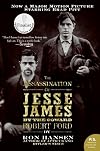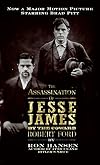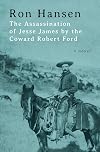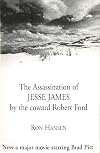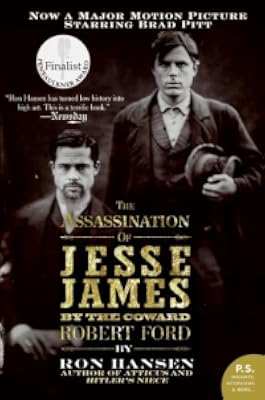
The Assassination of Jesse James by the Coward Robert Ford
by Ron Hansen
On This Page
Description
Ron Hansen's critically acclaimed historical novel about the life and untimely death of America's most infamous outlaw, and his relationship with the young man who killed him By age thirty-four, Jesse James was already one of the most notorious and admired men in America. Bank robber, train bandit, gang leader, killer, and beloved son of Missouri- James's many epithets live on in newspapers and novels alike. As his celebrity was reaching its apex, James met Robert Ford, the brother of a show more James gang member-an awkward, antihero-worshipping twenty-year-old with stars in his eyes. The young man's fascination with the legend borders on jealous obsession: While Ford wants to ride alongside James as his most-trusted confidant, sharing his spotlight is not enough. As a bond forms between the two men, Ford realizes that the only way he'll ever be as powerful as his idol is to become him; he must kill James and take his mantle. In the striking novel that inspired the film of the same name starring Brad Pitt and Casey Affleck, bestselling author Ron Hansen retells a classic Wild West story that has long captured the nation's imagination, and breathes new life into the final days and ignoble death of an iconic American man. show lessTags
Recommendations











Member Reviews
This work of historical fiction reads like a history book but a very entertaining one. This is a fair study of the foundations of our western culture, focusing on hero worship, and our propensity for violence. Jesse James is such a fascinating American figure - because he represents the dichotomy of the American experiment. Ron Hansen's writing is often illuminating and wonderful but sometimes gets bogged down by focusing on the historical accounts...Bob did this...Bod went here...and when he does this his writing gets a bit dry. However, overall, this book is a wonderful black and white portrait of time and a group of famous persons.
You'll have to excuse me if this review comes off as a bit of a love letter, I am simply obsessed with this book. Ron Hansen does a magnificent job in recreating the life and times of America's most notorious outlaw, Jesse James. Not only that but we get into the head and life of his assassin, Robert Ford.
I first picked up this book after seeing the completely underrated movie of the same name staring Brad Pitt as Jesse James, and Casey Affleck as Robert Ford. The film is simply beautiful. Three hours of pure filmmaking for the love of filmmaking. Even if you don't read the book, do yourself a great favor and see the film. The soundtrack alone, which I listen to to get myself in the mood to write, is worth it.
I also picked this book up show more because, since I was a little kid I had an unhealthy obsession with everything Jesse James. I had read kid version books of his exploits, glorifying him as the great American Robin Hood. I had seen the horribly historically inaccurate Colin Farrell movie, American Outlaws, and loved it regardless. But this book was something else altogether. It was as close to accurate as one could get to the honestly mysterious Jesse James and the events surrounding his death.
Well researched, and extremely well written, the book opens around Jesse's 34th birthday. His last birthday. It goes into detail explaining things about Jesse, that his enormous legend had left out, half a missing finger, unhealed bullet wounds, an eye condition that made him blink more rapidly than normal, leading Hansen to write one of the most beautiful lines in the book, "...caused him to blink more than usual, as if he found creation slightly more than he could accept." The vision that line alone conjures up in my head is amazing.
The book continues on to when Jesse and Robert Ford first meet, right before the final robbery of the James Gang. The book stikes a great balance between insights into Jesse's life, and the life he had lived up until that point, and the life of the young nineteen-year-old Robert Ford. Ford is hero obsessed with Jesse after growing up hearing and reading about the man's famous exploits. The phrase "you should never meet your heros" definitely applies in this case. Ford is discouraged that Jesse isn't the man the praise in the papers made him out to be, and Jesse is restless and wandering, lost trying to find the next phase in his life.
Hansen deftly weaves through the psychological pinings of both men. What Hansen constructs is a novel speaking on the weight of fame, the downfall of hopes and dreams, and the naivety of the young seeking glory it can't forsee. It is an excellent book for any history lover, a must read book for anyone into Jesse James, and an all around great read. This was a magnificent portrait of one of America's most loved and most misunderstood criminals. Hansen writes with a clarity that is unrivaled in his genre, and gives the reader insight into a man that didn't seem to even quite know himself. Highly recommended. show less
I first picked up this book after seeing the completely underrated movie of the same name staring Brad Pitt as Jesse James, and Casey Affleck as Robert Ford. The film is simply beautiful. Three hours of pure filmmaking for the love of filmmaking. Even if you don't read the book, do yourself a great favor and see the film. The soundtrack alone, which I listen to to get myself in the mood to write, is worth it.
I also picked this book up show more because, since I was a little kid I had an unhealthy obsession with everything Jesse James. I had read kid version books of his exploits, glorifying him as the great American Robin Hood. I had seen the horribly historically inaccurate Colin Farrell movie, American Outlaws, and loved it regardless. But this book was something else altogether. It was as close to accurate as one could get to the honestly mysterious Jesse James and the events surrounding his death.
Well researched, and extremely well written, the book opens around Jesse's 34th birthday. His last birthday. It goes into detail explaining things about Jesse, that his enormous legend had left out, half a missing finger, unhealed bullet wounds, an eye condition that made him blink more rapidly than normal, leading Hansen to write one of the most beautiful lines in the book, "...caused him to blink more than usual, as if he found creation slightly more than he could accept." The vision that line alone conjures up in my head is amazing.
The book continues on to when Jesse and Robert Ford first meet, right before the final robbery of the James Gang. The book stikes a great balance between insights into Jesse's life, and the life he had lived up until that point, and the life of the young nineteen-year-old Robert Ford. Ford is hero obsessed with Jesse after growing up hearing and reading about the man's famous exploits. The phrase "you should never meet your heros" definitely applies in this case. Ford is discouraged that Jesse isn't the man the praise in the papers made him out to be, and Jesse is restless and wandering, lost trying to find the next phase in his life.
Hansen deftly weaves through the psychological pinings of both men. What Hansen constructs is a novel speaking on the weight of fame, the downfall of hopes and dreams, and the naivety of the young seeking glory it can't forsee. It is an excellent book for any history lover, a must read book for anyone into Jesse James, and an all around great read. This was a magnificent portrait of one of America's most loved and most misunderstood criminals. Hansen writes with a clarity that is unrivaled in his genre, and gives the reader insight into a man that didn't seem to even quite know himself. Highly recommended. show less
This is a riveting story that reads quickly relative to its dense 400 pages of length. Hansen's writing is so confident and authentic that you as a reader immediately sense you're in the hands of a master. He marries fact and fiction in the most natural way possible; you have to think long and hard to discern where one ends and the other begins. An example:
The matter-of-fact prose -- at times electrifying in its succinctness -- helps with the characterization. Hansen also utilizes a wide variety of colorful imagery and metaphor to describe scenes in altogether unique ways. In the first pages of his description of Jesse James he magically brings him to life with such passages:
So those are all the reasons to read it, but it's not a flawless book. Because it is essentially a chronicle of the preamble and aftermath to one particular event, and because Hansen apparently takes pride in being thorough, providing a beginning and end for every person involved (no matter how minor), the book has a disjointed feel in places. This is notable especially after the assassination itself, and at the beginning of Part 2 when there is an extended aside about the feud between Wood Hite and Dick LIddil.
Also, while it becomes apparent fairly early on that Robert Ford is the main character, we are still left with maddeningly little explanation as to why he chose to act the way he did. Hansen does provide some more insight much later in the novel, when Ford is commiserating with Dorothy Evans a few months before his death, but it's a case of too-little-and-late for my tastes.
Overall, however, it's a captivating book about a fascinating time in the country's history: when it was transitioning from the uncivilized "Wild West" to the more lawful ways of the East. Bob Ford represents this transition in certain ways and thus serves as a supremely intriguing subject. Combined with Hansen's exceptional writing, this is a novel that will please anyone who doesn't require a traditional narrative. show less
But as (Bob Ford) lifted the dipper he viewed himself in the store window and was discouraged by the picture of a scroungy boy in a ridiculous stove-pipe hat that was dented and smudged, in an overlarge black coat that was soiled and stained and plowed with wrinkles and cinched at his waist by a low-slung holster. He thought he looked goofy and juvenile, so he went inside the storeshow more
and cruised the aisles. 112He goes onto describe the outfit that Ford picked out, which I assume is accurate and based on eyewitness accounts or maybe newspaper reports. But to describe the thought process behind the purchase takes it one step further. Hansen is actually inhabiting these historical figures, giving them motives and desires and insecurities, and the results are quite convincing.
The matter-of-fact prose -- at times electrifying in its succinctness -- helps with the characterization. Hansen also utilizes a wide variety of colorful imagery and metaphor to describe scenes in altogether unique ways. In the first pages of his description of Jesse James he magically brings him to life with such passages:
He could intimidate like Henry the Eighth; he could be reckless or serene, rational or lunatic, from one minute to the next. If he made an entrance, heads turned in his direction; if he strode down an aisle store clerks backed away; if he neared animals they retreated. Rooms seemed hotter when he was in them, rains fell straighter, clocks slowed, sounds were amplified: his enemies would not have been much surprised if he produced horned owls from beer bottles or made candles out of his fingers. 6On the next page there's this simple yet utterly effective description of a coat:
. . . climbed into a Confederate officer's coat that was rich with the odors of manual labor and was heavy enough to snap the pegs off a closet rack. 7And how about this for an interesting description of a death during a train robbery:
. . . Frank McMillan was craning to look inside for himself when a lead ball punched into his forehead above his right eye, stopping his life instantly. His body collapsed just as the air brakes screeched and McMillan too slipped off the slackening train. 92And check out the level of detail when describing Wood Hite's death:
Wood said nothing. His eyes were closed. A string of saliva hung from his mouth to the floor and it bowed with each cold draft of air. Martha tugged the blue muffler off and picked the blood-tipped hair from his brow. 151As a visual reader I love writing like this because I can actually see it happening. It definitely has a cinematic quality and I can understand how Brad Pitt and Andrew Dominik were so excited about filming it. What's more, the scenes with Jesse James are menacing and nerve-wracking without fail. The way he turns every gesture, glance or word from James into a paranoid delusion or veiled threat is masterful.
So those are all the reasons to read it, but it's not a flawless book. Because it is essentially a chronicle of the preamble and aftermath to one particular event, and because Hansen apparently takes pride in being thorough, providing a beginning and end for every person involved (no matter how minor), the book has a disjointed feel in places. This is notable especially after the assassination itself, and at the beginning of Part 2 when there is an extended aside about the feud between Wood Hite and Dick LIddil.
Also, while it becomes apparent fairly early on that Robert Ford is the main character, we are still left with maddeningly little explanation as to why he chose to act the way he did. Hansen does provide some more insight much later in the novel, when Ford is commiserating with Dorothy Evans a few months before his death, but it's a case of too-little-and-late for my tastes.
Overall, however, it's a captivating book about a fascinating time in the country's history: when it was transitioning from the uncivilized "Wild West" to the more lawful ways of the East. Bob Ford represents this transition in certain ways and thus serves as a supremely intriguing subject. Combined with Hansen's exceptional writing, this is a novel that will please anyone who doesn't require a traditional narrative. show less
Don’t be fooled by the title. This isn’t just a fictional retelling of a murder, of one of the most infamous celebrity assassinations in United States history. This is the story of two lives that once-upon-a-time intersected, and were forever changed, each by the other, for better or worse. Jesse James: train robber, thief, husband, father, ex-bushwacker and hero to many, at the long and lonely end of his ‘night riding’ ways. Bob Ford: young, impressionable, and desperate to be like his childhood hero, the one beloved by so very many, the one and only, Jesse James. Hansen captures a truth in these pages – heroes are human; humans are flawed; and flaws are sometimes as hard to live with as they are hard to live without because, show more they make us who we are. It’s a poetic journey that will thrust you back into a time when the Civil War was still a fresh wound on the American memory, and justice was often dealt out from a Colt revolver by the man who could draw the quickest. Highly recommended. show less
Historical fiction of the last few crimes of the James Gang, the death of Jesse James, and the subsequent struggles of those involved in his death, particularly the man who pulled the trigger, Robert Ford. I had purchased this book thinking it was non-fiction; however, it is clearly historical fiction. From subsequent research, it appears to be based on facts. The dialogue, which obviously had to be invented, is believable. James is portrayed as a complex personality. He is simultaneously a remorseless killer and a family man.
Hansen provides a vivid picture of life in the late 1800’s in scenes such as:
“It was March then and the weather was nasty and the road was ice and muck and scrambled wagon ruts. Their saddles creaked with every show more movement and their two horses were morose: their nostrils were frosted and their manes were braided with icicles and if they rested the animals their coats would steam in the cold.”
This book highlights one of the first celebrity obsessions. Robert Ford is fixated on Jesse James and believes he will become a celebrity himself by association, especially by the act of killing him. It excels as a portrait of two complex men of historical significance, but I am not sure it entirely succeeds as fiction, as it does not provide rationale for James’ choice to pursue a life of robbery and murder, nor does it explain the entrancing appeal James exerts on his followers. Hansen’s writing style occasionally slips into one more associated with narrative non-fiction. Recommended to those interested in the American West of the late 19th century, the life of notorious outlaws, or the origins of celebrity adulation. show less
Hansen provides a vivid picture of life in the late 1800’s in scenes such as:
“It was March then and the weather was nasty and the road was ice and muck and scrambled wagon ruts. Their saddles creaked with every show more movement and their two horses were morose: their nostrils were frosted and their manes were braided with icicles and if they rested the animals their coats would steam in the cold.”
This book highlights one of the first celebrity obsessions. Robert Ford is fixated on Jesse James and believes he will become a celebrity himself by association, especially by the act of killing him. It excels as a portrait of two complex men of historical significance, but I am not sure it entirely succeeds as fiction, as it does not provide rationale for James’ choice to pursue a life of robbery and murder, nor does it explain the entrancing appeal James exerts on his followers. Hansen’s writing style occasionally slips into one more associated with narrative non-fiction. Recommended to those interested in the American West of the late 19th century, the life of notorious outlaws, or the origins of celebrity adulation. show less
A tragic tale on a man born from legend, and one yearning to usurp his throne. Touchingly spiteful. Redemption isn’t always what you make of it.
This book was an experiment for me, as I tend to read neither Westerns nor historical fiction. However, high off a Cormac McCarthy trip and after hearing a recommendation for the movie version I decided to make the attempt. In the end, I unfortunately just couldn't get interested. The historical figures have great potential as characters, but they are not by nature sympathetic, and it was difficult for me to get inside them and understand their motivations. It's a good story, but the telling is almost too biographical -- a lot of narrative detail could have been replaced with character study in my opinion.
I don't think this is a bad book by any means. But not my cup of tea. Hopefully someone can write a positive review for those who may show more be more inclined to the genre. show less
I don't think this is a bad book by any means. But not my cup of tea. Hopefully someone can write a positive review for those who may show more be more inclined to the genre. show less
Members
- Recently Added By
Lists

N.T. McQueen's Inspiration List
23 works; 1 member
Author Information

25+ Works 4,680 Members
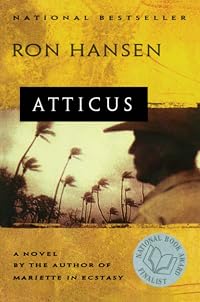
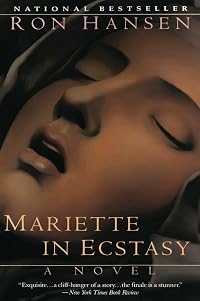
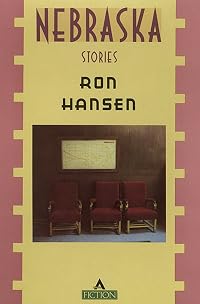
Ron Hansen was born in Omaha Nebraska in 1947.He received a BA degree in English from Creighton University in Nebraska in 1970. He is the author of more than 20 books, stories, and anthologies. He received the Award in Literature from the American Academy and Institute of Arts and Letters for his book Nebraska, a collection of short fiction, in show more 1989. Some of his other works include Mariette in Ecstasy; the children's book, The Shadowmaker; Desperadoes; the Assassination of Jesse James by the Coward Robert Ford, which won the John Edgar Wideman Award in 1984; and the novel Atticus, a suspenseful murder mystery detailing a father's fierce love for his son. Atticus was a finalist for the National Book Award in 1996. Among the anthologies written by Hansen are The Sun So Hot I Froze To Death, Can I Just Sit Here For A While?, and True Romance. His short stories, with titles ranging from "His Dog" to "Playland," have appeared in the Stanford Alumni Magazine, Atlantic Monthly, the Iowa Review, Esquire, and many others. Besides holding Guggenheim and National Endowment for the Arts fellowships, Hansen has received a Lyndhurst Foundation Grant and is a fellow of the University of Michigan Society of Fellows. Hansen has also held the position of Gerald Manley Hopkins S.J. Professor of Arts and Humanities at Santa Clara University. In May 2006 he was inducted into the College of Fellows at Dominican School of Philosophy and Theology. Also in that year The Assasination of Jesse James was adapted for the screen. In 2009 Mariette In Ecstasy was adapted for the stage at Lifetime Theater in Chicago. (Bowker Author Biography) show less
Some Editions
Awards and Honors
Awards
Work Relationships
Has the adaptation
Common Knowledge
- Original publication date
- 1983
- People/Characters
- Robert Ford; Jesse James; Frank James
- Important places
- USA
- Related movies
- The Assassination of Jesse James by the Coward Robert Ford (2007 | IMDb)
- Original language
- English
- Disambiguation notice
- Book
Classifications
Statistics
- Members
- 749
- Popularity
- 37,657
- Reviews
- 13
- Rating
- (3.75)
- Languages
- English, French, German, Portuguese
- Media
- Paper, Audiobook, Ebook
- ISBNs
- 28
- ASINs
- 7