On This Page
Description
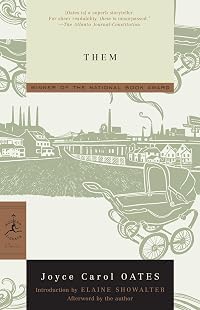
"If the phrase 'woman of letters' existed, [Joyce Carol Oates] would be, foremost in this country, entitled to it."--John Updike, The New Yorker As powerful and relevant today as it was on its initial publication, them chronicles the tumultuous lives of a family living on the edge of ruin in the Detroit slums, from the 1930s to the 1967 race riots. Praised by The Nation for her "potent, life-gripping imagination," Joyce Carol Oates traces the aspirations and struggles of Loretta Wendall, a show more dreamy young mother who is filled with regret by the age of sixteen, and the subsequent destinies of her children, Maureen and Jules, who must fight to survive in a world of violence and danger. Winner of the National Book Award, them is an enthralling novel about love, class, race, and the inhumanity of urban life. It is, raves The New York Times, "a superbly accomplished vision." Them is the third novel in the Wonderland Quartet. The books that complete this acclaimed series, A Garden of Earthly Delights, Expensive People, and Wonderland, are also available from the Modern Library. [Oates is] a superb storyteller. For sheer readability, them is unsurpassed."--The Atlanta Journal-Constitution show lessTags
Recommendations










Member Recommendations

Member Reviews
For a woman who only lived in Detroit for a few years, it's breathtaking how well she evokes this city. Everything feels real to me--and that's saying a lot since these characters are so hard to believe, extremely dysfunctional, sociopaths, even crazy. Oates is able to get into their skin, totally feeling every terrible thought and terrible deed. Yes, it's startlingly violent and as implausible as the characters seem they are true to their actions. Oates never flinches, she never explains or judges them. As she says there are myriad ways of interpreting a story and each reader takes with them what they may.
On the first reading, I was riveted by her authenticity and violence but also shocked by it.
On the second reading, I appreciated show more more of the characters and who they were and who they were was so intertwined with the world they came from. Oates allows them to be as they are without setting about to reform them, or impose a moral framework on this story. Despite its darkness and its bleakness and its crazyness, I discovered on this reading that when the shock wears off you can see tiny shafts of light in this dark portrait Oates has painted. It came to me as a tragic story illuminated. show less
On the first reading, I was riveted by her authenticity and violence but also shocked by it.
On the second reading, I appreciated show more more of the characters and who they were and who they were was so intertwined with the world they came from. Oates allows them to be as they are without setting about to reform them, or impose a moral framework on this story. Despite its darkness and its bleakness and its crazyness, I discovered on this reading that when the shock wears off you can see tiny shafts of light in this dark portrait Oates has painted. It came to me as a tragic story illuminated. show less
Set in the slums of Detroit in the decades of the 1930s through 1960s, Them follows the lives of three (white) family members: Loretta and her two children, Jules and Maureen. It’s an embarrassingly riveting story, a survival tale of relentless poverty and violence. I was mesmerized and flew through most of the novel’s nearly 500 pages.
JCO calls this novel history as fiction (a slight paraphrase). Maureen, the daughter in the story, was a student in one of the night classes JCO taught while at the University of Detroit. Some years later, Maureen wrote to her and, as they became acquainted, Maureen began to tell her own story. JCO says she was riveted by it, conscious that she was to bear witness of it. Maureen’s (not her real show more name, of course) actual remarks/recollections have been used verbatim wherever possible, and nothing has been exaggerated for dramatic effect. All this JCO notes in the preface.
And here is where I might add some synopsis but I think it’s best to leave that for you to discover. Suffice it to say that the three are survivors; and that, in and of itself, is a testament to the resilience of the human spirit.
While the book is about a specific, and very real “them,” one could also say that the story also speaks of a more general “other” — “them”, whomever they may be. For Loretta it seems to be anyone outside her small circle of family and friends. For us, the reader, it is this specific family as representative of the people in our culture we don’t see, the people who have no voice in our society. It’s a powerful story, we cannot help be carried along with it.
There was a section towards the end of the book that I found less enthralling, but otherwise the book captures one’s attention completely, right up through it’s climax—the awful 1967 Detroit riots. show less
JCO calls this novel history as fiction (a slight paraphrase). Maureen, the daughter in the story, was a student in one of the night classes JCO taught while at the University of Detroit. Some years later, Maureen wrote to her and, as they became acquainted, Maureen began to tell her own story. JCO says she was riveted by it, conscious that she was to bear witness of it. Maureen’s (not her real show more name, of course) actual remarks/recollections have been used verbatim wherever possible, and nothing has been exaggerated for dramatic effect. All this JCO notes in the preface.
And here is where I might add some synopsis but I think it’s best to leave that for you to discover. Suffice it to say that the three are survivors; and that, in and of itself, is a testament to the resilience of the human spirit.
While the book is about a specific, and very real “them,” one could also say that the story also speaks of a more general “other” — “them”, whomever they may be. For Loretta it seems to be anyone outside her small circle of family and friends. For us, the reader, it is this specific family as representative of the people in our culture we don’t see, the people who have no voice in our society. It’s a powerful story, we cannot help be carried along with it.
There was a section towards the end of the book that I found less enthralling, but otherwise the book captures one’s attention completely, right up through it’s climax—the awful 1967 Detroit riots. show less
Joyce Carol Oates' novel Them, the third novel in the Wonderland quartet is a gritty examination of Detroit as it transformed from prosperous "Motor City" to a burned out post-apocalyptic city in the aftermath of the race riots.
Oates takes the reader on this journey through the eyes of the Wendall family. The story is primarily told from the point of view of Loretta, Jules and Maureen Wendall beginning with Loretta finding her first lover shot in her bed by her brother, fleeing the scene and finding her first husband in a period of hours.
Oates examination of the life of these characters struggling to escape poverty is raw and painful. As the title implies there is a distinct division between "us" and "them", and each character struggles show more to leave their caste and join another often climbing over one another in the process.
"Them" echos Tolstoy's Anna Karenina in that Oates examines Detroit in all of its intricacies in relationship to the lives of her characters much in the same way Tolstoy examines St. Petersburg Russia. In fact one could even draw some similarities between some of the characters. Loretta Wendall is a modern albeit much poorer foil for Anna. Both women are similarly confined by their position in society and their gender. Maureen could be seen as a parallel for Kitty in some ways as well.
Them is not an enjoyable book to read, but it is an interesting book to read. It doesn't lift the reader with poetic language or refresh the reader's spirit by examining the humanity that lies within all of us. In fact, it does quite the opposite, but that is Oates' intention. Oates' language is direct and she examines with brutal honesty the baseness of human nature.
This book is a very worthwhile read if you are a lover of literature, a fan of Oates or just the kind of person who likes to lift the rug up an peek at the harsh underpinnings of human interaction. Not for the feint of heart! show less
Oates takes the reader on this journey through the eyes of the Wendall family. The story is primarily told from the point of view of Loretta, Jules and Maureen Wendall beginning with Loretta finding her first lover shot in her bed by her brother, fleeing the scene and finding her first husband in a period of hours.
Oates examination of the life of these characters struggling to escape poverty is raw and painful. As the title implies there is a distinct division between "us" and "them", and each character struggles show more to leave their caste and join another often climbing over one another in the process.
"Them" echos Tolstoy's Anna Karenina in that Oates examines Detroit in all of its intricacies in relationship to the lives of her characters much in the same way Tolstoy examines St. Petersburg Russia. In fact one could even draw some similarities between some of the characters. Loretta Wendall is a modern albeit much poorer foil for Anna. Both women are similarly confined by their position in society and their gender. Maureen could be seen as a parallel for Kitty in some ways as well.
Them is not an enjoyable book to read, but it is an interesting book to read. It doesn't lift the reader with poetic language or refresh the reader's spirit by examining the humanity that lies within all of us. In fact, it does quite the opposite, but that is Oates' intention. Oates' language is direct and she examines with brutal honesty the baseness of human nature.
This book is a very worthwhile read if you are a lover of literature, a fan of Oates or just the kind of person who likes to lift the rug up an peek at the harsh underpinnings of human interaction. Not for the feint of heart! show less
"Them" is the saga of a dysfunctional lower-class family from 1937 to about 1966. A laundry list of domestic turmoil--rape, murder, assault, and accidental death--devastates the Wendall family as they travel throughout the poor neighborhoods of Detroit, chasing solvency and dignity in vain. The story focuses on the oldest daughter, Maureen who is bright enough and behaves well; she likes to read and makes the public library her sanctuary, where in the permanence of the words of Jane Austen novels she finds a comforting reality lacking in the instability of her home life. Her brother Jules is intelligent and so very intricate you wonder what he is about to do next with that brain that never stops ticking.
This novel culminates with show more various kinds of violence in a race riot, against the backdrop of which the ideological diatribes, advocating large-scale social changes for the nation, seem distant from the private concerns of the Wendall family. But the Wendalls' privacy is impacted and influenced by the public force of human presence, the people we don't necessarily know: "them." Much of the novel is uncomfortable to read, not so much with regard to the physical violence as when the characters use abusive language to hurt each other, but it resonates with power and realism. show less
This novel culminates with show more various kinds of violence in a race riot, against the backdrop of which the ideological diatribes, advocating large-scale social changes for the nation, seem distant from the private concerns of the Wendall family. But the Wendalls' privacy is impacted and influenced by the public force of human presence, the people we don't necessarily know: "them." Much of the novel is uncomfortable to read, not so much with regard to the physical violence as when the characters use abusive language to hurt each other, but it resonates with power and realism. show less
Oates captures an unsettling (often nightmarish) world and the individual's desire to transcend (or, at least, escape) that world. This one was especially disturbing in describing how women are trapped in/by the obsessive and violent actions and desires of men.
I finished this novel yesterday. I have always been curious about Oates, who looks so characteristically novelistic in her promotional photos, and who is so very productive. I bought this leather bound edition of one of her first novels, and I always feel obligated to read my purchases. I sped through much of the book; I am interested in the story and characters, and want to see what happens, but I get tired of endless descriptions of the character's floating, dreamlike emotional states. I wish someone would have been rational and less random and emotionally driven. Jules is a bum and a murderer, but always dreamy and uncertain. Maureen has some plans, but is seductively evil, and Loretta is hopelessly irritating. I hung on for the 590 show more pages of this edition, but found the riot description at the end to be an afterthought, without much to do with the characters, other than to locate them in time and space. I think the prose is excellent, and would read Oates again. show less
Les débuts de Madame Oates dans sa carrière littéraire : la saga d'une famille de "petits blancs" comme on dirait dans le sud, mais ça se passe à Détroit, des années 40, 50 aux grandes émeutes des années 60.
Elle nous prévient : il s'agit presque d'une biographie, puisqu'elle a puisé dans la vie d'une de ces anciennes élèves des cours du soir qui lui reprochera plus tard de l'avoir laissée sur le bord de la route.
Ce qui explique probablement qu'on est à la fois très "dans le livre", je l'ai dévoré, mais également en dehors, ces personnages, fêlés, tarés, on en est très proches, mais quand même spectateurs.Et puis on lui sait gré d'en dire beaucoup, mais pas de tout nous dire, parce qu'on sait que dans la show more réalité, c'est souvent bien plus glauque.
On se rend bien compte que la vie est faite de ces petites choses, de ces embranchements qui n'ont l'air parfois de rien, et qui changent une vie, en vie de raté ou une vie de réussite.
Et "eux" ce sont déjà les personnages des livres de Oates, ces petites gens de l'Amérique ceux qu'ont pas de bol, qu'ont raté les bons embranchements, dont elle pourrait probablement faire partie si la lecture puis la littérature ne l'en avait pas sauvée. show less
Elle nous prévient : il s'agit presque d'une biographie, puisqu'elle a puisé dans la vie d'une de ces anciennes élèves des cours du soir qui lui reprochera plus tard de l'avoir laissée sur le bord de la route.
Ce qui explique probablement qu'on est à la fois très "dans le livre", je l'ai dévoré, mais également en dehors, ces personnages, fêlés, tarés, on en est très proches, mais quand même spectateurs.Et puis on lui sait gré d'en dire beaucoup, mais pas de tout nous dire, parce qu'on sait que dans la show more réalité, c'est souvent bien plus glauque.
On se rend bien compte que la vie est faite de ces petites choses, de ces embranchements qui n'ont l'air parfois de rien, et qui changent une vie, en vie de raté ou une vie de réussite.
Et "eux" ce sont déjà les personnages des livres de Oates, ces petites gens de l'Amérique ceux qu'ont pas de bol, qu'ont raté les bons embranchements, dont elle pourrait probablement faire partie si la lecture puis la littérature ne l'en avait pas sauvée. show less
Members
- Recently Added By
Published Reviews
ThingScore 100
She focuses on story, with a style that cajoles the reader by regularly switching viewpoints within single paragraphs. The art is almost invisible. Her style allows the reader to focus on story without the intrusion of unfamiliar language, so artfully done, an exercise in event, an adventure in domestic darkness.
added by Shortride
Lists

1001 Books You Must Read Before You Die
1,448 works; 1,133 members

Novels from The Guardian's Great American Novelist Tournament
148 works; 24 members

National Book Award - Fiction
78 works; 10 members
Harold Bloom - The Western Canon: D. The Chaotic Age
833 works; 24 members
1,001 BYMRBYD Concensus
723 works; 27 members

Greatest Books
40 works; 3 members

National Book Award winners
65 works; 11 members

Books Read in 2021
5,361 works; 114 members

Fiction With Familiar Settings
280 works; 93 members
Talk Discussions
Past Discussions
Group Read, October 2015: them in 1001 Books to read before you die (October 2015)
Author Information

476+ Works 62,410 Members
Joyce Carol Oates was born on June 16, 1938 in Lockport, New York. She received a bachelor's degree in English from Syracuse University and a master's degree in English from the University of Wisconsin. She is the author of numerous novels and collections of short stories. Her works include We Were the Mulvaneys, Blonde, Bellefleur, You Must show more Remember This, Because It Is Bitter, Because It Is My Heart, Solstice, Marya : A Life, and Give Me Your Heart. She has received numerous awards including the National Book Award for Them, the PEN/Malamud Award for Excellence in Short Fiction, and the F. Scott Fitzgerald Award for Lifetime Achievement in American Literature. She was a finalist for the 2015 Pulitzer Prize for Fiction with her title Lovely, Dark, Deep. She also wrote a series of suspense novels under the pseudonym Rosamond Smith. In 2015, her novel The Accursed became listed as a bestseller on the iBooks chart. She worked as a professor of English at the University of Windsor, before becoming the Roger S. Berlind Distinguished Professor of Humanities at Princeton University. She and her late husband Raymond J. Smith operated a small press and published a literary magazine, The Ontario Review. (Bowker Author Biography) Joyce Carol Oates is one of the most eminent and prolific literary figures and social critics of our times. She has won the National Book Award and several O. Henry and Pushcart prizes. Among her other awards are an NEA grant, a Guggenheim fellowship, the PEN/Malamud Lifetime Achievement Award, and the F. Scott Fitzgerald Award for Lifetime Achievement in American Literature. (Publisher Provided) show less
Some Editions
Awards and Honors
Awards
Distinctions
Series

Belongs to Publisher Series
Work Relationships
Has as a student's study guide
Common Knowledge
- Canonical title
- Them
- Original publication date
- 1969
- People/Characters
- Loretta Botsford; Brock Botsford; Howard Wendall; Maureen Wendall; Jules Wendall; Betty Wendall
- Important places
- Detroit, Michigan, USA; Michigan, USA; USA
- Epigraph
- ...because we are poor Shall we be vicious? -- The White Devil -- John Webster
- Dedication
- For my husband, Raymond
- First words
- One warm evening in August 1937 a girl in love stood before a mirror.
Her name was Loretta. It was her reflection in the mirror she loved, and out of this dreamy, pleasing love there arose a sense of excitement that... (show all) was restless and blind - which way would it move, what would happy? Her name was Loretta; she was pleased with that name too, though Loretta Botsford pleased her less. Her last name dragged down on her, it had no melody. -Chapter 1 - Last words
- (Click to show. Warning: May contain spoilers.)He took his sister's hand and kissed it and said good-by, making an ironic, affectionate bow over her with his head: it was the Jules she had always loved, and now she loved him for going away, saying good-by, leaving her forever.
- Canonical DDC/MDS
- 813.54
- Canonical LCC
- PZ4.O122
Classifications
Statistics
- Members
- 1,226
- Popularity
- 20,133
- Reviews
- 24
- Rating
- (3.56)
- Languages
- 7 — Dutch, English, French, German, Hungarian, Italian, Swedish
- Media
- Paper, Ebook
- ISBNs
- 17
- ASINs
- 20