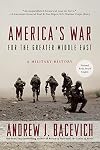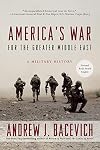
America's War for the Greater Middle East: A Military History
by Andrew Bacevich
On This Page
Description
A critical assessment of America's foreign policy in the Middle East throughout the past four decades evaluates and connects regional engagements since 1990 while revealing their massive costs. From the end of World War II until 1980, virtually no American soldiers were killed in action while serving in the Greater Middle East. Since 1990, virtually no American soldiers have been killed in action anywhere else. What caused this shift? Andrew J. Bacevich, one of the country's most respected show more voices on foreign affairs, offers an incisive critical history of this ongoing military enterprise--now more than thirty years old and with no end in sight. During the 1980s, Bacevich argues, a great transition occurred. As the Cold War wound down, the United States initiated a new conflict--a War for the Greater Middle East--that continues to the present day. The long twilight struggle with the Soviet Union had involved only occasional and sporadic fighting. But as this new war unfolded, hostilities became persistent. From the Balkans and East Africa to the Persian Gulf and Central Asia, U.S. forces embarked upon a seemingly endless series of campaigns across the Islamic world. Few achieved anything remotely like conclusive success. Instead, actions undertaken with expectations of promoting peace and stability produced just the opposite. As a consequence, phrases like "permanent war" and "open-ended war" have become part of everyday discourse. Connecting the dots in a way no other historian has done before, Bacevich weaves a compelling narrative out of episodes as varied as the Beirut bombing of 1983, the Mogadishu firefight of 1993, the invasion of Iraq in 2003, and the rise of ISIS in the present decade. Understanding what America's costly military exertions have wrought requires seeing these seemingly discrete events as parts of a single war. It also requires identifying the errors of judgment made by political leaders in both parties and by senior military officers who share responsibility for what has become a monumental march to folly. This Bacevich unflinchingly does.--From dust jacket. show lessTags
Recommendations




























Member Reviews
Bitter (with justification) account of the ways in which the US has screwed up since the 1970s, assuming that it has the right to control the area in order to maintain access to oil and superpower status. Frustrating and painful and ultimately quite isolationist, with very little to offer going forward (which might be the most truthful thing). We keep fighting the last wars but not even learning their lessons, first not considering culture/Islam in our calculations at all because we were so powerful they’d have to give way, right? Then considering each anti-American Islamicist leader as the weirdo who needed to be killed, for much the same arrogant reasons, without realizing that (1) new leaders do tend to arise, as the graveyards are show more filled with indispensable men, and (2) often fragmenting groups further via decapitation makes things worse. show less
This is a depressing book, but one that I believe should be widely read. "Depressing", because it makes the waste and futility of our 40-year involvement in the Middle East crystal clear, and because it offers no real prospect of that involvement changing. And "should be widely read" because if enough people realize just how costly and just how counter-productive this war has been there might be some hope of popular pressure for an exit. Bacevich dates the start of this long-running war back to President Carter, whose "Carter Doctrine" proclaimed that the U.S. would prevent any effort to seize the oil fields of the Middle East, and who initiated US funding of guerillas fighting the USSR in Afghanistan. It may have started with Carter, show more but every president since has broadened the US perceived sphere of military engagement. And it may have started with oil, but it morphed into a war to project US invincibility under President GW Bush. Since then, the language and the intensity of involvement has cooled, but its extent has grown even broader.
Bacevich details the whole process from a military and from a political point of view, naming names and placing blame. But he makes it clear that this is not something that can be blamed on militaristic presidents and bumbling military commanders alone. The willingness of the American people to buy into the process when various military adventures began, and to forget about it when they proved less than sucessful, is what has allowed the process to continue. show less
Bacevich details the whole process from a military and from a political point of view, naming names and placing blame. But he makes it clear that this is not something that can be blamed on militaristic presidents and bumbling military commanders alone. The willingness of the American people to buy into the process when various military adventures began, and to forget about it when they proved less than sucessful, is what has allowed the process to continue. show less
The United States has been at war in or for the Middle East for sixteen years. Yet, according to Andrew Bacevich, military historian and retired army colonel, you must go back four decades to the Carter Doctrine to clearly see how the US became so completely enmeshed in this quagmire and why it has been unable to extricate itself.
In his book, America’s War for the Greater Middle East, Bacevich gives a well-documented, concise, and highly readable account of the background, the motives, and the mistakes of successive commanders, presidents, and pundits and why, despite vastly superior weaponry, victory has remained illusory. This is a must-read for anyone who wishes to understand how war in the Middle East has become a seemingly show more permanent fixture of American foreign policy regardless of which political party is in power as well as the costs both in economic and human terms of perpetual war and what is needed to finally bring the conflict to an end. show less
In his book, America’s War for the Greater Middle East, Bacevich gives a well-documented, concise, and highly readable account of the background, the motives, and the mistakes of successive commanders, presidents, and pundits and why, despite vastly superior weaponry, victory has remained illusory. This is a must-read for anyone who wishes to understand how war in the Middle East has become a seemingly show more permanent fixture of American foreign policy regardless of which political party is in power as well as the costs both in economic and human terms of perpetual war and what is needed to finally bring the conflict to an end. show less
Review of: America’s War for the Greater Middle East: A Military History,
by Andrew J. Bacevich
by Stan Prager (3-30-2020)
“From the end of World War II until 1980, virtually no American soldiers were killed in action while serving in the greater Middle East. Since 1980, virtually no American soldiers have been killed anywhere else. What caused that shift?”
That stark question appears as a blurb on the back cover of my edition of America’s War for the Greater Middle East: A Military History, Andrew J. Bacevich’s ambitious, brilliantly conceived if flawed chronicle which seeks to both answer that question and place it in its appropriate context. It is, of course, quite the tall order: how is it that a geography ever on the show more periphery of an American foreign policy that for decades could best be described as benign neglect came to not only dominate our national attention but be identified as central to our strategic interests? And how is that as this review goes to press—nearly four years after the publication of Bacevich’s book—America’s longest war in its history endures beyond its eighteenth year … in Afghanistan of all places?!
The short answer, I would posit, is oil. Bacevich is older than me, and I wasn’t yet driving at the time in 1969 when he notes dropping three bucks to fill up the tank of his new Mustang at 29.9 cents a gallon. But I was on the road just a few years later, and I recall sitting in long lines at the pump for fuel priced nearly ten times that, as well as the random guy who threatened to shoot a certain long-haired teenager for trying to cut line, and that same teen later learning how to siphon gas from parked cars. It was a time.
That tumultuous time stemmed, of course, from the 1973 oil embargo placed on the United States by OPEC (Organization of the Petroleum Exporting Countries) in retaliation for its support of Israel during the Yom Kippur War. Because he has styled his book “A Military History,” the author does not dwell on the gasoline shortage that so shook American self-confidence in the early 1970s, nor on the related and still unresolved Israeli-Palestinian conflict that remains as central to the theme of Middle East unrest as slavery was to the American Civil War. Instead, after a brief “Prologue,” Bacevich rapidly shifts focus to the Iran hostage crisis and the 1980 debacle that was Operation Eagle Claw, the aborted mission to rescue those hostages that resulted in those first American casualties referenced in that jacket blurb. This decision by the author to not accord oil and Israel their respective fundamental significance in far greater detail proves to be a weakness that tends to undermine an otherwise well-researched and well-written narrative history.
That author certainly has both the credentials and the skills worthy of the task before him. Andrew Bacevich is a career army officer, veteran of the Vietnam and Persian Gulf wars, who retired with the rank of colonel. He is also a noted historian and award-winning author, someone who has described himself as a “Catholic conservative,” but defies traditional labels of parties and politics. He is a pronounced critic of American military interventionism, George W. Bush’s advocacy for so-called "preventive wars," and especially of the U.S. invasion of Iraq. In a kind of tragic irony, his own son, an army officer, was killed in combat in Iraq. I have read two of his previous books: Breach of Trust: How Americans Failed Their Soldiers and Their Country, and The Limits of Power: The End of American Exceptionalism, both magnificent treatises that reflect Bacevich’s ideological opposition to spending American lives needlessly in endless wars. But treatises don’t always translate well into narrative history—in fact these are and should be entirely separate channels—and Bacevich’s tendency to blur those boundaries here comes to weaken America’s War for the Greater Middle East.
The author points to repeated epic fails in Middle East policy that take us down all the wrong roads, while experts in and out of government shake their heads in bewilderment, yet one administration after another nevertheless presses on stubbornly. Bacevich is at his best when he underscores a series of unintended consequences on a road paved with occasional good intentions that not only exacerbate bad decision-making but cement unnecessary obligations to fickle, illusory allies that then put up almost insurmountable roadblocks to disentanglement. Two salient and substantial examples are: the poorly-conceived U.S. support for rebels opposed to the Russian-friendly regime in Afghanistan that was to spark Soviet intervention in 1979; and, subsequent U.S. backing for the Islamic fundamentalist Mujahideen that was to later spawn Al-Qaeda.
There is much more to come—more perhaps intended and incompetent rather than unintended—and much of that is either utterly unknown or long forgotten for most Americans, including the 1982 suicide-bombing of the Marine compound in Beirut that killed 241 but somehow failed to tarnish the “Teflon” presidency of Ronald Reagan, who retreated while euphemistically “redeploying.” From the vantage point of Washington, the greater enemy remained the Ayatollah, and all efforts were made to enable the brutal despot Saddam Hussein in his opportunistic war upon Iran, a decision that was to fuel Middle East instability for decades and lead to two future US conflicts with our former ally. And Reagan was still President and still all-Teflon in 1988 when the US shot down through either negligence or spite Iran Air Flight 655 over the Persian Gulf, a commercial airliner with 290 souls aboard. George H. W. Bush led a coalition to liberate Kuwait from our erstwhile ally Iraq, but then left a wounded, isolated and still dangerous Saddam to plague our future. But, of course, it was under George W. Bush that the tragedy that was 9-11 was hijacked and turned into a fanciful “War on Terror” that ultimately was to embolden Islamic fundamentalism, served as a pretext for an illegal invasion of Iraq that strengthened Iran and utterly destabilized the region, and later bred ISIL to terrorize multiple corridors of the Middle East. You can indeed draw almost a straight line from the Afghan Mujahideen of 1979 to ISIL suicide bombers today.
Bacevich is masterful with a pen, and his history is so well-written that there are literally no dry spots. The problem I found was with the tone, which while legitimately critical of American missteps is often needlessly arrogant, eye-rolling, even snarky—all of which detracts from the primary message, which is indeed spot-on. My politics often align closely with those of MSNBC host Rachel Maddow, but I simply cannot watch her show: I find her breathless exhalations and intimations of “How-could-anyone-be-so-stupid?” and “We-told-you-so” coupled with lip-curling grimaces intolerable. Bacevich is not that bad here by any means, but there is certainly a whiff of it that puts me off. Moreover, while he makes a cogent case for why just about every policy we put in place was wrong-headed, I would have much welcomed the author’s alternative recipes. Bacevich is a brilliant man: I truly wanted to know what he would have done differently if he was sitting behind the Resolute Desk instead of Carter or Reagan or Bush or any of the others.
Bacevich does deserve much credit for his far more panoramic view of what he rightly calls the “Greater Middle East,” as he widens the lens to focus upon the often neglected yet certainly related periphery of the Balkans and the Muslim population in the former Yugoslavia subjected to ethnic cleansing. Few mention Eastern Europe in the same breath as the Middle East, but for some five hundred years much of that geography was integral to the same Ottoman Empire that ruled over present-day Syria and Iraq. There is a common history that cannot be ignored. But just as I was disappointed elsewhere that Bacevich failed to highlight the background noise of the Israeli-Palestinian conflict that truly informs every conversation about Middle East affairs, in this case little was made of the bond between post-Soviet Russia and Slavs of “Greater Serbia,” which not only deeply influenced the Balkan Civil Wars but soured emerging US-Russian relations in its aftermath and resounded across the Islamic landscape. Likewise, the narrative swerves to take a peek at “Black Hawk Down” in Mogadishu, but the long history of ties between East Africa and Arabia remains unexplored.
America’s War for the Greater Middle East is divided into three parts: the first takes the reader to the conclusion of the Persian Gulf War (which Bacevich brands as “Second Gulf War”), and the second wraps up on the eve of 9-11. But it is the last part, dominated by the Iraq War, that strikes a markedly different tone and smacks of the more somber, perhaps coincidental to Bacevich’s own deeply personal loss, perhaps not. Alas, none of the sections are large enough to bear the weight of the material.
Rarely would I lobby for any book to be longer, but in this case the 370 pages in my edition—plus the copious notes and excellent maps—is simply not enough. The topic not only deserves but demands more. This book should either be three times longer or, better still, should be a three-volume series. A more comprehensive historical background—including the echo of the greater Ottoman heritage and the Russo-British grapple for Central Asia—of this entire milieu is requisite for getting a grasp upon how we got here. The Israeli-Palestinian conflict demands more focus. As does the Shia-Sunni division. And the relationships between Arab and non-Arab states, as well as the ties that transcend the regional to extend to Africa and Europe and beyond. There is no hope of a better grasp of all that has gone wrong with American entanglement in the Middle East without all of that and much more.
Given all these reservations, the reader of this review might be surprised that I nevertheless recommend this book. Warts and all, there is no other work out there that connects the dots of America’s involvement in the Middle East as well as it does, even as it cries for more depth, for more complexity. I would likely be less critical of this book if my admiration for Bacevich was less pronounced and my expectations for his work was not so high. Even if America’s War for the Greater Middle East falls short, it deserves to be on your reading list.
Review of: “America’s War for the Greater Middle East: A Military History,” by Andrew J. Bacevich https://regarp.com/2020/03/30/review-of-americas-war-for-the-greater-middle-east... show less
by Andrew J. Bacevich
by Stan Prager (3-30-2020)
“From the end of World War II until 1980, virtually no American soldiers were killed in action while serving in the greater Middle East. Since 1980, virtually no American soldiers have been killed anywhere else. What caused that shift?”
That stark question appears as a blurb on the back cover of my edition of America’s War for the Greater Middle East: A Military History, Andrew J. Bacevich’s ambitious, brilliantly conceived if flawed chronicle which seeks to both answer that question and place it in its appropriate context. It is, of course, quite the tall order: how is it that a geography ever on the show more periphery of an American foreign policy that for decades could best be described as benign neglect came to not only dominate our national attention but be identified as central to our strategic interests? And how is that as this review goes to press—nearly four years after the publication of Bacevich’s book—America’s longest war in its history endures beyond its eighteenth year … in Afghanistan of all places?!
The short answer, I would posit, is oil. Bacevich is older than me, and I wasn’t yet driving at the time in 1969 when he notes dropping three bucks to fill up the tank of his new Mustang at 29.9 cents a gallon. But I was on the road just a few years later, and I recall sitting in long lines at the pump for fuel priced nearly ten times that, as well as the random guy who threatened to shoot a certain long-haired teenager for trying to cut line, and that same teen later learning how to siphon gas from parked cars. It was a time.
That tumultuous time stemmed, of course, from the 1973 oil embargo placed on the United States by OPEC (Organization of the Petroleum Exporting Countries) in retaliation for its support of Israel during the Yom Kippur War. Because he has styled his book “A Military History,” the author does not dwell on the gasoline shortage that so shook American self-confidence in the early 1970s, nor on the related and still unresolved Israeli-Palestinian conflict that remains as central to the theme of Middle East unrest as slavery was to the American Civil War. Instead, after a brief “Prologue,” Bacevich rapidly shifts focus to the Iran hostage crisis and the 1980 debacle that was Operation Eagle Claw, the aborted mission to rescue those hostages that resulted in those first American casualties referenced in that jacket blurb. This decision by the author to not accord oil and Israel their respective fundamental significance in far greater detail proves to be a weakness that tends to undermine an otherwise well-researched and well-written narrative history.
That author certainly has both the credentials and the skills worthy of the task before him. Andrew Bacevich is a career army officer, veteran of the Vietnam and Persian Gulf wars, who retired with the rank of colonel. He is also a noted historian and award-winning author, someone who has described himself as a “Catholic conservative,” but defies traditional labels of parties and politics. He is a pronounced critic of American military interventionism, George W. Bush’s advocacy for so-called "preventive wars," and especially of the U.S. invasion of Iraq. In a kind of tragic irony, his own son, an army officer, was killed in combat in Iraq. I have read two of his previous books: Breach of Trust: How Americans Failed Their Soldiers and Their Country, and The Limits of Power: The End of American Exceptionalism, both magnificent treatises that reflect Bacevich’s ideological opposition to spending American lives needlessly in endless wars. But treatises don’t always translate well into narrative history—in fact these are and should be entirely separate channels—and Bacevich’s tendency to blur those boundaries here comes to weaken America’s War for the Greater Middle East.
The author points to repeated epic fails in Middle East policy that take us down all the wrong roads, while experts in and out of government shake their heads in bewilderment, yet one administration after another nevertheless presses on stubbornly. Bacevich is at his best when he underscores a series of unintended consequences on a road paved with occasional good intentions that not only exacerbate bad decision-making but cement unnecessary obligations to fickle, illusory allies that then put up almost insurmountable roadblocks to disentanglement. Two salient and substantial examples are: the poorly-conceived U.S. support for rebels opposed to the Russian-friendly regime in Afghanistan that was to spark Soviet intervention in 1979; and, subsequent U.S. backing for the Islamic fundamentalist Mujahideen that was to later spawn Al-Qaeda.
There is much more to come—more perhaps intended and incompetent rather than unintended—and much of that is either utterly unknown or long forgotten for most Americans, including the 1982 suicide-bombing of the Marine compound in Beirut that killed 241 but somehow failed to tarnish the “Teflon” presidency of Ronald Reagan, who retreated while euphemistically “redeploying.” From the vantage point of Washington, the greater enemy remained the Ayatollah, and all efforts were made to enable the brutal despot Saddam Hussein in his opportunistic war upon Iran, a decision that was to fuel Middle East instability for decades and lead to two future US conflicts with our former ally. And Reagan was still President and still all-Teflon in 1988 when the US shot down through either negligence or spite Iran Air Flight 655 over the Persian Gulf, a commercial airliner with 290 souls aboard. George H. W. Bush led a coalition to liberate Kuwait from our erstwhile ally Iraq, but then left a wounded, isolated and still dangerous Saddam to plague our future. But, of course, it was under George W. Bush that the tragedy that was 9-11 was hijacked and turned into a fanciful “War on Terror” that ultimately was to embolden Islamic fundamentalism, served as a pretext for an illegal invasion of Iraq that strengthened Iran and utterly destabilized the region, and later bred ISIL to terrorize multiple corridors of the Middle East. You can indeed draw almost a straight line from the Afghan Mujahideen of 1979 to ISIL suicide bombers today.
Bacevich is masterful with a pen, and his history is so well-written that there are literally no dry spots. The problem I found was with the tone, which while legitimately critical of American missteps is often needlessly arrogant, eye-rolling, even snarky—all of which detracts from the primary message, which is indeed spot-on. My politics often align closely with those of MSNBC host Rachel Maddow, but I simply cannot watch her show: I find her breathless exhalations and intimations of “How-could-anyone-be-so-stupid?” and “We-told-you-so” coupled with lip-curling grimaces intolerable. Bacevich is not that bad here by any means, but there is certainly a whiff of it that puts me off. Moreover, while he makes a cogent case for why just about every policy we put in place was wrong-headed, I would have much welcomed the author’s alternative recipes. Bacevich is a brilliant man: I truly wanted to know what he would have done differently if he was sitting behind the Resolute Desk instead of Carter or Reagan or Bush or any of the others.
Bacevich does deserve much credit for his far more panoramic view of what he rightly calls the “Greater Middle East,” as he widens the lens to focus upon the often neglected yet certainly related periphery of the Balkans and the Muslim population in the former Yugoslavia subjected to ethnic cleansing. Few mention Eastern Europe in the same breath as the Middle East, but for some five hundred years much of that geography was integral to the same Ottoman Empire that ruled over present-day Syria and Iraq. There is a common history that cannot be ignored. But just as I was disappointed elsewhere that Bacevich failed to highlight the background noise of the Israeli-Palestinian conflict that truly informs every conversation about Middle East affairs, in this case little was made of the bond between post-Soviet Russia and Slavs of “Greater Serbia,” which not only deeply influenced the Balkan Civil Wars but soured emerging US-Russian relations in its aftermath and resounded across the Islamic landscape. Likewise, the narrative swerves to take a peek at “Black Hawk Down” in Mogadishu, but the long history of ties between East Africa and Arabia remains unexplored.
America’s War for the Greater Middle East is divided into three parts: the first takes the reader to the conclusion of the Persian Gulf War (which Bacevich brands as “Second Gulf War”), and the second wraps up on the eve of 9-11. But it is the last part, dominated by the Iraq War, that strikes a markedly different tone and smacks of the more somber, perhaps coincidental to Bacevich’s own deeply personal loss, perhaps not. Alas, none of the sections are large enough to bear the weight of the material.
Rarely would I lobby for any book to be longer, but in this case the 370 pages in my edition—plus the copious notes and excellent maps—is simply not enough. The topic not only deserves but demands more. This book should either be three times longer or, better still, should be a three-volume series. A more comprehensive historical background—including the echo of the greater Ottoman heritage and the Russo-British grapple for Central Asia—of this entire milieu is requisite for getting a grasp upon how we got here. The Israeli-Palestinian conflict demands more focus. As does the Shia-Sunni division. And the relationships between Arab and non-Arab states, as well as the ties that transcend the regional to extend to Africa and Europe and beyond. There is no hope of a better grasp of all that has gone wrong with American entanglement in the Middle East without all of that and much more.
Given all these reservations, the reader of this review might be surprised that I nevertheless recommend this book. Warts and all, there is no other work out there that connects the dots of America’s involvement in the Middle East as well as it does, even as it cries for more depth, for more complexity. I would likely be less critical of this book if my admiration for Bacevich was less pronounced and my expectations for his work was not so high. Even if America’s War for the Greater Middle East falls short, it deserves to be on your reading list.
Review of: “America’s War for the Greater Middle East: A Military History,” by Andrew J. Bacevich https://regarp.com/2020/03/30/review-of-americas-war-for-the-greater-middle-east... show less
Disclaimer: I received this book as part of GoodReads FirstReads program.
Before 1980, no American soldiers had died in the Middle East. Since 1980, few American soldiers have died anywhere else. So states the author in the beginning of this book, and goes on to describe in great detail the many armed conflicts that have involved the US since the Iranian revolution during Jimmy Carter's presidency. In every case, he points out how the military leadership has misunderstood what was needed to successfully execute the various wars, how they misled the government, and how the government has misled the American people. The list of wars and military actions began with the Iran Hostage Crisis during Carter's term, the Iran-Iraq war during show more Reagan's, the Kuwait-Iran crisis during Bush Sr.'s, Somalia and Kosovo during Clinton's,Afghanistan and Iraq during Bush Jr.'s and Libya, Afghanistan, Iraq and Syria during Obama's term. Reagan openly supporting Iraq while (illegally) selling weapons on the down low to Iran was particularly bad. The Obama administration provided arms to the Iraqis to fight ISIS. These "soldiers" would then run away, leaving the weapons behind for ISIS to pick up and use against them (and our soldiers) in the future. Pretty much exactly what happened in Vietnam. American intervention in the regions has been going on, and expanding, for over 30 years with no sign of ending. In fact, the continuing American involvement has only made matters worse in the region.
This book should be required reading for every American adult, and should be taught in American history classes throughout the country. Only when everyone understands what's truly going on can we force our government to knock it off and stop killing out soldiers. When we pulled out of Vietnam, the world didn't end, and it won't end if we leave the Middle East. show less
Before 1980, no American soldiers had died in the Middle East. Since 1980, few American soldiers have died anywhere else. So states the author in the beginning of this book, and goes on to describe in great detail the many armed conflicts that have involved the US since the Iranian revolution during Jimmy Carter's presidency. In every case, he points out how the military leadership has misunderstood what was needed to successfully execute the various wars, how they misled the government, and how the government has misled the American people. The list of wars and military actions began with the Iran Hostage Crisis during Carter's term, the Iran-Iraq war during show more Reagan's, the Kuwait-Iran crisis during Bush Sr.'s, Somalia and Kosovo during Clinton's,Afghanistan and Iraq during Bush Jr.'s and Libya, Afghanistan, Iraq and Syria during Obama's term. Reagan openly supporting Iraq while (illegally) selling weapons on the down low to Iran was particularly bad. The Obama administration provided arms to the Iraqis to fight ISIS. These "soldiers" would then run away, leaving the weapons behind for ISIS to pick up and use against them (and our soldiers) in the future. Pretty much exactly what happened in Vietnam. American intervention in the regions has been going on, and expanding, for over 30 years with no sign of ending. In fact, the continuing American involvement has only made matters worse in the region.
This book should be required reading for every American adult, and should be taught in American history classes throughout the country. Only when everyone understands what's truly going on can we force our government to knock it off and stop killing out soldiers. When we pulled out of Vietnam, the world didn't end, and it won't end if we leave the Middle East. show less
Annoying habit of repeating the book’s title every seven paragraphs or so, but otherwise an outraged account of US policies since the 1970s. “Controlling the oil” as a key aim—without much thought to the strategies required to do that—gave way to “shaping history”—without any doubt that the US could actually do that and thus without, again, attention to the strategies required to do that. Includes the interventions into Kosovo because, Bacevich argues, that’s relevant to the argument that Americans kept assuming that Muslim groups would eventually agree on a set of universal human rights and democratic norms, and they rarely did, at least on American terms. Evocative description of the response to Iraq’s invasion of show more Kuwait as, from the American military’s perspective, “a proxy war with the Vietnam War.” show less
By “Greater Middle East,” Bacevich is referring to the oil states and the countries surrounding the Persian Gulf. Not all of these people are Arabs, and not all of the Muslims in this Islamic part of the world believe in the same things. Muslims consist of different and often violently opposed sects, but many Americans just think of all these peoples as “Arabs” - even the Iranians and Turks, the two most obviously non-Arabic states of the region. As a map in the front of the hardcover book shows, the geographic area of interest in the book extends from Turkey in the north to Somalia in the south, and includes Turkey, Iran, Syria, Iraq, Saudi Arabia, Egypt, and Sudan, as well as the relatively small area near Israel. Because the show more U.S. has had recent military involvement in the Balkans, this area also figures into Bacevich's narrative, but largely to illustrate the points he makes about fighting in and for the Greater Middle East.
This book is not only a history; it is also a polemic. However, I enjoyed it precisely for that reason, and undoubtedly because the author and I are in agreement about many issues.
The author, a career military man as well as a scholar of diplomatic history, reviews the recent history of U.S. involvement in the Greater Middle East, reminding us of numerous U.S. incursions, blunders, and cover-ups by the White House, including:
-The Carter Administration’s support of the Afghans who were fighting the Soviets, which was considered critical to Carter’s National Security Advisor, Zbigniew Brzeziński, a lifelong foe of the Soviets, but which led to blowback against the U.S. including, eventually, 9/11;
-Reagan’s double-dealing with Iran and Iraq during their war, including the secret and illegal Iran-Contra debacle, in which the U.S. funneled arms and money to Iran. This infuriated Sadaam Hussein, since we were ostensibly (and very expensively) supporting Iraq in that war;
-The 1988 downing of what was clearly an Iranian commercial airliner by the U.S.S. Vincennes (which was not in international waters as claimed but in Iranian territorial waters), also during the Reagan Administration, for which the Administration refused to apologize, in spite of the fact that 290 civilians were killed;
-The justification for the Iraq invasion by the George W. Bush Administration by "blatant scare-mongering," demagoguery, and dubious information, and then subsequent failure to restore that country, with its own bad repercussions for the U.S.;
-Washington’s decision to oust foreign leaders we no longer had use for, such as Sadaam Hussein and others, in the persistent belief that removing one person - the head of a movement or country - would make everything better, along with the insistence that it was not “terrorism” (because the U.S. did it) but “justified”;
-The continued efforts of the U.S. to employ military might in the region to advance our own interests and values without any consideration for the inhabitants of those countries or their needs or grievances, but in the putative pursuit of "freedom" for them;
-The enduring delusion that the people of the Greater Middle East are salivating over the prospect of embracing American values such as individualism, secular multiculturalism, consumption, and “democracy.”
Finally, Bacevich also documents the continued obfuscation and outright falsehoods of each administration to condone, conceal, or minimize the damage we caused. All the attempts at retaliation by groups in this area? Obviously a function of their derangement, not because of U.S. provocation.
Evaluation: This is an excellent book, and I can only say that Bacevich has a lot of guts to call out so many actors still on stage. But my comments above are by no means all I want to share about what it contains. This is an abbreviated version of my review. To read my full comments, you can find them on our [second] blog, Legal Legacy. show less
This book is not only a history; it is also a polemic. However, I enjoyed it precisely for that reason, and undoubtedly because the author and I are in agreement about many issues.
The author, a career military man as well as a scholar of diplomatic history, reviews the recent history of U.S. involvement in the Greater Middle East, reminding us of numerous U.S. incursions, blunders, and cover-ups by the White House, including:
-The Carter Administration’s support of the Afghans who were fighting the Soviets, which was considered critical to Carter’s National Security Advisor, Zbigniew Brzeziński, a lifelong foe of the Soviets, but which led to blowback against the U.S. including, eventually, 9/11;
-Reagan’s double-dealing with Iran and Iraq during their war, including the secret and illegal Iran-Contra debacle, in which the U.S. funneled arms and money to Iran. This infuriated Sadaam Hussein, since we were ostensibly (and very expensively) supporting Iraq in that war;
-The 1988 downing of what was clearly an Iranian commercial airliner by the U.S.S. Vincennes (which was not in international waters as claimed but in Iranian territorial waters), also during the Reagan Administration, for which the Administration refused to apologize, in spite of the fact that 290 civilians were killed;
-The justification for the Iraq invasion by the George W. Bush Administration by "blatant scare-mongering," demagoguery, and dubious information, and then subsequent failure to restore that country, with its own bad repercussions for the U.S.;
-Washington’s decision to oust foreign leaders we no longer had use for, such as Sadaam Hussein and others, in the persistent belief that removing one person - the head of a movement or country - would make everything better, along with the insistence that it was not “terrorism” (because the U.S. did it) but “justified”;
-The continued efforts of the U.S. to employ military might in the region to advance our own interests and values without any consideration for the inhabitants of those countries or their needs or grievances, but in the putative pursuit of "freedom" for them;
-The enduring delusion that the people of the Greater Middle East are salivating over the prospect of embracing American values such as individualism, secular multiculturalism, consumption, and “democracy.”
Finally, Bacevich also documents the continued obfuscation and outright falsehoods of each administration to condone, conceal, or minimize the damage we caused. All the attempts at retaliation by groups in this area? Obviously a function of their derangement, not because of U.S. provocation.
Evaluation: This is an excellent book, and I can only say that Bacevich has a lot of guts to call out so many actors still on stage. But my comments above are by no means all I want to share about what it contains. This is an abbreviated version of my review. To read my full comments, you can find them on our [second] blog, Legal Legacy. show less
Members
- Recently Added By
Author Information

32+ Works 2,994 Members
Andrew Bacevich was born in Normal Illinois. He was a graduate of West Point in 1969 and served in the U.S. Army during the Vietnam War. He later held posts in Germany and the Persian Gulf up until his retirement from service in the early 1990's. He has a PhD in American Diplomatic History from Princeton University and has taught at West Point and show more Johns Hopkins University before joining the faculty at Boston University in 1998 and becoming Professor of International Relations. He has been a critic of the U.S. occupation of Iraq calling the conflict a catastrophic failure. He wrote several books including American Empire: The Realities and Consequences of U.S. Diplomacy and Washington Rules. (Bowker Author Biography) show less
Awards and Honors
Awards
Distinctions
Notable Lists
Common Knowledge
- Original title
- America's War for the Greater Middle East: A Military History
- People/Characters
- Jimmy Carter; Zbigniew Brzezinski; Ronald Reagan; George W. Bush; Saddam Hussein; Bill Clinton
- Important places
- Iraq; Afghanistan; Bosnia
Classifications
- Genres
- History, Nonfiction, General Nonfiction
- DDC/MDS
- 956.05 — History & geography History of Asia Middle East Asia: Turkey, Iraq, Syria, Lebanon, Israel, Jordan Middle East 1980–
- LCC
- DS63.2 .U5 .B3214 — History of Europe, Asia, Africa and Oceania Asia History of Asia Middle East. Southwestern Asia. Ancient Orient. History
- BISAC
Statistics
- Members
- 384
- Popularity
- 81,121
- Reviews
- 16
- Rating
- (4.05)
- Languages
- English
- Media
- Paper, Audiobook, Ebook
- ISBNs
- 5
- ASINs
- 3