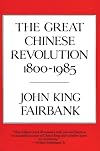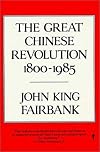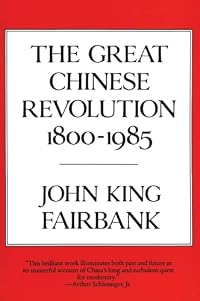
The Great Chinese Revolution 1800-1985
by John King Fairbank
On This Page
Description
A history of modern China recounting the gains, struggles and failures of the Chinese people since 1800.Tags
Recommendations








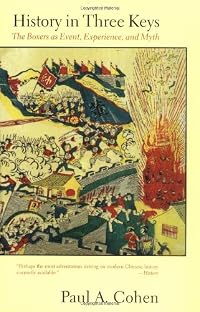

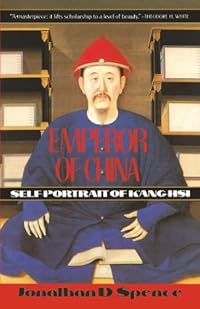

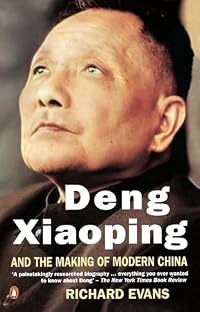
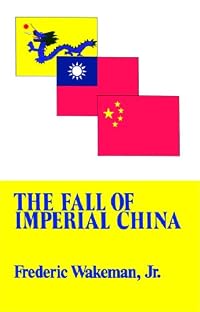







Member Recommendations

Member Reviews
This book is what I call a chewy read. John King Fairbank has his own style of writing and it took some getting used to but, boy was it worth it.
When I was in my formative years, Mao was leader of the PRC and was not only something of a mystery, but also as much of a bete noire as his Russian counterpart. We were regularly fed the latest crazy escapade of Mao and it was enough to steer me away from communism for many years. JKF does a sterling job with a gargantuan task; explaining China's history between 1800 and 1985 in a manner that a totally ignorant westerner might comprehend. Fairbank walks the reader through the story with sufficient confidence to take us along with him but, he has an equal supply of modesty making this an ideal show more starting place for one such as I (the aforementioned ignoramus). This is not a take it or leave it final word on Chinese history, it is a broad brush explanation which gives the reader a background.
Fairbank does not assume any previous knowledge and starts with a helpful chapter explaining where China stood prior to 1800. He then takes us through the failed attempts at replacing the Emperor right through Mao's audacious, and ultimately successful, revolt and the aftermath thereof. Although this book stops at 1985, and there is plenty to learn of china post that date (or at least, so I am told (remember, I'm the ignoramus)), I would suggest that it is vital reading for anyone wanting to develop an understanding of China and its culture. show less
When I was in my formative years, Mao was leader of the PRC and was not only something of a mystery, but also as much of a bete noire as his Russian counterpart. We were regularly fed the latest crazy escapade of Mao and it was enough to steer me away from communism for many years. JKF does a sterling job with a gargantuan task; explaining China's history between 1800 and 1985 in a manner that a totally ignorant westerner might comprehend. Fairbank walks the reader through the story with sufficient confidence to take us along with him but, he has an equal supply of modesty making this an ideal show more starting place for one such as I (the aforementioned ignoramus). This is not a take it or leave it final word on Chinese history, it is a broad brush explanation which gives the reader a background.
Fairbank does not assume any previous knowledge and starts with a helpful chapter explaining where China stood prior to 1800. He then takes us through the failed attempts at replacing the Emperor right through Mao's audacious, and ultimately successful, revolt and the aftermath thereof. Although this book stops at 1985, and there is plenty to learn of china post that date (or at least, so I am told (remember, I'm the ignoramus)), I would suggest that it is vital reading for anyone wanting to develop an understanding of China and its culture. show less
An excellent survey of modern Chinese history.
Values a strong sense of structure and analysis over wordy narrative diversions, but also maintains a high level of 'readability' - a notoriously difficult balance to strike in history books.
Highly recommended to newcomers of modern Chinese history who want an introduction to what makes China 'tick' without having to slug through wordy paragraphs regarding what Mao's favourite colour was.
Values a strong sense of structure and analysis over wordy narrative diversions, but also maintains a high level of 'readability' - a notoriously difficult balance to strike in history books.
Highly recommended to newcomers of modern Chinese history who want an introduction to what makes China 'tick' without having to slug through wordy paragraphs regarding what Mao's favourite colour was.
This was really challenging for me, as someone who doesn't know anything about China. I was determined to get through it, despite having less and less of a clue what was really going on, for its occasional wonderful characters and analyses of social institutions: salt smuggling, footbinding, the Ch'ing Dynasty academic system, etc. But damn it, I misplaced my copy somewhere. I *do* plan to finish it if it turns up.
Ratings
Members
- Recently Added By
Author Information

46+ Works 2,274 Members
Born in South Dakota, John King Fairbank attended local public schools for his early education. From there he went on first to Exeter, then the University of Wisconsin, and ultimately to Harvard, from which he received his B.A. degree summa cum laude in 1929. That year he traveled to Britain as a Rhodes Scholar. In 1932 he went to China as a show more teacher and after extensive travel there received his Ph.D. from Oxford University in 1936. Between 1941 and 1946, he was in government service---as a member of the Office of Strategic Services, as special assistant to the U.S. ambassador to China, and finally as director of the U.S. Information Service in China. Excepting those years, beginning in 1936, Fairbank spent his entire career at Harvard University, where he served in many positions, including Francis Lee Higginson Professor of History and director of Harvard's East Asian Research Center. Fairbank, who came to be considered one of the world's foremost authorities on modern Chinese history and Asian-West relations, was committed to reestablishing diplomatic and cultural relations with China. He was also committed to the idea that Americans had to become more conversant with Asian cultures and languages. In his leadership positions at Harvard and as president of the Association for Asian Studies and the American Historical Association, he sought to broaden the bases of expertise about Asia. At the same time, he wrote fluidly and accessibly, concentrating his work on the nineteenth century and emphasizing the relationship between China and the West. At the same time, his writings placed twentieth-century China within the context of a changed and changing global order. It was precisely this understanding that led him to emphasize the reestablishment of American links with China. More than anyone else, Fairbank helped create the modern fields of Chinese and Asian studies in America. His influence on American understanding of China and Asia has been profound. (Bowker Author Biography) show less
Series
Belongs to Publisher Series
Deutscher Taschenbuch Verlag (4497)
Common Knowledge
- Canonical title*
- Geschichte des modernen China
- Original title
- The Great Chinese Revolution, 1800-1985
- Original publication date
- 1986
- Important places
- China
- Original language
- English
*Some information comes from Common Knowledge in other languages. Click "Edit" for more information.
Classifications
Statistics
- Members
- 301
- Popularity
- 106,100
- Reviews
- 3
- Rating
- (3.88)
- Languages
- English, French, German, Spanish
- Media
- Paper
- ISBNs
- 9
- ASINs
- 1