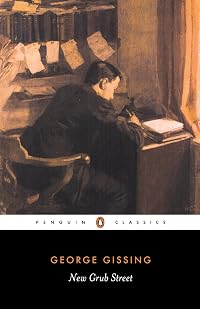
New Grub Street
by George Gissing
On This Page
Description
George Gissing's New Grub Street has been widely lauded as one of the best novels ever written, but readers who harbor literary ambitions may want to approach this masterwork of realism with caution. By juxtaposing the lives of two very different breeds of writers, Jasper Milvain and Edwin Reardon, Gissing considers the evolving role of writers and literature in the modern world—and his ultimate assessment is unfailingly bleak..
Tags
Recommendations


















Member Recommendations

DLSmithies Both addressing, in their different ways, the relationship between financial security and the writing of fiction.
Member Reviews
Poverty has many faces in this novel, but they are always grim. While not, with a few exceptions, suffering from the deadly poverty of the utterly destitute, the characters nonetheless experience the grinding and soul-destroying lack of enough money to pay for the necessities of life as they see it. Gissing captures the indignities and choices of poverty: the man who keeps his overcoat on because he has jacket to wear under it; the man who lacks a penny to buy a loaf of bread locally and has to walk farther to buy a cheaper one, or the man who carefully keeps one decent set of clothes to wear to work and an infinitely shabbier one to wear all the rest of the time. Clothes may not make the man, but they reveal his finances and how far he show more has fallen since well-made clothes take longer to become shabby than cheap ones.
Primarily this novel is about the literary world of 1880s London and, by extenseion, the conflict between art and commerce. The would-be novelist Edward Reardon (loosely based on Gissing himself according to the introduction to my Penguin edition) aims only for art, while the up-and-comer Jasper Milvain seeks to exploit the new gossippy world of periodicals to become literarily and financially successful. Contrasting with hem is Alfred Yule, an older man who had been a classical scholar and literary success in an earlier era and who has trained his adult daughter Marian to do his research and write for him. Rounding out the characters are Marian's cousin Amy, who marries Reardon because she'd like to have a famous novelist for a husband; Milvain's two sisters who he sets to writing children's books as they have no income after their mother dies; Marian's mother who came from a less educated background than her husband and is shunned by him; and several other aspiring and poverty-stricken writers. It is the interactions of all these characters, and their rising and falling fortunes, that form this complex and depressing novel.
The characters in this novel often behave in ways that, as with Jude the Obscure (which also involves a young man forced to abandon his dreams because of poverty) that made me want to slap them and tell them to shape up. Why is Reardon so stubbornly self-destructive in so many ways. Why is Yule so cruel and unfeeling to his wife and daughter? Why is Milvain so cold and calculating? I am not complaining about Gissing's characterizations; rather my reactions show how real the characters became for me. When the possibility of both Marian and Amy receiving bequests upon the death of an uncle becomes a reality, the characters show what they are really made of and the money clarifies what had been partially hidden.
In addition to presenting the literary scene and its conflicts (plus ça change, plus c'est la même chose) and a vivid portrait of what poverty looks like, both for the utterly poor and for those who desire to remain "respectable" and "genteel" when their income cannot support it, Gissing provides a look at the role of women, the mechanics of publishing in the era, and the class distinctions among what we would now call the middle and lower classes. But overall what he creates in this novel is an overwhelming feeling of gloom, mirrored by the fog that so often envelops London.
As an additional note, the Penguin edition I read was enhanced by an insightful introduction that helped me understand the structure of the publishing world and Gissing's role in it. show less
Primarily this novel is about the literary world of 1880s London and, by extenseion, the conflict between art and commerce. The would-be novelist Edward Reardon (loosely based on Gissing himself according to the introduction to my Penguin edition) aims only for art, while the up-and-comer Jasper Milvain seeks to exploit the new gossippy world of periodicals to become literarily and financially successful. Contrasting with hem is Alfred Yule, an older man who had been a classical scholar and literary success in an earlier era and who has trained his adult daughter Marian to do his research and write for him. Rounding out the characters are Marian's cousin Amy, who marries Reardon because she'd like to have a famous novelist for a husband; Milvain's two sisters who he sets to writing children's books as they have no income after their mother dies; Marian's mother who came from a less educated background than her husband and is shunned by him; and several other aspiring and poverty-stricken writers. It is the interactions of all these characters, and their rising and falling fortunes, that form this complex and depressing novel.
The characters in this novel often behave in ways that, as with Jude the Obscure (which also involves a young man forced to abandon his dreams because of poverty) that made me want to slap them and tell them to shape up. Why is Reardon so stubbornly self-destructive in so many ways. Why is Yule so cruel and unfeeling to his wife and daughter? Why is Milvain so cold and calculating? I am not complaining about Gissing's characterizations; rather my reactions show how real the characters became for me. When the possibility of both Marian and Amy receiving bequests upon the death of an uncle becomes a reality, the characters show what they are really made of and the money clarifies what had been partially hidden.
In addition to presenting the literary scene and its conflicts (plus ça change, plus c'est la même chose) and a vivid portrait of what poverty looks like, both for the utterly poor and for those who desire to remain "respectable" and "genteel" when their income cannot support it, Gissing provides a look at the role of women, the mechanics of publishing in the era, and the class distinctions among what we would now call the middle and lower classes. But overall what he creates in this novel is an overwhelming feeling of gloom, mirrored by the fog that so often envelops London.
As an additional note, the Penguin edition I read was enhanced by an insightful introduction that helped me understand the structure of the publishing world and Gissing's role in it. show less
I read this a few months ago but the characters remain vivid. This is a testament to Gissing's storytelling. He took time to build up the plot and the characters, allowing you to understand how they feel and think. As a result, it's very hard to choose sides. Jasper Milvain may be a villain to break off his engagement with Marian Yule but how do you fault a man who took care of his sisters and has drive and ambition? Amy Yule thinks her husband, Edwin Reardon, didn't try hard enough but we, as readers, know that he did, and how much it took him. A clash between ideals and money, and there's no right or wrong.
The novel 'New Grub Street' was first published in 1891 but some elements still resonates today. It opens with aspiring writer Jasper Milvain lamenting to his family that his friend and fellow author Edwin Reardon has made the terrible error of marrying for love. Reardon’s wife, Amy, is from a comfortable background, but Reardon will be incapable of making enough from his writing to support her because he is incapable of exploiting the burgeoning periodicals market. The growth of the periodicals market here is almost comparable with the rise of the ebook a few years ago as a way for authors to make money — or more often fail to.
Milvain likes to see himself as ambitious and aware of the challenges of the market but he soon falls in show more love with a cousin of Reardon’s wife, Marian Yule. Marian is intelligent and represents the woman he would marry if money was not a factor but sadly neither have any. Her father is a respected but unsuccessful writer for periodicals and Marian works alongside him as researcher but while he gets all the credit. When Marian is in line for an inheritance, Milvain decides that he can marry the woman he loves, secure in the knowledge that they will have enough to live on. But when the inheritance fails to materialise he backtracks but rather than him break the engagement off he manipulates her so that she is the one who actually breaks off.
Meanwhile Rearden's financial worries only deepen. There is some beautifully subtle dialogue between Rearden and Amy as they struggle with these conflicting demands. For Amy art is not just about money but about status, identity, her place in society. Reardon decides to abandon writing and secures a place as a clerk but Amy is horrified and returns to live with her family rather than live in obscurity with him. When Amy inherits a substantial sum of money and after the convenient death of Reardon, Milvain and Amy marry, both have a similarly jaundiced worldview.
'New Grub Street' takes on some pretty broad social issues, class, money, the price of art and women's' place in a male dominated society. The characterisation is astute and beautifully crafted whilst London with it's fog is vividly evoked. I was particularly interested in the depiction of the young women who feature– Marian Yule, Amy Reardon, and Milvain’s sisters, Maud and Dora, all are thoughtful and articulate, and the woman's place in society is gradually changing, they have some financial rights of their own. However, my biggest disappointment was with Milvain himself. I found him rather insipid and would have preferred him to have been an out and out rotter rather than simply pragmatic.
On the whole 'New Grub Street' offers both a fascinating slice of social history and a realisation that, while the technology might have changed, the rivalries of the myriad authors are not so different. Despite the public being generally much better educated today, most writers still rely on endorsements by their peers to get their books noticed by the buying public and to actually make a living out of writing. show less
Milvain likes to see himself as ambitious and aware of the challenges of the market but he soon falls in show more love with a cousin of Reardon’s wife, Marian Yule. Marian is intelligent and represents the woman he would marry if money was not a factor but sadly neither have any. Her father is a respected but unsuccessful writer for periodicals and Marian works alongside him as researcher but while he gets all the credit. When Marian is in line for an inheritance, Milvain decides that he can marry the woman he loves, secure in the knowledge that they will have enough to live on. But when the inheritance fails to materialise he backtracks but rather than him break the engagement off he manipulates her so that she is the one who actually breaks off.
Meanwhile Rearden's financial worries only deepen. There is some beautifully subtle dialogue between Rearden and Amy as they struggle with these conflicting demands. For Amy art is not just about money but about status, identity, her place in society. Reardon decides to abandon writing and secures a place as a clerk but Amy is horrified and returns to live with her family rather than live in obscurity with him. When Amy inherits a substantial sum of money and after the convenient death of Reardon, Milvain and Amy marry, both have a similarly jaundiced worldview.
'New Grub Street' takes on some pretty broad social issues, class, money, the price of art and women's' place in a male dominated society. The characterisation is astute and beautifully crafted whilst London with it's fog is vividly evoked. I was particularly interested in the depiction of the young women who feature– Marian Yule, Amy Reardon, and Milvain’s sisters, Maud and Dora, all are thoughtful and articulate, and the woman's place in society is gradually changing, they have some financial rights of their own. However, my biggest disappointment was with Milvain himself. I found him rather insipid and would have preferred him to have been an out and out rotter rather than simply pragmatic.
On the whole 'New Grub Street' offers both a fascinating slice of social history and a realisation that, while the technology might have changed, the rivalries of the myriad authors are not so different. Despite the public being generally much better educated today, most writers still rely on endorsements by their peers to get their books noticed by the buying public and to actually make a living out of writing. show less
What a gem of a book this is!
I came across this book on a Guardian list of 100 greatest novels (https://www.theguardian.com/books/2015/aug/17/the-100-best-novels-written-in-english-the-full-list) and had not previously read this one.
While I am generally a fan of Victorian era novels and have read and enjoyed Trollope, Hardy, Dickens and many others, I have recently found re-reading some of the books more challenging - they are often, long, the plots contrived, and the characters tend to be stereotypical. Well, Gissing has broken the mould - this book is alive with authorial insight, with flawed but believable characters and a strong theme - of the tough life faced by the talented but poor sector of genteel society.
There is still some show more Victorian nonsense: "In his gait there was a singular dignity; only a man of cultivated mind and graceful character could move and stand as he did." But this drivel is far out-weighed by the author's astute insight into the actions and behaviours of his characters.
In researching Gissing, I found that George Orwell rated him "perhaps the best novelist England has produced". show less
I came across this book on a Guardian list of 100 greatest novels (https://www.theguardian.com/books/2015/aug/17/the-100-best-novels-written-in-english-the-full-list) and had not previously read this one.
While I am generally a fan of Victorian era novels and have read and enjoyed Trollope, Hardy, Dickens and many others, I have recently found re-reading some of the books more challenging - they are often, long, the plots contrived, and the characters tend to be stereotypical. Well, Gissing has broken the mould - this book is alive with authorial insight, with flawed but believable characters and a strong theme - of the tough life faced by the talented but poor sector of genteel society.
There is still some show more Victorian nonsense: "In his gait there was a singular dignity; only a man of cultivated mind and graceful character could move and stand as he did." But this drivel is far out-weighed by the author's astute insight into the actions and behaviours of his characters.
In researching Gissing, I found that George Orwell rated him "perhaps the best novelist England has produced". show less
FINAL REVIEW
"Literature nowadays is a trade. Putting aside men of genius, who may succeed by mere cosmic force, your successful man of letters is your skillful tradesman. He thinks first and foremost of the markets; when one kind of goods begins to go off slackly, he is ready with something new and appetizing. He knows perfectly all the possible sources of income."
New Grub Street - George Gissing
Unforgettable 500-page British classic set in 1880s London about the men and women working as part of the literary hub of New Grub Street. Indeed, we encounter some of the most articulate, refined, educated people in society; however, since these genteel men and women of letters lack the benefit of either family fortune or private wealth, they show more must continually use their pens to stave off grueling poverty and starvation as they attempt to stake their claim in the world of books and publishing. Not an easy task even when their writing is going well, a fact author George Gissing (1857-1903) knew first-hand since circumstances hurled him into much the same plight; matter of fact, his earliest published novel, Workers in the Dawn, hit bookstores in 1880, when Gissing was a mere twenty-three years old, a semi-autobiographical three-volume novel recounting the unhappy life of a struggling, half-starved London artist married to a prostitute. Incidentally, when the author read the first book review of Workers he became so outraged he described literary critics as “unprincipled vagabonds.” Ooooo, George! If you were alive today, I hope you wouldn’t lump me among those nasty, filthy English cads.
Anyway, New Grub Street is also a “triple-decker,” that is, a novel in three volumes, which was standard fare at the time - almost predictably, the reason for this format was money: rather than purchasing novels, the reading public typically used circulating libraries and these circulating libraries could make a separate charge for each volume checked out. One of the main characters, Jasper Milvain, bemoans how such a demanding structure is “a triple-headed monster, sucking the blood of English novelists.” And Milvain isn’t even a novelist; rather, as we come to know in much more detail, his literary focus is entirely practical and utilitarian – acknowledging his turn of mind and skill level, he writers columns for literary periodicals.
As counterpoise to all these literary folk, there’s old John Yule, a wealthy retired merchant who would very much like to see literary production abolished since by his reckoning the writing and especially the reading of books makes men weak, flabby creatures with ruined eyes and dyspeptic stomachs, men who should spend their leisure hours not reading but out in open-air exercise. But, alas, John is fighting a losing battle since in 1880s England reading has caught on like wildfire – books, journals, magazines and newspapers are all the rage.
One of the novel’s overarching themes is the hierarchy of social class. A prime example is John’s brother Alfred Yule, a literary man and journalist, who disgraced his family by taking a humble servant woman for his wife. Then when Mrs. Yule gave birth to daughter Marian, Alfred forbade his wife to speak to her daughter since he was horrified at the prospect that Marian might be infected with his wife’s faulty grammar and hackneyed diction. No, no, no – as soon as humanly possible, Marian was separated from her mother and sent off to a day school. Then, some years later, after hearing her mother’s grammatical errors, young Marian innocently asked her father, “Why doesn’t mother speak as properly as we do?”
Along somewhat the same lines, in conversation with his hyper class-conscious wife Amy, young novelist Edwin Reardon stresses the biggest difference in all the world: that the man with money thinks: “How should I use my life?” and the man without money thinks: “How shall I keep myself alive?” Reardon goes on to ruminate that if he should fail to make a great name for himself as a novelist, how such a fate would be a grievous disappointment to Amy. However, when we first encounter the novelist around age thirty, the promise of fame is very much alive as he did write and have published two marginally successful novels prior to his marriage. But shortly thereafter, as we read further on, a crisis is at hand: sensitive, high-principled Edwin Reardon encounters the ever-looming nightmare for a poor novelist attempting to make money in order to support a family by the publication of his work: writer’s block. In many respects, the drama of Edwin Reardon’s personal and artistic integrity is at the heart of the heart of Gissing’s compelling tale.
Another writer with integrity is Reardon’s friend Harold Biffen, a habitually half-starved scarecrow of a man who has a vision for a realistic novel, a novel depicting life as it truly is, specifically, the grimy nitty-gritty of an everyday drudge, in his case, a grocer living hardscrabble in the poorest section of the city. This literary skeleton-man despises romantic novels with their heroes performing predictable heroic acts, so it is something of an irony that Biffen performs the most singularly heroic act in the entire novel. Listening to Harold Biffen’s philosophy on realism and the realistic novel, I hear echoes of this very three volume George Gissing, a novel realistic in the extreme, reminding me much more of the Paris destitute depicted in Émile Zola’s The Gin Palace than any Charles Dickens misty-eyed yarn with a happy ending.
At one point, a demoralized, forlorn Edwin Reardon shares with Harold Biffen the highpoints of his life, a time prior to his marriage when he was traveling. As he relates: “The best moments of life are those when we contemplate beauty in the purely artistic spirit – objectively. I have had such moments in Greece and Italy; times when I was a free spirit, utterly remote from the temptations and harassings of sexual emotion. What we call love is mere turmoil. Who wouldn’t release himself from it forever, if the possibility offered?” The novelist’s statement accords with Edmund Burke’s philosophy of the sublime - the magnificent experience of beauty and overwhelming majesty out in nature, so distinct from the toil of even a creative expression such as novel writing, an endeavor forever bound to the pressures of schedule and the anxiety of possible rejection. Also, Edwin’s words speak to English society as a whole in the nineteenth century, where the vast majority of men, women and even children were condemned to a life of unrelenting toil, forever bound to the wheel of Ixian, slaving from dawn to dusk as if they were nothing more than beasts of burden.
Yet again another aspect of nineteenth century British society takes center stage with the unfolding events in the life of Marion Yule. How free is Marion and how eligible is she as a lover and future wife? The answers to these questions are closely tied to how much money, if any, she will receive in her inheritance from her rich uncle, John Yule, along with to what degree she will be obliged to care for her ailing father. With Marion, Gissing provides us with a clear perspective on how a woman’s life and possible tragic fate is so dependent on outside forces, especially the letter of the law.
Toward the end of the novel, we listen in on a discussion of the future face of publishing with Jasper Milvain and others as the forward-looking Mr. Whelpdale proposes a change in the name of a paper: “In the first place I should slightly alter the name; only slightly, but that little alteration would in itself have an enormous effect. Instead of Chat, I should call it Chit-Chat. . . . Chat doesn’t attract any one, but Chit-Chat would sell like hot cakes, as they say in America.” With this brief exchange George Gissing conveys how well-worn, conventional notions of culture are rapidly transforming, how success in literature is becoming Americanized along with everything else, how what people read will be driven by catchphrases and slick marketing. Utilitarian, optimistic, pragmatic, materialist Jasper Milvain is all for it. The more I reflect on Gissing’s novel, the more I discern distinctly how the entire current day mass-media is the new literary New Grub Street. show less
"Literature nowadays is a trade. Putting aside men of genius, who may succeed by mere cosmic force, your successful man of letters is your skillful tradesman. He thinks first and foremost of the markets; when one kind of goods begins to go off slackly, he is ready with something new and appetizing. He knows perfectly all the possible sources of income."
New Grub Street - George Gissing
Unforgettable 500-page British classic set in 1880s London about the men and women working as part of the literary hub of New Grub Street. Indeed, we encounter some of the most articulate, refined, educated people in society; however, since these genteel men and women of letters lack the benefit of either family fortune or private wealth, they show more must continually use their pens to stave off grueling poverty and starvation as they attempt to stake their claim in the world of books and publishing. Not an easy task even when their writing is going well, a fact author George Gissing (1857-1903) knew first-hand since circumstances hurled him into much the same plight; matter of fact, his earliest published novel, Workers in the Dawn, hit bookstores in 1880, when Gissing was a mere twenty-three years old, a semi-autobiographical three-volume novel recounting the unhappy life of a struggling, half-starved London artist married to a prostitute. Incidentally, when the author read the first book review of Workers he became so outraged he described literary critics as “unprincipled vagabonds.” Ooooo, George! If you were alive today, I hope you wouldn’t lump me among those nasty, filthy English cads.
Anyway, New Grub Street is also a “triple-decker,” that is, a novel in three volumes, which was standard fare at the time - almost predictably, the reason for this format was money: rather than purchasing novels, the reading public typically used circulating libraries and these circulating libraries could make a separate charge for each volume checked out. One of the main characters, Jasper Milvain, bemoans how such a demanding structure is “a triple-headed monster, sucking the blood of English novelists.” And Milvain isn’t even a novelist; rather, as we come to know in much more detail, his literary focus is entirely practical and utilitarian – acknowledging his turn of mind and skill level, he writers columns for literary periodicals.
As counterpoise to all these literary folk, there’s old John Yule, a wealthy retired merchant who would very much like to see literary production abolished since by his reckoning the writing and especially the reading of books makes men weak, flabby creatures with ruined eyes and dyspeptic stomachs, men who should spend their leisure hours not reading but out in open-air exercise. But, alas, John is fighting a losing battle since in 1880s England reading has caught on like wildfire – books, journals, magazines and newspapers are all the rage.
One of the novel’s overarching themes is the hierarchy of social class. A prime example is John’s brother Alfred Yule, a literary man and journalist, who disgraced his family by taking a humble servant woman for his wife. Then when Mrs. Yule gave birth to daughter Marian, Alfred forbade his wife to speak to her daughter since he was horrified at the prospect that Marian might be infected with his wife’s faulty grammar and hackneyed diction. No, no, no – as soon as humanly possible, Marian was separated from her mother and sent off to a day school. Then, some years later, after hearing her mother’s grammatical errors, young Marian innocently asked her father, “Why doesn’t mother speak as properly as we do?”
Along somewhat the same lines, in conversation with his hyper class-conscious wife Amy, young novelist Edwin Reardon stresses the biggest difference in all the world: that the man with money thinks: “How should I use my life?” and the man without money thinks: “How shall I keep myself alive?” Reardon goes on to ruminate that if he should fail to make a great name for himself as a novelist, how such a fate would be a grievous disappointment to Amy. However, when we first encounter the novelist around age thirty, the promise of fame is very much alive as he did write and have published two marginally successful novels prior to his marriage. But shortly thereafter, as we read further on, a crisis is at hand: sensitive, high-principled Edwin Reardon encounters the ever-looming nightmare for a poor novelist attempting to make money in order to support a family by the publication of his work: writer’s block. In many respects, the drama of Edwin Reardon’s personal and artistic integrity is at the heart of the heart of Gissing’s compelling tale.
Another writer with integrity is Reardon’s friend Harold Biffen, a habitually half-starved scarecrow of a man who has a vision for a realistic novel, a novel depicting life as it truly is, specifically, the grimy nitty-gritty of an everyday drudge, in his case, a grocer living hardscrabble in the poorest section of the city. This literary skeleton-man despises romantic novels with their heroes performing predictable heroic acts, so it is something of an irony that Biffen performs the most singularly heroic act in the entire novel. Listening to Harold Biffen’s philosophy on realism and the realistic novel, I hear echoes of this very three volume George Gissing, a novel realistic in the extreme, reminding me much more of the Paris destitute depicted in Émile Zola’s The Gin Palace than any Charles Dickens misty-eyed yarn with a happy ending.
At one point, a demoralized, forlorn Edwin Reardon shares with Harold Biffen the highpoints of his life, a time prior to his marriage when he was traveling. As he relates: “The best moments of life are those when we contemplate beauty in the purely artistic spirit – objectively. I have had such moments in Greece and Italy; times when I was a free spirit, utterly remote from the temptations and harassings of sexual emotion. What we call love is mere turmoil. Who wouldn’t release himself from it forever, if the possibility offered?” The novelist’s statement accords with Edmund Burke’s philosophy of the sublime - the magnificent experience of beauty and overwhelming majesty out in nature, so distinct from the toil of even a creative expression such as novel writing, an endeavor forever bound to the pressures of schedule and the anxiety of possible rejection. Also, Edwin’s words speak to English society as a whole in the nineteenth century, where the vast majority of men, women and even children were condemned to a life of unrelenting toil, forever bound to the wheel of Ixian, slaving from dawn to dusk as if they were nothing more than beasts of burden.
Yet again another aspect of nineteenth century British society takes center stage with the unfolding events in the life of Marion Yule. How free is Marion and how eligible is she as a lover and future wife? The answers to these questions are closely tied to how much money, if any, she will receive in her inheritance from her rich uncle, John Yule, along with to what degree she will be obliged to care for her ailing father. With Marion, Gissing provides us with a clear perspective on how a woman’s life and possible tragic fate is so dependent on outside forces, especially the letter of the law.
Toward the end of the novel, we listen in on a discussion of the future face of publishing with Jasper Milvain and others as the forward-looking Mr. Whelpdale proposes a change in the name of a paper: “In the first place I should slightly alter the name; only slightly, but that little alteration would in itself have an enormous effect. Instead of Chat, I should call it Chit-Chat. . . . Chat doesn’t attract any one, but Chit-Chat would sell like hot cakes, as they say in America.” With this brief exchange George Gissing conveys how well-worn, conventional notions of culture are rapidly transforming, how success in literature is becoming Americanized along with everything else, how what people read will be driven by catchphrases and slick marketing. Utilitarian, optimistic, pragmatic, materialist Jasper Milvain is all for it. The more I reflect on Gissing’s novel, the more I discern distinctly how the entire current day mass-media is the new literary New Grub Street. show less
Covid Christmas book number 4 was a real downer, so took me a little while to get into. I expected no less from George Gissing after reading [b:The Odd Women|675037|The Odd Women|George Gissing|https://i.gr-assets.com/images/S/compressed.photo.goodreads.com/books/1177017769l/675037._SY75_.jpg|661046]. However [b:New Grub Street|782519|New Grub Street|George Gissing|https://i.gr-assets.com/images/S/compressed.photo.goodreads.com/books/1414700331l/782519._SY75_.jpg|768534] is also a fascinating work of socioeconomic observation, psychological insight, and literary critique. That’s critique of literature as a profession, rather than as an abstraction. The novel is set in 1880s London among struggling writers who turn out novels and show more articles for just enough to subsist upon, if they’re lucky. The introduction states the not-very-surprising fact that Gissing was writing autobiographically. His own experiences and opinions are spread between several characters, while types he encountered must have inspired others. When I say [b:New Grub Street|782519|New Grub Street|George Gissing|https://i.gr-assets.com/images/S/compressed.photo.goodreads.com/books/1414700331l/782519._SY75_.jpg|768534] is downer, I do not mean it flippantly. At least three characters seriously contemplate suicide and one goes through with it. Gissing delves deep into the despair of wretched poverty, unhappy marriages, chronic illness, and disappointed hopes of improvement. Although I found his characters convincing and compelling, their lives are not comfortable to follow.
In the light of current developments in machine learning, it’s interesting to see one of Gissing’s unfortunate freelance scribblers look forward to her job being automated:
[b:New Grub Street|782519|New Grub Street|George Gissing|https://i.gr-assets.com/images/S/compressed.photo.goodreads.com/books/1414700331l/782519._SY75_.jpg|768534] totally demolishes romanticised notions of the novelist as an artistic genius writing for the joy of it. Gissing’s writers crank out words in order to pay the rent and put food on the table. They yearn for fame and success, but know them to be impossible without already being wealthy and socially well-known. This is still has considerable contemporary relevance in the arts and literary scenes, despite all the talk of social media democratising attention. Indeed, the trend in magazines that is discussed late in the novel, short eye-catching pieces focused on the famous, anticipates current news websites and gossip blogs. Gissing’s eye may be singularly jaded, but he’s a very astute observer.
His unfortunate experiences of marriage must surely colour his depictions of romantic relationships, which are consistently unhappy. Family bonds are also strained and difficult, so the only stable and joyful companionship shown is same-sex friendship. Even this can be damaged by professional and personal differences. Still, the least troubled bond in the whole book is the friendship between Reardon and Biffin.Alas, both come to terribly tragic ends: Reardon dying of a fever shortly after his son then Biffin committing suicide. I found both of these unlucky men to be sympathetic despite their flaws, so was surprised to be addressed thus by the author at the start of chapter 31:
Given that Gissing has spent the prior 460 pages attempting to evoke such understanding and sympathy, I can only conclude this was meant ironically. The men I actually had little to no sympathy for were Alfred Yule (who takes out his needless bitterness on his wife and daughter) and Jasper Milvain (who prioritises his own advancement over everything and everyone else). There are no moral lessons to be found here and the plot is relentless in its fatalism. As the introduction notes, Gissing offers no suggestions to improve the awful situation of impoverished writers like his protagonists. His aim appears to be showing that they are damned whatever they do. Get married to someone of middle class? Unhappiness. Get married to someone of working class? Wretchedness. Don’t get married? Despair. For all that it is very well-written and historically interesting, this is a profoundly depressing and depressed book. show less
In the light of current developments in machine learning, it’s interesting to see one of Gissing’s unfortunate freelance scribblers look forward to her job being automated:
It was agony to sit here and support the paltry pretence of intellectual dignity. A few days ago her startled eye had caught an advertisement in the newspaper, headed ‘Literary Machine’; had it been invented at last, some automaton to supply the place of such poor creatures as herself, to turn out books and articles? Alas! The machine was only one for holding volumes conveniently. But surely before long some Edison would make the true automaton; the problem must be comparatively such a simple one. Only to throw in a given number of old books, and have them reduced, blended, modernised into a single one for today’s consumption.
[b:New Grub Street|782519|New Grub Street|George Gissing|https://i.gr-assets.com/images/S/compressed.photo.goodreads.com/books/1414700331l/782519._SY75_.jpg|768534] totally demolishes romanticised notions of the novelist as an artistic genius writing for the joy of it. Gissing’s writers crank out words in order to pay the rent and put food on the table. They yearn for fame and success, but know them to be impossible without already being wealthy and socially well-known. This is still has considerable contemporary relevance in the arts and literary scenes, despite all the talk of social media democratising attention. Indeed, the trend in magazines that is discussed late in the novel, short eye-catching pieces focused on the famous, anticipates current news websites and gossip blogs. Gissing’s eye may be singularly jaded, but he’s a very astute observer.
His unfortunate experiences of marriage must surely colour his depictions of romantic relationships, which are consistently unhappy. Family bonds are also strained and difficult, so the only stable and joyful companionship shown is same-sex friendship. Even this can be damaged by professional and personal differences. Still, the least troubled bond in the whole book is the friendship between Reardon and Biffin.
The chances are that you have neither understanding nor sympathy for such men as Edwin Reardon and Harold Biffin. They merely provoke you. They seem to you inert, flabby, weakly envious, foolishly obstinate, impiously mutinous, and many other things. You are made angrily contemptuous by their failure to get on...
Given that Gissing has spent the prior 460 pages attempting to evoke such understanding and sympathy, I can only conclude this was meant ironically. The men I actually had little to no sympathy for were Alfred Yule (who takes out his needless bitterness on his wife and daughter) and Jasper Milvain (who prioritises his own advancement over everything and everyone else). There are no moral lessons to be found here and the plot is relentless in its fatalism. As the introduction notes, Gissing offers no suggestions to improve the awful situation of impoverished writers like his protagonists. His aim appears to be showing that they are damned whatever they do. Get married to someone of middle class? Unhappiness. Get married to someone of working class? Wretchedness. Don’t get married? Despair. For all that it is very well-written and historically interesting, this is a profoundly depressing and depressed book. show less
This is a story that encompasses changes in the art of writing. Paper is becoming easier to make and print and books are able to be marketed to the "vulgar". The story contrasts the writer who is till trying to be literary and the one that writes to "make money". It also explores the plight of females and their efforts to be more independent and make a living. I enjoy the author's writing. This is the second book by him and it is the last of the books that Gissing has on the 1001 list.
Members
- Recently Added By
Lists

The Guardian's 1000 Novels Everyone Must Read
1,005 works; 550 members

stories at work
43 works; 7 members

The Guardian's 100 Best Novels Written in English
105 works; 13 members

Jones and Newman's Horror: Another 100 Best Books
100 works; 7 members

1,001 BYMRBYD Concensus
723 works; 27 members

Books Read in 2015
3,299 works; 129 members

Undiscovered Classics to Read
70 works; 15 members

Best Horror Mega-List
342 works; 6 members

Read These Too
458 works; 9 members

Literary Works Read in College
316 works; 15 members

Harold Bloom - The Western Canon: C. The Democratic Age
336 works; 15 members

My TBR
371 works; 3 members
Talk Discussions
Past Discussions
Group Read, March 2022: New Grub Street in 1001 Books to read before you die (March 2022)
Author Information

108+ Works 4,835 Members
Some Editions
Awards and Honors
Notable Lists
Series
Belongs to Publisher Series
Common Knowledge
- Canonical title
- New Grub Street
- Original title
- New Grub Street
- Original publication date
- 1891
- People/Characters
- Jasper Milvain; Marian Yule; Edwin Reardon; Alfred Yule
- Important places
- London, England, UK; England, UK
- First words
- As the Milvains sat down to breakfast the clock of Wattleborough parish church struck eight; it was two miles away, but the strokes were borne very distinctly on the west wind this autumn morning.
- Quotations
- ... at one-and-twenty John Yule obtained a clerk's place in the office of a London newspaper. Three years after, his father died, and the small patrimony which fell to him he used in making himself practically acquainted with... (show all) the details of paper manufacture, his aim being to establish himself in partnership with an acquaintance who had started a small paper-mill in Hertfordshire. His speculation succeeded, and as years went of he became a thriving manufacturer.
All these people about her [in the British Museum Reading Room], what aim had they save to make new books out of those already existing, that yet >newer books might be made out of theirs? This huge library, growing into unwie... (show all)ldiness, threatening to become a trackless desert of print -- how intolerably it weighed upon the spirit! ... A few days ago her startled eye had caught an advertisement in the newspaper, headed "Literary Machine"; it had then been invented at last, some automaton to supply the place of such poor creatures as herself, to turn out books and articles? Alas! the machine was only one for holding volumes conveniently, that the work of literary manufacture might be physically lightened. But surely before long some Edison would make the true automaton; the problem must be comparatively such a simple one. Only to throw in a given number of old books, and have then reduced, blended, modernised into a single one for today's consumptions. - Last words
- (Click to show. Warning: May contain spoilers.)So Amy first played and then sang, and Jasper lay back in dreamy bliss.
- Blurbers
- Orwell, George
Classifications
Statistics
- Members
- 1,595
- Popularity
- 14,244
- Reviews
- 27
- Rating
- (3.93)
- Languages
- 7 — Dutch, English, French, German, Greek, Russian, Spanish
- Media
- Paper, Audiobook, Ebook
- ISBNs
- 85
- UPCs
- 1
- ASINs
- 23