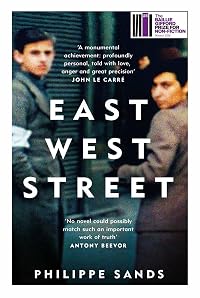
East West Street
by Philippe Sands
On This Page
Description
"A ... personal detective story, an uncovering of secret pasts, and a book that explores the creation and development of world-changing legal concepts that came about as a result of the unprecedented atrocities of Hitler's Third Reich. East West Street looks at the personal and intellectual evolution of the two men who simultaneously originated the ideas of "genocide" and crimes against humanity," both of whom not knowing the other, studied at the same university with the same professor, in show more a city little know today that was a major cultural center of Europe, "the little Paris of Ukraine," a city variously called Lemberg, Lwów, Lvov, or Lviv... Sands... realized that his own field of international law had been forged by two men--Rafael Lemkin and Hersch Lauterpacht--each of whom had studied law at Lviv University in the city of his grandfather's birth, each of whom had come to be considered the finest international legal mind of the twentieth century, each considered to be the father of the modern human rights movement, and each, at parallel times, forging diametrically opposite, revolutionary concepts of humanitarian law that had changed the world. "-- show lessTags
Recommendations









Member Recommendations

Member Reviews
In his novel, published in English in 2016 and translated into German in 2018: ‘Rückkehr nach Lemberg. On the Origins of Genocide and Crimes against Humanity. A Personal History’, Phillipe Sands tells of the erasure and rebirth of international criminal law after the Second World War. The author is a lawyer and Professor of International Law at University College London. When Sands is invited by the University of Lviv to give a lecture on the origins of international criminal law, he learns that the city itself is linked to its origins. And he discovers roots of his own family history in Lviv that were previously unknown to him. Sands weaves both stories, his personal and that of the law, into a captivating narrative.
The first show more narrative level deals with the fate of his Jewish grandparents during the Nazi era. Only his grandfather survived, while his grandmother was murdered in Theresienstadt. A second narrative level focusses on the Nuremberg Trials, in which Nazi figures were called to account for the crimes against humanity committed during the Holocaust. In these trials, elementary principles of today's international criminal law were applied. The origin of these foundations of international law forms the actual centre of the novel.
Until then, the right of nations to self-determination applied. It meant that, in extreme cases, the ruling national powers could do as they pleased with their subjects. The Nuremberg war crimes trials therefore had to create the law they wanted to apply in the first place. And this is where two Jewish lawyers from Lviv came into play: Raphael Lemkin and Hersch Lauterpracht. Both had studied in Lviv, in some cases with the same academic teachers, before they had to go into exile in Great Britain and the USA. There, in uncertainty about the fate of their families, they independently formulated two central offences with which international law would later punish the deaths of their parents and siblings: ‘crimes against humanity’ and ‘genocide’.
Philippe Sands shows that these categories competed with each other from the outset. While Lemkin considered the introduction of the term genocide into international law to be indispensable in order to prevent the Holocaust forever in the future, the legal positivist Lauterpracht feared that the orientation towards a group would override the legal claim of the individual. ‘Does it matter whether the law wants to protect you because you are an individual or because you happen to belong to a group? This was a question that has stayed with me ever since,’ Sands recalls in the prologue to his book. In fact, both of the Lviv jurists' arguments were incorporated into international law after 1946.
The current political debates about whether the state-organised crimes against the civilian population of Ukraine and the Palestinians should be described as genocide remind us that the fundamental legal work of Lemkin and Lauterbracht is one of the great intellectual achievements of 20th century European legal history and legal culture - it led to the conviction of Hermann Göring and Hans Frank, the punishment of Pol Pot and Slobodan Milošević and, last but not least, made the international arrest warrant against Vladimir Putin possible. However, without the liberation of the Eastern European states and the regaining of their political self-determination after the collapse of communist tyranny, Philippe Sands would not have been able to compile this diverse range of source material. However, in this magnificent book, Sands was able to recall a time in which those ideas emerged in Lviv that have become ominously topical again since 24 February 2022 at the latest. show less
The first show more narrative level deals with the fate of his Jewish grandparents during the Nazi era. Only his grandfather survived, while his grandmother was murdered in Theresienstadt. A second narrative level focusses on the Nuremberg Trials, in which Nazi figures were called to account for the crimes against humanity committed during the Holocaust. In these trials, elementary principles of today's international criminal law were applied. The origin of these foundations of international law forms the actual centre of the novel.
Until then, the right of nations to self-determination applied. It meant that, in extreme cases, the ruling national powers could do as they pleased with their subjects. The Nuremberg war crimes trials therefore had to create the law they wanted to apply in the first place. And this is where two Jewish lawyers from Lviv came into play: Raphael Lemkin and Hersch Lauterpracht. Both had studied in Lviv, in some cases with the same academic teachers, before they had to go into exile in Great Britain and the USA. There, in uncertainty about the fate of their families, they independently formulated two central offences with which international law would later punish the deaths of their parents and siblings: ‘crimes against humanity’ and ‘genocide’.
Philippe Sands shows that these categories competed with each other from the outset. While Lemkin considered the introduction of the term genocide into international law to be indispensable in order to prevent the Holocaust forever in the future, the legal positivist Lauterpracht feared that the orientation towards a group would override the legal claim of the individual. ‘Does it matter whether the law wants to protect you because you are an individual or because you happen to belong to a group? This was a question that has stayed with me ever since,’ Sands recalls in the prologue to his book. In fact, both of the Lviv jurists' arguments were incorporated into international law after 1946.
The current political debates about whether the state-organised crimes against the civilian population of Ukraine and the Palestinians should be described as genocide remind us that the fundamental legal work of Lemkin and Lauterbracht is one of the great intellectual achievements of 20th century European legal history and legal culture - it led to the conviction of Hermann Göring and Hans Frank, the punishment of Pol Pot and Slobodan Milošević and, last but not least, made the international arrest warrant against Vladimir Putin possible. However, without the liberation of the Eastern European states and the regaining of their political self-determination after the collapse of communist tyranny, Philippe Sands would not have been able to compile this diverse range of source material. However, in this magnificent book, Sands was able to recall a time in which those ideas emerged in Lviv that have become ominously topical again since 24 February 2022 at the latest. show less
Beautifully crafted reconstruction of the lives and roles of three main characters whose families shared a home at the East West street of Zolkiew, a small place North of Lemberg, Lwow, Lviv, the city that changed nationality many times in a short span of time between 1914-1944 (Austria-Hungary; Soviet Union, independent Western Ukraine, Poland, Soviet Union, Nazi Germany, Ukraine). All three characters play an (in)direct role in the Nuremberg trials.
Leon Buchholz, Phillippe Sands maternal granddad, who fled to Vienna and then Paris in the wake of ww2, survived the war, but lost all 70 Jewish relatives of his from Lemberg/Zolkiew. Secondly there is Hersch Lauterpacht, Jewish lawyer, who also flees, ends up in Cambridge, England, and show more coins the term ‘crimes against humanity’ a key indictment at the Nuremberg trials. Hersch is a member of the British prosecution delegation at Nuremberg. His legal contribution emphasizes the existence of State orchestrated crimes against individual citizens. This concept contrasts with Rafael Lemkin’s legal contribution to Nuremberg – genocide (a contraction of the Greek term for people (genos) and the Latin term for murder). While genocide was part of the original Nuremberg indictment, it was not part of the verdict. And yet if we compare ‘crimes against humanity’ and genocide in legal practice ever since, genocide with its emphasis on the prosecution of groups in society is much more commonly used than the individually oriented crimes against humanity.
Lemkin and Lauterpacht both studied at the same law faculty of the University of Lvov, to which Phillippe Sands is invited for a lecture in 2010, putting the genesis of this wonderful book into motion. It starts with a simple question – how come the legacy of two Jewish lawyers who stood at the cradle of the human rights movement is not remembered in the city where they were both raised and studied? Well, Sands’ first audience suggests, perhaps because they were Jewish and anti-semitism has always been rife in a city that was once a battleground of three groups (Poles, Jews and Ukrainians). And perhaps the latter turbulent history of violence against groups and individuals explains why two inhabitants of Lvov crafted the legal ideas which came to dominate the international human right movement after the war. show less
Leon Buchholz, Phillippe Sands maternal granddad, who fled to Vienna and then Paris in the wake of ww2, survived the war, but lost all 70 Jewish relatives of his from Lemberg/Zolkiew. Secondly there is Hersch Lauterpacht, Jewish lawyer, who also flees, ends up in Cambridge, England, and show more coins the term ‘crimes against humanity’ a key indictment at the Nuremberg trials. Hersch is a member of the British prosecution delegation at Nuremberg. His legal contribution emphasizes the existence of State orchestrated crimes against individual citizens. This concept contrasts with Rafael Lemkin’s legal contribution to Nuremberg – genocide (a contraction of the Greek term for people (genos) and the Latin term for murder). While genocide was part of the original Nuremberg indictment, it was not part of the verdict. And yet if we compare ‘crimes against humanity’ and genocide in legal practice ever since, genocide with its emphasis on the prosecution of groups in society is much more commonly used than the individually oriented crimes against humanity.
Lemkin and Lauterpacht both studied at the same law faculty of the University of Lvov, to which Phillippe Sands is invited for a lecture in 2010, putting the genesis of this wonderful book into motion. It starts with a simple question – how come the legacy of two Jewish lawyers who stood at the cradle of the human rights movement is not remembered in the city where they were both raised and studied? Well, Sands’ first audience suggests, perhaps because they were Jewish and anti-semitism has always been rife in a city that was once a battleground of three groups (Poles, Jews and Ukrainians). And perhaps the latter turbulent history of violence against groups and individuals explains why two inhabitants of Lvov crafted the legal ideas which came to dominate the international human right movement after the war. show less
East West Street – A Profoundly Personal Story
On the 13th April 1940 in Skałat, my Great Grandmother was arrested by officers of the NKVD for the given reason her husband was a Police Officer in the border town of Podwołoczyska to the right of the river Zbruch and her son was in the Polish Army fighting for the enemy (Poland). She was transported to Siberia, in cattle trucks, that the following year would be utilised by the Nazi regime of Hans Frank in Galicia.
Skałat is 92 miles to the east of Lwów or as it was called from 1792, Lemberg, both are in what is referred to as the Kresy, the eastern borderlands of Poland were reborn in 1918 after 100 years of being partitioned by the occupying forces of Austria, Russia and Prussia. In show more the pre-war census of Lwów it was a City whose population was one third Polish, one third Jewish, 15 per cent Ukrainian with a mixture of German, Russians, Swedes, Latvians, Estonians and Lithuanians making up the rest of the population.
The Lemberg that Philippe Sands introduces us to as the back drop to this personal story really was a multicultural City of learning, arts and cultures. But behind this though was a background of suspicion towards other cultures, and religiously different. Jewish pogroms were not unknown to many either side of the river Zbruch something even today people would rather forget or not talk about.
Like Philippe Sands and many others from the Kresy, those that lived through those times rarely if ever actually spoke about the period. My Grandfather was exactly the same as Leon, Sands Grandfather, but with less pictures, and not allowed to visit Poland until 1970. Fortunately, now those stories are being recorded and published as these stories must not die. One cannot allow either the Holocaust or the deportation of the Polish and Jewish Intelligentsia by both sides be forgotten.
In this very personal story we find that that Sands has been invited to give a lecture in Lwów or as it is now L’viv University, on international law. So he begins an investigation not only in to his own family’s link with the city but also the City’s links with the origins of genocide and crimes against humanity as part of international law. That these not only are inextricably linked with the Nuremberg Trials but also linked to the City, by two men born, educated in the borderlands, both Jewish both lawyers, both fortunate to escape the Nazi invasion.
What Sands uncovers is an absolutely fascinating story which he is able to tell without any personal animosity, but the great love and the lawyer’s precision brings all this to life. What he does do is weave together part family history, part historical detective and throw in to the mix the legal backdrop to the story. From introducing his search of what happened to his Grandfather Leon, we also follow the stories of Hersch Lauterpacht and Rafael Lemkin, both Polish Jews, both academics, both studied in Lemberg and then like Leon paths diverged.
While both Lauterpacht and Lemkin’s links to the Nuremberg Trails are either hidden or very much forgotten, it was due to these two jurists that we now have a human rights law and more importantly an International Criminal Court, even if it took well over fifty years to come in to existence. Without either we today would not have either ‘Crimes against humanity’ or ‘Genocide’ in the modern lexicon and more importantly in the legal lexicon.
While our three main characters did not know each other, their families were deeply affected by the actions and decisions of Hans Frank the Governor-General of Nazi occupied Poland. Whose story is told via his son Niklas which was interesting and especially his feelings towards his father.
The breadth and in a way the brevity of this very personal investigation makes for stunning and absolutely riveting read. Like any successful lawyer there are no wasted words or meaningless detours but the facts of the story laid bare which makes East West Street so engrossing.
Like many from the Kresy is I need to learn something that Sands has been able to do in this story, in the ability to forgive and move on something that is not easy, when members of your family are murdered because they are Jewish. But Sands does state that ‘forgetting is not an option’ which is so true and so important.
East West Street has transcended so many genres, and like his legal forebears he breaks convention and has created an engrossing read. He has managed to weave the highly personal stories of three people and the global impact of their times and what they achieved in to a success, and this in the face of evil, intent on killing them.
From first to last page the reader will be drawn in to a powerful story. East West Street is not a book I shall forget and shall never fail to recommend. show less
On the 13th April 1940 in Skałat, my Great Grandmother was arrested by officers of the NKVD for the given reason her husband was a Police Officer in the border town of Podwołoczyska to the right of the river Zbruch and her son was in the Polish Army fighting for the enemy (Poland). She was transported to Siberia, in cattle trucks, that the following year would be utilised by the Nazi regime of Hans Frank in Galicia.
Skałat is 92 miles to the east of Lwów or as it was called from 1792, Lemberg, both are in what is referred to as the Kresy, the eastern borderlands of Poland were reborn in 1918 after 100 years of being partitioned by the occupying forces of Austria, Russia and Prussia. In show more the pre-war census of Lwów it was a City whose population was one third Polish, one third Jewish, 15 per cent Ukrainian with a mixture of German, Russians, Swedes, Latvians, Estonians and Lithuanians making up the rest of the population.
The Lemberg that Philippe Sands introduces us to as the back drop to this personal story really was a multicultural City of learning, arts and cultures. But behind this though was a background of suspicion towards other cultures, and religiously different. Jewish pogroms were not unknown to many either side of the river Zbruch something even today people would rather forget or not talk about.
Like Philippe Sands and many others from the Kresy, those that lived through those times rarely if ever actually spoke about the period. My Grandfather was exactly the same as Leon, Sands Grandfather, but with less pictures, and not allowed to visit Poland until 1970. Fortunately, now those stories are being recorded and published as these stories must not die. One cannot allow either the Holocaust or the deportation of the Polish and Jewish Intelligentsia by both sides be forgotten.
In this very personal story we find that that Sands has been invited to give a lecture in Lwów or as it is now L’viv University, on international law. So he begins an investigation not only in to his own family’s link with the city but also the City’s links with the origins of genocide and crimes against humanity as part of international law. That these not only are inextricably linked with the Nuremberg Trials but also linked to the City, by two men born, educated in the borderlands, both Jewish both lawyers, both fortunate to escape the Nazi invasion.
What Sands uncovers is an absolutely fascinating story which he is able to tell without any personal animosity, but the great love and the lawyer’s precision brings all this to life. What he does do is weave together part family history, part historical detective and throw in to the mix the legal backdrop to the story. From introducing his search of what happened to his Grandfather Leon, we also follow the stories of Hersch Lauterpacht and Rafael Lemkin, both Polish Jews, both academics, both studied in Lemberg and then like Leon paths diverged.
While both Lauterpacht and Lemkin’s links to the Nuremberg Trails are either hidden or very much forgotten, it was due to these two jurists that we now have a human rights law and more importantly an International Criminal Court, even if it took well over fifty years to come in to existence. Without either we today would not have either ‘Crimes against humanity’ or ‘Genocide’ in the modern lexicon and more importantly in the legal lexicon.
While our three main characters did not know each other, their families were deeply affected by the actions and decisions of Hans Frank the Governor-General of Nazi occupied Poland. Whose story is told via his son Niklas which was interesting and especially his feelings towards his father.
The breadth and in a way the brevity of this very personal investigation makes for stunning and absolutely riveting read. Like any successful lawyer there are no wasted words or meaningless detours but the facts of the story laid bare which makes East West Street so engrossing.
Like many from the Kresy is I need to learn something that Sands has been able to do in this story, in the ability to forgive and move on something that is not easy, when members of your family are murdered because they are Jewish. But Sands does state that ‘forgetting is not an option’ which is so true and so important.
East West Street has transcended so many genres, and like his legal forebears he breaks convention and has created an engrossing read. He has managed to weave the highly personal stories of three people and the global impact of their times and what they achieved in to a success, and this in the face of evil, intent on killing them.
From first to last page the reader will be drawn in to a powerful story. East West Street is not a book I shall forget and shall never fail to recommend. show less
Back in 2010 the barrister Philippe Sands was asked to give a lecture at Lviv University in Ukraine on the subjects of genocide and crimes against humanity. This gave him the opportunity to visit the city, and maybe discover more about his maternal grandfather, a man who he knew so little about. Sands knew he was Jewish, had moved to Vienna as war enveloped Europe in 1914 and then moved onto Paris after the Nazis entered Austria. When he probed further he discovered that there were scant details about him; it was a life enveloped in secrecy. Little by little, he discovered details of his grandfather’s life, how the family had moved across Europe, his mother’s journey to Paris as a small child in the company of someone other than her show more parents, somehow staying one-step ahead as the Nazi regime started sending people to the death camps.
His visit to Lviv University also revealed that his own field of legal expertise, international humanitarian law, had been conceived by two men who had studied law there. Rafael Lemkin and Hersch Lauterpacht were the men who forged the ideas of genocide and crimes against humanity. These legal concepts were first used in anger in the Nuremburg trials post World War II when the prosecution of Nazi war criminals took place. He brings the governor-general of Nazi-occupied Poland, Hans Frank into the narrative. Responsible for the deaths of over 1 million Poles and Jews in the short time he was in charge, he also had the dubious honour of being Hitler’s personal lawyer. After the war, the lives of Franks, Lemkin and Lauterpacht would come together in the International Military Tribunals in room 600 at the Palace of Justice as the world learnt of the horrors of the Third Reich .
Sands has written a poignant and personal memoir of tracing his grandfather. However, this book is so much more than that. His story of the three people that culminated in the Nuremburg trials is a fascinating account of the development of international law. It was personal for Lemkin and Lauterpacht and his grandfather Leon too as they were among the people lost numerous members of their families in this absolute tragic and pointless loss of life that swept Europe. Words like genocide and crimes against humanity should never exist, but sadly, they do. For a book that is full of much sadness, there is hope too; the legal principles that they initiated are being used to bring people to justice. These principles that they defined will never solve the problems of the world, but they do give peoples and cultures opportunity for redress. It is a influential historical account of men who were prepared to fight brutality with peaceful means. Can highly recommend this. show less
His visit to Lviv University also revealed that his own field of legal expertise, international humanitarian law, had been conceived by two men who had studied law there. Rafael Lemkin and Hersch Lauterpacht were the men who forged the ideas of genocide and crimes against humanity. These legal concepts were first used in anger in the Nuremburg trials post World War II when the prosecution of Nazi war criminals took place. He brings the governor-general of Nazi-occupied Poland, Hans Frank into the narrative. Responsible for the deaths of over 1 million Poles and Jews in the short time he was in charge, he also had the dubious honour of being Hitler’s personal lawyer. After the war, the lives of Franks, Lemkin and Lauterpacht would come together in the International Military Tribunals in room 600 at the Palace of Justice as the world learnt of the horrors of the Third Reich .
Sands has written a poignant and personal memoir of tracing his grandfather. However, this book is so much more than that. His story of the three people that culminated in the Nuremburg trials is a fascinating account of the development of international law. It was personal for Lemkin and Lauterpacht and his grandfather Leon too as they were among the people lost numerous members of their families in this absolute tragic and pointless loss of life that swept Europe. Words like genocide and crimes against humanity should never exist, but sadly, they do. For a book that is full of much sadness, there is hope too; the legal principles that they initiated are being used to bring people to justice. These principles that they defined will never solve the problems of the world, but they do give peoples and cultures opportunity for redress. It is a influential historical account of men who were prepared to fight brutality with peaceful means. Can highly recommend this. show less
The terms “Human Rights”, “Crimes against Humanity” and “Genocide” are today so familiar and ubiquitous, that we take them for granted without too much thought as to what they imply. Indeed, we are all too familiar with their misuse when they are deployed against Israel by its enemies. Yet these terms had to be explicitly argued into existence just 70 years ago in order to provide a legal justification for the Nuremberg war crimes tribunal, which tried the surviving leaders of Nazi Germany as war criminals. The Nuremberg Tribunal is at the center of Philippe Sands’ book but, although he is a barrister and prominent human rights lawyer, his is not an account of the proceedings of the Tribunal, already amply covered in book show more and film. Rather, his account is about the lives of four men, three of whom were key figures involved in the Tribunal and the fourth of whom was not, but he was the author’s grandfather, Leon Buchholz. He and one of the others, Hersch Lauterpacht, both grew up on the same East West Street of the book's title in the Galician town of Zolkiew. The third man was Rafael Lemkin; he and Lauterpacht were lawyers; both had deep intellectual and personal reasons for their involvement in what would be the first ever international criminal trial. Both men had studied law - at different times - at the university of Lviv/Lwow/ Lemburg, then the capital of Polish Galicia, now the largest city in western Ukraine.
After the Nazis came to power in 1933, when it was clear that they intended in some way to put their racist theories into practice, there was a growing academic interest, in western Europe and the USA, in defining the legal limits of national sovereignty. Was the government of a country really entitled to put into effect any type of law it liked, regardless of how that might affect the lives and welfare of some of its citizens? Because of their writings on this very question of law, the professional attainments of both Lauterpacht and Lemkin had independently achieved some renown abroad; thus, both men left their homes - Lauterpacht to come to England and Lemkin to the USA – to pursue their careers. Both men left behind them extensive families who – with very few exceptions – were subsequently murdered by the Nazis after the invasion of Poland. The family of the author’s grandfather suffered the same fate; Bucholz himself had moved to live in Vienna before the Nazis came to power, from where he fled to Paris before the trap shut closed.
The fourth man in this story was one of the perpetrators of the Nazi crimes, and one of the most notorious of the war criminals on trial at Nuremberg, Hans Frank. He had been Hitler’s personal lawyer, one of the prime drafters of the Nuremberg decrees that gave Nazi racial theories the force of law in Germany and, following the invasion of Poland in 1939, he was appointed Governor-General of German-occupied Poland. When Germany reneged on the infamous Ribbentrop-Molotov pact, and attacked and overran the Soviet Union positions in eastern Poland, Frank’s rule was extended to the whole of Poland- including Galicia. Thus it was that Hans Frank was the man responsible for the murder of the families of the other three men.
Once the enormity of the Nazi crimes became evident, there was a broad consensus that individual human rights must transcend and take priority over the sovereign rights of a nation. However, the question arose as to whether international law should provide protection for the rights of the individual or for those of the group - ethnic, national, religious, or any other. While still ignorant of the fates of their families but fearing the worst, Lauterpacht and Lemkin were on opposite sides of this debate. Over-familiarity with the two terms prevents us today from seeing the very clear distinction between "crimes against humanity" and "genocide" – the latter a term first coined by Lemkin. Lauterpacht believed very strongly that defining protections for groups inevitably led to inter-group conflict; protecting one group would cause a reaction from groups not defined as protected; by focusing on the individual rather than the group, he felt that the scope for inter-group conflict would be minimised. Lemkin, on the other hand, believed that individuals were targeted because they were members of a group, and that to ignore this was unrealistic.
This debate is what makes the book more than just a very compelling set of biographies of parallel lives. In far less dramatic and tragic circumstances, the issue is still a live one today; the US policy of affirmative action, whereby discrimination against African-Americans is countered by deliberate policies to favour them with opportunities - in university admissions or government employment, for example - is opposed by many people on the grounds that it produces distortions and disadvantages other ethnicities; there is similar controversy over deliberate "diversity" policies in hiring. The issue is the same; do you protect members of specific groups, or all individuals irrespective of their group membership?
The diametrically opposed views of the two men were mirrored by two very different personalities and life-styles. Lauterpacht became a consummate insider; he was a highly respected professor at Cambridge, he had an official position on the British prosecution team and drafted much of the language of the chief British prosecutor’s speeches at Nuremberg. Lauterpacht was cool and detached in his manner, almost emotionless. In contrast, the highly emotional and frequently hyper Lemkin often alienated people with his insistence on the correctness of his views. Although he secured an academic position at a North Carolina college, and was initially part of the US government prosecution team, he was increasingly sidelined, and only managed to get to Nuremberg by using some fancy footwork. His concept of genocide had some traction with the French and Soviet prosecutors, but was rejected by the British and his own US team. He enjoyed a minor triumph when the chief US prosecutor did refer to genocide in his summing up, but the term was not in the indictment and none of the accused was convicted of genocide.
This is a strange book in many ways – part biography, part personal family memoire, part legal exposition; but it is fascinating and thought provoking. The research that has gone into documenting the lives of these four men, ferreting out long-lost individuals who could shed light on some of the dark places, is extraordinary. Two of Sands' informants were the sons of war criminals - one the son of Hans Frank, and the other of his main lieutenant in Galicia, Otto von Wachter. In a film Sands made with these two men, shown on the BBC last year, Frank's son completely repudiates his father, whereas Horst von Wachter still defiantly defends his. Nor does the author shrink from the salacious, revealing an extra-marital love affair of his grandmother while she was alone in Vienna, and the possibility of his grandfather having had a homosexual relationship. At many levels, it is a very good read. show less
After the Nazis came to power in 1933, when it was clear that they intended in some way to put their racist theories into practice, there was a growing academic interest, in western Europe and the USA, in defining the legal limits of national sovereignty. Was the government of a country really entitled to put into effect any type of law it liked, regardless of how that might affect the lives and welfare of some of its citizens? Because of their writings on this very question of law, the professional attainments of both Lauterpacht and Lemkin had independently achieved some renown abroad; thus, both men left their homes - Lauterpacht to come to England and Lemkin to the USA – to pursue their careers. Both men left behind them extensive families who – with very few exceptions – were subsequently murdered by the Nazis after the invasion of Poland. The family of the author’s grandfather suffered the same fate; Bucholz himself had moved to live in Vienna before the Nazis came to power, from where he fled to Paris before the trap shut closed.
The fourth man in this story was one of the perpetrators of the Nazi crimes, and one of the most notorious of the war criminals on trial at Nuremberg, Hans Frank. He had been Hitler’s personal lawyer, one of the prime drafters of the Nuremberg decrees that gave Nazi racial theories the force of law in Germany and, following the invasion of Poland in 1939, he was appointed Governor-General of German-occupied Poland. When Germany reneged on the infamous Ribbentrop-Molotov pact, and attacked and overran the Soviet Union positions in eastern Poland, Frank’s rule was extended to the whole of Poland- including Galicia. Thus it was that Hans Frank was the man responsible for the murder of the families of the other three men.
Once the enormity of the Nazi crimes became evident, there was a broad consensus that individual human rights must transcend and take priority over the sovereign rights of a nation. However, the question arose as to whether international law should provide protection for the rights of the individual or for those of the group - ethnic, national, religious, or any other. While still ignorant of the fates of their families but fearing the worst, Lauterpacht and Lemkin were on opposite sides of this debate. Over-familiarity with the two terms prevents us today from seeing the very clear distinction between "crimes against humanity" and "genocide" – the latter a term first coined by Lemkin. Lauterpacht believed very strongly that defining protections for groups inevitably led to inter-group conflict; protecting one group would cause a reaction from groups not defined as protected; by focusing on the individual rather than the group, he felt that the scope for inter-group conflict would be minimised. Lemkin, on the other hand, believed that individuals were targeted because they were members of a group, and that to ignore this was unrealistic.
This debate is what makes the book more than just a very compelling set of biographies of parallel lives. In far less dramatic and tragic circumstances, the issue is still a live one today; the US policy of affirmative action, whereby discrimination against African-Americans is countered by deliberate policies to favour them with opportunities - in university admissions or government employment, for example - is opposed by many people on the grounds that it produces distortions and disadvantages other ethnicities; there is similar controversy over deliberate "diversity" policies in hiring. The issue is the same; do you protect members of specific groups, or all individuals irrespective of their group membership?
The diametrically opposed views of the two men were mirrored by two very different personalities and life-styles. Lauterpacht became a consummate insider; he was a highly respected professor at Cambridge, he had an official position on the British prosecution team and drafted much of the language of the chief British prosecutor’s speeches at Nuremberg. Lauterpacht was cool and detached in his manner, almost emotionless. In contrast, the highly emotional and frequently hyper Lemkin often alienated people with his insistence on the correctness of his views. Although he secured an academic position at a North Carolina college, and was initially part of the US government prosecution team, he was increasingly sidelined, and only managed to get to Nuremberg by using some fancy footwork. His concept of genocide had some traction with the French and Soviet prosecutors, but was rejected by the British and his own US team. He enjoyed a minor triumph when the chief US prosecutor did refer to genocide in his summing up, but the term was not in the indictment and none of the accused was convicted of genocide.
This is a strange book in many ways – part biography, part personal family memoire, part legal exposition; but it is fascinating and thought provoking. The research that has gone into documenting the lives of these four men, ferreting out long-lost individuals who could shed light on some of the dark places, is extraordinary. Two of Sands' informants were the sons of war criminals - one the son of Hans Frank, and the other of his main lieutenant in Galicia, Otto von Wachter. In a film Sands made with these two men, shown on the BBC last year, Frank's son completely repudiates his father, whereas Horst von Wachter still defiantly defends his. Nor does the author shrink from the salacious, revealing an extra-marital love affair of his grandmother while she was alone in Vienna, and the possibility of his grandfather having had a homosexual relationship. At many levels, it is a very good read. show less
https://nwhyte.livejournal.com/3497644.html
A great book by international human rights lawyer Philippe Sands, which looks at his own family history and the background of two hugely significant international lawyers, Hersch Lauterpacht, who successfully promoted human rights as an international responsibility, and Raphael Lemkin, who developed the legal concept of genocide, and how they intertwined in the city of Lviv (as it now is) and the nearby town of Zhovka/Żółkiew. He also throws into the mix Hans Frank, the Nazi ruler of Poland, and his sidekick Otto von Wächter, both of whom have surviving sons whose takes on their fathers' careers are grimly different from each other. Carefully reconstructed from letters, photographs, show more documentation and memories, and framed by the Nuremberg trial of Hans Frank for crimes against humanity, it's a superb account of how ordinary enough circumstances can transform into horror and also generate genius. show less
A great book by international human rights lawyer Philippe Sands, which looks at his own family history and the background of two hugely significant international lawyers, Hersch Lauterpacht, who successfully promoted human rights as an international responsibility, and Raphael Lemkin, who developed the legal concept of genocide, and how they intertwined in the city of Lviv (as it now is) and the nearby town of Zhovka/Żółkiew. He also throws into the mix Hans Frank, the Nazi ruler of Poland, and his sidekick Otto von Wächter, both of whom have surviving sons whose takes on their fathers' careers are grimly different from each other. Carefully reconstructed from letters, photographs, show more documentation and memories, and framed by the Nuremberg trial of Hans Frank for crimes against humanity, it's a superb account of how ordinary enough circumstances can transform into horror and also generate genius. show less
Absolutely fascinating! It was hard to put down - it reads almost like a thriller, even though it isn't fiction. Philippe Sands weaves together the stories of his grandparents, the two lawyers who came up with the concepts of genocide and crimes against humanity, and the Nazi commander in Poland during World War 2. It all culminates in the Nuremburg trials.
Sands research is meticulous, and it is incredible how much he is able to find out from a few initial clues. Informative as well as exciting.
The reason I picked up this book is that I listened to his BBC podcast series "The Ratline", where he investigates what happened to Otto von Wächter, another high-ranking Nazi in Poland during the war. Equally fascinating.
Sands research is meticulous, and it is incredible how much he is able to find out from a few initial clues. Informative as well as exciting.
The reason I picked up this book is that I listened to his BBC podcast series "The Ratline", where he investigates what happened to Otto von Wächter, another high-ranking Nazi in Poland during the war. Equally fascinating.
Members
- Recently Added By
Lists

A Ukraine Reading List
121 works; 90 members

Books Read in 2017
4,249 works; 129 members

Books Read in 2018
4,360 works; 110 members

The Burned Letter Book List
56 works; 1 member
Author Information

18+ Works 2,355 Members
Philippe Sands was born in 1960 in London. He is a graduate of Corpus Christi College, Cambridge, receiving his B.A. in 1982 and his LLM, first class honours in 1983. He finished his postgraduate studies at Cambridge and was a visiting scholar at Harvard Law School. He has held positions at numerous distinguished universities around the world. He show more was called to the Bar of England and Wales in 1985. He has written numerous academic and general nonfiction books, newspaper articles, book reviews, and more. His books include Lawless World, and Torture Team. In 2016, he won the Baillie Gifford Prize for nonfiction, for East West Street: On the Origins of Genocide and Crimes against Humanity. (Bowker Author Biography) show less
All Editions
Some Editions
Awards and Honors
Awards
Distinctions
Notable Lists
Common Knowledge
- Canonical title
- East West Street
- Alternate titles
- East West Street: On the Origins of Genocide and Crimes Against Humanity
- Original publication date
- 2016
- People/Characters
- Hersch Lauterpacht; Hans Frank; Rafael Lemkin; Leon Buchholz
- Important places
- Lviv, Ukraine
- Important events
- Nuremberg War Crimes Trials; World War II
- Epigraph
- The little town lies in the middle of a great plain...It begins with little huts and ends with them. After a while the huts are replaced by houses. Streets begin. One runs from north to south, the other from east to west.
... (show all)
Joseph Roth, The Wandering Jews, 1927
What haunts are not the dead, but the gaps left within us by the secrets of others.
Nicolas Abraham, 'Notes on the Phantom', 1975 - Dedication
- For Malke and Rosa,
for Rita and Leon,
for Annie,
for Ruth - First words
- A little after three o'clock in the afternoon, the wooden door behind the defendants' dock slid open and Hans Frank entered courtroom 600. (Prologue)
The city of Lviv occupies an important place in this story. (Note to the Reader)
My earliest memory of Leon dates back to the 1960s, when he was living in Paris with his wife, Rita, my grandmother.
The trial at Nuremberg had consequences. (Epilogue) - Last words
- (Click to show. Warning: May contain spoilers.)Italy never controlled the city, but if it had, it would be Leopolis, the City of Lions. (Note to the Reader)
(Click to show. Warning: May contain spoilers.)'I understand your interest in Lauterpacht and Lemkin,' she continued, 'but isn't your grandfather the one you should be chasing? Isn't he the one closest to your heart?' (Prologue)
(Click to show. Warning: May contain spoilers.)'Every day I look at this,' Niklas said. 'To remind me, to make sure, that he is dead.'
(Click to show. Warning: May contain spoilers.)Right there, for a brief moment, I understood. (Epilogue) - Blurbers
- le Carré, John; Beevor, Antony; Thirlwell, Adam; Figes, Orlando; Kennedy, A L; Fraser, Antonia (show all 8); Snow, Jon; Rentzenbrink, Cathy
- Original language
- English
Classifications
- Genres
- Politics and Government, History, General Nonfiction, Nonfiction, Biography & Memoir
- DDC/MDS
- 345.0251 — Society, government, & culture Law Criminal Law Criminal offenses
- LCC
- KZ7180 .S26 — Law Law of nations Law of nations International criminal law and procedure International criminal law International crimes or groups of crimes Genocide
- BISAC
Statistics
- Members
- 1,052
- Popularity
- 24,469
- Reviews
- 25
- Rating
- (4.35)
- Languages
- 9 — Danish, Dutch, English, French, German, Italian, Portuguese, Spanish, Swedish
- Media
- Paper, Audiobook, Ebook
- ISBNs
- 33
- ASINs
- 10