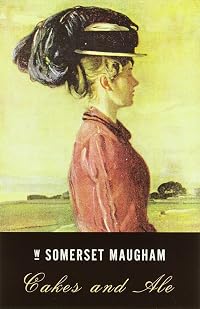
Cakes and Ale
by W. Somerset Maugham  , Dodie Masterman (Illustrator)
On This Page
Description
Cakes and Ale is a delicious satire of London literary society between the Wars. Social climber Alroy Kear is flattered when he is selected by Edward Driffield's wife to pen the official biography of her lionized novelist husband, and determined to write a bestseller. But then Kear discovers the great novelist's voluptuous muse (and unlikely first wife), Rosie. The lively, loving heroine once gave Driffield enough material to last a lifetime, but now her memory casts an embarrissing shadow show more over his career and respectable image. Wise, witty, deeply satisfying, Cakes and Ale is Maugham at his best. show lessTags
Recommendations

















Member Reviews
An entertaining tale of priggishness and hypocrisy in the world of letters, memorable for its waspish portrait of mountebank scribbler/social climber Alroy Flear. But the story has a warm heart in the character of Rosie Driffield, writers’ muse and genuine good time girl. Maugham has such a talent for balancing bitchiness and benevolence.
I'm reading and rereading a lot of popular British books from between the wars in order to try to understand popular support for appeasement. Maugham is an extraordinary stylist, and I'd read everything of his before, and he typifies a kind of acceptable anti-Semitism specifically and racism generally.
This time I noticed the snobbery. The last line. Dang.
So, I'd say this is a beautifully-written and incredibly snarky book that exemplifies how acceptable various kinds of racism were. The narrator of the book is an incredible snob, who seems to reconsider his snobbery, but the last line makes it clear: not really. Maugham was a snob. And worth reading for that reason.
This time I noticed the snobbery. The last line. Dang.
So, I'd say this is a beautifully-written and incredibly snarky book that exemplifies how acceptable various kinds of racism were. The narrator of the book is an incredible snob, who seems to reconsider his snobbery, but the last line makes it clear: not really. Maugham was a snob. And worth reading for that reason.
tl;dr Cakes and Ale is proof in the pudding dead white dudes could write whatever the fuck they want and have it hailed as literary masterpiece, even when it is utterly beyond crap.
Review
I picked this book up a couple of months ago and it has been the bane of my existence as the more I read, the more I hated it. It is poorly written and badly edited, with random thoughts dropped into the middle of scenes that do not make any sense to the story or plot. For example, near the end of the book while discussing the character, Rosie Driffield, in question, the narrator suddenly decides this would be a good time to go on a two page bender on the withal of telling a story in first person narrative. Then as suddenly as he leapt into that show more thought, he leaps back into his discourse of Rosie's admirable/questionable qualities.
The book is littered with jumps like this. There was 30 pages leveled on the discourse of beauty, what it meant, how it was applicable to life, who got it, and who didn't. Another 10 pages on the virtues of a secondary minor character who doesn't show up until near the end of the book. Roughly 20 pages was spent discussing the attributes of a another character who never actually shows up later in the story.
Maugham name checks of the day famous literary talent, real and imaginary. He draws comparison between his protagonist, William Ashenden, and these literary giants and whom you realise is really a stand in for him. He fangirls over so many famous people, it gets kind of embarrassing.
The crux of the story is William Ashenden, the narrator, is asked by Alroy Kear, another London literary snob, to help him with his research on writing a biography of recently deceased late-Victorian author, Edward Driffield. Driffield's wife, the second Mrs. Driffield, wants any mention of the first Mrs. Driffield, our supposed heroine Rosie, to be erased from Edward's history for she was an amoral character to the ninth degree and whose influence over poor dear Edward nearly killed him.
With this set up, one would think the whole of the story would be the bringing to life, discussion, and telling of Rosie Driffield's relationship with Edward. Rosie is mentioned in the beginning of the book briefly and then it's not until another 200 pages later she's brought into focus again and then carried out. It was as if someone had said to Maugham, "Yo. You are far off plot here buddy, rein it in!" And he did.
The whole of the book is to examine the snobbery and the often absurd social mores of the late Victorians and later, the Edwardians, and how these attitudes were affected and perceived. I get that, I do. But in that vein, the book is so poorly executed I spent a lot of time wondering what the fuck I was reading. I checked the synopsis on the back of the book so often to verify that what it said was actually what I was reading and not something else entirely.
It is well documented Maugham had issues with women, as he often saw them as his sexual and affection competitors, so his women are often described and treated as if they scum on shoes because of their sex. It is also well established Maugham, despite impressive number of novels under his belt, is at his best as a short story writer. With that in mind, I would recommend you stay the hell away from Cakes and Ale. I cannot in good conscious even conceive how this book gets so much love because of how flawed it is from start to finish. It is not even coherent, and yet! Yet, the mere existence proves that a dead white dude could write anything and have it called a literary masterpiece. show less
Review
I picked this book up a couple of months ago and it has been the bane of my existence as the more I read, the more I hated it. It is poorly written and badly edited, with random thoughts dropped into the middle of scenes that do not make any sense to the story or plot. For example, near the end of the book while discussing the character, Rosie Driffield, in question, the narrator suddenly decides this would be a good time to go on a two page bender on the withal of telling a story in first person narrative. Then as suddenly as he leapt into that show more thought, he leaps back into his discourse of Rosie's admirable/questionable qualities.
The book is littered with jumps like this. There was 30 pages leveled on the discourse of beauty, what it meant, how it was applicable to life, who got it, and who didn't. Another 10 pages on the virtues of a secondary minor character who doesn't show up until near the end of the book. Roughly 20 pages was spent discussing the attributes of a another character who never actually shows up later in the story.
Maugham name checks of the day famous literary talent, real and imaginary. He draws comparison between his protagonist, William Ashenden, and these literary giants and whom you realise is really a stand in for him. He fangirls over so many famous people, it gets kind of embarrassing.
The crux of the story is William Ashenden, the narrator, is asked by Alroy Kear, another London literary snob, to help him with his research on writing a biography of recently deceased late-Victorian author, Edward Driffield. Driffield's wife, the second Mrs. Driffield, wants any mention of the first Mrs. Driffield, our supposed heroine Rosie, to be erased from Edward's history for she was an amoral character to the ninth degree and whose influence over poor dear Edward nearly killed him.
With this set up, one would think the whole of the story would be the bringing to life, discussion, and telling of Rosie Driffield's relationship with Edward. Rosie is mentioned in the beginning of the book briefly and then it's not until another 200 pages later she's brought into focus again and then carried out. It was as if someone had said to Maugham, "Yo. You are far off plot here buddy, rein it in!" And he did.
The whole of the book is to examine the snobbery and the often absurd social mores of the late Victorians and later, the Edwardians, and how these attitudes were affected and perceived. I get that, I do. But in that vein, the book is so poorly executed I spent a lot of time wondering what the fuck I was reading. I checked the synopsis on the back of the book so often to verify that what it said was actually what I was reading and not something else entirely.
It is well documented Maugham had issues with women, as he often saw them as his sexual and affection competitors, so his women are often described and treated as if they scum on shoes because of their sex. It is also well established Maugham, despite impressive number of novels under his belt, is at his best as a short story writer. With that in mind, I would recommend you stay the hell away from Cakes and Ale. I cannot in good conscious even conceive how this book gets so much love because of how flawed it is from start to finish. It is not even coherent, and yet! Yet, the mere existence proves that a dead white dude could write anything and have it called a literary masterpiece. show less
Tanmese a viktoriánus emlékezetről, avagy miből lesz a cserebogár. Ashenden, az író nyugalmát két kollégája zavarja meg: az egyikük, Alroy Kear él, a másikuk, Driffield épp most halt meg. Eme sajnálatos tény (mármint az elhalálozás) indítja arra az élő írót, hogy felkeresse Ashendent, mégpedig abból a célból, hogy csepegtessen már neki némi életrajzi adatot az elhunytról, merthogy Ashenden hamvas kölyökfóka korában állítólag jól ismerte őt. Csakhogy amit Ashenden tud Driffieldről (és amit nosztalgikus visszaemlékezések füzérén keresztül meg is oszt az olvasóval), az aligha építhető bele organikusan egy szalonképes életrajzba – és itt kezdődnek a problémák. Maugham regénye show more egy kettős átváltozás története: egyfelől láthatjuk, ahogy szegény Driffieldből kiszipolyozza a vért környezete, mert túl elevennek találja ahhoz, hogy egy viktoriánus mítosz tárgya legyen – ha már szobrot formáznak belőle, legalább legyen élettelen. Másrészt pedig (és talán elsősorban) Ashenden átalakulásának története is, aki nem kis részben Driffield (pontosabban felesége, Rosa) hatására válik hétköznapi konformista brit fiatalemberből művésszé. Elegáns, hajlékony, okos (néha okoskodó) kötet a művészről, és arról, milyennek akarja látni a művészt a társadalom, és hogy e két elem között mekkora szakadék tud lenni. Végig belengi valami finom avíttság, ez elfeledett Anglia emléke, amit én különösen sokra értékeltem. Jó volt. show less
What a lovely novel! The reader can curl up in the discursive style as if it were a nice warm quilt, enjoying the leisurely unfolding of the story and the characters in perfect comfort. Moreover, this is a very funny book, about the British class system and the literary world a hundred years ago. Plus que ca change --- . It's also clearly a roman a clef, which adds to the fun. Great read.
William Ashenden is an author of reasonable success, who is contacted by an old friend – fellow author and literary darling Alroy Kear, who in turn has been asked to write a biography of a recently deceased writer named Edward Driffield, by Driffield’s widow. Kear – and Driffield’s widow Amy – want William’s help, as he knew Driffield many years earlier. This request sparks William’s memory, and the majority of Cakes and Ale is written in flashback, as William – who also narrates the story recalls his friendship with Edward Driffield and his first wife Rosie.
Here, he faces a dilemma, because Rosie is remembered with disdain and even disgust by most people, due to her promiscuity, and her unfaithfulness to her husband. show more However, William remembers her with affection, and is concerned over how much to tell Kear, and what exactly should appear in Kear’s biography.
I have never read anything by W. Somerset Maugham before, and was not sure what to expect, but I was thoroughly charmed by this novel. It is narrated in a meandering fashion – laced with cynicism, but also very wry and humorous in parts. William, who was clearly something of a wannabe snob in his earlier years, has clearly mellowed with age, and is able to think of Rosie without disapproval; seemingly the only person who is willing or able to do so. The story is written in a conversational manner, and William’s observations about small town life, and the people who inhabited his childhood village were sharp and very ‘on the ball’ (I definitely felt like I knew some of these people!)
It sounds contradictory, but while quite a lot happens, it feels also like not much happens – perhaps because the main bulk of the story is written as a reminiscence, rather than events which are taking place in the present time. It’s a light and easy read, and one that is perfect to curl up on the sofa with on a rainy day.
I would definitely recommend this book, and will be seeking out more work by Maugham as a result of reading it. show less
Here, he faces a dilemma, because Rosie is remembered with disdain and even disgust by most people, due to her promiscuity, and her unfaithfulness to her husband. show more However, William remembers her with affection, and is concerned over how much to tell Kear, and what exactly should appear in Kear’s biography.
I have never read anything by W. Somerset Maugham before, and was not sure what to expect, but I was thoroughly charmed by this novel. It is narrated in a meandering fashion – laced with cynicism, but also very wry and humorous in parts. William, who was clearly something of a wannabe snob in his earlier years, has clearly mellowed with age, and is able to think of Rosie without disapproval; seemingly the only person who is willing or able to do so. The story is written in a conversational manner, and William’s observations about small town life, and the people who inhabited his childhood village were sharp and very ‘on the ball’ (I definitely felt like I knew some of these people!)
It sounds contradictory, but while quite a lot happens, it feels also like not much happens – perhaps because the main bulk of the story is written as a reminiscence, rather than events which are taking place in the present time. It’s a light and easy read, and one that is perfect to curl up on the sofa with on a rainy day.
I would definitely recommend this book, and will be seeking out more work by Maugham as a result of reading it. show less
Given my poor track record, no one is more surprised than me that I have finished my book on time for the 1930s Club, hosted by Karen at Kaggsy's Bookish Rambings and Simon at Stuck in a Book. I didn't have anything published in 1930 that I hadn't already read on the shelves at home, and I was not expecting my library to come up trumps so quickly. But here I am, delighted by my luck at discovering Cakes and Ale, said to be the favourite book of W. Somerset Maugham...
Maugham (1894-1965) was safely settled in the south of France when the storm broke over this book. Cakes and Ale is a piercing satire of British literary circles, and features (apparently) very recognisable portraits of authors Thomas Hardy, and Maugham's erstwhile friend show more target="_top">Horace Walpole. The Introduction by Nicholas Shakespeare gossips about these and other correspondences, but really, the pleasure in reading this novel for contemporary readers comes from Maugham's self-awareness of his own adolescent snobberies; from the satirical depiction of literary circles and their modus operandi; and from the wonderful portrait of Rosie Driffield which foreshadows the rise of independent women free from the stuffy constraints of prevailing social and sexual mores.
Narrated by the author William Ashenden, Cakes and Ale tells the story of fellow-author Alroy Kear's efforts to write a biography of the recently deceased Edward Driffield. Urged on by Driffield's legacy-building widow, the second Mrs Driffield, Alroy wants to plunder Ashenden's memories of the Driffields from his days in Blackstable. The first Mrs Driffield was a barmaid, so Alroy is interested in some salacious revelations, but not intending to include them. What he is hoping to find for his 'dignified' bio is the reason why Driffield wrote his best work while with her, and not so much with the second wife who managed his career (and him). The book is structured so that Ashenden can trawl his schoolboy memories of Rosie and his eventual undergraduate affair with her—without revealing how much of any of this is to be disclosed to Alroy.
There are many lough-out-loud moments in Cakes and Ale. Alroy is soon revealed to have had a literary career that could have served as a model for other aspiring writers: Ashenden can think of no other among his contemporaries who had achieved so considerable a position on so little talent. Which like the wise man's daily dose of Bemax [a wheatgerm dietary supplement, presumably for constipation] might have gone into a heaped-up tablespoon. Alroy has taken the advice of Thomas Carlyle (1795-1881) who said that genius was an infinite capacity for taking pains. Ashenden's scorn for Alroy is obvious:
To read the rest of my review please visit https://anzlitlovers.com/2019/10/04/cakes-and-ale-by-w-somerset-maugham/ show less
Maugham (1894-1965) was safely settled in the south of France when the storm broke over this book. Cakes and Ale is a piercing satire of British literary circles, and features (apparently) very recognisable portraits of authors Thomas Hardy, and Maugham's erstwhile friend show more target="_top">Horace Walpole. The Introduction by Nicholas Shakespeare gossips about these and other correspondences, but really, the pleasure in reading this novel for contemporary readers comes from Maugham's self-awareness of his own adolescent snobberies; from the satirical depiction of literary circles and their modus operandi; and from the wonderful portrait of Rosie Driffield which foreshadows the rise of independent women free from the stuffy constraints of prevailing social and sexual mores.
Narrated by the author William Ashenden, Cakes and Ale tells the story of fellow-author Alroy Kear's efforts to write a biography of the recently deceased Edward Driffield. Urged on by Driffield's legacy-building widow, the second Mrs Driffield, Alroy wants to plunder Ashenden's memories of the Driffields from his days in Blackstable. The first Mrs Driffield was a barmaid, so Alroy is interested in some salacious revelations, but not intending to include them. What he is hoping to find for his 'dignified' bio is the reason why Driffield wrote his best work while with her, and not so much with the second wife who managed his career (and him). The book is structured so that Ashenden can trawl his schoolboy memories of Rosie and his eventual undergraduate affair with her—without revealing how much of any of this is to be disclosed to Alroy.
There are many lough-out-loud moments in Cakes and Ale. Alroy is soon revealed to have had a literary career that could have served as a model for other aspiring writers: Ashenden can think of no other among his contemporaries who had achieved so considerable a position on so little talent. Which like the wise man's daily dose of Bemax [a wheatgerm dietary supplement, presumably for constipation] might have gone into a heaped-up tablespoon. Alroy has taken the advice of Thomas Carlyle (1795-1881) who said that genius was an infinite capacity for taking pains. Ashenden's scorn for Alroy is obvious:
If that was all, he must have told himself, he could be a genius like the rest; and when the excited reviewer of a lady's paper, writing a notice of one of his works, used the word (and of late the critics have been doing it with agreeable frequency) he must have sighed with the satisfaction of one who after long hours of toil has completed a cross-word puzzle. (p.9)
To read the rest of my review please visit https://anzlitlovers.com/2019/10/04/cakes-and-ale-by-w-somerset-maugham/ show less
Members
- Recently Added By
Lists

The Guardian's 1000 Novels Everyone Must Read
1,005 works; 547 members

1001 Books You Must Read Before You Die
1,448 works; 1,134 members
501 Must-Read Books
529 works; 72 members
20th Century Literature
1,161 works; 54 members
Best Satire
188 works; 29 members

Global Reads: Books Set in the United Kingdom and Ireland
109 works; 5 members

In or About the 1930s
198 works; 27 members

Readable Classics
110 works; 15 members

The Novels of W. Somerset Maugham
22 works; 2 members

Books Read in 2014
2,343 works; 89 members

1930s
262 works; 5 members
Books Read in 2016
4,666 works; 197 members

Michael Dirda's 100 Best Comic Novels
100 works; 1 member
Talk Discussions
Past Discussions
Cakes and Ale. All aboard! in friends of Maugham (December 2010)
Author Information

700+ Works 46,625 Members
Writer William Somerset Maugham was born in Paris on January 25, 1874. He attended St. Thomas's Medical School in London. A prolific writer, Maugham produced novels, short stories, plays, and an autobiographical novel, "Of Human Bondage." Although he remains popular for his novels and short stories, when he was alive his plays, now dated, were show more also popular, and in 1908 four of his plays ran simultaneously. Maugham died in Nice, France, on December 16, 1965. (Bowker Author Biography) show less
W. Somerset Maugham has a Legacy Library. Legacy libraries are the personal libraries of famous readers, entered by LibraryThing members from the Legacy Libraries group.

Some Editions
Awards and Honors
Series
Belongs to Publisher Series
Work Relationships
Common Knowledge
- Canonical title
- Cakes and Ale
- Original title
- Cakes and Ale, or The Skeleton in the Cupboard
- Alternate titles
- Rosie und die Künstler [German]; Il fantasma nell'armadio [Italian]; Вино и баници [Bulgarian]
- Original publication date
- 1930, Heinemann, First Edition; 1934, Heinemann, The Collected Edition, new preface; 1950, Modern Library, new preface
- People/Characters
- Edward Driffield; Alroy Kear; Rosie; Ashenden [narrator]; Mrs Driffield
- Important places
- Blackstable, England, UK; London, England, UK
- Related movies
- Cakes and Ale (1974 | IMDb)
- First words
- I have noticed that whenever someone asks for you on the telephone and, finding you out, leaves a message begging you to call him up the moment you come in, as it's important, the matter is more often important to him than to... (show all) you.
- Quotations
- I have noticed that when I am most serious people are apt to laugh at me, and indeed when after a lapse of time I have read passages that I wrote from the fullness of my heart I have been tempted to laugh at myself. It must b... (show all)e that there is something naturally absurd in a sincere emotion, though why there should be I cannot imagine, unless it is that man, the ephemeral inhabitant of an insignificant planet, with all his pain and all his striving is but a jest in an eternal mind.
- Last words
- (Click to show. Warning: May contain spoilers.)"I'll tell you," said Rosie. "He was always such a perfect gentleman."
- Original language
- English
Classifications
Statistics
- Members
- 2,124
- Popularity
- 9,642
- Reviews
- 44
- Rating
- (3.78)
- Languages
- 19 — Bulgarian, Chinese, Czech, Danish, Dutch, English, Estonian, Finnish, French, German, Hungarian, Italian, Japanese, Lithuanian, Norwegian (Bokmål), Russian, Spanish, Swedish, Portuguese (Portugal)
- Media
- Paper, Audiobook, Ebook
- ISBNs
- 47
- UPCs
- 1
- ASINs
- 83