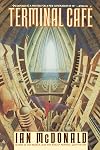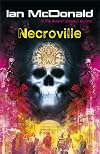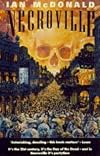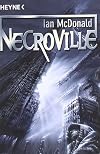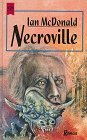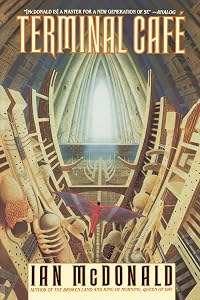
Necroville
by Ian McDonald
On This Page
Description
In the Los Angeles ghetto of Necroville, the yearly celebration of the Night of the Dead - where the dead are resurrected through the miracle of nanotechnology and live their second lives as non-citizens - becomes a journey of discovery and revelation for five individuals on the run from their pasts. With his customary flair for making the bizarre both credible and fascinating, McDonald tosses aside the line of demarcation between living and dead in a story that confronts the central show more quandary of human existence: the essence of non-being. show lessTags
Recommendations











Member Recommendations
paradoxosalpha Mid-90s SF concerned with the social enfranchisement of technologically-resurrected humans.
Member Reviews
I think I prefer the American title Terminal Café for McDonald's Necroville. It shares and supports the misdirection of the jacket copy and the opening chapter, to make the psychopharm/VR auteur Santiago Columbar the central character of this story. Like nearly all of McDonald's novels that I've read, there is no sole central character. Instead, there is a dispersed ensemble, not united until the book's ending. This one is unusual in that there is a clear prior relationship among the members of the ensemble from the outset: they are a former school cohort, now 27-year-olds (a "funny age") who have been holding a reunion annually on the Day of the Dead at the Terminal Café in the necroville connected to Los Angeles.
This book was show more written prior to McDonald's "New World Order" cycle of novels (River of Gods, Brasyl, The Dervish House, etc.), and it does not seem to share any narrative continuity with them. It is, however, much closer to them in its sensibility and narrative style than it is to Desolation Road. Necroville is set in the (former?) United States, but it seems that the dominant language is Spanish. Former civil governments seem to have been reduced to suppliers of law on the open market, where corporadas are the dominating players.
The future setting might be in the twenty-second century. It doesn't have a date other than November 1-2--the whole story transpires over a single twenty-four-hour period. Transformative nanotechnology hasn't supplied "deathless immortality," but the dead can be durably reanimated through "Jesus Tanks" that analyze them and then reconstruct them out of "tectors." The supposedly foggy life-memories of the dead are, however, no guarantee of a subjective continuity of consciousness, so people are really no more inclined to die. What's more, the dead are not recognized as having full human entity or legal rights to property; they are relegated to necrovilles when not performing services for the living.
The revolutionary struggle of the dead against their subordination by the living is the largest backdrop (and often foreground) of the novel. McDonald does not balk at references implying comparison of the situation of the dead to that of Africans introduced by slavery to the Western hemisphere. The "Freedead" have spaceships with names like Marcus Garvey and Malcolm X, and the member of Santiago Columbar's set who is most critical to the political events of the novel is named Toussaint.
In Desolation Road, McDonald had already established his ability to artfully advert to the prior canon of science fiction. In this book, the allusions seem predominantly Phildickian. The theme of epistemologically obscure resurrection connects Necroville with Dick's UBIK. McDonald quietly name-drops at least two PKD novels, Man in the High Castle (177) and Galactic Pot Healer (214). And one of the major plot threads borrows more than a little from Blade Runner, the film based on Dick's Do Androids Dream of Electric Sheep? In fact, the dead of Necroville are in many respects not much different than the replicants of Blade Runner. Even the tyrannical demiurge's name Tesler is not so far from Tyrell.
After more than twenty years, this novel doesn't feel dated at all. I wouldn't quite class it among McDonald's few best, but those are a terrifically high standard. It's very worth reading. show less
This book was show more written prior to McDonald's "New World Order" cycle of novels (River of Gods, Brasyl, The Dervish House, etc.), and it does not seem to share any narrative continuity with them. It is, however, much closer to them in its sensibility and narrative style than it is to Desolation Road. Necroville is set in the (former?) United States, but it seems that the dominant language is Spanish. Former civil governments seem to have been reduced to suppliers of law on the open market, where corporadas are the dominating players.
The future setting might be in the twenty-second century. It doesn't have a date other than November 1-2--the whole story transpires over a single twenty-four-hour period. Transformative nanotechnology hasn't supplied "deathless immortality," but the dead can be durably reanimated through "Jesus Tanks" that analyze them and then reconstruct them out of "tectors." The supposedly foggy life-memories of the dead are, however, no guarantee of a subjective continuity of consciousness, so people are really no more inclined to die. What's more, the dead are not recognized as having full human entity or legal rights to property; they are relegated to necrovilles when not performing services for the living.
The revolutionary struggle of the dead against their subordination by the living is the largest backdrop (and often foreground) of the novel. McDonald does not balk at references implying comparison of the situation of the dead to that of Africans introduced by slavery to the Western hemisphere. The "Freedead" have spaceships with names like Marcus Garvey and Malcolm X, and the member of Santiago Columbar's set who is most critical to the political events of the novel is named Toussaint.
In Desolation Road, McDonald had already established his ability to artfully advert to the prior canon of science fiction. In this book, the allusions seem predominantly Phildickian. The theme of epistemologically obscure resurrection connects Necroville with Dick's UBIK. McDonald quietly name-drops at least two PKD novels, Man in the High Castle (177) and Galactic Pot Healer (214). And one of the major plot threads borrows more than a little from Blade Runner, the film based on Dick's Do Androids Dream of Electric Sheep? In fact, the dead of Necroville are in many respects not much different than the replicants of Blade Runner. Even the tyrannical demiurge's name Tesler is not so far from Tyrell.
After more than twenty years, this novel doesn't feel dated at all. I wouldn't quite class it among McDonald's few best, but those are a terrifically high standard. It's very worth reading. show less
McDonald, Ian. Terminal Café. Spectra, 1994.
I was inspired to get back to McDonald after reading his impressive Luna series last year. If anything, I am more impressed with Terminal Café, which presents what one might call a nano-dystopian future that would be right at home in the works of Philip K. Dick and William Gibson. Nanotechnology has put immortality within our reach, but there are strings attached. First, it does not just repair the body, it replaces it with a one in which proteins have been replaced with a type of plastic. Thus, the resurrected dead will always seem eerily wrong to the living. The technology is also run by corporations that charge a bundle for it, creating an indentured servant class of the resurrected dead. show more In the Los Angeles area, the dead are segregated into a ghetto called Necroville, which was the title of the novel when it was published in Britain. In Necroville, the day of the dead is celebrated every year as a blood sport. Our two main living (i.e., meat) characters are Santiago Columbar, a burned-out artist looking for thrills in Necroville, and YoYo Mok, a lawyer whose case pits her against the corporate bosses of nanotech. The dense, poetic style of the novel reminds me of Roger Zelazny at his best and seems to have created its own brand of Spanglish, which will not surprise readers of the Luna series. If the novel looks back to Gibson, Zelazny, and Dick, it also looks forward to writers like Charles Stross and Richard K. Morgan. That is good company to be in. Recommended. show less
I was inspired to get back to McDonald after reading his impressive Luna series last year. If anything, I am more impressed with Terminal Café, which presents what one might call a nano-dystopian future that would be right at home in the works of Philip K. Dick and William Gibson. Nanotechnology has put immortality within our reach, but there are strings attached. First, it does not just repair the body, it replaces it with a one in which proteins have been replaced with a type of plastic. Thus, the resurrected dead will always seem eerily wrong to the living. The technology is also run by corporations that charge a bundle for it, creating an indentured servant class of the resurrected dead. show more In the Los Angeles area, the dead are segregated into a ghetto called Necroville, which was the title of the novel when it was published in Britain. In Necroville, the day of the dead is celebrated every year as a blood sport. Our two main living (i.e., meat) characters are Santiago Columbar, a burned-out artist looking for thrills in Necroville, and YoYo Mok, a lawyer whose case pits her against the corporate bosses of nanotech. The dense, poetic style of the novel reminds me of Roger Zelazny at his best and seems to have created its own brand of Spanglish, which will not surprise readers of the Luna series. If the novel looks back to Gibson, Zelazny, and Dick, it also looks forward to writers like Charles Stross and Richard K. Morgan. That is good company to be in. Recommended. show less
My reactions to reading this novel in 1995. Spoilers follow.
A very impressive novel both stylistically and intellectually.
McDonald does more with the implications of nanotechnology than anyone except Greg Bear in Blood Music (taking a wide definition of nanotechnology). McDonald goes right to the heart of nanotechnology’s attraction: its potential to offer immortality. (McDonald calls the notion that “the first thing we get with nanotechnology is immortality” Watson’s Postulate after sf writer Ian Watson who set him straight on nanotechnology’s core importance.)
He bases the central idea of his book around an obvious notion: resurrecting the dead. MacDonald envisions an expensive process of resurrection paid for by making the show more resurrected dead (simply referred to as the dead) indentured servants with no legal rights or legal existence (nevertheless, they exist in a shadow economy connected to the land of the willing). Like the androids in the movie Blade Runner, the dead are primarily the product of one man, Adam Tessler, and linked to one corporation, Tessler-Thanos. Like the dead of Robert Silverberg’s “Born with the Dead”, the dead of this novel often feel little connection to the family, friends, and lovers of their previous life. As in Blade Runner, there is a fatal meeting between a band of dead from space (androids from space in the movie) and their creator.
MacDonald creates a vivid world of wonderful imagery described with wit as he shows some of the more outré results of widespread nanotechnology running the gambit from virtual reality “bodygloves” (MacDonald has a real knack for creating plausible future jargon slang, and words) which hook molecular feeds up to the body’s optic nerves, inner ear, and the olfactory part of the brain) to shapechanging prostitutes and people engineered to live underwater or glide through the world to dinosaurs analogs running amok over the California landscape. (They are escapees from a disastrous Walt Disney project – the resulting lawsuits shut the company down, one of my favorite background bits.) His depiction of war in the nanotechnology age, while brief, was convincing and well thought out. The only objection I had to his depiction of how nanotechnology would work is I think the speed of some of the processes he depicts is exaggerated, and he seems to forget that all these processes require energy and the dumping of waste heat.
Stylistically, MacDonald gets away with following 5 friends during the annual Night of the Dead celebration. They do not meet each other till novel’s end (and even then one has died during the night,) and their stories don’t have much connection (with the exception of Toussaint Tessler) or impact on each other. Most seem to involve the central character learning a lesson about life in this age and all reveal a particular element of that age. Bored Santiago Columbar, a designer of drugs and “virtuality”, is taken in hand by a dead woman, an ex-mentor and lover, and thrown into a seemingly sadistic, decadent game some dead play of hunting and being hunted, killing and being killed. But in a world where resurrection is commonly available, murdering and being murdered is not a crime or a tragedy but an aesthetic experience which ultimately provides Columbar the transcendent experience he has been seeking, he learns to revel in the sheer experience of existence in a state of pain, terror, and being without higher thought that drugs and virtuality can’t provide. (The need for real experiences in a world of virtual reality has a counterpoint in Adam Tessler’s observation that the great advances of the Information Age have not been seized on by most people to better themselves or to seek transcendence. I think most gurus of the Information Age overestimate the intellectual curiosity of most people.)
Trinidad seems to learn that, to evoke a feminist cliché, she doesn’t need a man around to fulfill herself or live a complete life. This is learned after falling in with a man hell bent on taking vengeance on a Zoo Cult – a religious group that promises the possibility of immortality – without resurrection.
Camaguey, with the help of a dead prostitute, learns to accept his imminent death and resurrection and to look forward to taking his place in a world of emancipated, immortal, everchanging – yet living with immediacy – dead. Toussaint Tessler gets involved with a group of Freedead (one turns out to be a half-brother he never knew he had) who are part of a revolution to make all the dead free. He helps to kill his hypocritical father, Adam Tessler, who is actually dead but who has hid the fact to retain his power; yet, he will not emancipate the dead. (The one element linking 2 of the main characters stories is that they become involved in this revolution. The novel is set during one day). The Freedead (the dead who have seized space from the living) tell him of a world where bodies are configured to live in the vacuum of space, of giant constructions in space complete with vacuum trees, of freedom from most of the constraints of the human body.
In a very cyberpunkish section of the book, corporate lawyer YoYo Mok, a woman from a poor background who can’t seem to stand the squalor, untidiness, and limitations of reality and who invests her time and sensuality in the virtual worlds she accesses via her bodyglove, becomes involved in the typical cyberpunk situation of a bloody battle between corporations (events actually precipitated by the dead to further their revolution). I liked her being pestered by the serafino ( a sort of intelligent presence in the computer net that spontaneously arises out of the vast accumulations of data – it’s reminiscent of the loas in William Gibson’s Count Zero).
MacDonald is derivative in certain aspects – the idea of the dead’s alienation from the living, the scenes between Adam Tessler and his dead son are reminiscent of Roy Batty and Tyrell in Blade Runner, the YoYo Mok plot, the resurrection potential of nanotechnology, the idea of serafinos – but those are very minor similarities in a novel told with great skill, wit, and full of interesting technological speculations and their implications for society. show less
A very impressive novel both stylistically and intellectually.
McDonald does more with the implications of nanotechnology than anyone except Greg Bear in Blood Music (taking a wide definition of nanotechnology). McDonald goes right to the heart of nanotechnology’s attraction: its potential to offer immortality. (McDonald calls the notion that “the first thing we get with nanotechnology is immortality” Watson’s Postulate after sf writer Ian Watson who set him straight on nanotechnology’s core importance.)
He bases the central idea of his book around an obvious notion: resurrecting the dead. MacDonald envisions an expensive process of resurrection paid for by making the show more resurrected dead (simply referred to as the dead) indentured servants with no legal rights or legal existence (nevertheless, they exist in a shadow economy connected to the land of the willing). Like the androids in the movie Blade Runner, the dead are primarily the product of one man, Adam Tessler, and linked to one corporation, Tessler-Thanos. Like the dead of Robert Silverberg’s “Born with the Dead”, the dead of this novel often feel little connection to the family, friends, and lovers of their previous life. As in Blade Runner, there is a fatal meeting between a band of dead from space (androids from space in the movie) and their creator.
MacDonald creates a vivid world of wonderful imagery described with wit as he shows some of the more outré results of widespread nanotechnology running the gambit from virtual reality “bodygloves” (MacDonald has a real knack for creating plausible future jargon slang, and words) which hook molecular feeds up to the body’s optic nerves, inner ear, and the olfactory part of the brain) to shapechanging prostitutes and people engineered to live underwater or glide through the world to dinosaurs analogs running amok over the California landscape. (They are escapees from a disastrous Walt Disney project – the resulting lawsuits shut the company down, one of my favorite background bits.) His depiction of war in the nanotechnology age, while brief, was convincing and well thought out. The only objection I had to his depiction of how nanotechnology would work is I think the speed of some of the processes he depicts is exaggerated, and he seems to forget that all these processes require energy and the dumping of waste heat.
Stylistically, MacDonald gets away with following 5 friends during the annual Night of the Dead celebration. They do not meet each other till novel’s end (and even then one has died during the night,) and their stories don’t have much connection (with the exception of Toussaint Tessler) or impact on each other. Most seem to involve the central character learning a lesson about life in this age and all reveal a particular element of that age. Bored Santiago Columbar, a designer of drugs and “virtuality”, is taken in hand by a dead woman, an ex-mentor and lover, and thrown into a seemingly sadistic, decadent game some dead play of hunting and being hunted, killing and being killed. But in a world where resurrection is commonly available, murdering and being murdered is not a crime or a tragedy but an aesthetic experience which ultimately provides Columbar the transcendent experience he has been seeking, he learns to revel in the sheer experience of existence in a state of pain, terror, and being without higher thought that drugs and virtuality can’t provide. (The need for real experiences in a world of virtual reality has a counterpoint in Adam Tessler’s observation that the great advances of the Information Age have not been seized on by most people to better themselves or to seek transcendence. I think most gurus of the Information Age overestimate the intellectual curiosity of most people.)
Trinidad seems to learn that, to evoke a feminist cliché, she doesn’t need a man around to fulfill herself or live a complete life. This is learned after falling in with a man hell bent on taking vengeance on a Zoo Cult – a religious group that promises the possibility of immortality – without resurrection.
Camaguey, with the help of a dead prostitute, learns to accept his imminent death and resurrection and to look forward to taking his place in a world of emancipated, immortal, everchanging – yet living with immediacy – dead. Toussaint Tessler gets involved with a group of Freedead (one turns out to be a half-brother he never knew he had) who are part of a revolution to make all the dead free. He helps to kill his hypocritical father, Adam Tessler, who is actually dead but who has hid the fact to retain his power; yet, he will not emancipate the dead. (The one element linking 2 of the main characters stories is that they become involved in this revolution. The novel is set during one day). The Freedead (the dead who have seized space from the living) tell him of a world where bodies are configured to live in the vacuum of space, of giant constructions in space complete with vacuum trees, of freedom from most of the constraints of the human body.
In a very cyberpunkish section of the book, corporate lawyer YoYo Mok, a woman from a poor background who can’t seem to stand the squalor, untidiness, and limitations of reality and who invests her time and sensuality in the virtual worlds she accesses via her bodyglove, becomes involved in the typical cyberpunk situation of a bloody battle between corporations (events actually precipitated by the dead to further their revolution). I liked her being pestered by the serafino ( a sort of intelligent presence in the computer net that spontaneously arises out of the vast accumulations of data – it’s reminiscent of the loas in William Gibson’s Count Zero).
MacDonald is derivative in certain aspects – the idea of the dead’s alienation from the living, the scenes between Adam Tessler and his dead son are reminiscent of Roy Batty and Tyrell in Blade Runner, the YoYo Mok plot, the resurrection potential of nanotechnology, the idea of serafinos – but those are very minor similarities in a novel told with great skill, wit, and full of interesting technological speculations and their implications for society. show less
This book reminded me of a cross between JG Ballard and Bruce Sterling. In a future LA, nanotechnology has allowed for the resurrection of the dead. This has resulted in a huge shift in social mores - life has become cheaper, and the living are playboys, experimenting with designer drugs and thrill games, served by the dead, who are essentially human but have no legal status. However, out in space, freedead revolutionaries fight for their rights.
The story centers loosely on a group of old friends who, traditionally, meet up at the Terminal Cafe annually. However, they really don't all like each other, and each has their own thing going on... emotional ambivalence and violent trouble surround them, variously...
The book is really more a show more "slice of life" in McDonald's postulated future than a plot-driven novel. At times I liked it, at others, I found it a bit hard to follow and to maintain interest. show less
The story centers loosely on a group of old friends who, traditionally, meet up at the Terminal Cafe annually. However, they really don't all like each other, and each has their own thing going on... emotional ambivalence and violent trouble surround them, variously...
The book is really more a show more "slice of life" in McDonald's postulated future than a plot-driven novel. At times I liked it, at others, I found it a bit hard to follow and to maintain interest. show less
Radical nanotech future set in future L.A. and space, where nano-resurrected dead are slaves on Earth and the Freedead settle the solar system. The nanotech is basically magic, but fun to imagine. Multiple storylines thread their way to a great finale.
I saw this book on LT. It looked just right up my alley. I love the idea of the dead and how their return disrupted society and how they dealt with it. The result of nano-tech changes the reality of the world, but the laws, traditions, an politics don't change. It allows the dead to be exploited almost like immigrant/foreign workers now. The problem is this book is incoherent in both writing, character development and story telling.
I am reminded of a dark, intricate stained glass window that has been broken, and reassembled in any order, so that the pictures no longer match up or make sense.
There may be certain fragments of the story that are interesting and written well, but there is no continuity, no focus. The story follows a group show more of friends. They seem to be rich, spoiled, and dedicated to pleasure. They are bored with life, and whine when they don't get their way.
The story takes place in California which has been over-run with Hispanic words and culture. The living are in gated communities and the dead are let out of their Necrovilles during the day to work as menials for the living. The living can slum in the Necrovilles for excitement, but only during the day. Its not safe for the living to be in Necrovilles at night.
The dead have no rights and no standing in society. The rich have insurance policies to take care of their fees for resurrection. They have family to protect and shelter them (dead can't own property) when they return. The poor and the regular people have to work off their debt to the Death House - the corporate entity that controls the resurrection process. Because death is not a problem, there are no 'worker protections' anymore. Everything is possible, but of course going through the process changes you (dying, resurrection and suffering).
The living can now engage in wild stuff like hunting dinosaurs, and changing their shape so they can fly without a machine.
There are a group of people called the Free Dead and they have escaped the grind of worker enslavement and live their own lives for their own purposes. Their movement started out in space - since the dead were sent to work in space as expendable. As the story opens the Free Dead are returning to earth to liberate the dead, and there is a space battle raging between the living and the dead.
The story is just a bunch of vignettes of the various characters living their lives. They are supposed to all meet in one of the Necrovilles for a party on the Day of the Dead. The man who is hosting the party is the virtual artist Santiago Columbar. He plans a twist to the party that will make it more exciting. They all seek greater and greater excitement levels as their behavior takes them beyond decency, and community, and responsibility and caring.
The characters are not likable, the story is jerky, and the backstory is more implied than explained. I kept hoping for it to be over because it was so frustrating and boring a lot of time. show less
I am reminded of a dark, intricate stained glass window that has been broken, and reassembled in any order, so that the pictures no longer match up or make sense.
There may be certain fragments of the story that are interesting and written well, but there is no continuity, no focus. The story follows a group show more of friends. They seem to be rich, spoiled, and dedicated to pleasure. They are bored with life, and whine when they don't get their way.
The story takes place in California which has been over-run with Hispanic words and culture. The living are in gated communities and the dead are let out of their Necrovilles during the day to work as menials for the living. The living can slum in the Necrovilles for excitement, but only during the day. Its not safe for the living to be in Necrovilles at night.
The dead have no rights and no standing in society. The rich have insurance policies to take care of their fees for resurrection. They have family to protect and shelter them (dead can't own property) when they return. The poor and the regular people have to work off their debt to the Death House - the corporate entity that controls the resurrection process. Because death is not a problem, there are no 'worker protections' anymore. Everything is possible, but of course going through the process changes you (dying, resurrection and suffering).
The living can now engage in wild stuff like hunting dinosaurs, and changing their shape so they can fly without a machine.
There are a group of people called the Free Dead and they have escaped the grind of worker enslavement and live their own lives for their own purposes. Their movement started out in space - since the dead were sent to work in space as expendable. As the story opens the Free Dead are returning to earth to liberate the dead, and there is a space battle raging between the living and the dead.
The story is just a bunch of vignettes of the various characters living their lives. They are supposed to all meet in one of the Necrovilles for a party on the Day of the Dead. The man who is hosting the party is the virtual artist Santiago Columbar. He plans a twist to the party that will make it more exciting. They all seek greater and greater excitement levels as their behavior takes them beyond decency, and community, and responsibility and caring.
The characters are not likable, the story is jerky, and the backstory is more implied than explained. I kept hoping for it to be over because it was so frustrating and boring a lot of time. show less
Didn't enjoy it. A bunch of thrill-seeking yuppies running around aimlessly, and the whole "resurrection of the dead" thing just didn't seem plausible. Couldn't be bothered to finish it.
Members
- Recently Added By
Author Information

98+ Works 11,076 Members
Some Editions
Awards and Honors
Awards
Work Relationships
Is contained in
Has as a commentary on the text
Common Knowledge
- Canonical title
- Necroville
- Original title
- Necroville
- Alternate titles
- Terminal Cafe
- Original publication date
- 1994-07
- Dedication*
- Für dich, Trisha.
- First words*
- Am Morgen fand Santiego einen mit der straßenwärtigen Mauer seines Hauses verschmolzenen Toten vor.
- Last words*
- (Click to show. Warning: May contain spoilers.)Er hat mich gebeten, Ihnen etwas auszurichten.
*Some information comes from Common Knowledge in other languages. Click "Edit" for more information.
Classifications
Statistics
- Members
- 398
- Popularity
- 78,397
- Reviews
- 9
- Rating
- (3.50)
- Languages
- English, French, German, Italian
- Media
- Paper, Ebook
- ISBNs
- 14
- ASINs
- 6