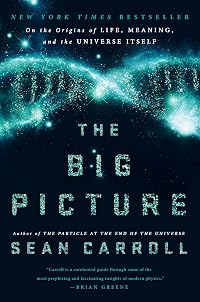
The Big Picture: On the Origins of Life, Meaning, and the Universe Itself
by Sean M. Carroll
On This Page
Description
"The award-winning Caltech physicist and author of The Particle at the End of the Universe shares sweeping perspectives into how human purpose and meaning naturally fit into a scientific worldview,"--Amazon.com. "Sean Carroll is emerging as one of the greatest humanist thinkers of his generation as he brings his extraordinary intellect to bear not only on Higgs bosons and extra dimensions but now also on our deepest personal questions. Where are we? Who are we? Are our emotions, our beliefs, show more and our hopes and dreams ultimately meaningless out there in the void? Does human purpose and meaning fit into a scientific worldview. In short chapters filled with intriguing historical anecdotes, personal asides, and rigorous exposition, readers learn the difference between how the world works at the quantum level, the cosmic level, and the human level–and then how each connects to the other. Carroll's presentation of the principles that have guided the scientific revolution from Darwin and Einstein to the origins of life, consciousness, and the universe is dazzlingly unique. Carroll shows how an avalanche of discoveries in the past few hundred years has changed our world and what really matters to us. Our lives are dwarfed like never before by the immensity of space and time, but they are redeemed by our capacity to comprehend it and give it meaning."--Dust jacket. show lessTags
Recommendations


Member Reviews
TLDR (especially because I have more in the comments): read the book if you're interested. It's worth the work, imo.
p. 44. Loving how Carroll doesn't talk down to the reader. I really appreciate that I'm seeing all sorts of concepts that are 'familiar' to me and realizing that I didn't fully understand them. Carroll is adding just enough information to link them together, to, indeed, help me see bigger and bigger pictures. I even understand what the word 'ontology' means now. And I realize that Laplace's work is totally underappreciated. And I feel assured that I *can* still read real books, that I've not gotten too senile or soft for them, that other 'hard' books were just not as well-written as this.
At least so far. ;)
---
p. 152. Got show more sidetracked, which did throw me off a bit. But I still feel like I understand the science, and that I'm ready for him to actually start with the expanded arguments towards the points he'll eventually make.
But since I did read other things in between, I am glad that I marked passages with bookdarts. Seems like a good time to record the ones I've got so far:
"We still, with good reason, talk about causes in everyday speech, but they're no longer part of our best fundamental ontology."
"When we think about cause and effect, by contrast, we single out certain events as uniquely responsible for events that come afterward, as 'making them happen.' That's not quite how the laws of physics work; events simply are arranged in a certain order with no special responsibility attributed to one over any of the others.... no one moment pauses any other."
"... the Big Bang doesn't actually mark the beginning of our universe; it marks the end of our theoretical understanding."
An important phase transition in the history of the cosmos is "Electrons combining with atomic nuclei to make atoms, several hundred thousand years after The Big Bang."
"... Black holes will evaporate... our most likely scenario for the future of our universe is nothing but cold, empty space, which will last literally forever."
And there are other bits I just want to remember &/or share:
"... cancer survivor Emily McDowell sells empathy cards reading 'Please let me be the first to punch the next person who tells you everything happens for a reason.'"
"Curiosity is a virtue."
---
p.222
"We still use Newtonian mechanics where it works. We teach it to our students, and we use it to send spaceships to the moon. It's "correct," as long as we understand the domain in which it's applicable."
"The strength of effective field theory is what allows us to assert 'this time is different' when we make our audacious claim that the laws of physics underlying everyday life are completely known.... There are a million ways to interpret 'the laws of physics underlying everyday life are completely known.' While it's an undeniably bold claim, it would be easy to mistake it for something even more grandiose than it actually is, and then dismiss that exaggerated claim. It certainly does not imply that we know all of physics." show less
p. 44. Loving how Carroll doesn't talk down to the reader. I really appreciate that I'm seeing all sorts of concepts that are 'familiar' to me and realizing that I didn't fully understand them. Carroll is adding just enough information to link them together, to, indeed, help me see bigger and bigger pictures. I even understand what the word 'ontology' means now. And I realize that Laplace's work is totally underappreciated. And I feel assured that I *can* still read real books, that I've not gotten too senile or soft for them, that other 'hard' books were just not as well-written as this.
At least so far. ;)
---
p. 152. Got show more sidetracked, which did throw me off a bit. But I still feel like I understand the science, and that I'm ready for him to actually start with the expanded arguments towards the points he'll eventually make.
But since I did read other things in between, I am glad that I marked passages with bookdarts. Seems like a good time to record the ones I've got so far:
"We still, with good reason, talk about causes in everyday speech, but they're no longer part of our best fundamental ontology."
"When we think about cause and effect, by contrast, we single out certain events as uniquely responsible for events that come afterward, as 'making them happen.' That's not quite how the laws of physics work; events simply are arranged in a certain order with no special responsibility attributed to one over any of the others.... no one moment pauses any other."
"... the Big Bang doesn't actually mark the beginning of our universe; it marks the end of our theoretical understanding."
An important phase transition in the history of the cosmos is "Electrons combining with atomic nuclei to make atoms, several hundred thousand years after The Big Bang."
"... Black holes will evaporate... our most likely scenario for the future of our universe is nothing but cold, empty space, which will last literally forever."
And there are other bits I just want to remember &/or share:
"... cancer survivor Emily McDowell sells empathy cards reading 'Please let me be the first to punch the next person who tells you everything happens for a reason.'"
"Curiosity is a virtue."
---
p.222
"We still use Newtonian mechanics where it works. We teach it to our students, and we use it to send spaceships to the moon. It's "correct," as long as we understand the domain in which it's applicable."
"The strength of effective field theory is what allows us to assert 'this time is different' when we make our audacious claim that the laws of physics underlying everyday life are completely known.... There are a million ways to interpret 'the laws of physics underlying everyday life are completely known.' While it's an undeniably bold claim, it would be easy to mistake it for something even more grandiose than it actually is, and then dismiss that exaggerated claim. It certainly does not imply that we know all of physics." show less
To say this is an ambitious book is an understatement. Just read the subtitle: On the Origins of Life, Meaning and the Universe Itself. The author, Sean Carroll, is a professor of physics at Cal Tech, which alone entitles him to a certain amount of hubris. Moreover, I learned in a YouTube video that he inherited Richard Feynman’s desk (the physical thing) if not his chair (the position within the Cal Tech hierarchy).
Carroll begins by acquainting the reader with what he calls the “Core Theory,” (a term coined by Frank Wilczek) which refers to our present understanding of the basic laws of physics. He asserts that the physics of everyday life are completely known, even if we lack complete knowledge about all of physics. He contends show more that while we may continue to develop deeper understanding or more accurate and precise theories, the current conception of the Core Theory will still be essentially valid a thousand years from now because it works. (That is to say, for example, we can send people into outer space with absolute confidence based on its premises.)
Carroll analyzes in detail the process by which scientists form beliefs about the world. Essentially, we engage in the process described by Bayes’ theorem. (In probability theory, Bayes' theorem describes predicting the probability of an event based on prior knowledge of conditions that might be related to the event.) New information can, however, alter and affect our existing “credences,” or beliefs about what must be true.
As Carroll explains, Leibnitz and Spinoza formulated the “principle of sufficient reason,” the surprisingly controversial theory that there must be a reason why things are the way they are rather than some other way. Carroll points out that man seeks to understand the world in terms of reasons or causes - i.e., "existing credences." David Hume, with whom Carroll agrees, argued that the principle of sufficient reason is an empirical observation, not a law of logic. Hence, there may be things or phenomena that simply do not have explanations. They are brute facts — they just are! To Carroll, the existence of the universe itself, and the fact that it was once in a very low entropy state are just such brute facts. [The physicist Richard Feynman, on the other hand, asserted that everything that appeared mystical was simply an insufficiently explained mystery with a physical answer not yet found.]
Although he is a physicist by training, Carroll has mastered a great deal of evolutionary biology, microbiology, and information theory. He provides a cogent explication of the origin of life and subsequent evolution (with a little help from Charles Darwin) that obviates a theological explanation.
Carroll takes issue with the principle of "intelligent design" to justify unexplained complexity. As Carroll argues, one could make a powerful rebuttal to the intelligent design argument based on an important biological process underlying how our universe works, i.e., that of emergence. “Emergence” refers to the self-organization of complex systems.
Life itself is a classic example of an emergent phenomenon. Scientists have found, for example, that polymers (many molecules all strung together to form really long chains) can and do catalyze the formation of other polymers and a diverse number of reactions by themselves. Something new emerges and starts to form a pattern, and if it has a survival advantage, it will continue to happen. Thus, the whole turns into something different than the parts, and its properties can only be understood at the macro level. Think about trying to predict an avalanche that is made up of only snow or sand. How would you know which single grain of either would be the one to set off the avalanche when they are all the same? Emergence indeed seems “miraculous” but it is predictable, and can be replicated in a laboratory. But there is no reason philosophers would necessarily have knowledge of the process of the autocatalysis that characterizes emergence.
Carroll uses the concept of emergence to discuss free will. In a sense, one’s actions and desires may be “determined” at the atomic level, but an explanation of behavior based on atomic phenomena would simply be too complicated and incomprehensible to attempt. Instead, descriptions of acts and desires on a macro level are useful and comprehensible.
While Carroll is an avowed atheist, he is not as polemical as Richard Dawkins, Sam Harris, or Christopher Hitchens. He is an excellent, hard-headed scientist, but he gets a little touchy-feely when he wanders into philosophy. He espouses a philosophy he calls “poetic naturalism.” Here is how he explains this concept:
"By that I mean to emphasize that, while there is only one world, there are many ways of talking about the world. 'Ways of talking' shouldn’t be underestimated; they can otherwise be labeled 'theories' or 'models' or 'vocabularies' or 'stories,' and if a particular way of talking turns out to be sufficiently accurate and useful, the elements in its corresponding vocabulary deserve to be called real.
The poet Muriel Rukeyser once wrote, 'The universe is made of stories, not atoms.' That is absolutely correct. There is more to the world than what happens; there are the ways we make sense of it by telling its story. The vocabulary we use is not handed to us from outside; it’s ultimately a matter of our choice."
Many other scientists would take issue with Carroll on this. There are too many people who think that anecdotal incidents and opinions should hold the same weight as scientifically derived evidence, to the detriment of our political choices, and ultimately the fate of our planet.
Evaluation: With the few exceptions, and some limitations described below on listening to this as opposed to reading it in hard copy, this is for the most part an excellent book, clearly written with a surprising sense of humor, considering the topic.
A Few Notes on the Audio Production:
I listened to an audio version of the book read by the author. I have watched his lectures on YouTube, where he is an excellent speaker and presenter. However, for this audiobook, he reads in “upspeak.” It is as if every assertion is a question. In addition, in an obvious effort to avoid sexism, whenever he refers to an unidentified individual of an unidentified gender he calls him or her “they” or “them.” That locution has become pretty commonplace, but I find it annoying.
Another shortcoming in listening to the book is that in the epilogue, Carroll states that the Core Theory can be encapsulated in Richard Feynman’s path integral formulation of quantum mechanics. That would be okay, except that that formula is quite complex and simply does not lend itself to being read aloud. One would have to look at it to digest it, but Carroll just reads it.
(JAB) show less
Carroll begins by acquainting the reader with what he calls the “Core Theory,” (a term coined by Frank Wilczek) which refers to our present understanding of the basic laws of physics. He asserts that the physics of everyday life are completely known, even if we lack complete knowledge about all of physics. He contends show more that while we may continue to develop deeper understanding or more accurate and precise theories, the current conception of the Core Theory will still be essentially valid a thousand years from now because it works. (That is to say, for example, we can send people into outer space with absolute confidence based on its premises.)
Carroll analyzes in detail the process by which scientists form beliefs about the world. Essentially, we engage in the process described by Bayes’ theorem. (In probability theory, Bayes' theorem describes predicting the probability of an event based on prior knowledge of conditions that might be related to the event.) New information can, however, alter and affect our existing “credences,” or beliefs about what must be true.
As Carroll explains, Leibnitz and Spinoza formulated the “principle of sufficient reason,” the surprisingly controversial theory that there must be a reason why things are the way they are rather than some other way. Carroll points out that man seeks to understand the world in terms of reasons or causes - i.e., "existing credences." David Hume, with whom Carroll agrees, argued that the principle of sufficient reason is an empirical observation, not a law of logic. Hence, there may be things or phenomena that simply do not have explanations. They are brute facts — they just are! To Carroll, the existence of the universe itself, and the fact that it was once in a very low entropy state are just such brute facts. [The physicist Richard Feynman, on the other hand, asserted that everything that appeared mystical was simply an insufficiently explained mystery with a physical answer not yet found.]
Although he is a physicist by training, Carroll has mastered a great deal of evolutionary biology, microbiology, and information theory. He provides a cogent explication of the origin of life and subsequent evolution (with a little help from Charles Darwin) that obviates a theological explanation.
Carroll takes issue with the principle of "intelligent design" to justify unexplained complexity. As Carroll argues, one could make a powerful rebuttal to the intelligent design argument based on an important biological process underlying how our universe works, i.e., that of emergence. “Emergence” refers to the self-organization of complex systems.
Life itself is a classic example of an emergent phenomenon. Scientists have found, for example, that polymers (many molecules all strung together to form really long chains) can and do catalyze the formation of other polymers and a diverse number of reactions by themselves. Something new emerges and starts to form a pattern, and if it has a survival advantage, it will continue to happen. Thus, the whole turns into something different than the parts, and its properties can only be understood at the macro level. Think about trying to predict an avalanche that is made up of only snow or sand. How would you know which single grain of either would be the one to set off the avalanche when they are all the same? Emergence indeed seems “miraculous” but it is predictable, and can be replicated in a laboratory. But there is no reason philosophers would necessarily have knowledge of the process of the autocatalysis that characterizes emergence.
Carroll uses the concept of emergence to discuss free will. In a sense, one’s actions and desires may be “determined” at the atomic level, but an explanation of behavior based on atomic phenomena would simply be too complicated and incomprehensible to attempt. Instead, descriptions of acts and desires on a macro level are useful and comprehensible.
While Carroll is an avowed atheist, he is not as polemical as Richard Dawkins, Sam Harris, or Christopher Hitchens. He is an excellent, hard-headed scientist, but he gets a little touchy-feely when he wanders into philosophy. He espouses a philosophy he calls “poetic naturalism.” Here is how he explains this concept:
"By that I mean to emphasize that, while there is only one world, there are many ways of talking about the world. 'Ways of talking' shouldn’t be underestimated; they can otherwise be labeled 'theories' or 'models' or 'vocabularies' or 'stories,' and if a particular way of talking turns out to be sufficiently accurate and useful, the elements in its corresponding vocabulary deserve to be called real.
The poet Muriel Rukeyser once wrote, 'The universe is made of stories, not atoms.' That is absolutely correct. There is more to the world than what happens; there are the ways we make sense of it by telling its story. The vocabulary we use is not handed to us from outside; it’s ultimately a matter of our choice."
Many other scientists would take issue with Carroll on this. There are too many people who think that anecdotal incidents and opinions should hold the same weight as scientifically derived evidence, to the detriment of our political choices, and ultimately the fate of our planet.
Evaluation: With the few exceptions, and some limitations described below on listening to this as opposed to reading it in hard copy, this is for the most part an excellent book, clearly written with a surprising sense of humor, considering the topic.
A Few Notes on the Audio Production:
I listened to an audio version of the book read by the author. I have watched his lectures on YouTube, where he is an excellent speaker and presenter. However, for this audiobook, he reads in “upspeak.” It is as if every assertion is a question. In addition, in an obvious effort to avoid sexism, whenever he refers to an unidentified individual of an unidentified gender he calls him or her “they” or “them.” That locution has become pretty commonplace, but I find it annoying.
Another shortcoming in listening to the book is that in the epilogue, Carroll states that the Core Theory can be encapsulated in Richard Feynman’s path integral formulation of quantum mechanics. That would be okay, except that that formula is quite complex and simply does not lend itself to being read aloud. One would have to look at it to digest it, but Carroll just reads it.
(JAB) show less
This is an ambitious book, covering a whole bunch of deep and controversial topics, to build up a world view the author calls "poetic naturalism." Basically, it's a physicist applying what we know about the universe (cosmology, quantum field theory, the laws of thermodynamics, etc.) to the human condition and a host of philosophical dilemmas.
The book starts out with an excellent introduction to ontology - the philosophy of knowledge, i.e. what do we know and how do we know what we know. It tackles relevant ideas and clears up lots of confusion, such as the difference between faith and belief, between skepticism and pragmatism, between determinism and free will.
Along the way we are presented with the basics of the Philosophy of Mind, show more of causality, the philosophy of science, and examples ranging from Bayes and Descartes to Bill & Ted and the Trolly Problem. Difficult concepts are explained clearly and succinctly, and tied back to the main premise of the book to keep things relevant.
Since to cover any of the ideas raised in sufficient detail would have meant a 3,800 page tome, this book is best viewed as a "brief" introduction to the topics discussed (if a 500 page volume can be described as "brief"). This can be frustrating, as he tends to move on to the next topic just as things are getting interesting, but is also good because if there is a less interesting chapter, we know that a new subject is waiting just around the corner.
This is a great introductory text that raises a bunch of interesting questions, and even if the reader doesn't agree with all of the answers, it presents a compelling worldview for our times, firmly grounded in our scientific understanding of the universe, optimistic in its outlook but realistic on its limitations. show less
The book starts out with an excellent introduction to ontology - the philosophy of knowledge, i.e. what do we know and how do we know what we know. It tackles relevant ideas and clears up lots of confusion, such as the difference between faith and belief, between skepticism and pragmatism, between determinism and free will.
Along the way we are presented with the basics of the Philosophy of Mind, show more of causality, the philosophy of science, and examples ranging from Bayes and Descartes to Bill & Ted and the Trolly Problem. Difficult concepts are explained clearly and succinctly, and tied back to the main premise of the book to keep things relevant.
Since to cover any of the ideas raised in sufficient detail would have meant a 3,800 page tome, this book is best viewed as a "brief" introduction to the topics discussed (if a 500 page volume can be described as "brief"). This can be frustrating, as he tends to move on to the next topic just as things are getting interesting, but is also good because if there is a less interesting chapter, we know that a new subject is waiting just around the corner.
This is a great introductory text that raises a bunch of interesting questions, and even if the reader doesn't agree with all of the answers, it presents a compelling worldview for our times, firmly grounded in our scientific understanding of the universe, optimistic in its outlook but realistic on its limitations. show less
A masterpiece. ranges from the nature of the universe, large scale and small, to the place of life and human values within it. He's a physicist so he knows what he's talking about. the approach is in line with scientific method, with frequent reference to Bayesian techniques. Manages to do all that while remaining readable, witty and personal.
This is one of those books that will not only teach you things about how the world works, but also sticks with you for days and weeks as you realize it has subtly shifted the way you think about everything. In short, a well written general survey of what we know about how the world works. Carroll does a very good job of describing in understandable terms areas of physics and biology and scientific thinking in general. One example is that he managed to get me to finally understand Bayesian reasoning even though I have read specific books on the topic.
But perhaps the most affecting part of this book is Carroll's description and thoughts on poetic naturalism and how it helps us to understand and describe the world around us appropriately. show more That's the part that has stuck with me as I looked back out on the world and saw how there were different and appropriate "levels" for different types of speech. And it's one of the reasons I have recommended this book to so many of my friends during and after reading it. show less
But perhaps the most affecting part of this book is Carroll's description and thoughts on poetic naturalism and how it helps us to understand and describe the world around us appropriately. show more That's the part that has stuck with me as I looked back out on the world and saw how there were different and appropriate "levels" for different types of speech. And it's one of the reasons I have recommended this book to so many of my friends during and after reading it. show less
Wonderful book, mostly pretty easy to read, tying together concepts about particle physics, cosmology, the origin of life, all sorts of stuff - along with a naturalistic philosophy to show how it all might relate to meaning in human life. I thought the science part was stronger than the philosophy part - I agreed with the philosophy stuff, it just didn't seem all that exciting. But I like the guy's attitude - sympathetic and respectful towards those he doesn't agree with.
The Big Picture by Sean Carroll is a very accessible addition to the category of science books for the general public. As is usually the case this incorporates contextualizing the science within the more philosophical parameters of daily life. We may not think of our lives as philosophically driven but our actions and ideas are indeed so in the broadest sense. Carroll uses the concept of “poetic naturalism” to bring the discussion from the hows of science to the whys of the humanities.
I found his discussions quite enjoyable and his arguments well grounded both scientifically (of course) and philosophically. That isn’t to say I agreed with every use of every term but he did not grossly misuse any terms to make a concept fit his show more paradigm. This is often where books at the boundaries between disciplines begin to falter; that does not occur here.
I would recommend this to anyone who generally likes these books as well as anyone looking for a substantive discussion of naturalism using the latest science as part of the case-building. An enjoyable read with very few instances which should require extensive background.
Reviewed from a copy made available through Goodreads First Reads. show less
I found his discussions quite enjoyable and his arguments well grounded both scientifically (of course) and philosophically. That isn’t to say I agreed with every use of every term but he did not grossly misuse any terms to make a concept fit his show more paradigm. This is often where books at the boundaries between disciplines begin to falter; that does not occur here.
I would recommend this to anyone who generally likes these books as well as anyone looking for a substantive discussion of naturalism using the latest science as part of the case-building. An enjoyable read with very few instances which should require extensive background.
Reviewed from a copy made available through Goodreads First Reads. show less
Members
- Recently Added By
Lists

Wisdom
31 works; 5 members

Books Read in 2017
4,249 works; 130 members

The Joe Rogan Experience Library
254 works; 3 members

Isaac Arthur’s Book Recommendations
98 works; 3 members

Books Read in 2021
5,361 works; 114 members

How it can be.
14 works; 2 members

Really awesome
10 works; 1 member

Free Will
6 works; 1 member

Books Read in 2024
4,623 works; 126 members
Author Information

24+ Works 4,549 Members
Awards and Honors
Awards
Distinctions
Work Relationships
Common Knowledge
- Canonical title
- The Big Picture: On the Origins of Life, Meaning, and the Universe Itself
- Quotations
- A person is a diminutive, ephemeral thing, standing smaller in comparison with the universe than a single atom stands in comparison with the Earth. Can any one individual existence really matter?
Life is a process, not a substance, and it is necessarily temporary. We are not the reason for the existence of the universe, but our ability for self-awareness and reflection makes us special within it.
As we understand the world better, the idea that it has a transcendent purpose seems increasingly untenable.
The truth is that the ground has disappeared beneath us, and we are just beginning to work up the courage to look down.
The difference between a living being and an inanimate object seems much more profound than the way certain molecules are arranged.
To say that consciousness is real isn't to say that it's something over and above the physical world; it's emergent, and it's also real, just like almost every other thing we've encountered in our lives. (show all 8)
the trash heap of history is populated by scientists claiming to know more than they really do, or predicting that they will know almost everything any day now.
If it's not easy to see how consciousness can be smoothly incorporated as part of physical reality, it's even harder to imagine how it could be anything else.
Classifications
Statistics
- Members
- 1,139
- Popularity
- 22,140
- Reviews
- 22
- Rating
- (4.08)
- Languages
- 6 — English, French, Italian, Polish, Spanish, Turkish
- Media
- Paper, Audiobook, Ebook
- ISBNs
- 14
- ASINs
- 4