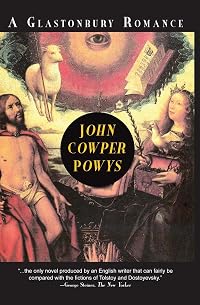
A Glastonbury Romance
by John Cowper Powys
On This Page
Description
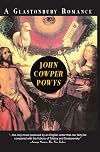
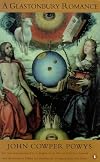
"A Glastonbury Romance," first published in 1932, is Powys masterwork, an epic novel of terrific cumulative force and lyrical intensity. In it he probes the mystical and spiritual ethos of the small English village of Glastonbury, and the effect upon its inhabitants of a mythical tradition from the remotest past of human history - the legend of the Grail. Powys's rich iconography interweaves the ancient with the modern, the historical with the legendary, and the imaginative within man with show more the natural world outside him to create a book of astonishing scope and beauty. show lessTags
Recommendations




















Member Recommendations

Member Reviews
Hello David Lynch? Or David Milch? Are you listening? John Cowper Powys's A Glastonbury Romance is a novel that calls for transfiguration into a television drama series. But only at the hands of a writer/director who has a certain witchy twitchy je ne sais quoi. Glastonbury Tor! A Druid isle of the dead? The final resting place of Joseph of Arimathea and the Holy Grail? A Camelot waiting for Arthur's return? Just think, if Lynch transformed the rainsodden gloomfilled backwoods of the Pacific Northwest into a mystico-wonderland of Black Lodges and log ladies, then what could he do with this rich historical nexus?
Powys's novel, like Middlemarch, is an intricate detailed portrait of British village. The story concerns a clash of political, show more economic and spiritual interests in a quirky struggle for power. A capitalist, a trio of commune organizers, and an evangelist preacher hold very opposing and ambitious visions for Glastonbury's future. Should the village become a model of economic development (i.e. mining and factories), a paragon of communalism on the order of Robert Owen's New Harmony, or a tourist attraction with deeply spiritual overtones like Lourdes? On a personal level, the players and their paramours and families are every bit as eccentric and lusty as any of the denizens of Twin Peaks. Romantic interests overlap and are entangled in myriad ways that flirt with lesbianism, incest, and sadism. Everyone knows everyone's business and yet all are just a bit cloaked in shadow at the same time.
The main problem for a reader of the novel (as opposed to a viewer of the cinematic work I envision) is Powys prolix attempt to capture a pagan mystic sensibility and establish it as a mood and background element. Call it his paen to "the First Cause". In cinema this type of work can be done convincingly with lighting, camera angles, and music. With prose, the job is infinitely more difficult. Consider the opening sentence of this 1100 page tome:
"At the striking of noon on a certain fifth of March, there occurred within a causal radius of Brandon railway station and yet beyond the deepest pools of emptiness between the uttermost stellar systems one of those infinitesimal ripples in the creative silence of the First Cause which always occur when an exceptional stir of heightened consciousness agitates any living organism in this astronomical universe."
This import is something David Lynch could convey with red drapes, a dwarf, and the Beatles played backwards. With Powys, you sometimes long, upon third reading of a sentence, for a simple "Once upon a time". However, with a few hundred pages, that difficulty passes. In fact, when I finished the book, I felt ready to read it again. After three mere weeks, I was comfortable with its rhythms and nuances.
Oh - one final note to David Lynch about that movie version, I'm pretty sure that many of the male roles could be played, in Peter Sellers fashion, by Steve Buscemi, the exception being Mr. Geard who could only be played by Joachim Phoenix. Oh - and Natalie Portman must play either Crummie or Nell. And Laura Dern, as always, will be fine. show less
Powys's novel, like Middlemarch, is an intricate detailed portrait of British village. The story concerns a clash of political, show more economic and spiritual interests in a quirky struggle for power. A capitalist, a trio of commune organizers, and an evangelist preacher hold very opposing and ambitious visions for Glastonbury's future. Should the village become a model of economic development (i.e. mining and factories), a paragon of communalism on the order of Robert Owen's New Harmony, or a tourist attraction with deeply spiritual overtones like Lourdes? On a personal level, the players and their paramours and families are every bit as eccentric and lusty as any of the denizens of Twin Peaks. Romantic interests overlap and are entangled in myriad ways that flirt with lesbianism, incest, and sadism. Everyone knows everyone's business and yet all are just a bit cloaked in shadow at the same time.
The main problem for a reader of the novel (as opposed to a viewer of the cinematic work I envision) is Powys prolix attempt to capture a pagan mystic sensibility and establish it as a mood and background element. Call it his paen to "the First Cause". In cinema this type of work can be done convincingly with lighting, camera angles, and music. With prose, the job is infinitely more difficult. Consider the opening sentence of this 1100 page tome:
"At the striking of noon on a certain fifth of March, there occurred within a causal radius of Brandon railway station and yet beyond the deepest pools of emptiness between the uttermost stellar systems one of those infinitesimal ripples in the creative silence of the First Cause which always occur when an exceptional stir of heightened consciousness agitates any living organism in this astronomical universe."
This import is something David Lynch could convey with red drapes, a dwarf, and the Beatles played backwards. With Powys, you sometimes long, upon third reading of a sentence, for a simple "Once upon a time". However, with a few hundred pages, that difficulty passes. In fact, when I finished the book, I felt ready to read it again. After three mere weeks, I was comfortable with its rhythms and nuances.
Oh - one final note to David Lynch about that movie version, I'm pretty sure that many of the male roles could be played, in Peter Sellers fashion, by Steve Buscemi, the exception being Mr. Geard who could only be played by Joachim Phoenix. Oh - and Natalie Portman must play either Crummie or Nell. And Laura Dern, as always, will be fine. show less
(I'll put this up here until a better review comes along; I hope for one to appear shortly!)
So. A Glastonbury Romance is about life, I think. The cosmos is alive from the First Cause through the sun and moon and down to the earth and its denizens. Even the mud and rocks get their proper due, and worms and fish and lice and other creepy crawlies get more than their due sometimes. People may or may not realize their place in the great cosmic chain. The ones who do in this book are fortunate to live in Glastonbury, which is a hub for cosmic influence. So we meet the Crow family, very powerful in many ways and mostly unaware of the life around them. And we meet the saints who are in touch with the Other or some Other - John Geard, show more newly-elected mayor of Glastonbury with his family, Mat Dekker (the Anglican priest and arch-enemy of the sun) and his son Sam who becomes "Holy" Sam, and Owen Evans, a wild Welshman. Sexual activity abounds (but there's no graphic sex) and women have their place although none of them gets to be a mystic. In fact, it seems that we meet most of the residents of Glastonbury in one way or another as the book drives toward an epiphany. It's wild; it's funny; it's beautiful; it's exasperating; it's powerful and profound; it's a lot like life. show less
So. A Glastonbury Romance is about life, I think. The cosmos is alive from the First Cause through the sun and moon and down to the earth and its denizens. Even the mud and rocks get their proper due, and worms and fish and lice and other creepy crawlies get more than their due sometimes. People may or may not realize their place in the great cosmic chain. The ones who do in this book are fortunate to live in Glastonbury, which is a hub for cosmic influence. So we meet the Crow family, very powerful in many ways and mostly unaware of the life around them. And we meet the saints who are in touch with the Other or some Other - John Geard, show more newly-elected mayor of Glastonbury with his family, Mat Dekker (the Anglican priest and arch-enemy of the sun) and his son Sam who becomes "Holy" Sam, and Owen Evans, a wild Welshman. Sexual activity abounds (but there's no graphic sex) and women have their place although none of them gets to be a mystic. In fact, it seems that we meet most of the residents of Glastonbury in one way or another as the book drives toward an epiphany. It's wild; it's funny; it's beautiful; it's exasperating; it's powerful and profound; it's a lot like life. show less
Good to great writing, but what a lot of it. A huge cast of characters with numerous plot lines that dont often lead anywhere, and a lot of New Age mumbo-jumbo that has some resonance in truth but mostly adds heft to the book.
I finally gave up on this book after 3 attempts, about 10 years apart -- sure some of the descriptions are beautiful, even memorable, but Powys at times uses 10 adjectives when he could use 2, and the story plods EVER so slowly...I just couldn't drag any farther through it than about 250 pages.
A very odd novel, combining politics, mysticism, an individual philosophy on the sexes.
I read 500 pages and gave up because I did not like the characters.
An epic, well regarded sorta-fantasy wandering modern novel from 1932. Yes please.
Members
- Recently Added By
Lists

The Guardian's 1000 Novels Everyone Must Read
1,005 works; 551 members

Modern Arthurian Fiction
237 works; 16 members

Harold Bloom - The Western Canon: D. The Chaotic Age
833 works; 24 members

Jones & Newman: Best Horror Books Further Recommended Reading
577 works; 4 members

Mustich's 1000 Books to Read Before You Die: A Life Changing List
1,001 works; 20 members
Talk Discussions
Past Discussions
Group read: A Glastonbury Romance in 75 Books Challenge for 2011 (March 2011)
Author Information

111+ Works 3,658 Members
British novelist, poet and philosopher John Cowper Powys was born in Shirley, Derbyshire on October 8, 1872. He was a lecturer for more than three decades, traveling across America but eventually returned to Great Britain. He has written regional romances, historical fiction and critical studies including A Glastonbury Romance and Wolf Solent. He show more died on June 17, 1963. (Bowker Author Biography) show less
Awards and Honors
Work Relationships
Common Knowledge
- Original publication date
- 1932
- People/Characters
- John Crow; Philip Crow; Mary Crow; Elizabeth Crow; Canon William Crow (deceased); Tilly Crow (show all 47); Persephone Spear; Dave Spear; Euphemia Drew; Tom Barter; Mat Dekker; Sam Dekker; Penny Pitches; Owen Evans; Isaac Weatherwax; Nell Zoyland; Will Zoyland; John Geard; Megan Heard; Cordelia Geard; Crummie Geard; Red Robinson; Mrs. Robinson; Sally Jones; Jackie Jones; Nelly Morgan; Sis Coles; Bert Coles; Abel Twig (Number One); Louie Rogers; Lily Rogers; Emma Sly; Tossie Stickles; Timothy Wallop; Nancy Robinson; Tittie Petherton; Tom Chinnock; Edward Atheling; Pet Othery; Bet Chinnock (Mad Bet); Bartholomew Jones (Number Two); Young Tewsey; Mother Legge; Henry Zoyland, 10th Marquis of P.; Rachel Zoyland; John Bellamy; Sergeant Blimp
- Important places
- Glastonbury, Somerset, England, UK; England, UK; Somerset, England, UK; Wookey Hole, Somerset, England, UK; Brandon, Norfolk, England, UK; Northwold, Norfolk, England, UK (show all 16); Harrod's Mill, Norwold, Norfolk, England, UK; Abbey House, Glastonbury, Somerset, England, UK; East Anglia, England, UK; Salisbury Plain, Wiltshire, England, UK; Stonehenge, Wiltshire, England, UK; Chalice Well, Glastonbury, Somerset, England, UK; Bove, Glastonbury, Somerset, England, UK; Chalice Hill, Glastonbury, Somerset, England, UK; Taunton, Somerset, England, UK; Mark Moor Court, Somerset, England, UK
- Epigraph
- "Bet y march, bet y guythur.
bet y gugaun cletyfrut.
anoeth bid bet y arthur."
"A grave for Mark, a grave for Gwythur,
A grave for Gwgawn of the ruddy Sword,
Not wise (the thought) a grave for Arthur."
B... (show all)LACK BOOK OF CARMARTHEN
Trans. JOHN RHYS - Dedication
- TO
My youngest sister and oldest god-daughter
LUCY AMELIA PENNY - First words
- At the striking of noon on a certain fifth of March, there occurred within a causal radius of Brandon railway station and yet beyond the deepest pools of emptiness between the uttermost stellar systems one of those infinitesi... (show all)mal ripples in the creative silence of the First Cause which always occur when an exceptional stir of heightened consciousness agitates any living organism in this astronomical universe.
- Quotations
- Ruins! Ruins! It was not only in ancient stone that baffled human hopes held up their broken outlines, their sad skeleton-patterns, as resting places for the birds of the night!
(Chapter: Geard of Glastonbury) - Last words
- (Click to show. Warning: May contain spoilers.)Never or Always.
- Blurbers
- Steiner, George; Miller, Henry; Dillard, Annie; Godwin, Gail
- Original language
- English
Classifications
Statistics
- Members
- 618
- Popularity
- 47,289
- Reviews
- 11
- Rating
- (3.94)
- Languages
- English, French, German
- Media
- Paper, Ebook
- ISBNs
- 14
- ASINs
- 10