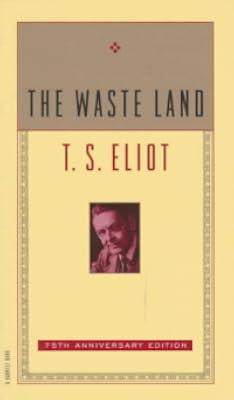
The Waste Land
by T. S. Eliot
There is 1 current discussion about this work.
On This Page
Description
The Waste Land (1922) is a poem by T.S. Eliot. After suffering a nervous breakdown, Eliot took a leave of absence from his job at a London bank to stay with his wife Vivienne at the coastal town of Margate. He worked on the poem during these months before showing an early draft to Ezra Pound, who helped edit the poem toward publication. The Waste Land, dedicated to Pound, includes hundreds of quotations of and allusions to such figures as Homer, Sophocles, Virgil, Ovid, Dante, Saint show more Augustine, Chaucer, Baudelaire, and Whitman, to name only a few. Divided into five sections-"The Burial of the Dead;" "A Game of Chess;" "The Fire Sermon;" "Death by Water;" and "What the Thunder Said"-The Waste Land is a complex poem that translates Eliot's fragile emotional state and increasing dissatisfaction with married life into an apocalyptic vision of postwar England. The poem begins with a meditation on despair before moving to a polyphonic narration by figures on the theme. The third section focuses on death and denial through the lens of eastern and western religions, using Saint Augustine as a prominent figure. Eliot then moves from a brief lyric poem to an apocalyptic conclusion, declaring: "He who was living is now dead / We who were living are now dying / With a little patience." Both personal and universal, global in scope and intensely insular, The Waste Land changed the course of literary history, inspiring countless poets and establishing Eliot's reputation as one of the foremost artists of his generation. With a beautifully designed cover and professionally typeset manuscript, this edition of T.S. Eliot's The Waste Land is a classic of English literature reimagined for modern readers. show lessTags
Recommendations








Member Recommendations
Member Reviews
The Waste Land is a poem to be studied rather than read, analysed rather than enjoyed, and this fact will already put it firmly into the debit column for many readers. T. S. Eliot apparently had a theory that 'poetry can communicate before it is understood', and certainly you get this from The Waste Land: the sense of foreboding and cataclysm, and of disharmony and then harmony, synergy, comes through to you even if you do not have a clue what is going on. Eliot chooses his words well and there is a wealth of allusion hinting at an unspoken metaphysical layer. There is a Pandora's box of dark potential in Eliot's piece, like an atom that could be split with explosive power, and while you might well prefer Stephen King or Marian Keyes show more (and more power to you), I for one am glad that there are complex artistic contraptions like The Waste Land in the world. show less
As is true for most readers, when I first encountered The Waste Land in the 1960s, I found myself in a very foreign poetic land. I read the annotations and explications. I listened to my professors. I reread and mad innumerable margin notes. I felt the poem's power and despair. But its meaning seemed hard to parse.
Now, decades later, rereading yet again, I know the poem and the poem knows me. We still live in The Waste Land. The loss of all mooring after WWI still remains a debris we drift with. But the poem itself seems very approachable now, its discordant ballet of voices powerful as ever, but its sense much more apparent to me.
You must read and reread this poem. My critical opinion of it had moved over time to it being show more overrated---but now, no. It is a seminal poem of the last century. And its relevance today is profound. show less
Now, decades later, rereading yet again, I know the poem and the poem knows me. We still live in The Waste Land. The loss of all mooring after WWI still remains a debris we drift with. But the poem itself seems very approachable now, its discordant ballet of voices powerful as ever, but its sense much more apparent to me.
You must read and reread this poem. My critical opinion of it had moved over time to it being show more overrated---but now, no. It is a seminal poem of the last century. And its relevance today is profound. show less
I decided I needed to read The Wasteland by T. S. Eliot because well... it's by T. S. Eliot and it's an important poem... Not the best reason for reading a poem, but at least it brought me to it. That said, it felt oddly familiar and completely unfamiliar all at once. I read the words and felt taken away from reality and immersed in reality all at once. Eliot hit on universal truths that will mean different things to different people at different times in their lives. I read it slowly - intentionally slowly - over several night, so I could think about the words and the message. The Wasteland sparked thoughts about the current state of the world in which we live forcing me to wonder just how much things really change yet there were show more moments when I struggled to connect to Eliot's words. show less
Genuine poetry can communicate before it is understood. - T.S Eliot
Less understanding on my part, though some communication on Mr. Eliot's, so by his own
definition, The Waste Land must be genuine poetry. If that sounds less than enthusiastic, it's probably a reflection of my disappointment at not being totally blown away by what is generally reckoned to be one of the greatest poems of the twentieth century. I'm sure the deficit is on my side, and I'll certainly return to this poem as there are undoubtedly depths I've not plumbed.
Four stars, nonetheless, because there's some nice stuff about the cruelty of April, drowned Phoenicians, and overheard gossip about abortions.
Less understanding on my part, though some communication on Mr. Eliot's, so by his own
definition, The Waste Land must be genuine poetry. If that sounds less than enthusiastic, it's probably a reflection of my disappointment at not being totally blown away by what is generally reckoned to be one of the greatest poems of the twentieth century. I'm sure the deficit is on my side, and I'll certainly return to this poem as there are undoubtedly depths I've not plumbed.
Four stars, nonetheless, because there's some nice stuff about the cruelty of April, drowned Phoenicians, and overheard gossip about abortions.
I was impressed with this long poem about the crumbling of civilization, specifically Western Culture. I did need to do some study as there is a lot of references to poems, plays, Shakespeare, Dante, etc.
"April is the cruellest month, breeding Lilacs out of the dead land, mixing Memory and desire, stirring Dull roots with spring rain. Winter kept us warm, covering Earth in forgotten snow, feeding a little life with dried tubers."
"The river's tent is broken: the last fingers of leaf clutch and sink into the wet bank."
Here's a quote to fit Halloween, since I read this in October, "A woman drew her long black hair out tight and fiddled whisper music on those strings And bats with baby faces in the violet light Whistled, and beat their show more wings And crawled head downward down a blackened wall"
And finally, Eliot implores us to Datta. Dayadhvam. Damyata. Give, show compassion, self control. show less
"April is the cruellest month, breeding Lilacs out of the dead land, mixing Memory and desire, stirring Dull roots with spring rain. Winter kept us warm, covering Earth in forgotten snow, feeding a little life with dried tubers."
"The river's tent is broken: the last fingers of leaf clutch and sink into the wet bank."
Here's a quote to fit Halloween, since I read this in October, "A woman drew her long black hair out tight and fiddled whisper music on those strings And bats with baby faces in the violet light Whistled, and beat their show more wings And crawled head downward down a blackened wall"
And finally, Eliot implores us to Datta. Dayadhvam. Damyata. Give, show compassion, self control. show less
non posso dire che la poesia sia il mio pane. Pochi sono gli autori per i quali faccio eccezione. L'ingessato Eliot è uno di questi. Chissà perchè mi piace? Forse perchè agita antichi ricordi di classicismo scolastico? Forse perchè la sua scrittura è più spesso, una prosa poetica? forse perchè mi fa pensare a Gabriele Rossetti, un pittore che amo molto? Chissà.
Certo ha scritto uno dei versi più evocativi che abbia mai letto: "Aprile è il più crudele dei mesi: genera lillà dalla terra morta, mescola ricordo e desiderio..."
Certo ha scritto uno dei versi più evocativi che abbia mai letto: "Aprile è il più crudele dei mesi: genera lillà dalla terra morta, mescola ricordo e desiderio..."
Poem by T S Eliot.
I don't quite know what to make of this. Every so often I thought I had some idea of what it's about but then I'd lose track again. I've tried reading it with an online commentary, which helped, but also made it seem like hard work and something to study rather than read for pleasure. OTOH, what I did understand I enjoyed
I don't quite know what to make of this. Every so often I thought I had some idea of what it's about but then I'd lose track again. I've tried reading it with an online commentary, which helped, but also made it seem like hard work and something to study rather than read for pleasure. OTOH, what I did understand I enjoyed
Members
- Recently Added By
Published Reviews
ThingScore 58
I will take a brief look at Consider Phlebas and then at The Waste Land, followed by examples of how the latter informs the former.
added by elenchus
Eliot was to tell the Paris Review that in the composition of the closing sections "I wasn't even bothering whether I understood what I was saying." There seems no reason at all why we should not take him at his word. Defensive modesty of this variety can often be worth noting; what critic has ever succeeded in getting any sense or any beauty out of the final pages? And in what conceivable show more universe—even the batty, sinister one of Ezra Pound, who insisted that the poem open in that manner—is April the cruelest month?
It is not disputable that by publishing The Waste Land when he did, Eliot caught something of the zeitgeist and enthralled those who needed borrowed words and concepts to capture or re-express the desolation of Europe after 1918... It is certainly the most overrated poem in the Anglo-American canon. show less
It is not disputable that by publishing The Waste Land when he did, Eliot caught something of the zeitgeist and enthralled those who needed borrowed words and concepts to capture or re-express the desolation of Europe after 1918... It is certainly the most overrated poem in the Anglo-American canon. show less
added by SnootyBaronet
Look at it as a film scenario, which in many ways it resembles, and you can see that it goes much farther – with its jump cuts and flashes backward and forward and montages and intense economy – than anything by Truffaut or Godard or Fellini or Antonioni....
The twentieth century has seen bigger and more ambitious poems than The Waste Land – such as the Cantos of Pound, the Anathemata of show more David Jones, the Anabase of St-John Perse – but no poem has been a more miraculous mediator between the hermetic and demotic. It is, curiously when one considers the weight of polyglot learning it carries, essentially a popular poem, outgoing rather than ingrown, closer to Shakespeare than to Donne. It was Pound who said that music decays when it moves too far away from the dance, and poetry decays when it neglects to sing. The Waste Land sticks in one’s mind like a diverse recital performed by a voice of immense variety but essentially a single organ: it sings and goes on singing. show less
The twentieth century has seen bigger and more ambitious poems than The Waste Land – such as the Cantos of Pound, the Anathemata of show more David Jones, the Anabase of St-John Perse – but no poem has been a more miraculous mediator between the hermetic and demotic. It is, curiously when one considers the weight of polyglot learning it carries, essentially a popular poem, outgoing rather than ingrown, closer to Shakespeare than to Donne. It was Pound who said that music decays when it moves too far away from the dance, and poetry decays when it neglects to sing. The Waste Land sticks in one’s mind like a diverse recital performed by a voice of immense variety but essentially a single organ: it sings and goes on singing. show less
added by SnootyBaronet
Lists

Bibliography for Among Others
159 works; 15 members

Overdue Podcast
808 works; 9 members

In Our Time books
4,934 works; 2 members

Writers In Public Domain 2026
90 works; 1 member

.
396 works; 1 member

Bookshelf from Interstellar
62 works; 1 member

Recommendations by Peter Kreeft
45 works; 4 members

Books that don't know they belong in a bathroom
41 works; 3 members

David Bowie’s Top 100 Favourite Reads
100 works; 3 members

.
194 works; 2 members

Recommended Reading : 600 Classics Reviewed, Editors of Salem Press, 2015
634 works; 6 members

important
24 works; 1 member

poetry
15 works; 1 member

Books Read In 2009
43 works; 1 member

Books You Read For University
184 works; 3 members

Greatest Books, allegedly
484 works; 9 members

Books Read in 2022
5,226 works; 112 members
Favourite Books
1,820 works; 308 members

Books Read in 2006
424 works; 8 members

Books I Loved
17 works; 1 member
Tonikat reading completed on Librarything journals
329 works; 2 members

Books Read in 2017
4,249 works; 129 members
Favourite Poems
34 works; 1 member
http://thegreatestbooks.org's Greatest Fiction Books
59 works; 1 member

David Bowie's List of Top 100 Books
94 works; 6 members

Poetry Corner
187 works; 15 members

University literature
145 works; 5 members

New York Public Library's Books of the Century - All
170 works; 14 members
New York Public Library's Books of the Century
120 works; 20 members

20th Century Literature
1,161 works; 55 members
David Bowie's Top 100
97 works; 23 members
In and About the 1920s
181 works; 31 members

Take Four Books
130 works; 1 member
Talk Discussions
Current Discussions
Folio Society -- The Waste Land LE -- Review in Fine Press Forum (Sunday 6:43am)
Past Discussions
LE: The Wasteland - T.S. Eliot in Folio Society Devotees (January 2025)
Author Information

507+ Works 48,035 Members
T. S. Eliot is considered by many to be a literary genius and one of the most influential men of letters during the half-century after World War I. He was born on September 26, 1888, in St. Louis, Missouri. Eliot attended Harvard University, with time abroad pursuing graduate studies at the Sorbonne, Marburg, and Oxford. The outbreak of World War show more I prevented his return to the United States, and, persuaded by Ezra Pound to remain in England, he decided to settle there permanently. He published his influential early criticism, much of it written as occasional pieces for literary periodicals. He developed such doctrines as the "dissociation of sensibility" and the "objective correlative" and elaborated his views on wit and on the relation of tradition to the individual talent. Eliot by this time had left his early, derivative verse far behind and had begun to publish avant-garde poetry (including "The Love Song of J. Alfred Prufrock" (1915), which exploited fresh rhythms, abrupt juxtapositions, contemporary subject matter, and witty allusion. This period of creativity also resulted in another collection of verse (including "Gerontian") and culminated in The Waste Land, a masterpiece published in 1922 and produced partly during a period of psychological breakdown while married to his wife, Vivienne Haigh-Wood Eliot. In 1922, Eliot became a director of the Faber & Faber publishing house, and in 1927 he became a British citizen and joined the Church of England. Thereafter, his career underwent a change. With the publication of Ash Wednesday in 1930, his poetry became more overtly Christian. As editor of the influential literary magazine The Criterion, he turned his hand to social as well as literary criticism, with an increasingly conservative orientation. His religious poetry culminated in Four Quartets, published individually from 1936 onward and collectively in 1943. This work is often considered to be his greatest poetic achievement. Eliot also wrote poetry in a much lighter vein, such as Old Possum's Book of Practical Cats (1939), a collection that was used during the early 1980s as the basis for the musical, Cats. In addition to his contributions in poetry and criticism, Eliot is the pivotal verse dramatist of this century. He followed the lead of William Butler Yeats in attempting to revive metrical language in the theater. But, unlike Yeats, Eliot wanted a dramatic verse that would be self-effacing, capable of expressing the most prosaic passages in a play, and an insistent, undetected presence capable of elevating itself at a moment's notice. His progression from the pageant The Rock (1934) and Murder in the Cathedral (1935), written for the Canterbury Festival, through The Family Reunion (1939) and The Cocktail Party (1949), a West End hit, was thus a matter of neutralizing obvious poetic effects and bringing prose passages into the flow of verse. Recent critics have seen Eliot as a divided figure, covertly attracted to the very elements (romanticism, personality, heresy) he overtly condemned. His early attacks on romantic poets, for example, often reveal him as a romantic against the grain. The same divisions carry over into his verse, where violence struggles against restraint, emotion against order, and imagination against ironic detachment. This Eliot is more human and more attractive to contemporary taste. During his lifetime, Eliot received many honors and awards, including the Nobel Prize for literature in 1948. (Bowker Author Biography) show less
Some Editions
Awards and Honors
Distinctions
Notable Lists
Series
Belongs to Publisher Series
Work Relationships
Is contained in
Has the adaptation
Was inspired by
Inspired
Has as a reference guide/companion
Has as a study
Has as a commentary on the text
Has as a student's study guide
Common Knowledge
- Canonical title*
- La Terra desolata - Frammento di un agone - Marcia Trionfale
- Original title
- The Waste Land -Fragment of an Agon - Triumphal March
- Original publication date
- 1922-10
- People/Characters
- Madame Sosostris; Tiresias; Phlebas the Phoenician
- Epigraph*
- Nam Sibyllam quidem Cumis ego ipse oculis meis vidi in ampulla pendere, et cum illi pueri dicerent: Sibilla, ti thelis?; respondebat illa: Apothanin thelo.
- Dedication*
- Per Ezra Pound il miglior fabbro.
- First words
- April is the cruelest month, breeding
Lilacs out of the dead land, mixing
Memory and desire, stirring
Dull roots with spring rain. - Quotations
- What are the roots that clutch, what branches grow
Out of this stony rubbish? Son of man,
You cannot say, or guess, for you know only
A heap of broken images
I will show you fear in a handful of dust
If there were water
And no rock
If there were rock
And also water
And water
A spring
A pool among the rock
If there were the sound of water only
My friend, blood shaking my heart
The awful daring of a moment's surrender
Which an age of prudence can never retract
By this, and this only, we have existed - Last words
- (Click to show. Warning: May contain spoilers.)Shantih shantih shantih
- Original language
- English
- Disambiguation notice
- Contains only The Waste Land and nothing else. Do not combine with collections of Eliot's work, including The Waste Land and Other Poems.
*Some information comes from Common Knowledge in other languages. Click "Edit" for more information.
Classifications
Statistics
- Members
- 1,181
- Popularity
- 21,291
- Reviews
- 25
- Rating
- (4.02)
- Languages
- 15 — Catalan, Czech, Dutch, English, German, Greek, Hungarian, Italian, Japanese, Multiple languages, Norwegian, Polish, Portuguese, Spanish, Swedish
- Media
- Paper, Audiobook, Ebook
- ISBNs
- 80
- ASINs
- 33