On This Page
Description
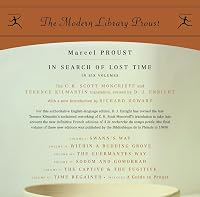
Proust's great work, the major French literary statement of the 20th Century, looks back at the old social order while noting the rise of a different way of life. It is extraordinary not only in its length, but for the remarkable observations on the aspirations, the foibles and emotions of life. Once experienced, 'En busca del tiempo perdido' ('Remembrance of things past') and the voice of Proust are never forgotten.Tags
Recommendations






Member Recommendations


Member Reviews
"Stories somehow lengthen when begun" - Lord Byron, Beppo
And so, after 11 months and 3 weeks, I find myself making the emotionally harrowing descent from Mont Proust. And, boy, has it been worth it. Le Temps retrouvé (Time Regained, also translated as Finding Time Again) is the final volume of the masterful Search, and is a distinct step up from its immediate predecessors, for a few reasons. (My reviews of the previous volumes : Unum Duo Tria Quattuor Quinque Sex )
Published a few years after Proust's death, Time Regained exists in something of a draft form, and this is rampantly evident throughout. The narrative is fragmented; key characters make cameo appearances in what must surely have been pencil sketches for larger farewells; the show more dead return to life with alarming regularity; and some sections betray a sense of repetition that even Gertrude Stein would have hesitated at. Anyone who tells you that they can explain what Proust intended is lying however, like any good paleontologist, we can hope to reconstruct at least some of what lies at the end of Proust's search. (Walking with Proust?) And thank goodness we can.
“My great adventure is really Proust. Well-- what remains to be written after that? - Virginia Woolf
Broadly speaking, Time Regained can be separated into four sections. The first, brief chapter takes place before WWI, and is sometimes included at the end of The Fugitive instead, although I prefer it here, as in my Vintage edition. With Gilberte, the narrator (we'll call him Marcel however, as I've previously established, I don't like that name for him) returns to Combray, marking the beginning of his psychological reassessment of what has gone before. It's remarkable to think that when Proust began the novel, he could not have predicted that there would be a Great War allowing him to destroy Méséglise and to so powerfully capture the downfall of so many of his characters and the society in which they move. What this vignette shows us is the susceptibility of memory, of perspective. Marcel could not have known, all those years ago, what Gilberte truly intended as a child, nor that this valuations of people - such as the seemingly upright Saint-Loup - could be proven so incomplete with the passing of the years. The grand revelation that the two "ways" are connected is a perfect symbol of everything the novel has attempted to say. The novel constantly hints at other lives Marcel may have led: an early, happy marriage to Gilberte? An early death, perhaps? As with homosexuality and Jewishness, those two big, bad questions that academics and readers can't help asking about the narrator/author connection, I wonder how much of a role age and illness played. Proust was famously hands-on when it came to revisions, and there is certainly a level of denial in the narrator's claims that he has "totally forgotten" Albertine, and that he is perfectly happy to retreat from the world. One wonders.
A book is a huge cemetery in which on the majority of the tombs the names are effaced and can no longer be read.
The second of the four is the part that most obviously shows evidence of being a rough draft. The war years are, to a large part, glossed over, with indications that Marcel spent time in a sanatorium. We will, alas, never find out what happened to Mamma and Papa. Yet, the war actually seems a fitting if unintended conclusion to the political drama that has played out in the background of the Search, from the Dreyfus Affair to the naiveté of the aristocracy on Europe's nationalist troubles at the beginning of the 20th century. It also allows for an obvious transition point, a kind of termination shock, after which everyone has changed, and their society has changed with them. ("It is all a question of chronology.")
Various rumours are cleared up as we meet Saint-Loup, Jupien, and Charlus for the last time. The brothel sequence, in which Morel and Jupien take their "inverted" tastes to the logical extreme, is perhaps a bit silly. It feels too calculated to shock, too desperate and contrived (why exactly Marcel needs to rent a private room for a glass of cassis is beyond me) but, nevertheless, it provides a logical endpoint for the discussion of social codes-within-codes that has often dominated the story and, in the tale of Saint-Loup's sad demise (oh, that croix de guerre!) and Morel's ironic rise, he captures all the irony of a Madame Bovary with just a few, brief, moonlit images. If the novel really is like Vinteuil's septet, then this is most certainly the "da capo al fine" section. Thankfully, with the rise and fall of the war, Proust's social eye - arguably his strongest single literary skill - gets to put a little extra sharpness into his pen after quite some time in which we have focused only on the immediate concerns of the protagonist. After all these years, a younger generation are rising up in society, and what good is a war if you can't use it to forget the inconvenient facts about the past? Social status has changed for so many since the teenaged Marcel burst on to the scene, and everyone is doing their best to obfuscate their origins. Perhaps the single funniest line in the whole novel is when Madame Verdurin, continuing her rise from the bourgeoisie (to which she was once so firmly proud), describes someone with great disdain as being hopelessly "pre-war"! And, of course, Francoise continues to be the greatest comic relief character written since Shakespeare's death.
An hour is not merely an hour, it is a vase full of scents and sounds and projects and climates.
Next up is the single most dense section of the entire Search, as Marcel - and, I think we can all agree, Proust - lays out his extensive theory of art and creation. (It's important to note both are equally important; those critics who most savagely deride Proust for filling a novel with platitudes on art rarely seem to notice that this is really a novel about creating it.) Here is the ultimate modernist push Proust made, to create a climax that is, really, entirely passive and internal. The reason this section fascinates (even if, true, it is heavy going) is that these revelations are so important to Marcel, for Marcel. He is realising a rebellion against the so-called "literature of description", and seeking an answer to "the vision... of a person situated in the distorting perspective of Time". With each revelation about previous moments, our narrator is seeking to find whether all of that time has been truly wasted (an equally good translation for the title's "perdu", translated usually as "lost") or whether we can keep it with us, whether we can find time again. And indeed, we can all find it through art. To do so, Marcel needs to "become a mirror" and transcribe the music of all these years. As he says, "oblivion is at work within us". That's not to say that creating art is a vanity project - it may well be for La Berma, and perhaps Bergotte, and it took Elstir until his dying moments to realise otherwise - but that desire to write must come from somewhere. Marcel here seems to find that desire in his realisation of the ultimate tragedy of life: that we can't let go - "If our life is vagabond, our memory is sedentary" - but neither are we holding on in the right way. Here, more than ever, one understands that now conventional wisdom of why Remembrance of Things Past is such a bad title: Marcel may be the first truly internally-driven protagonist in literary history, but he is still driven. It's just that Albertine was never truly the fugitive; the fugitive was Time (yep, capital T, no way around it).
Profound Albertine, whom I saw sleeping and who was dead.
(What a quote, huh? What a freaking quote.)
The final fascicle of Time Regained captures surely the longest social engagement of the entire work and, to be frank, it feels it. I assume Proust would have done some pruning and elaborating before he published this section, or at least I hope so! That's not to say this section isn't gorgeous, by the way, because it is. However, it contains all the hallmarks of a reworked draft, with characters recognising one another before they've even arrived at the party, identical analogies in quick succession, fragmentary portraits that deserve more airtime, and occasionally grand statements from the narrator that haven't earned their place.
It's tragic in retrospect, but this section takes place assumedly in the late '20s, i.e. the time the volume was published, and which Proust expected he would live to see. Marcel, now a man in his 50s, is attending a reception at the home of the aged Princesse de Guermantes. It's a bit of a greatest hits package, as we are reunited one last time with the Duc, Morel, Rachael, Gilberte, Odette, Bloch, and Mme Verdurin who has completed her ascent to become the new Duchesse de Guermantes, for all the happiness it will bring her. Proust opens this section with a startling narrative conceit, that of appearing to enter a costume ball where everyone has come as the walking dead, until he realises it is simply that everyone has substantially aged. (It is clear that Marcel has been removed from society for some time, although he is also only just making the decision to truly retreat, one of many little inconsistencies that poke out from this draft volume.) While the heartbreaking final scene for Charlus is fitting, one hopes that Morel and Mme Verdurin would have received greater farewells in the finished work - although the last we see of the new Duchesse is her truly enjoying the music at the reception even as those around her engage in intrigues, a reminder of her bourgeois past, so at least that's fitting. Warming my heart is the fact that, although we don't get a farewell to Francoise, this is because she appears to be the only character who will remain in the narrator's life after he retreats from society on the final page.
The ponderings on old age seem to go on for some time, often repeating themselves, suggesting that Proust was uncontrollably - and reasonably - fascinated by the subject as he entered his 50s himself, a dying man living like a hermit in his cork-lined room (I suppose you could argue that this is a deliberate literary technique to present the narrator as aged and forgetful but this seems overly generous and also, I would think, a way of writing that hadn't really been invented yet). However, they are constantly delightful, and indeed much of this section is light-hearted, suggesting to me yet again that the popular image of the depressive, wilting Proust is in fact only one aspect of his personality. Two portraits particularly stand out. The ageing Odette who, like so many others, has forgotten Marcel's own early years in the haze of her memory (fairly reasonably; after all, he was no-one special to her!), now mistakes his minor successes for true fame, and takes the time to exaggerate events from her early life for his benefit. Describing her new place as the constantly demeaned mistress of the "magnificent ruin" that is the Duc de Guermantes, Proust speaks thus: "She was commonplace in this role as she had been in all her others. Not that life had not frequently given her good parts; it had, but she had not known how to play them". Can this man write, or can this man write? And, perhaps the best scene of the entire second half of the Search takes only a few pages, as Berma - the character I least expected to see receiving such narrative focus in the closing chapter - hosts the world's saddest dinner party. It's a testament to the great skill Proust had developed over the course of writing his magnum opus that a conflict between two fairly minor characters, taking us from location to location, from past to present to future, can at all times seem so razor-sharp, so thematically apt, and so dimensional. There is certainly an air of tragedy underlying everything, though. Our protagonist at last finds his way, but this newfound focus on genealogy couldn't but remind me of that other original protagonist, Charles Swann. In an earlier volume, it was mentioned that the late Swann wished to leave three things behind: good memories in friends, his child, and his name. Well, his name is barely known at all by the new generation, his ageing friends hold some good memories although they're largely fictionalised (and often bowdlerised) from reality, and his child - who, having married twice, no longer even bears his name - has largely renounced him. (Marcel says of Gilberte early on that she is "like one of those countries with which one dare not form an alliance because of their too frequent changes of government.")
A few of those old bugbears return to haunt us in the final pages. First, Marcel decides that the logical next step in his life would be to take Gilberte and Robert's 16-year-old daughter, Mlle de Saint-Loup, as his next mistress (um...?), and Gilberte indicates that Robert would probably have preferred a son given his homosexual tendencies (ummmmmmm....?). And then Marcel becomes obsessed with death in the same way he once obsessed over jealousy and, before that, over kisses from his mother. Well, at least he's consistent! The problematic nature of parts of the novel should not be neglected by serious readers, and I hope I have not, but they only add to my desire to reread, and to study more of Proust's life, to better capture all the complexities of this man and his work. The final pages, as the narrator agonises about whether death will take him before he finishes his great work, are sobering given Proust's untimely end, but they also enlighten and enrapture, as Marcel realises that over the course of his life, his book was "perpetually in the process of becoming".
(On a housekeeping note, this Vintage imprint includes the substantial A Guide to Proust which catalogues the Characters, Real-Life Persons, Places, and Themes of the novel with handy breakdowns of key moments. It's by no means a complete concordance, but it's a satisfyingly researched appendix to the volumes, and I really appreciate its inclusion - not that it makes up for the frustrating lack of annotations! I appreciate the complexity of such things but, for a work written in a vastly different society in a different language a century ago, there were many areas of discussion and reference where the knowing voice of an expert would have helped me, and many others with which I was familiar, but which I suspect most people of my generation would not be. In this "do more with less" era, I appreciate why publishing houses issue these bare-bones editions, but it is a cheap shortcut now that will only lead to an incomplete map in the future, as young people struggle with the Everest that is four centuries of art and literature in an age when such things are already less and less valued. Simply put, the cost of a world without introductions and endnotes is too much for Western culture to afford.)
How many great cathedrals remain unfinished!
As I finished the last page of this 3,000-page masterpiece, I achieved a truth that I'm sure everyone has felt who has finished Proust: one never finishes Proust. This world created, these philosophies explored: they will never leave me. It may be several years before I read the Search again, but I know that I will. I chose to embark upon the Scott Moncrieff/Kilmartin/Enright translation because it is the foundation text upon which most Proust criticism is written, but next time I look forward to devouring the new 21st century translations. The layers to the Search are historical, biographical, emotional, psychological, literary and, it seems, are endless. When at last, the narrator sits down to write, he at last understands "this notion of Time embodied, of years past but not separated from us", and it is one of the most beautiful revelations I have yet had the privilege to read in all of literature. That final image of the Duc de Guermantes on the ever-growing stilts that we all wear in this life, is indelibly etched upon my memory. Much like the young Marcel and Gilberte in the pink hawthorn grove, I feel as if I have witnessed countless signs I have only just begun to comprehend. Yet also, like an evening salon with the Verdurins or a walk by the seaside in Balbec, this year of reading Proust has only been a part of my life, a tiny aspect of that tapestry of memory, that web created between our mind and the world. Proust mentions in this volume that all art, particularly good art, is on some level only what the reader makes of it. Less charitably (with due credit to the wonderful 182 Days of Proust) Schopenhauer said "Books are like a mirror. If an ass looks in, you can't expect an angel to look out". Indeed, I can only agree - with both of them! Over the past year, I have connected so much of my own life to what Proust writes about, and conversely I have connected much of Proust's search to my own. Reading Proust has been bewildering, delightful, uplifting, heartbreaking, philosophical, and occasionally infuriating. But, whatever else it may have been, I know I have not wasted Time. show less
And so, after 11 months and 3 weeks, I find myself making the emotionally harrowing descent from Mont Proust. And, boy, has it been worth it. Le Temps retrouvé (Time Regained, also translated as Finding Time Again) is the final volume of the masterful Search, and is a distinct step up from its immediate predecessors, for a few reasons. (My reviews of the previous volumes : Unum Duo Tria Quattuor Quinque Sex )
Published a few years after Proust's death, Time Regained exists in something of a draft form, and this is rampantly evident throughout. The narrative is fragmented; key characters make cameo appearances in what must surely have been pencil sketches for larger farewells; the show more dead return to life with alarming regularity; and some sections betray a sense of repetition that even Gertrude Stein would have hesitated at. Anyone who tells you that they can explain what Proust intended is lying however, like any good paleontologist, we can hope to reconstruct at least some of what lies at the end of Proust's search. (Walking with Proust?) And thank goodness we can.
“My great adventure is really Proust. Well-- what remains to be written after that? - Virginia Woolf
Broadly speaking, Time Regained can be separated into four sections. The first, brief chapter takes place before WWI, and is sometimes included at the end of The Fugitive instead, although I prefer it here, as in my Vintage edition. With Gilberte, the narrator (we'll call him Marcel however, as I've previously established, I don't like that name for him) returns to Combray, marking the beginning of his psychological reassessment of what has gone before. It's remarkable to think that when Proust began the novel, he could not have predicted that there would be a Great War allowing him to destroy Méséglise and to so powerfully capture the downfall of so many of his characters and the society in which they move. What this vignette shows us is the susceptibility of memory, of perspective. Marcel could not have known, all those years ago, what Gilberte truly intended as a child, nor that this valuations of people - such as the seemingly upright Saint-Loup - could be proven so incomplete with the passing of the years. The grand revelation that the two "ways" are connected is a perfect symbol of everything the novel has attempted to say. The novel constantly hints at other lives Marcel may have led: an early, happy marriage to Gilberte? An early death, perhaps? As with homosexuality and Jewishness, those two big, bad questions that academics and readers can't help asking about the narrator/author connection, I wonder how much of a role age and illness played. Proust was famously hands-on when it came to revisions, and there is certainly a level of denial in the narrator's claims that he has "totally forgotten" Albertine, and that he is perfectly happy to retreat from the world. One wonders.
A book is a huge cemetery in which on the majority of the tombs the names are effaced and can no longer be read.
The second of the four is the part that most obviously shows evidence of being a rough draft. The war years are, to a large part, glossed over, with indications that Marcel spent time in a sanatorium. We will, alas, never find out what happened to Mamma and Papa. Yet, the war actually seems a fitting if unintended conclusion to the political drama that has played out in the background of the Search, from the Dreyfus Affair to the naiveté of the aristocracy on Europe's nationalist troubles at the beginning of the 20th century. It also allows for an obvious transition point, a kind of termination shock, after which everyone has changed, and their society has changed with them. ("It is all a question of chronology.")
Various rumours are cleared up as we meet Saint-Loup, Jupien, and Charlus for the last time. The brothel sequence, in which Morel and Jupien take their "inverted" tastes to the logical extreme, is perhaps a bit silly. It feels too calculated to shock, too desperate and contrived (why exactly Marcel needs to rent a private room for a glass of cassis is beyond me) but, nevertheless, it provides a logical endpoint for the discussion of social codes-within-codes that has often dominated the story and, in the tale of Saint-Loup's sad demise (oh, that croix de guerre!) and Morel's ironic rise, he captures all the irony of a Madame Bovary with just a few, brief, moonlit images. If the novel really is like Vinteuil's septet, then this is most certainly the "da capo al fine" section. Thankfully, with the rise and fall of the war, Proust's social eye - arguably his strongest single literary skill - gets to put a little extra sharpness into his pen after quite some time in which we have focused only on the immediate concerns of the protagonist. After all these years, a younger generation are rising up in society, and what good is a war if you can't use it to forget the inconvenient facts about the past? Social status has changed for so many since the teenaged Marcel burst on to the scene, and everyone is doing their best to obfuscate their origins. Perhaps the single funniest line in the whole novel is when Madame Verdurin, continuing her rise from the bourgeoisie (to which she was once so firmly proud), describes someone with great disdain as being hopelessly "pre-war"! And, of course, Francoise continues to be the greatest comic relief character written since Shakespeare's death.
An hour is not merely an hour, it is a vase full of scents and sounds and projects and climates.
Next up is the single most dense section of the entire Search, as Marcel - and, I think we can all agree, Proust - lays out his extensive theory of art and creation. (It's important to note both are equally important; those critics who most savagely deride Proust for filling a novel with platitudes on art rarely seem to notice that this is really a novel about creating it.) Here is the ultimate modernist push Proust made, to create a climax that is, really, entirely passive and internal. The reason this section fascinates (even if, true, it is heavy going) is that these revelations are so important to Marcel, for Marcel. He is realising a rebellion against the so-called "literature of description", and seeking an answer to "the vision... of a person situated in the distorting perspective of Time". With each revelation about previous moments, our narrator is seeking to find whether all of that time has been truly wasted (an equally good translation for the title's "perdu", translated usually as "lost") or whether we can keep it with us, whether we can find time again. And indeed, we can all find it through art. To do so, Marcel needs to "become a mirror" and transcribe the music of all these years. As he says, "oblivion is at work within us". That's not to say that creating art is a vanity project - it may well be for La Berma, and perhaps Bergotte, and it took Elstir until his dying moments to realise otherwise - but that desire to write must come from somewhere. Marcel here seems to find that desire in his realisation of the ultimate tragedy of life: that we can't let go - "If our life is vagabond, our memory is sedentary" - but neither are we holding on in the right way. Here, more than ever, one understands that now conventional wisdom of why Remembrance of Things Past is such a bad title: Marcel may be the first truly internally-driven protagonist in literary history, but he is still driven. It's just that Albertine was never truly the fugitive; the fugitive was Time (yep, capital T, no way around it).
Profound Albertine, whom I saw sleeping and who was dead.
(What a quote, huh? What a freaking quote.)
The final fascicle of Time Regained captures surely the longest social engagement of the entire work and, to be frank, it feels it. I assume Proust would have done some pruning and elaborating before he published this section, or at least I hope so! That's not to say this section isn't gorgeous, by the way, because it is. However, it contains all the hallmarks of a reworked draft, with characters recognising one another before they've even arrived at the party, identical analogies in quick succession, fragmentary portraits that deserve more airtime, and occasionally grand statements from the narrator that haven't earned their place.
It's tragic in retrospect, but this section takes place assumedly in the late '20s, i.e. the time the volume was published, and which Proust expected he would live to see. Marcel, now a man in his 50s, is attending a reception at the home of the aged Princesse de Guermantes. It's a bit of a greatest hits package, as we are reunited one last time with the Duc, Morel, Rachael, Gilberte, Odette, Bloch, and Mme Verdurin who has completed her ascent to become the new Duchesse de Guermantes, for all the happiness it will bring her. Proust opens this section with a startling narrative conceit, that of appearing to enter a costume ball where everyone has come as the walking dead, until he realises it is simply that everyone has substantially aged. (It is clear that Marcel has been removed from society for some time, although he is also only just making the decision to truly retreat, one of many little inconsistencies that poke out from this draft volume.) While the heartbreaking final scene for Charlus is fitting, one hopes that Morel and Mme Verdurin would have received greater farewells in the finished work - although the last we see of the new Duchesse is her truly enjoying the music at the reception even as those around her engage in intrigues, a reminder of her bourgeois past, so at least that's fitting. Warming my heart is the fact that, although we don't get a farewell to Francoise, this is because she appears to be the only character who will remain in the narrator's life after he retreats from society on the final page.
The ponderings on old age seem to go on for some time, often repeating themselves, suggesting that Proust was uncontrollably - and reasonably - fascinated by the subject as he entered his 50s himself, a dying man living like a hermit in his cork-lined room (I suppose you could argue that this is a deliberate literary technique to present the narrator as aged and forgetful but this seems overly generous and also, I would think, a way of writing that hadn't really been invented yet). However, they are constantly delightful, and indeed much of this section is light-hearted, suggesting to me yet again that the popular image of the depressive, wilting Proust is in fact only one aspect of his personality. Two portraits particularly stand out. The ageing Odette who, like so many others, has forgotten Marcel's own early years in the haze of her memory (fairly reasonably; after all, he was no-one special to her!), now mistakes his minor successes for true fame, and takes the time to exaggerate events from her early life for his benefit. Describing her new place as the constantly demeaned mistress of the "magnificent ruin" that is the Duc de Guermantes, Proust speaks thus: "She was commonplace in this role as she had been in all her others. Not that life had not frequently given her good parts; it had, but she had not known how to play them". Can this man write, or can this man write? And, perhaps the best scene of the entire second half of the Search takes only a few pages, as Berma - the character I least expected to see receiving such narrative focus in the closing chapter - hosts the world's saddest dinner party. It's a testament to the great skill Proust had developed over the course of writing his magnum opus that a conflict between two fairly minor characters, taking us from location to location, from past to present to future, can at all times seem so razor-sharp, so thematically apt, and so dimensional. There is certainly an air of tragedy underlying everything, though. Our protagonist at last finds his way, but this newfound focus on genealogy couldn't but remind me of that other original protagonist, Charles Swann. In an earlier volume, it was mentioned that the late Swann wished to leave three things behind: good memories in friends, his child, and his name. Well, his name is barely known at all by the new generation, his ageing friends hold some good memories although they're largely fictionalised (and often bowdlerised) from reality, and his child - who, having married twice, no longer even bears his name - has largely renounced him. (Marcel says of Gilberte early on that she is "like one of those countries with which one dare not form an alliance because of their too frequent changes of government.")
A few of those old bugbears return to haunt us in the final pages. First, Marcel decides that the logical next step in his life would be to take Gilberte and Robert's 16-year-old daughter, Mlle de Saint-Loup, as his next mistress (um...?), and Gilberte indicates that Robert would probably have preferred a son given his homosexual tendencies (ummmmmmm....?). And then Marcel becomes obsessed with death in the same way he once obsessed over jealousy and, before that, over kisses from his mother. Well, at least he's consistent! The problematic nature of parts of the novel should not be neglected by serious readers, and I hope I have not, but they only add to my desire to reread, and to study more of Proust's life, to better capture all the complexities of this man and his work. The final pages, as the narrator agonises about whether death will take him before he finishes his great work, are sobering given Proust's untimely end, but they also enlighten and enrapture, as Marcel realises that over the course of his life, his book was "perpetually in the process of becoming".
(On a housekeeping note, this Vintage imprint includes the substantial A Guide to Proust which catalogues the Characters, Real-Life Persons, Places, and Themes of the novel with handy breakdowns of key moments. It's by no means a complete concordance, but it's a satisfyingly researched appendix to the volumes, and I really appreciate its inclusion - not that it makes up for the frustrating lack of annotations! I appreciate the complexity of such things but, for a work written in a vastly different society in a different language a century ago, there were many areas of discussion and reference where the knowing voice of an expert would have helped me, and many others with which I was familiar, but which I suspect most people of my generation would not be. In this "do more with less" era, I appreciate why publishing houses issue these bare-bones editions, but it is a cheap shortcut now that will only lead to an incomplete map in the future, as young people struggle with the Everest that is four centuries of art and literature in an age when such things are already less and less valued. Simply put, the cost of a world without introductions and endnotes is too much for Western culture to afford.)
How many great cathedrals remain unfinished!
As I finished the last page of this 3,000-page masterpiece, I achieved a truth that I'm sure everyone has felt who has finished Proust: one never finishes Proust. This world created, these philosophies explored: they will never leave me. It may be several years before I read the Search again, but I know that I will. I chose to embark upon the Scott Moncrieff/Kilmartin/Enright translation because it is the foundation text upon which most Proust criticism is written, but next time I look forward to devouring the new 21st century translations. The layers to the Search are historical, biographical, emotional, psychological, literary and, it seems, are endless. When at last, the narrator sits down to write, he at last understands "this notion of Time embodied, of years past but not separated from us", and it is one of the most beautiful revelations I have yet had the privilege to read in all of literature. That final image of the Duc de Guermantes on the ever-growing stilts that we all wear in this life, is indelibly etched upon my memory. Much like the young Marcel and Gilberte in the pink hawthorn grove, I feel as if I have witnessed countless signs I have only just begun to comprehend. Yet also, like an evening salon with the Verdurins or a walk by the seaside in Balbec, this year of reading Proust has only been a part of my life, a tiny aspect of that tapestry of memory, that web created between our mind and the world. Proust mentions in this volume that all art, particularly good art, is on some level only what the reader makes of it. Less charitably (with due credit to the wonderful 182 Days of Proust) Schopenhauer said "Books are like a mirror. If an ass looks in, you can't expect an angel to look out". Indeed, I can only agree - with both of them! Over the past year, I have connected so much of my own life to what Proust writes about, and conversely I have connected much of Proust's search to my own. Reading Proust has been bewildering, delightful, uplifting, heartbreaking, philosophical, and occasionally infuriating. But, whatever else it may have been, I know I have not wasted Time. show less
If there was only one thing we could leave for future civilizations studying our own, I think this should be it.
On the surface it is about a man remembering his own life in France at the turn of the 19th to the 20th century, but intertwined within its straightforward story are dissertations on the nature of memory, history, philosophy, society, art, science, religion, war, and time itself. You are not supposed to "read" this book as much as "feel" it; the main point is to lure out your own memories as you turn the pages. Proust's impressions of art, love, lights, sounds, tastes, smells and other ordinary observations successfully triggered a powerful nostalgia that made me briefly stop reading to swallow the memories of my own life that show more inevitably bubbled up.
This book has the Guinness world record for longest novel; it took me almost two years of reading on and off (while stopping to read other books along the way) to finish it, but anyone who manages to plow through its entirety will hopefully have a better understanding of their own life and the nature of the human condition. This cathedral of a book is one of the highest achievements of human consciousness. Life changed. show less
On the surface it is about a man remembering his own life in France at the turn of the 19th to the 20th century, but intertwined within its straightforward story are dissertations on the nature of memory, history, philosophy, society, art, science, religion, war, and time itself. You are not supposed to "read" this book as much as "feel" it; the main point is to lure out your own memories as you turn the pages. Proust's impressions of art, love, lights, sounds, tastes, smells and other ordinary observations successfully triggered a powerful nostalgia that made me briefly stop reading to swallow the memories of my own life that show more inevitably bubbled up.
This book has the Guinness world record for longest novel; it took me almost two years of reading on and off (while stopping to read other books along the way) to finish it, but anyone who manages to plow through its entirety will hopefully have a better understanding of their own life and the nature of the human condition. This cathedral of a book is one of the highest achievements of human consciousness. Life changed. show less
Yes, I have finished In Search of Lost Time by Marcel Proust. Writing a review of this novel now is, of course, not all that easy. I spent sixteen months with these seven volumes. When I talk to people who have also read the book, or when I read other reviews online, they almost always emphasize how wonderfully Proust can clothe involuntary memory in language and how profoundly this novel may have awakened memories in the reader, how deeply it may have inspired changes in the reader’s life.
And truly, when I began reading Swann’s Way, it was much the same for me. To read how the drama of going to bed unfolds, to read the justly famous madeleine scene, are unique moments of reading.
Yet I find that those reviews do not really do show more justice to this work. Not only because they cannot measure it in all its monumentality (who could?), but because they so often give the impression that all seven volumes, all those thousands of pages, read like the madeleine episode. That, however, is not the case at all.
I do not know how many hundreds of pages I spent accompanying the protagonist to various social gatherings, listening to aristocratic figures, learning about their depths and failings, engaging with political affairs and with the emerging twentieth century. And I am not exaggerating. It is hundreds and hundreds of pages. I cannot claim that I read each of them with pleasure or that every passage opened up a new horizon for me. On the contrary, I must honestly admit that many passages did bore me.
This is due not least to the fact that, as a man who has slept with men and even loved them a little, I do not find homosexuality as exciting or as profound as Proust apparently does. One loves the same sex, and that is about as deep as it goes.
Yet at least as many passages carried me away, made me think, and moved me. Now that I stand at the end of this monument, I must say that it is precisely this contradiction, this tension, that has produced something special. Ultimately I had to admit that all these characters had become close to me: the Baron de Charlus, Albertine, Gilberte, Françoise, Saint-Loup, Legrandin, and so many others.
And in the end, I was swept away by the protagonist’s aesthetic philosophy. I do not wish to anticipate that philosophy here, but I consider it an incomparable artistic and aesthetic achievement to unfold such an aesthetic at the end of seven volumes, and to do so in a way that all the thousands of preceding pages flow naturally into it.
It seems almost impossible that Proust, when he wrote the drama of going to bed in 1909, already knew where it would all lead. He did not even know that the First World War was coming. I find it fascinating, incomprehensible, and unfathomable how this enormous literary undertaking could succeed so well, even though it was never truly completed.
So, in short: Read Proust. Take your time. Stay open. Stay with it. Live. Once in your life, Proust! show less
And truly, when I began reading Swann’s Way, it was much the same for me. To read how the drama of going to bed unfolds, to read the justly famous madeleine scene, are unique moments of reading.
Yet I find that those reviews do not really do show more justice to this work. Not only because they cannot measure it in all its monumentality (who could?), but because they so often give the impression that all seven volumes, all those thousands of pages, read like the madeleine episode. That, however, is not the case at all.
I do not know how many hundreds of pages I spent accompanying the protagonist to various social gatherings, listening to aristocratic figures, learning about their depths and failings, engaging with political affairs and with the emerging twentieth century. And I am not exaggerating. It is hundreds and hundreds of pages. I cannot claim that I read each of them with pleasure or that every passage opened up a new horizon for me. On the contrary, I must honestly admit that many passages did bore me.
This is due not least to the fact that, as a man who has slept with men and even loved them a little, I do not find homosexuality as exciting or as profound as Proust apparently does. One loves the same sex, and that is about as deep as it goes.
Yet at least as many passages carried me away, made me think, and moved me. Now that I stand at the end of this monument, I must say that it is precisely this contradiction, this tension, that has produced something special. Ultimately I had to admit that all these characters had become close to me: the Baron de Charlus, Albertine, Gilberte, Françoise, Saint-Loup, Legrandin, and so many others.
And in the end, I was swept away by the protagonist’s aesthetic philosophy. I do not wish to anticipate that philosophy here, but I consider it an incomparable artistic and aesthetic achievement to unfold such an aesthetic at the end of seven volumes, and to do so in a way that all the thousands of preceding pages flow naturally into it.
It seems almost impossible that Proust, when he wrote the drama of going to bed in 1909, already knew where it would all lead. He did not even know that the First World War was coming. I find it fascinating, incomprehensible, and unfathomable how this enormous literary undertaking could succeed so well, even though it was never truly completed.
So, in short: Read Proust. Take your time. Stay open. Stay with it. Live. Once in your life, Proust! show less
Meritevole ma faticoso. Qualcuno lo definisce un romanzo-trattato. In effetti è la storia di una vocazione all'arte, in particolare alla scrittura, un trattato filosofico su tempo, memoria e coscienza, sul ruolo del bello. Ed una descrizione senza sconti del declino del gran mondo aristocratico, della fine di un secolo, nonché una feroce critica nei confronti della falsità del ruolo mondano. Memorabili le pagine sull'amore e la gelosia, vere fino nel midollo. Proust ha una capacità introspettiva incredibile, mi sono ritrovata nelle sue descrizioni di alcuni aspetti dell'io profondo, in modo quasi psicanalitico. Pur pensando a volte che il quadro da lui descritto sia eccessivo, mi sono ritrovata invece a pensare se nella mia vita non show more abbia forse agito spinta da certi meccanismi piuttosto che da altri.
Inprescindibile anche la descrizione dell'omosessualità, fatta ribaltando drammaticamente la realtà (Proust è omosessuale ma il suo protagonista no), in particolare il personaggio di Albertine e della sua omosessualità femminile è specchio del grande amore di Proust per Agostinelli e nello stesso tempo specchio dei sensi di colpa dello stesso Proust nei confronti dei suoi familiari.
Proust è inoltre un grande pittore di paesaggi a parole (memorabili le descrizioni dei biancospini di Combray). Quello che non mi è andato giù è lo stile. Ho certamente letto nella postfazione il ruolo dello stile, che sembra quasi avere le caratteristiche di un fiume in piena, o di un motivo musicale. Ma l'ho apprezzato poco. E' un fraseggio amplissimo, lento, che si avvolge su se stesso, e che richiede una attenzione spasmodica per poter essere compreso appieno, sia nel senso sia nella musicalità. Ho trovato dei punti a dir poco geniali e alcuni esteticamente perfetti. Ma è stato un lavoro faticoso che mi sono in certi momenti imposta, lasciandolo per altri libri. Non è un libro quindi che mi ha dato piacere. Mi ha arricchito da diversi punti di vista ma ho provato quasi sollievo nel finirlo. Con questo non voglio dire che non sia effettivamente un classico imprescindibile. Però affrontarlo è una piccola e coraggiosa impresa. Alla fine, pur faticoso, convengo di aver fatto bene a finirlo perché è stata una scoperta che mi ha arricchito. show less
Inprescindibile anche la descrizione dell'omosessualità, fatta ribaltando drammaticamente la realtà (Proust è omosessuale ma il suo protagonista no), in particolare il personaggio di Albertine e della sua omosessualità femminile è specchio del grande amore di Proust per Agostinelli e nello stesso tempo specchio dei sensi di colpa dello stesso Proust nei confronti dei suoi familiari.
Proust è inoltre un grande pittore di paesaggi a parole (memorabili le descrizioni dei biancospini di Combray). Quello che non mi è andato giù è lo stile. Ho certamente letto nella postfazione il ruolo dello stile, che sembra quasi avere le caratteristiche di un fiume in piena, o di un motivo musicale. Ma l'ho apprezzato poco. E' un fraseggio amplissimo, lento, che si avvolge su se stesso, e che richiede una attenzione spasmodica per poter essere compreso appieno, sia nel senso sia nella musicalità. Ho trovato dei punti a dir poco geniali e alcuni esteticamente perfetti. Ma è stato un lavoro faticoso che mi sono in certi momenti imposta, lasciandolo per altri libri. Non è un libro quindi che mi ha dato piacere. Mi ha arricchito da diversi punti di vista ma ho provato quasi sollievo nel finirlo. Con questo non voglio dire che non sia effettivamente un classico imprescindibile. Però affrontarlo è una piccola e coraggiosa impresa. Alla fine, pur faticoso, convengo di aver fatto bene a finirlo perché è stata una scoperta che mi ha arricchito. show less
This was my second time reading In Search of Time Lost. The first time took me a while and was not without its starts and stops. I found on the second turn though that I could read it all the way through. How much more there is to gain from revisiting such a work! It only seems fitting that one would re-read a work built around remembrance such that when starting afresh it touches of the familiar.
If you are looking for entertainment this is not going to be for you. Given its scope very little actually happens. The wonder in Proust is in the way he is able to craft a sentence. These sentences can drive you made at times with their elegance and frustrate you to no end in their complexity. Nothing is wasted. Proust acknowledges his own show more inability to capture certain particulars. You do not get very fine depictions of people. Rather you get a distilled version of their essence. It is not about what one says or does but how one goes about performing a task. It is these subtleties that create the impressions that are so painstakingly composed and create a martyr out of the most insignificant of characters. In this sense, as Proust himself says, “Now that Olympus no longer exists, its inhabitants dwell upon the earth. And when, in composing a mythological scene, painters have engaged to pose as Venus or Ceres young women of the people following the humblest callings, so far from committing sacrilege they have merely added or restored to them the quality, the divine attributes of which they have been stripped.”
One of the most striking motifs for me in this work lies in Proust’s elucidation on how we are forever irrevocably cut off from each other. No matter how hard we try it is impossible to ever fully penetrate into and know another person. Love has more to do with how a person flatters our own sensibilities than it does with communion. I see Proust as an antidote to those people who suffer from a love lost, since this work shows how subjective love is and that the possession, which is the only thing that could satisfy our desire for a person, is the very thing that will dispel the illusion. We are condemned to our own selves. Only through art are we able to experience other subjectivities. show less
If you are looking for entertainment this is not going to be for you. Given its scope very little actually happens. The wonder in Proust is in the way he is able to craft a sentence. These sentences can drive you made at times with their elegance and frustrate you to no end in their complexity. Nothing is wasted. Proust acknowledges his own show more inability to capture certain particulars. You do not get very fine depictions of people. Rather you get a distilled version of their essence. It is not about what one says or does but how one goes about performing a task. It is these subtleties that create the impressions that are so painstakingly composed and create a martyr out of the most insignificant of characters. In this sense, as Proust himself says, “Now that Olympus no longer exists, its inhabitants dwell upon the earth. And when, in composing a mythological scene, painters have engaged to pose as Venus or Ceres young women of the people following the humblest callings, so far from committing sacrilege they have merely added or restored to them the quality, the divine attributes of which they have been stripped.”
One of the most striking motifs for me in this work lies in Proust’s elucidation on how we are forever irrevocably cut off from each other. No matter how hard we try it is impossible to ever fully penetrate into and know another person. Love has more to do with how a person flatters our own sensibilities than it does with communion. I see Proust as an antidote to those people who suffer from a love lost, since this work shows how subjective love is and that the possession, which is the only thing that could satisfy our desire for a person, is the very thing that will dispel the illusion. We are condemned to our own selves. Only through art are we able to experience other subjectivities. show less
In the car I am listening again to Remembrance of Things Past on CD. I have reached CD number 3 of 39. There is so much there about human nature, behaviour and emotions. There is so much beauty in the writing despite its occasional complexity. There is so much humour deriving from the traits of the characters, their class, their idiosyncrasies and downright self-centredness. Take the snobbery of Legrandin who considers snobbery to be an evil sin but whose behaviour epitomises it. Take Aunt Leonie, bedridden, who despises her friends, nearly all of them and especially those who consider her to be as ill as she claims to be and those who consider that she is not as ill as she says she is.This is not to mention Swann and his unfortunate show more marriage and its social consequences and the narrator’s aunts and their thanks delivered to Swann for his gift of wine so subtly that no one could conceivably notice the understated gratitude. As well as explaining and demonstrating the difference between involuntary and voluntary memory, the book uncovers every aspect of human nature, the strengths and weaknesses of us all as individuals, families or in any form of relationship. show less
More than a commentary on Swann’s jealousy or M. Charlus’s homosexuality or the frivolity of the Guermantes’ sorties, Marcel Proust’s monumental work In Search of Lost Time paints the unsuccessful reconstruction of a forgone world and a lost existence from fickle memories, which like morning mists would fade with the rising sun. The narrator Marcel, longing for a past that didn’t exist but must be created, sought to experience Bergson’s continuous time rather than the fragmented and still-framed instantaneous moments by attempting to blur the boundaries between Cambray and Paris, childhood and adolescence, and Swann and himself and integrate here and there, before and after, and him and me through memory fragments of show more previous objects, people and sensations. As in a neural network or a mind-map, the madeleine linked his aunt to his mother, who in turn was linked to Albertine through jealousy, which also connected Marcel with Saint Loop and Swann, who, as with his (Marcel’s) grandmother, linked his childhood and adolescence. And through recollection, Marcel would try to relive the buried years and resurrect his grandmother and Albertine.
But even during the narrative, Marcel realized memory’s willfulness and the variation in hues, shapes, pitch and timbre between the actual object and its mental reconstruction. When he encountered an old friend, the facial features were so different from his recollection and reconstruction, for better or for worse pregnant with all the emotions, preoccupation, biases, that he could not match face with voice.
Because recollected sensation can never equate with the actual experience and time, like a patient thief, steals memories a morsel at a time until one day the owner would realize he was ruined, Marcel ultimately would fail to recapture and assemble stolen sensations and decayed seconds and in the end, must create new moments, new sensations and ultimately a new biography, through the synergy between past experiences and creative imagination. From those deceased hours and decayed memories sprouted In Search of Lost Time, not only Proust’s novel but also that of the narrator.
Whether we savor Marcel’s frailness, Swann’s infatuation, Charlus’s pompousness, Franscoise’s independent-mindedness, the sorties’ frivolousness or the social revelation of the Dreyfuss Affair, we can enjoy Proust’s classic without resorting to Marxist or Freudian or Feminist critique. And the sentences, like the serpentine Amazon, seemed to flow unceasingly into the distant horizon carrying with it the sparkling sunlight. Although ascending the novel’s three thousand pages appears precipitous, the effort will be well worth the while and, at the end of the adventure, the reader can rest on the crisp apex and savor time’s transience and memory’s playfulness as if they were alpine zephyrs. show less
But even during the narrative, Marcel realized memory’s willfulness and the variation in hues, shapes, pitch and timbre between the actual object and its mental reconstruction. When he encountered an old friend, the facial features were so different from his recollection and reconstruction, for better or for worse pregnant with all the emotions, preoccupation, biases, that he could not match face with voice.
Because recollected sensation can never equate with the actual experience and time, like a patient thief, steals memories a morsel at a time until one day the owner would realize he was ruined, Marcel ultimately would fail to recapture and assemble stolen sensations and decayed seconds and in the end, must create new moments, new sensations and ultimately a new biography, through the synergy between past experiences and creative imagination. From those deceased hours and decayed memories sprouted In Search of Lost Time, not only Proust’s novel but also that of the narrator.
Whether we savor Marcel’s frailness, Swann’s infatuation, Charlus’s pompousness, Franscoise’s independent-mindedness, the sorties’ frivolousness or the social revelation of the Dreyfuss Affair, we can enjoy Proust’s classic without resorting to Marxist or Freudian or Feminist critique. And the sentences, like the serpentine Amazon, seemed to flow unceasingly into the distant horizon carrying with it the sparkling sunlight. Although ascending the novel’s three thousand pages appears precipitous, the effort will be well worth the while and, at the end of the adventure, the reader can rest on the crisp apex and savor time’s transience and memory’s playfulness as if they were alpine zephyrs. show less
Members
- Recently Added By
Lists

The Guardian's 1000 Novels Everyone Must Read
1,005 works; 552 members

1001 Books You Must Read Before You Die
1,448 works; 1,137 members

Le Monde - Les 100 livres du siècle
121 works; 25 members

Classics you know you should have read but probably haven't
421 works; 409 members
501 Must-Read Books
529 works; 72 members

Best of French Literature
138 works; 27 members

The 100 Best Books of All Time by Norwegian Book Club (World Library)
104 works; 23 members

Favorite Long Books
330 works; 42 members
New York Public Library's Books of the Century
120 works; 20 members

Newsweek's Top 100 Books: The Meta-List
100 works; 18 members

The Telegraph's 110 Best Books: The Perfect Library
101 works; 18 members
The Top Ten: Writers Pick Their Favorite Books
240 works; 33 members
20th Century Literature
1,161 works; 55 members
Philip Ward's Lifetime Reading Plan
592 works; 22 members

Stream of Consciousness
87 works; 8 members
Favourite Books
1,820 works; 316 members
Canon de la narrativa universal del siglo XX
254 works; 6 members

Recommend the 20 best books you've read in the last five years
2,168 works; 607 members

The Guardian's 100 greatest novels of all time
100 works; 16 members

Philosophical Fiction
97 works; 27 members

French Books
102 works; 15 members
Most difficult novels
68 works; 27 members

Western World's Greatest Books - Project Gutenberg
295 works; 15 members
LibraryThingers' 1001 Books You Must Read Before You Die
442 works; 30 members
Harold Bloom - The Western Canon: D. The Chaotic Age
833 works; 24 members
Folio Society
831 works; 48 members

The One Book That Changed You
15 works; 16 members

Five star books
1,767 works; 110 members

The Greatest Books
99 works; 5 members

Backlisted
109 works; 9 members
Love Triangles in Literature
108 works; 15 members
1,001 BYMRBYD Concensus
723 works; 27 members
1920s
141 works; 6 members

W. S. Maugham's Reading Suggestions for Spiritual Enrichment: Continental
19 works; 3 members

Rory Gilmore Book Club
193 works; 5 members

A Novel Cure
742 works; 23 members
How to Read a Book's Recommended Reading List
309 works; 10 members
Fake Top 100 Fiction
81 works; 4 members

Books featuring grandmothers
56 works; 12 members
Elegant Prose
80 works; 4 members

Publishing Triangle 100 Best Lesbian and Gay Novels
97 works; 6 members
Lamont's Hundred Best Novels (1947)
100 works; 4 members
My list of 100 books to read next
100 works; 4 members

SHOULD Read Books!
354 works; 9 members

Plan to Read Books
75 works; 1 member

Romans
49 works; 1 member
Paris, City of Lights
103 works; 17 members

The 150 Greatest Novels of All Time
150 works; 6 members
Canon de la narrativa universal del s. XX (cicutadry)
499 works; 3 members
.
396 works; 1 member

Recommended Reading : 600 Classics Reviewed, Editors of Salem Press, 2015
634 works; 6 members

The Five Books That Represent Us
391 works; 150 members
Les 50 meilleurs livres de langue française de 1900 à aujourd’hui
69 works; 2 members
The Complete Rory Gilmore Reading List
506 works; 5 members

DigitalDreamDoor top 300
300 works; 4 members

Juggernauts (fiction)
21 works; 3 members
My wishlist
85 works; 1 member
Books We Love to Reread
695 works; 298 members
sotiris' favourites circa january 2023
43 works; 2 members

Trinity College Booklist (1951): Class Nine, Foreign Literatures
161 works; 3 members
Books We'd Want on a Desert Island
204 works; 133 members
New Lifetime Reading Plan by Fadiman and Major
225 works; 5 members

Books With the Most Memorable Titles
478 works; 158 members

Shared Library
5 works; 1 member
The Most Overrated
2 works; 1 member

Greatest Books, allegedly
484 works; 9 members

Books by Jewish Authors
68 works; 5 members

Women and the Family, European Fiction, 1900-1934
68 works; 1 member

Best Books of 1926-1935
403 works; 10 members

Art of Reading
188 works; 5 members

Books referenced in Jim Holt's Why Does the World Exist?
119 works; 1 member
Read These Too
458 works; 9 members
Reading List: Books for Insomniacs
17 works; 4 members

For the Senses (Fiction)
13 works; 7 members

Favorite French Fiction
211 works; 97 members
Talk Discussions
Past Discussions
In Search of Lost Time - Another 2014 year long group read in 1001 Books to read before you die (April 2014)
Reading "Remembrance of Things Past" in 1001 Books to read before you die (February 2010)
Proust's In Search of Lost Time in 1001 Books to read before you die (December 2009)
Fixing up Proust in Combiners! (October 2006)
Author Information

871+ Works 48,124 Members
Proust is one of the seminal figures in modern literature, matched only in stature by Joyce, Woolf, Mann and Kafka. By the last decade of the 19th century, the charming and ambitious Proust, born into a wealthy bourgeois family, was already a famous Paris socialite who attended the most fashionable salons of the day. The death of his parents in show more the early years of the 20th century, coupled with his own increasingly ill health, made of Proust a recluse who confined himself to his cork-lined bedroom on the Boulevard Haussmann. There he concentrated on the composition of his great masterpiece, Remembrance of Things Past (1913-27). In recent years, it was discovered that he had already prepared a first draft of the work in the 1890s in Jean Santeuil, which was only published posthumously in 1952. Remembrance of Things Past resists summary. Seeming at turns to be fiction, autobiography, and essay, Remembrance is a vast meditation on the relationship between time, memory, and art. In it the narrator, who bears the same first name as the author, attempts to reconstruct his life from early childhood to middle age. In the process, he surveys French society at the turn of the century and describes the eventual decline of the aristocracy in the face of the rising middle class. The process of reconstruction of Marcel's past life is made possible by the psychological device of involuntary memory; according to this theory, all of our past lies hidden within us only to be rediscovered and brought to the surface by some unexpected sense perception. In the final volume of the work, the narrator, who has succeeded in recapturing his past, resolves to preserve it through the Work of Art, his novel. He died of pneumonia and a pulmonary abscess in 1922. He was buried in the Père Lachaise Cemetery in Paris. (Bowker Author Biography) show less
Some Editions
Awards and Honors
Series

Belongs to Publisher Series
Work Relationships
Contains
Is abridged in
Inspired
Has as a reference guide/companion
Has as a study
Has as a commentary on the text
Has as a student's study guide
Common Knowledge
- Canonical title
- In Search of Lost Time
- Original title
- À la recherche du temps perdu; Le temps retrouvé
- Alternate titles
- Remembrance of Things Past
- Original publication date
- 1913 - 1927; 1925; 1927
- People/Characters
- Charles Swann; Albertine; Marcel, The Narrator; Duc de Guermantes; Duchesse de Guermantes; Prince de Guermantes (show all 11); Baron Charlus; Saint-Loup; Odette de Crécy, Mme Swann; Madame Verdurin; Vinteuil
- Important places
- Paris, France; Combray, Normandy, France; Tansonville, France; Balbec, Normandy, France; Venice, Veneto, Italy
- Important events
- Dreyfus Affair
- Related movies
- Le temps retrouvé, d'après l'oeuvre de Marcel Proust (1999 | IMDb)
- First words
- For a long time, I would go to bed early.
Longtemps, je me suis couché de bonne heure - Quotations*
- Hvis min bestefar da trengte å påkalles søstrenes oppmerksomhet, måtte han gripe til slike kraftige signaler som sinnssykeleger bruker overfor visse distré manikere: en serie skarpe slag med knivbladet mot glasset, ledsa... (show all)get av inntrengende henvendelser med stemmen og blikket - voldsomme midler som psykiaterne ofte overfører på sine forbindelser med friske menneske, enten det nu skyldes inngrodd profesjonell vane eller det er fordi de mener at alle mennesker er litt gale.
I virkeligheten hadde hun aldri kunnet beslutte seg til å kjøpe noe som ikke kunne gi et åndelig utbytte, og helst da et slikt utbytte som kunstverk gir, ved å åpne vårt sinn for gleder som ikke har sin kilde i tilfreds... (show all)stillelsen av et materielt eller forfengelig behov.
Men nu som min angst var bragt til ro, forstod jeg den ikke lenger; dessuten var det ennu lang tid til i morgen; jeg sa til meg selv at jeg ville ha nok av tid til å tenke over det, enskjønt denne tiden ikke ville kunne til... (show all)føre meg noen kraft som jeg nu ikke hadde, for det dreier seg om ting som var uavhengig min vilje; og om jeg i øyeblikket hadde en flyktig fornemmelse av å kunne unngå dem, var det utelukkende på grunn av det tidsrom som ennu adskilte meg fra dem.
'Monsieur, jeg er ute av stand til å si Dem hvorvidt det har regnet eller ikke. Jeg lever så fullstendig utenfor enhver fysisk betingethet at mine sanser ikke lenger gjør seg den umake å informere meg om det.'
Da hun var helt blottet for kultur og var redd for at hennes sprog skulle røbe dette pinlige faktum, uttalte hun med vilje alle ord så utydelig at hennes tale lød som en eneste lang og uforståelig harking, hvor man bare k... (show all)unne skjelne enkelte korte ord som hun følte seg sikker på. På den måten trodde hun at alle feil ble omhyllet med så meget tåke at ingen ville feste seg ved dem. - Last words*
- (Click to show. Warning: May contain spoilers.)Si du moins il m'était laissé assez de temps pour accomplir mon oeuvre, je ne manquerais pas de la marquer au sceau de ce Temps dont l'idée s'imposait à moi avec tant de force aujourd'hui, et j'y décrirais les hommes, cela dût-il les faire ressembler à des êtres monstrueux, comme occupant dans le Temps une place autrement considérable que celle si restreinte qui leur est réservée dans l'espace, une place, au contraire, prolongée sans mesure, puisqu'ils touchent simultanément, comme des géants, plongés dans les années, à des époques vécues par eux, si distantes, - entre lesquelles tant de jours sont venus se placer - dans le Temps.
- Original language
- French
- Canonical DDC/MDS
- 843.9
- Disambiguation notice
- This is the complete work. Do not include individual novels or individual volumes of a multi-volume set.
*Some information comes from Common Knowledge in other languages. Click "Edit" for more information.
Classifications
Statistics
- Members
- 4,381
- Popularity
- 3,438
- Reviews
- 50
- Rating
- (4.56)
- Languages
- 19 — Catalan, Chinese, Czech, Danish, Dutch, English, Finnish, French, German, Hebrew, Hungarian, Italian, Norwegian (Bokmål), Norwegian, Polish, Portuguese, Russian, Spanish, Turkish
- Media
- Paper, Audiobook, Ebook
- ISBNs
- 149
- ASINs
- 124