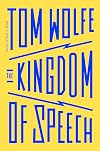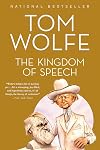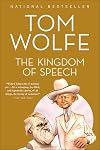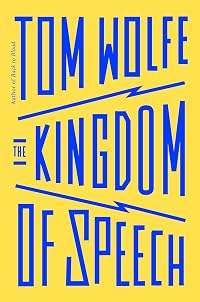
The Kingdom of Speech
by Tom Wolfe
On This Page
Description
The maestro storyteller and reporter provocatively argues that what we think we know about speech and human evolution is wrong. Tom Wolfe, whose legend began in journalism, takes us on an eye-opening journey that is sure to arouse widespread debate. THE KINGDOM OF SPEECH is a captivating, paradigm-shifting argument that speech--not evolution--is responsible for humanity's complex societies and achievements. From Alfred Russel Wallace, the Englishman who beat Darwin to the theory of natural show more selection but later renounced it, and through the controversial work of modern-day anthropologist Daniel Everett, who defies the current wisdom that language is hard-wired in humans, Wolfe examines the solemn, long-faced, laugh-out-loud zig-zags of Darwinism, old and Neo, and finds it irrelevant here in the Kingdom of Speech. show lessTags
Recommendations

















Member Reviews
The one purely positive thing to be said about The Kingdom of Speech is that it really is a rather engrossing and entertaining read. It has a certain dynamism to it and and a very expressive style that is quite absorbing. It is easily read in one quick sitting and certainly doesn't commit the cardinal sin of being boring. That fact, however, says very little about the quality of both the form and substance of the book, which are rather questionable, to put it mildly. We will therefore proceed to question them.
Let us begin with the writing style.
The most glaringly annoying and supremely unnecessary part of Wolfe's style is the excessive... use... of... ellipses... It is so distracting! There is simply no good reason to interrupt the flow show more of prose with ellipses when full stops, commas or semi-colons do the job perfectly well. The ellipsis has a certain limited function in writing, but it is limited for a reason. It can produce an interesting and deliberate effect once in a while, as in pages 4-5, where it is supposed to illustrate a jumbled train of thought as Wolfe considers an article by Chomsky et al. and draws the conclusion that since Darwin, "linguists, biologists, anthropologists, and people from every other discipline [have] discovered... nothing...about language". (p.5) But even when the use of ellipsis is deliberate (putting aside the patent untruthfulness of the above-quoted statement), it comes off as annoying and disruptive. What is, however, simply inexcusable, is the use of 1-2 ellipses on almost every single page, often for no (apparent) stylistic reason.
Otherwise, the style is flashy and overly rambling. Wolfe often restates his point far too many times, like for example the different mnemonic examples (p.161-162) and digresses into strange and unrelated aspects of the narrative, for example recounting personal anecdotes and not linguistic arguments from Everett's book. The attempt to create a parallel between Darwin/Wallace and Chomsky/Everett also seemed a little bit strained and introduced some unnecessary bias.
The case that Wolfe is trying to make (and that Everett has supposedly vindicated) is this: "language is an artifact, shaped by culture". How this conclusion is reached is incredibly unclear. Okay, Piraha proved recursion theory and some other aspects of the innate-language orthodoxy wrong. That I understood, and an important point was made about dogmatic attitudes and the danger of ego in science. It is fascinating how a single discovery can overturn so much scientific consensus. But Piraha and artifact-language theory only raise more questions than Wolfe ever attempts to answer. Even if language is an artifact, the question of how that artifact was constructed (rather than evolved) still remains. Pooh-pooh or bow-wow theories are still relevant, since it is unclear exactly how humans constructed languages even as simple (and complex) as Piraha. Language is shaped by culture, okay, but isn't culture also shaped by language? How do they interact? This is a chicken-and-egg question very relevant to the debate, but Wolfe nowhere even acknowledges it.
Furthermore, Wolfe dismisses all Chomskyan thought as pie-in-the-sky theorizing, without every engaging with actual arguments AND research that might support innate language paradigms. It is true that Chomsky et al. often rely on theory rather than empiricism, but that doesn't change the fact that there are observations and research that seem to support innate language. The one counter-argument that Wolfe does note - that Piraha speakers easily learn a very different language, Portuguese, raises some interesting questions. Obviously Piraha speakers have full mental capabilities, but their cultural structure doesn't require language innovation, or perhaps their language inhibits cultural innovation... who knows? Wolfe is a good PR-spokesman for Everett, whose books do seem quite interesting and probably do tackle these questions in a serious manner. Also, even if language is an artifact that has enabled all of human civilization, how did humans gain the capacity for such creativity? And we are back to evolutionary questions.
Tom Wolfe is more interested in linguistics as a story, rather than as a field of study. He wants to deflate Chomsky and Darwin and vindicate the underdogs more than he actually wants to understand anything about language. This book is good for some historical background behind The Origin of Species and certain developments in linguistics (although he does overestimate Chomsky's influence), but ultimately it is not greatly informative. It tries to reach conclusions but only raises questions and muddies the waters - not necessarily a bad thing, but Wolfe is overly ambitious and overly certain of his premise compared to the actual evidence he provides. The book suffers from an author who is obviously a stranger to the field of both linguistics and evolutionary biology, often making factually inaccurate statements and misunderstanding concepts. I would probably not recommend The Kingdom of Speech , but I might look into Dan Everett's book for a more satisfying approach to this new language-as-artifact paradigm. show less
Let us begin with the writing style.
The most glaringly annoying and supremely unnecessary part of Wolfe's style is the excessive... use... of... ellipses... It is so distracting! There is simply no good reason to interrupt the flow show more of prose with ellipses when full stops, commas or semi-colons do the job perfectly well. The ellipsis has a certain limited function in writing, but it is limited for a reason. It can produce an interesting and deliberate effect once in a while, as in pages 4-5, where it is supposed to illustrate a jumbled train of thought as Wolfe considers an article by Chomsky et al. and draws the conclusion that since Darwin, "linguists, biologists, anthropologists, and people from every other discipline [have] discovered... nothing...about language". (p.5) But even when the use of ellipsis is deliberate (putting aside the patent untruthfulness of the above-quoted statement), it comes off as annoying and disruptive. What is, however, simply inexcusable, is the use of 1-2 ellipses on almost every single page, often for no (apparent) stylistic reason.
Otherwise, the style is flashy and overly rambling. Wolfe often restates his point far too many times, like for example the different mnemonic examples (p.161-162) and digresses into strange and unrelated aspects of the narrative, for example recounting personal anecdotes and not linguistic arguments from Everett's book. The attempt to create a parallel between Darwin/Wallace and Chomsky/Everett also seemed a little bit strained and introduced some unnecessary bias.
The case that Wolfe is trying to make (and that Everett has supposedly vindicated) is this: "language is an artifact, shaped by culture". How this conclusion is reached is incredibly unclear. Okay, Piraha proved recursion theory and some other aspects of the innate-language orthodoxy wrong. That I understood, and an important point was made about dogmatic attitudes and the danger of ego in science. It is fascinating how a single discovery can overturn so much scientific consensus. But Piraha and artifact-language theory only raise more questions than Wolfe ever attempts to answer. Even if language is an artifact, the question of how that artifact was constructed (rather than evolved) still remains. Pooh-pooh or bow-wow theories are still relevant, since it is unclear exactly how humans constructed languages even as simple (and complex) as Piraha. Language is shaped by culture, okay, but isn't culture also shaped by language? How do they interact? This is a chicken-and-egg question very relevant to the debate, but Wolfe nowhere even acknowledges it.
Furthermore, Wolfe dismisses all Chomskyan thought as pie-in-the-sky theorizing, without every engaging with actual arguments AND research that might support innate language paradigms. It is true that Chomsky et al. often rely on theory rather than empiricism, but that doesn't change the fact that there are observations and research that seem to support innate language. The one counter-argument that Wolfe does note - that Piraha speakers easily learn a very different language, Portuguese, raises some interesting questions. Obviously Piraha speakers have full mental capabilities, but their cultural structure doesn't require language innovation, or perhaps their language inhibits cultural innovation... who knows? Wolfe is a good PR-spokesman for Everett, whose books do seem quite interesting and probably do tackle these questions in a serious manner. Also, even if language is an artifact that has enabled all of human civilization, how did humans gain the capacity for such creativity? And we are back to evolutionary questions.
Tom Wolfe is more interested in linguistics as a story, rather than as a field of study. He wants to deflate Chomsky and Darwin and vindicate the underdogs more than he actually wants to understand anything about language. This book is good for some historical background behind The Origin of Species and certain developments in linguistics (although he does overestimate Chomsky's influence), but ultimately it is not greatly informative. It tries to reach conclusions but only raises questions and muddies the waters - not necessarily a bad thing, but Wolfe is overly ambitious and overly certain of his premise compared to the actual evidence he provides. The book suffers from an author who is obviously a stranger to the field of both linguistics and evolutionary biology, often making factually inaccurate statements and misunderstanding concepts. I would probably not recommend The Kingdom of Speech , but I might look into Dan Everett's book for a more satisfying approach to this new language-as-artifact paradigm. show less
A majority of this book is published in Harpers Magazine (this book tops out at about 150 pages). As someone who studied linguistics, specifically Chomskian linguistics, it was, surprising, jolting. Chomsky is in his 90s now if he's a day, and the desperation in which he spoke with Tom Wolfe about the pushback against his work, his life's work, is agonizing, as someone who sparked my love affair with language and with how we have created this monster that drives the world, his frailty frightens me, his cold dismissal that once excited me when leveled against political foes, now is aimed at everyone, is heartbreaking. I haven't studied linguistics in years. I'm thinking I'm going to have to start reading linguisitcs texts again because show more this book actually caused me physical pain. What do they say? Kill your darlings, kill your idols. Chomsky, no matter happens to his law of recursion, his universal grammar, is already in the patheon of immortals. 2016 has already cost me a lot in public figure deaths, and I'm not saying Chomsky is going to be one of them. But I'm watching him more intensly now than I have in many years. I don't even like fucking Tom Wolfe. But I'm calling this essential reading for anyone who cares about language and how language and speech got here, despite Wolfe's bizarrly smarmy, overly intellectual spewage, which I have no idea if Chomsky and Wolfe hate each other, but there is something really unduly vicious about the way he talks about Chomsky. Maybe not. Maybe it's time that someone took a sword to Chomsky and his words. We'll see. Read The Kingdom of Speech and think on your words carefully. show less
Not having read any Tom Wolfe before, I was riveted by the prose style of this book, with its ellipses, colloquial asides, and multiple exclamation marks. I am sure it is possible to write a great book with this technique and perhaps Tom Wolfe has already done it, but this one is unfortunately a complete mess.
I say ‘unfortunately’ because as a matter of fact I agree with his basic position. What Wolfe is trying to do is summarise the internecine fighting of the linguistics world that followed Daniel Everett's work on the Pirahã language, which attacked Noam Chomsky's idea of a universal grammar. I've written lots about all this in my review of Everett's Language: The Cultural Tool; suffice to say here that UG had become more of an show more ideology than an academic theory, an aggressively enforced orthodoxy that had never produced any very interesting results, or been proved even slightly to reflect physiological or neurological reality.
Wolfe sees this as a David v. Goliath story, plucky little Dan Everett taking on the mean old dictator Chomsky, and in his telling the characters, and the arguments, are so simplified as to become cartoons. Furthermore, the first half of the book for some reason is about Charles Darwin and Charles Lyell, a diversion that is at best irrelevant and at worst misleading; the main effect on me was of exhausting my patience with Wolfe's cavalier approach to historical incident (‘Oh, Charlie, Charlie, Charlie…said Lyell’).
When we finally get on to the main event, Wolfe simply lifts anecdotes wholesale from Everett's Don't Sleep, There Are Snakes and retells them. It's impossible not to feel that you'd rather just be reading Everett first-hand. More dangerously, Wolfe gives the impression that the debate over language origins has now been solved, by Everett, which is very far from the case. Everett's main contribution was to puncture the Chomskyan hegemony; his own explanation, that language didn't evolve but rather was invented, like a bow and arrow, is interesting but a hell of a long way from conclusive.
That matters, because we already get too many writers making assumptions about where language came from, and when it developed, and what it was for, whereas the truth is that no one has the slightest idea – nothing about that has changed, and nor does it seem likely to, not that you'd know it from Wolfe's strange and breathless polemic. show less
I say ‘unfortunately’ because as a matter of fact I agree with his basic position. What Wolfe is trying to do is summarise the internecine fighting of the linguistics world that followed Daniel Everett's work on the Pirahã language, which attacked Noam Chomsky's idea of a universal grammar. I've written lots about all this in my review of Everett's Language: The Cultural Tool; suffice to say here that UG had become more of an show more ideology than an academic theory, an aggressively enforced orthodoxy that had never produced any very interesting results, or been proved even slightly to reflect physiological or neurological reality.
Wolfe sees this as a David v. Goliath story, plucky little Dan Everett taking on the mean old dictator Chomsky, and in his telling the characters, and the arguments, are so simplified as to become cartoons. Furthermore, the first half of the book for some reason is about Charles Darwin and Charles Lyell, a diversion that is at best irrelevant and at worst misleading; the main effect on me was of exhausting my patience with Wolfe's cavalier approach to historical incident (‘Oh, Charlie, Charlie, Charlie…said Lyell’).
When we finally get on to the main event, Wolfe simply lifts anecdotes wholesale from Everett's Don't Sleep, There Are Snakes and retells them. It's impossible not to feel that you'd rather just be reading Everett first-hand. More dangerously, Wolfe gives the impression that the debate over language origins has now been solved, by Everett, which is very far from the case. Everett's main contribution was to puncture the Chomskyan hegemony; his own explanation, that language didn't evolve but rather was invented, like a bow and arrow, is interesting but a hell of a long way from conclusive.
That matters, because we already get too many writers making assumptions about where language came from, and when it developed, and what it was for, whereas the truth is that no one has the slightest idea – nothing about that has changed, and nor does it seem likely to, not that you'd know it from Wolfe's strange and breathless polemic. show less
This is the first Tom Wolfe book I've read and I quite enjoyed the frenetic style. I was amused by how much fun Tom seemed to be having on the page. It more than once reminded me of the style Horrible Histories use in their books.
He obviously tries to fit history into interesting narratives, so go into this looking for a light, fun treatment of the material. It's well-researched but doesn't shy away from bestowing real people with exaggerated personas (the most common one being the David-Goliath dynamic) in service of a dramatic narrative.
The only real complaint I have from this otherwise highly enjoyable book is that, towards the end, it feels rushed. The Darwin-Wallace is given the deepest treatment when its only job is to set show more background for the actual theme of the language debate. When we get to the language question, we're fed a binary David-Goliath narrative that isn't fleshed out as well as the chapters on Darwin. And the last ten pages, which had the potential to be the most interesting because that's when Speech-with-a-capital-S is introduced (alongwith the provocative statement "Language is Mnemonics"), are just disappointingly unsupported by any of the credible footnotes that held up the previous pages. It foreshadows something cool is coming, like maybe, language is neither universal nor an artifact. But that insight is never delivered, and we're stuck with a ten-page sermon on the importance of speech. It seemed like Tom worked his butt off on Darwin, read up on Chomsky, Universal Grammar, Everett, but prematurely abandoned the project when he reached the meat of the book, namely speech.
Still, enjoyable light-reading. show less
He obviously tries to fit history into interesting narratives, so go into this looking for a light, fun treatment of the material. It's well-researched but doesn't shy away from bestowing real people with exaggerated personas (the most common one being the David-Goliath dynamic) in service of a dramatic narrative.
The only real complaint I have from this otherwise highly enjoyable book is that, towards the end, it feels rushed. The Darwin-Wallace is given the deepest treatment when its only job is to set show more background for the actual theme of the language debate. When we get to the language question, we're fed a binary David-Goliath narrative that isn't fleshed out as well as the chapters on Darwin. And the last ten pages, which had the potential to be the most interesting because that's when Speech-with-a-capital-S is introduced (alongwith the provocative statement "Language is Mnemonics"), are just disappointingly unsupported by any of the credible footnotes that held up the previous pages. It foreshadows something cool is coming, like maybe, language is neither universal nor an artifact. But that insight is never delivered, and we're stuck with a ten-page sermon on the importance of speech. It seemed like Tom worked his butt off on Darwin, read up on Chomsky, Universal Grammar, Everett, but prematurely abandoned the project when he reached the meat of the book, namely speech.
Still, enjoyable light-reading. show less
Wolfe attempts to write a history of the study of human speech, but his personal style and the lack of detail included in the book ruin much of the potential that his original idea had.
In the first chapter, Wolfe stumbles upon an article in which Noam Chomsky and seven other leading linguists admit the lack of concrete theory about the evolution of human speech. The article prompts Wolfe to his own research, since he can hardly believe that humanity would not even have a generally accepted theory on the matter. He researches the writings mainly of Chomsky, Charles Darwin, Alfred Wallace, and Daniel Everett, and from there writes a brief history of the debate before he closes with his own theory on speech in humans.
Wolfe crafts his story show more as a sort of parallel narrative of academic jealousy and ostracism. He begins with Wallace and Darwin's similar publications, and especially details how Wallace's criticisms of Darwin's theory were ignored but never answered by the Darwinist community. He then presents the similar tale of Noam Chomsky and Daniel Everett, claiming that Chomsky and modern linguists ignore Everett's valid work.
I had read about Wolfe before, but I'd never actually read one of his books. Bango; a jolt right to the solar plexus. He uses a largely informal style filled with parenthesis, points of ellipsis, and injections: the hallmarks of New Journalism. However, the informality drains his work of the actual meat that his story might have. He gives his impressions of the historical figures (especially Noam Chomsky), but he does not go into detail on most of the theories he skims over, or many of the characters in his own book. He ends the book with less than two hundred pages, while it really could occupy four or even five hundred. show less
In the first chapter, Wolfe stumbles upon an article in which Noam Chomsky and seven other leading linguists admit the lack of concrete theory about the evolution of human speech. The article prompts Wolfe to his own research, since he can hardly believe that humanity would not even have a generally accepted theory on the matter. He researches the writings mainly of Chomsky, Charles Darwin, Alfred Wallace, and Daniel Everett, and from there writes a brief history of the debate before he closes with his own theory on speech in humans.
Wolfe crafts his story show more as a sort of parallel narrative of academic jealousy and ostracism. He begins with Wallace and Darwin's similar publications, and especially details how Wallace's criticisms of Darwin's theory were ignored but never answered by the Darwinist community. He then presents the similar tale of Noam Chomsky and Daniel Everett, claiming that Chomsky and modern linguists ignore Everett's valid work.
I had read about Wolfe before, but I'd never actually read one of his books. Bango; a jolt right to the solar plexus. He uses a largely informal style filled with parenthesis, points of ellipsis, and injections: the hallmarks of New Journalism. However, the informality drains his work of the actual meat that his story might have. He gives his impressions of the historical figures (especially Noam Chomsky), but he does not go into detail on most of the theories he skims over, or many of the characters in his own book. He ends the book with less than two hundred pages, while it really could occupy four or even five hundred. show less
Mr. Wolfe does an excellent literary takedown of Charles Darwin and uses the second part of the book to take down Noam Chomsky. Arguments are entertainingly expressed and well documented.
Written with panache but probably rather biased against the big hitters in favour of the lone voice which rather undercuts his case. But the last chapter is a brilliant hymn of praise to language.
Members
- Recently Added By
Published Reviews
Evolution, he argues, isn’t a “scientific hypothesis” because nobody’s seen it happen, there’s no observation that could falsify it, it yields no predictions and it doesn’t “illuminate hitherto unknown or baffling areas of science.” Wrong — four times over. We’ve seen evolution via real-time observations and ordered series of fossils; evolution could be falsified by finding show more fossils out of place, such as that of a rabbit in 400 million-year-old sediments; and evolution certainly makes predictions (Darwin predicted, correctly, that human ancestors evolved in Africa). As for evolution’s supposed failure to solve biological puzzles, Wolfe might revisit Darwin’s description of how evolution not only unlocks enigmas about embryology and vestigial organs, but clarifies some perplexing geographic ranges of animals and plants. Or he could rouse himself to read recent biology journals, which describe multitudes of evolutionary riddles being solved.
...
But every part of this story is wrong. Chomsky’s views were influential but hardly, as Wolfe maintains, a universal paradigm — perhaps not even the majority view. And Everett didn’t slay universal grammar: Later linguists found that the Pirahã language indeed had recursion (e.g., “I want the same hammock you just showed me”). Finally, the technical notion of “recursion” was never the totality of Chomsky’s theory anyway. He highlighted the idea in a brief paper in 2003, but his theory always consisted of operations for merging words into bigger and bigger phrases, something no one disputes.
...
All this grammatical structure, genetic data and uniquely human behavior implies something Wolfe cannot abide: that our language is — horrors! — the result of . . . evolution! But why would evolution do that? If the good Mr. Wolfe thought about it for a minute, maybe he’d see some advantage in our group-living, problem-solving ancestors producing and comprehending language — and realize that any mutually intelligible language needs, well, rules and conventions! And those who most effortlessly understand and follow such conventions — might they not have a reproductive advantage? And wouldn’t that produce genetic change? But of course he can’t bear to think about that . . . for it leads him back to bearded old Darwin.
...
Somewhere on his mission to tear down the famous, elevate the neglected outsider and hit the exclamation-point key as often as possible, Wolfe has forgotten how to think. show less
...
But every part of this story is wrong. Chomsky’s views were influential but hardly, as Wolfe maintains, a universal paradigm — perhaps not even the majority view. And Everett didn’t slay universal grammar: Later linguists found that the Pirahã language indeed had recursion (e.g., “I want the same hammock you just showed me”). Finally, the technical notion of “recursion” was never the totality of Chomsky’s theory anyway. He highlighted the idea in a brief paper in 2003, but his theory always consisted of operations for merging words into bigger and bigger phrases, something no one disputes.
...
All this grammatical structure, genetic data and uniquely human behavior implies something Wolfe cannot abide: that our language is — horrors! — the result of . . . evolution! But why would evolution do that? If the good Mr. Wolfe thought about it for a minute, maybe he’d see some advantage in our group-living, problem-solving ancestors producing and comprehending language — and realize that any mutually intelligible language needs, well, rules and conventions! And those who most effortlessly understand and follow such conventions — might they not have a reproductive advantage? And wouldn’t that produce genetic change? But of course he can’t bear to think about that . . . for it leads him back to bearded old Darwin.
...
Somewhere on his mission to tear down the famous, elevate the neglected outsider and hit the exclamation-point key as often as possible, Wolfe has forgotten how to think. show less
added by jimroberts
In an increasingly batty finale, Wolfe explains that Darwin and Chomsky screwed up by trying to apply evolutionary theory to language, which, as a man-made artefact, exists outside biological constraints. And it is language alone, Wolfe concludes, that accounts for humankind’s progress and fundamental difference from the rest of the animal kingdom.
Well, where to start? Take Wolfe’s great show more revelation about the uniqueness and importance of language: that has long been a basic given. And the new post-Chomsky consensus follows the proposals of Terrence Deacon nearly 20 years ago that human language did indeed evolve, over several million years, beginning with the proto-languages of our ancestor hominids. Deacon also proposes that languages themselves are subject to intense evolutionary pressure; either they are learned by children or not, and if they aren’t, they die. So languages have evolved to be learnable by toddlers. Language isn’t Darwin’s nemesis as Wolfe thinks — it provides triumphant vindication of evolutionary theory’s almost-universal application.
If Wolfe’s argument is all over the shop, his style also comes unstuck. All attempts to enliven what is basically a history of ideas with wordplay, daft ellipses and repetition of key words in this context seem rather lazy and silly and embarrassing, like a vicar getting down with the kids at the youth club by dancing the twist. show less
Well, where to start? Take Wolfe’s great show more revelation about the uniqueness and importance of language: that has long been a basic given. And the new post-Chomsky consensus follows the proposals of Terrence Deacon nearly 20 years ago that human language did indeed evolve, over several million years, beginning with the proto-languages of our ancestor hominids. Deacon also proposes that languages themselves are subject to intense evolutionary pressure; either they are learned by children or not, and if they aren’t, they die. So languages have evolved to be learnable by toddlers. Language isn’t Darwin’s nemesis as Wolfe thinks — it provides triumphant vindication of evolutionary theory’s almost-universal application.
If Wolfe’s argument is all over the shop, his style also comes unstuck. All attempts to enliven what is basically a history of ideas with wordplay, daft ellipses and repetition of key words in this context seem rather lazy and silly and embarrassing, like a vicar getting down with the kids at the youth club by dancing the twist. show less
added by jimroberts
Author Information

40+ Works 39,917 Members
Thomas Kennerly Wolfe Jr. was born in Richmond, Virginia on March 2, 1930. He received bachelor's degree in English from Washington and Lee University in 1951 and a Ph.D in American studies from Yale University in 1957. He started his journalism career as a general-assignment reporter at The Springfield Union. While he was working for The show more Washington Post, he was assigned to cover Latin America and won the Washington Newspaper Guild's foreign news prize for a series on Cuba in 1961. In 1962, he became a reporter for the New York Herald Tribune and a staff writer for New York magazine. His work also appeared in Harper's and Esquire. His first book, a collection of articles about the flamboyant Sixties written for New York and Esquire entitled The Kandy-Kolored Tangerine-Flake Streamline Baby, was published in 1968. His other collections included Radical Chic and Mau-Mauing the Flak Catchers and Hooking Up. His non-fiction works included The Pump House Gang; The Electric Kool-Aid Acid Test; The Painted Word; Mauve Gloves and Madmen, Clutter and Vine; In Our Time; and From Bauhaus to Our House. The Right Stuff won the American Book Award for nonfiction, the National Institute of Arts and Letters Harold Vursell Award for prose style, and the Columbia Journalism Award. It was adapted into a film in 1983. His fiction books included The Bonfire of the Vanities, Ambush at Fort Bragg, A Man in Full, The Kingdom of Speech, I Am Charlotte Simmons, and Back to Blood. He was also a contributing artist at Harper's from 1978 to 1981. Many of his illustrations were collected in In Our Time. He died on May 14, 2018 at the age of 88. (Bowker Author Biography) show less
Awards and Honors
Distinctions
The Guardian Book of the Day (2016-09-08)
Common Knowledge
- People/Characters
- Charles Darwin [Charles Robert: 1809-1882]; Noam Chomsky; Daniel Everett; George Wallace
- Important places
- London, England, UK
Classifications
Statistics
- Members
- 361
- Popularity
- 87,761
- Reviews
- 13
- Rating
- (3.43)
- Languages
- 8 — Catalan, Dutch, English, French, German, Italian, Portuguese (Portugal), Spanish
- Media
- Paper, Audiobook, Ebook
- ISBNs
- 26
- ASINs
- 6