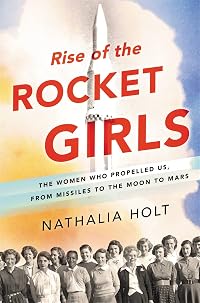
Rise of the Rocket Girls: The Women Who Propelled Us, from Missiles to the Moon to Mars
by Nathalia Holt
On This Page
Description
The riveting true story of the women who launched America into space.In the 1940s and 50s, when the newly minted Jet Propulsion Laboratory needed quick-thinking mathematicians to calculate velocities and plot trajectories, they didn't turn to male graduates. Rather, they recruited an elite group of young women who, with only pencil, paper, and mathematical prowess, transformed rocket design, helped bring about the first American satellites, and made the exploration of the solar system show more possible.
For the first time, Rise of the Rocket Girls tells the stories of these women — known as "human computers" — who broke the boundaries of both gender and science. Based on extensive research and interviews with all the living members of the team, Rise of the Rocket Girls offers a unique perspective on the role of women in science: both where we've been, and the far reaches of space to which we're heading.
"If Hidden Figures has you itching to learn more about the women who worked in the space program, pick up Nathalia Holt's lively, immensely readable history, Rise of the Rocket Girls." — Entertainment Weekly
. show less
Tags
Recommendations












































Member Recommendations


by anonymous user
Member Reviews
For the younger generations who have grown up with personal computers and tiny calculators that perform complex mathematical calculations this book will come as an eye-opener. Even for myself (I can remember programming a main frame computer by punch card), it was inspiring to think that before electronic calculators there was only paper and pencil and slide rules to do the math that calculated trajectories for rockets. This year's movie "Hidden Figures" told the story of one group of females involved in the space race but on the other side of the US there were more women "computers" doing their bit. This is their story.
The Jet Propulsion Laboratory (JPL) was a small and crazy workshop in the 1940s that wanted to develop rockets to show more propel airplanes and they needed someone good with numbers to do all the calculations. They hired one woman and then another and then more. These women had to work in an unheated building in the hills above Pasadena right beside the testing grounds. They became a tight-knit group who could be relied upon to take the raw data and produce the calculations for thrust and velocity for all manner of rockets. Unlike the women in Hidden Figures they didn't work on the manned missions but their work led the way for the Apollo missions. They also worked on the missions that sent spacecraft to the other planets of the solar system and further. They put in long hours when required and also had homes and children and churches and husbands that required their attention. They were eventually given the job title of engineer but male engineers made more intially. Just a few years ago NASA decided that engineers had to have an advanced degree and they demoted a woman who had been an employee for 50 years to an hourly wage because she didn't have a degree. They had to reverse the decision when they learned that because of the hours she worked she was making even more money than before.
The writing of this book was not at all dry because the human stories were mixed in with the technological explanations. There are also lots of great pictures that show the women and the equipment. I would recommend this to anyone interested in women's history or the space race or changing technology or fans of Hidden Figures. show less
The Jet Propulsion Laboratory (JPL) was a small and crazy workshop in the 1940s that wanted to develop rockets to show more propel airplanes and they needed someone good with numbers to do all the calculations. They hired one woman and then another and then more. These women had to work in an unheated building in the hills above Pasadena right beside the testing grounds. They became a tight-knit group who could be relied upon to take the raw data and produce the calculations for thrust and velocity for all manner of rockets. Unlike the women in Hidden Figures they didn't work on the manned missions but their work led the way for the Apollo missions. They also worked on the missions that sent spacecraft to the other planets of the solar system and further. They put in long hours when required and also had homes and children and churches and husbands that required their attention. They were eventually given the job title of engineer but male engineers made more intially. Just a few years ago NASA decided that engineers had to have an advanced degree and they demoted a woman who had been an employee for 50 years to an hourly wage because she didn't have a degree. They had to reverse the decision when they learned that because of the hours she worked she was making even more money than before.
The writing of this book was not at all dry because the human stories were mixed in with the technological explanations. There are also lots of great pictures that show the women and the equipment. I would recommend this to anyone interested in women's history or the space race or changing technology or fans of Hidden Figures. show less
I have a saying I often include as a prelude to a forwarded social media posting boasting of the historical accomplishments of a woman: "Women never did anything but support their history-making husbands." The prelude is sarcastic and a biting response to a history professor (male) who replied to my question, 'Where were the women?' with the statement, 'They were busy taking care of their husbands and families and didn't have time to contribute to the advances chronicled in history.' Since that response by an obviously ignorant and uncreative individual who nevertheless held a PhD, I made it a point to discover women's contributions. Today, many wonderful authors share my fever for an answer to my question, 'Where were the women?', with show more a dogged determination that impresses me beyond words. I consider the mother of my women's history movement to be historian Laurel Thatcher Ulrich. Ulrich gave us the immensely reproduced quote, "Well-behaved women seldom make history." Ulrich is also the author of A Midwife's Tale taking diaries of a c1800 New England midwife...diaries no historian before Ulrich had thought of as important...to piece together an intricately detailed and much celebrated history of a small New England town. Now we know the answer to my question. Women were making history. Their accomplishments simply were not chronicled beyond their own hands. Add Rise of the Rocket Girls as a tribute to the history-making women whose contributions to our space exploration history are only recorded among the stars and not the history books. Literally, among the stars, as their lines of intricate mathematical programming continue to work within the technology of such advances as the Hubble Telescope and Voyager craft of the Juno mission that orbited Jupiter in June 2016.
Why have we never heard of these women? Because they were hired to serve as mathematical work horses. These women were hired to do the difficult, intricate, painstakingly precise equations, by hand, of rocket designs, rocket thrust, module trajectories, control systems, landing systems, and numerous other details that allowed men to walk on the moon and a rover to explore Mars. Eventually, these women became the engineers who wrote the copious amounts of computer code that were used to engineer the International Space Station and the Space Shuttle. These women worked alongside the men who were recognized for their efforts, though the women rarely received any public acclaim. So much were these tremendous women obscured from history, JPL, the company they helped start, demoted one of its long-time, long-admired, brilliant women engineers to an hourly wage (because she didn't hold an advanced degree) and none of the women were even invited to celebrate the fiftieth anniversary of Explorer I honoring esteemed male guests. These women...these fantastic, phenomenal, genius women...were simply left off the invitation list to celebrate the satellite they helped successfully create. When will we learn? Women are not part of history because they are deliberately written out of it.
I am grateful Holt brought these women out of obscurity. This is a book that MUST be read. The stories of these women must be recognized and remembered. It is proof that women made history, though to find their contributions one may have to let go of biases in order to look in different and unique spaces. show less
Why have we never heard of these women? Because they were hired to serve as mathematical work horses. These women were hired to do the difficult, intricate, painstakingly precise equations, by hand, of rocket designs, rocket thrust, module trajectories, control systems, landing systems, and numerous other details that allowed men to walk on the moon and a rover to explore Mars. Eventually, these women became the engineers who wrote the copious amounts of computer code that were used to engineer the International Space Station and the Space Shuttle. These women worked alongside the men who were recognized for their efforts, though the women rarely received any public acclaim. So much were these tremendous women obscured from history, JPL, the company they helped start, demoted one of its long-time, long-admired, brilliant women engineers to an hourly wage (because she didn't hold an advanced degree) and none of the women were even invited to celebrate the fiftieth anniversary of Explorer I honoring esteemed male guests. These women...these fantastic, phenomenal, genius women...were simply left off the invitation list to celebrate the satellite they helped successfully create. When will we learn? Women are not part of history because they are deliberately written out of it.
I am grateful Holt brought these women out of obscurity. This is a book that MUST be read. The stories of these women must be recognized and remembered. It is proof that women made history, though to find their contributions one may have to let go of biases in order to look in different and unique spaces. show less
This book should be required reading in junior high and middle school classes and for anyone who feels that women aren't suited for STEM classes or careers. Not only is it packed with history on the American Space program, it also shows the integral parts played in said history by women.
Adult women should to read this book, to see all the amazing first steps taken by the Rocket Girls--working moms, pioneering computer science majors, first users of electronic calculating machines and computers, the first women to wear pantsuits to work.
Boychild geeks who want women out of science fiction need to read this book and learn that there wouldn't be jet engines or spaceflight without women.
And frankly, anyone who loves a good story should show more read this, because it's not at all dry. The book is factual and supported with all kinds of documentation, but it's also a thrilling adventure tale that sweeps you right along.
I also learned that the first flyby of Mars happened on the evening of the day I was born. show less
Adult women should to read this book, to see all the amazing first steps taken by the Rocket Girls--working moms, pioneering computer science majors, first users of electronic calculating machines and computers, the first women to wear pantsuits to work.
Boychild geeks who want women out of science fiction need to read this book and learn that there wouldn't be jet engines or spaceflight without women.
And frankly, anyone who loves a good story should show more read this, because it's not at all dry. The book is factual and supported with all kinds of documentation, but it's also a thrilling adventure tale that sweeps you right along.
I also learned that the first flyby of Mars happened on the evening of the day I was born. show less
This book tells the story of several women who worked at the Jet Propulsion Lab (JPL) in Pasedena, California in the 40s, 50s, 60s, and 70s. Their work was instrumental in creating missiles for military use and rockets that lifted their payloads into space. They were particularly key in working on Ranger and Surveyor missions to the Moon that prepared the way for Apollo, the Mariner missions to Venus, Mars, and Mercury, and the Voyager program missions to Jupiter, Saturn, Uranus, and Neptune. Holt interviewed several women who worked at the JPL to get their perspectives on this age of discovery.
Many of the women got their start as "computers," who were JPL employees who performed mathematical computations (a usage of the term that's show more been made familiar by the book and movie Hidden Figures). Working as a computer provided an opportunity for women who studied mathematics to use their skills. While it was a support position to the (predominantly male) engineers, the position was highly-regarded within JPL and well paid. The group of women working together, with women supervisors, also felt that they had a close-knit family at JPL. Not everything was positive as the group of women felt that they had to look out for one another at office parties when men were on the prowl. Woman employees were also fired when they got pregnant.
Holt does a great job of telling these women's stories from their roles in furthering interplanetary exploration to their everyday lives of marriages, raising children, and even oddities like a JPL beauty contest. As Holt notes, it was the progressive hiring practices at JPL that made it possible to have enough women to even to something as seemingly outdated as a beauty contest. show less
Many of the women got their start as "computers," who were JPL employees who performed mathematical computations (a usage of the term that's show more been made familiar by the book and movie Hidden Figures). Working as a computer provided an opportunity for women who studied mathematics to use their skills. While it was a support position to the (predominantly male) engineers, the position was highly-regarded within JPL and well paid. The group of women working together, with women supervisors, also felt that they had a close-knit family at JPL. Not everything was positive as the group of women felt that they had to look out for one another at office parties when men were on the prowl. Woman employees were also fired when they got pregnant.
Holt does a great job of telling these women's stories from their roles in furthering interplanetary exploration to their everyday lives of marriages, raising children, and even oddities like a JPL beauty contest. As Holt notes, it was the progressive hiring practices at JPL that made it possible to have enough women to even to something as seemingly outdated as a beauty contest. show less
A history of women at JPL (NASA's Jet Propulsion Laboratory), from its origins in the 1940s, through many decades of exploring the solar system, up to the present day (or very nearly: the book was published in 2016). For much of this time, most of the women there were employed as computers, calculating complex engineering equations and rocket trajectories by hand with pencil and paper. If you've seen the movie Hidden Figures, or read the book it's based on, this is the same type of job the women featured there were doing elsewhere at NASA. (And, yes, not all of the women at JPL where white, either.) Later on, as electronic computers began to replace human ones, they became computer programmers, as well. And by now, of course, there are show more many female engineers working there, although still not in the same numbers as the men.
I wasn't always exactly engaged by the writing in this particular volume. It wanders back and forth between being a straightforward history and trying to go for a "narrative nonfiction" approach of dramatizing things from various women's POV, and the two things are grafted rather awkwardly together. (This seems to be a common structure in non-fiction these days, and too few writers, in my opinion, pull it off especially gracefully.) The subject matter is certainly interesting, though. Holt covers a lot of the space missions fairly quickly and not in immense depth, but as a general overview of what JPL has done in its history, it works well enough. And the lives and careers of these women provide a really vivid illustration of what life was like for working women in the 1940s, 50s, and 60s, when equally qualified men and women were seldom hired for the same positions and a woman could be summarily fired for getting pregnant. These are worthwhile stories to hear and remember, and even if I have slightly mixed feelings about the writing here, I am unambiguously glad to see these intelligent, dedicated women getting the recognition they deserve. show less
I wasn't always exactly engaged by the writing in this particular volume. It wanders back and forth between being a straightforward history and trying to go for a "narrative nonfiction" approach of dramatizing things from various women's POV, and the two things are grafted rather awkwardly together. (This seems to be a common structure in non-fiction these days, and too few writers, in my opinion, pull it off especially gracefully.) The subject matter is certainly interesting, though. Holt covers a lot of the space missions fairly quickly and not in immense depth, but as a general overview of what JPL has done in its history, it works well enough. And the lives and careers of these women provide a really vivid illustration of what life was like for working women in the 1940s, 50s, and 60s, when equally qualified men and women were seldom hired for the same positions and a woman could be summarily fired for getting pregnant. These are worthwhile stories to hear and remember, and even if I have slightly mixed feelings about the writing here, I am unambiguously glad to see these intelligent, dedicated women getting the recognition they deserve. show less
I give this a 4.5
You know when you find a book that takes you into your past and helps you to want to learn more? That for me is this book. I enjoyed meeting, learning and being encouraged by the female "computers" of the Jet Propulsion Lab in Pasadena, California.
My father was a computer programer, reading about the different computers, different ways of programing those electronic computers from Pin punch cards to, FORTRAN to BASIC programing language it was a blast from the past for me. I still own punch cards that my dad saved from the trash heap of change. Those punch cards served as late note pleas to allow me to enter class without a tardy, a pass from missing a day at school and gathering homework on those months that I needed show more to be monitored because I wasn't turning work in. Those punchcards meant to much to me and still do. I use them diligently, once they are gone, there are no more to gather... It is a reminder of a history gone.
Barby Canright was JPL's first computer before it was JPL and was just a nerdy boys rocket group consisting of 4 men and Barby. These men attended CALTECH but breathed rocketry. :0)
The women of the JPL computing division were intelligent, hard working and not equal to their male counterparts if doing other work at the lab. There in the Computing division they were top dog. They forecasted the paths of war missles, satellites and rockets to the moon. Also, helped solved design flaws (such as Appollo I's door restriction that kept Ed White, Cafferty and ???? From escaping during a horrific fire.)
These women were expected to quit their jobs when they got married and started a family. Most of the JPL ladies did as expected then returned because they were usually too smart to just throw dinner parties, take care of their children and run the daily household. They were going crazy not being involved.
Modern electronic computers were starting to come to use while the young JPL computers were adjusting to the possibility of being outsourced to the machines. These women made themselves non-expendable by being the first ones to learn the procedures, languages and foibles of those machines. Continuing their careers with advanced college learning, encouraged by each other to become faster, smarter, more reliable. These women to me were superstars!!!
Can you imagine the satisfaction that they felt knowing they were doing something that made a significant impact on the world through out the 40's to today? I am in awe of these women who paved the way for other women to be NASA engineers and Astronauts.
The Rise of the Rocket Girls might have been a little technical for the average reader, however I thoroughly enjoyed the technicality. The look into their private lives, their careers and the friendships that they held for lifetimes was refreshing and uplifting. Little girls, women of my age group (oh, heck, all women) need to hear these stories more often.
The book is a great catalyst for the continued conversation of the need for females to excel in STEM programs.
Author Nathalia Holt did a fantastic job sharing the early history of missles and Pre-NASA Rockets, through an engaging story carried over decades of success, disappointment, death and the frustration that was felt for the women working at the Pasadena Jet Propulsion Laboratory
This book has feed my desire to visit the JPL my next jaunt down to Southern California.
If you love Rockets, NASA, and Space this book will not disappoint you. show less
You know when you find a book that takes you into your past and helps you to want to learn more? That for me is this book. I enjoyed meeting, learning and being encouraged by the female "computers" of the Jet Propulsion Lab in Pasadena, California.
My father was a computer programer, reading about the different computers, different ways of programing those electronic computers from Pin punch cards to, FORTRAN to BASIC programing language it was a blast from the past for me. I still own punch cards that my dad saved from the trash heap of change. Those punch cards served as late note pleas to allow me to enter class without a tardy, a pass from missing a day at school and gathering homework on those months that I needed show more to be monitored because I wasn't turning work in. Those punchcards meant to much to me and still do. I use them diligently, once they are gone, there are no more to gather... It is a reminder of a history gone.
Barby Canright was JPL's first computer before it was JPL and was just a nerdy boys rocket group consisting of 4 men and Barby. These men attended CALTECH but breathed rocketry. :0)
The women of the JPL computing division were intelligent, hard working and not equal to their male counterparts if doing other work at the lab. There in the Computing division they were top dog. They forecasted the paths of war missles, satellites and rockets to the moon. Also, helped solved design flaws (such as Appollo I's door restriction that kept Ed White, Cafferty and ???? From escaping during a horrific fire.)
These women were expected to quit their jobs when they got married and started a family. Most of the JPL ladies did as expected then returned because they were usually too smart to just throw dinner parties, take care of their children and run the daily household. They were going crazy not being involved.
Modern electronic computers were starting to come to use while the young JPL computers were adjusting to the possibility of being outsourced to the machines. These women made themselves non-expendable by being the first ones to learn the procedures, languages and foibles of those machines. Continuing their careers with advanced college learning, encouraged by each other to become faster, smarter, more reliable. These women to me were superstars!!!
Can you imagine the satisfaction that they felt knowing they were doing something that made a significant impact on the world through out the 40's to today? I am in awe of these women who paved the way for other women to be NASA engineers and Astronauts.
The Rise of the Rocket Girls might have been a little technical for the average reader, however I thoroughly enjoyed the technicality. The look into their private lives, their careers and the friendships that they held for lifetimes was refreshing and uplifting. Little girls, women of my age group (oh, heck, all women) need to hear these stories more often.
The book is a great catalyst for the continued conversation of the need for females to excel in STEM programs.
Author Nathalia Holt did a fantastic job sharing the early history of missles and Pre-NASA Rockets, through an engaging story carried over decades of success, disappointment, death and the frustration that was felt for the women working at the Pasadena Jet Propulsion Laboratory
This book has feed my desire to visit the JPL my next jaunt down to Southern California.
If you love Rockets, NASA, and Space this book will not disappoint you. show less
Loved the film, but this book is better because we get all the 'girls' and their stories from the earliest days as human calculators right up to rocket launch.
Author Nathalia Holt allows these women to tell their stories about how they were the mathematical people who worked out the details without which missiles and rockets could not have flown. They were calculators when machines to calculate hard barely been invented. With slide rule and log tables these women used their brains to work out the formulas needed to fly a rocket or missile.
Having faced the same problem as these women did: where do bright girls go if they don't want to be a teacher a nurse or a secretary? I chuckled at the book group's younger members asking 'Did that show more really happen? Even if you had been to university?' Yes it did, and women are still restricted in how far they can get career wise. These women wanted to use their mathematical and scientific skills and were able to by luck and being in the right place at the right time. How many women missed opportunities to fulfill their abilities because of those entrenched attitudes?
Well worth a read, and a good book for young women who might just grow up to be scientists and mathematicians. show less
Author Nathalia Holt allows these women to tell their stories about how they were the mathematical people who worked out the details without which missiles and rockets could not have flown. They were calculators when machines to calculate hard barely been invented. With slide rule and log tables these women used their brains to work out the formulas needed to fly a rocket or missile.
Having faced the same problem as these women did: where do bright girls go if they don't want to be a teacher a nurse or a secretary? I chuckled at the book group's younger members asking 'Did that show more really happen? Even if you had been to university?' Yes it did, and women are still restricted in how far they can get career wise. These women wanted to use their mathematical and scientific skills and were able to by luck and being in the right place at the right time. How many women missed opportunities to fulfill their abilities because of those entrenched attitudes?
Well worth a read, and a good book for young women who might just grow up to be scientists and mathematicians. show less
Members
- Recently Added By
Lists

Science: Astronomy
62 works; 2 members

Hachette Book Group
152 works; 6 members
Author Information

5 Works 1,638 Members
Nathalia Holt is the author of Cured: The People Who Defeated HIV and a former Fellow at the Ragon Institute of Massachusetts General Hospital, MIT, and Harvard University. Her writing has appeared in the New York Times, the Los Angeles limes, The Atlantic, Slate. Popular Science, and Time. She lives in Boston.
Some Editions
Awards and Honors
Common Knowledge
- Original title
- Rise of the Rocket Girls: The Women Who Propelled Us, From Missiles To The Moon to Mars
- Original publication date
- 2016-04-05
- Related movies
- When We Left Earth: The NASA Missions (2008 | IMDb); The Imitation Game (2014 | IMDb); Hidden Figures (2016 | IMDb)
- Epigraph
- I did not come to NASA to make history. - Sally Ride
Why do we, the solar sails, fragile as a feather's frond, silently seek to sail so far? We walk the air from here to planet out beyond Because we're more than fond of life and what we are. - Ray Bradbury and Jonathan V. Post ... (show all)- To Sail Beyond the Sun - Dedication
- For Larkin and our little rocket girls, Eleanor and Philippa
- First words
- The young woman's heart was pounding.
- Last words
- (Click to show. Warning: May contain spoilers.)Buried in those final good-byes are friendships far more powerful than any rocket engine.
- Blurbers
- Lineberry, Cate; Ackmann, Martha; Fagone, Jason; Nesbit, Tarashea; Bidwell Smith, Claire
- Original language
- English
Classifications
- Genres
- General Nonfiction, Science & Nature, History, Nonfiction, Technology, Biography & Memoir, Sexuality and Gender Studies
- DDC/MDS
- 629.4072 — Applied science & technology Engineering Transportation Vehicles Spacecraft & Vehicles Aerospace education
- LCC
- TL862 .J48 .H65 — Technology Motor vehicles. Aeronautics. Astronautics Motor vehicles. Aeronautics. Astronautics Astronautics. Space travel
- BISAC
Statistics
- Members
- 960
- Popularity
- 27,552
- Reviews
- 32
- Rating
- (3.84)
- Languages
- English, Spanish
- Media
- Paper, Audiobook, Ebook
- ISBNs
- 12
- ASINs
- 4