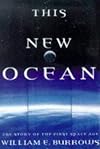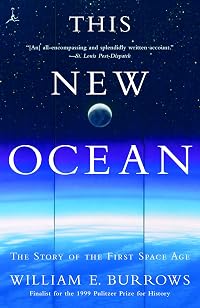
This New Ocean: The Story of the First Space Age (Modern Library Paperbacks)
by William E. Burrows
On This Page
Description
It was all part of man's greatest adventure--landing men on the Moon and sending a rover to Mars, finally seeing the edge of the universe and the birth of stars, and launching planetary explorers across the solar system to Neptune and beyond. The ancient dream of breaking gravity's hold and taking to space became a reality only because of the intense cold-war rivalry between the superpowers, with towering geniuses like Wernher von Braun and Sergei Korolyov shelving dreams of space travel and show more instead developing rockets for ballistic missiles and space spectaculars. Now that Russian archives are open and thousands of formerly top-secret U.S. documents are declassified, an often startling new picture of the space age emerges- the frantic effort by the Soviet Union to beat the United States to the Moon was doomed from the beginning by gross inefficiency and by infighting so treacherous that Winston Churchill likened it to "dogs fighting under a carpet"; there was more than science behind the United States' suggestion that satellites be launched during the International Geophysical Year, and in one crucial respect, Sputnik was a godsend to Washington; the hundred-odd German V-2s that provided the vital start to the U.S. missile and space programs legally belonged to the Soviet Union and were spirited to the United States in a derring-do operation worthy of a spy thriller; despite NASA's claim that it was a civilian agency, it had an intimate relationship with the military at the outset and still does--a distinction the Soviet Union never pretended to make; constant efforts to portray astronauts and cosmonauts as "Boy Scouts" were often contradicted by reality; the Apollo missions to the Moon may have been an unexcelled political triumph and feat of exploration, but they also created a headache for the space agency that lingers to this day. This New Oceanis based on 175 interviews with Russian and American scientists and engineers; on archival documents, including formerly top-secret National Intelligence Estimates and spy satellite pictures; and on nearly three decades of reporting. The impressive result is this fascinating story--the first comprehensive account--of the space age. Here are the strategists and war planners; engineers and scientists; politicians and industrialists; astronauts and cosmonauts; science fiction writers and journalists; and plain, ordinary, unabashed dreamers who wanted to transcend gravity's shackles for the ultimate ride. The story is written from the perspective of a witness who was present at the beginning and who has seen the conclusion of the first space age and the start of the second. show lessTags
Recommendations






















Member Reviews
Members
- Recently Added By
Author Information
13 Works 927 Members
William E. Burrows is the author of Deep Black: Space Espionage and National Security, and is a former reporter for The New York Times, The Washington Post, and The Wall Street Journal. He is the founder and director of New York University's graduate Science and Environmental Reporting Program, and lives with his wife in Connecticut
Awards and Honors
Series
Belongs to Publisher Series
Common Knowledge
- Original title
- This New Ocean: The Story of the First Space Age
- Alternate titles
- This New Ocean: History of the First Space Age
- Important places
- Space
- Dedication
- To Galileo, Magister of the glass eye. Thanks for everything.
- First words
- The bronze archer is called the Saltine Warrior.
- Last words
- (Click to show. Warning: May contain spoilers.)Saunders Kramer and the Saltine Warrior.
Classifications
Statistics
- Members
- 353
- Popularity
- 89,460
- Rating
- (3.91)
- Languages
- English
- Media
- Paper, Ebook
- ISBNs
- 3
- ASINs
- 3