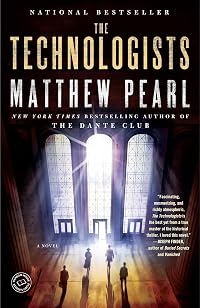
The Technologists + The Professor's Assassin
by Matthew Pearl 
On This Page
Description
“A terrific historical mystery in the fine old Arthur Conan Doyle style . . . Who knew that a mystery formed around the founding of the Massachusetts Institute of Technology could be so good? . . . There are cliffhanger endings and fortuitous escapes. . . . There are even a couple of very sweet romances.”—The Globe and MailNATIONAL BESTSELLER
Boston, 1868. The Civil War may be over but a new war has begun, one between past and present, tradition and technology. The daring show more Massachusetts Institute of Technology is on a mission to harness science for the benefit of all. But when an unnatural disaster strikes the ships in Boston Harbor, and an equally inexplicable catastrophe devastates the heart of the city, an antiscience backlash casts a pall over MIT and threatens its very survival. So the best and brightest from the Institute’s first graduating class secretly join forces to save innocent lives and track down the truth. Armed with ingenuity and their unique scientific training, gifted war veteran Marcus Mansfield, blueblood Robert Richards, genius Edwin Hoyt, and brilliant freshman Ellen Swallow will match wits with a master criminal bent on the utter destruction of the city.
Don’t miss Matthew Pearl’s short story “The Professor’s Assassin,” featuring characters from The Technologists, in the back of the book.
Look for special features inside. Join the Circle for author chats and more. show less
Tags
Recommendations











Member Reviews
It is 1868, and Boston is hit with a series of catastrophes: compasses of ships in the harbor go awry simultaneously, glass in the business district suddenly melts. Suspicion falls on science. The fledgeling Massachusetts Institute of Technology is vulnerable, to fears of the public and sneers of Harvard. Three MIT students vow to save the reputation of their school, meeting as The Technologists in a basement laboratory, conducting experiments to uncover the physics and chemistry behind the catastrophes. They are soon joined by the sole female student, who has been consigned to the laboratory next door, prohibited from attending classes. Meanwhile the police have put their faith in Louis Agassiz of Harvard.
I expected to be caught up in show more the story, but 100 or so pages along the characters remained more cardboard stock than human, going through the right motions and uttering the right words to sketch the historical context, but not quite fully living within it. I stuck through the entire 468 pages because of all the positive reviews, and, well, there were moments: cameo appearances, romance, geekiness. Not science fiction; the science stays within the bounds of the time. Sort of historical fiction, but with significant non-historical events. The template seemed more Harry Potter, without the magic.
(read 2 Jul 2012) show less
I expected to be caught up in show more the story, but 100 or so pages along the characters remained more cardboard stock than human, going through the right motions and uttering the right words to sketch the historical context, but not quite fully living within it. I stuck through the entire 468 pages because of all the positive reviews, and, well, there were moments: cameo appearances, romance, geekiness. Not science fiction; the science stays within the bounds of the time. Sort of historical fiction, but with significant non-historical events. The template seemed more Harry Potter, without the magic.
(read 2 Jul 2012) show less
I had high expectations going into this one, given its academic and historical settings and its respectable treatment of geeks, but it didn't work out. The likable protagonist and most of the supporting cast were fine and interesting enough, and the overarching theme was good, centered as it was on a fear of technology and the jobs that it might take from people--a theme that's not unheard of even in today's world. But what killed this one for me was the pacing. To say that it was glacial would be to insult glaciers. It simply dragged on for far too long, coupled with far too many slow patches tossed in during what should have been the more intense, up-tempo scenes. At first I thought that it might have been due to real life forcing me show more to read this one in bits and pieces instead of going through it chunks at a time, but I just kept getting the same impression over and over again with regard to the pacing, coupled with the realization that I never reached for this book with excitement at the thought of picking up where I left off. Rather, there were reading sessions that seemed more like chores, which is just not a good thing. Ever. show less
My original review can be seen here:
http://www.amazon.com/review/R1A4PYWRSGMWKB
Please note: Read and reviewed in February 2012 from a copy provided by Amazon Vine in exchange for an honest review.
My Synopsis: In 1868, MIT (Massachusetts Institute of Technology) had been in operation for four years, and the first class was preparing for their graduation. "Technology" was a new word, and people were as skittish about the results of technology as more ancient people were of witchcraft - unionists raged against the idea of machines taking away work from people, more traditional colleges and universities raged against the ideals of the "ungodly" sciences being taught at MIT and, more sinisterly, someone began to use mysterious technologies show more to cause a series of disasters across Boston. Suspicion fell almost immediately, of course, upon the people who worked and studied at MIT. A small group of students, including the sole woman studying at MIT at the time, set out to discover what has caused the trouble and to stop in, in order to save not only the reputation of their college, but also the lives of many of the residents in Boston. Will they succeed?
My Thoughts: I read Pearl's earlier work, "The Dante Club," and really loved it, so had high expectations for this book. The mystery and suspense did not disappoint, nor did the details and research that went into the book. I had a hard time, however, connecting with the characters, and so often found myself enraged by the attitudes of the people in the story that I didn't really enjoy my time reading it. That's not, however, necessarily a bad thing - a strong reaction like that means that the author knows how to create a reaction, and that is important in writing a strong novel. People interested in the history of Boston, the history of the development of technology, and people who enjoy a suspenseful thriller will all enjoy this book. show less
http://www.amazon.com/review/R1A4PYWRSGMWKB
Please note: Read and reviewed in February 2012 from a copy provided by Amazon Vine in exchange for an honest review.
My Synopsis: In 1868, MIT (Massachusetts Institute of Technology) had been in operation for four years, and the first class was preparing for their graduation. "Technology" was a new word, and people were as skittish about the results of technology as more ancient people were of witchcraft - unionists raged against the idea of machines taking away work from people, more traditional colleges and universities raged against the ideals of the "ungodly" sciences being taught at MIT and, more sinisterly, someone began to use mysterious technologies show more to cause a series of disasters across Boston. Suspicion fell almost immediately, of course, upon the people who worked and studied at MIT. A small group of students, including the sole woman studying at MIT at the time, set out to discover what has caused the trouble and to stop in, in order to save not only the reputation of their college, but also the lives of many of the residents in Boston. Will they succeed?
My Thoughts: I read Pearl's earlier work, "The Dante Club," and really loved it, so had high expectations for this book. The mystery and suspense did not disappoint, nor did the details and research that went into the book. I had a hard time, however, connecting with the characters, and so often found myself enraged by the attitudes of the people in the story that I didn't really enjoy my time reading it. That's not, however, necessarily a bad thing - a strong reaction like that means that the author knows how to create a reaction, and that is important in writing a strong novel. People interested in the history of Boston, the history of the development of technology, and people who enjoy a suspenseful thriller will all enjoy this book. show less
This was an entertaining book with the plot based on real science. Since the science was circa 1868, and since I am currently rereading my old college physics book, I was able to appreciate the finer points of that part of the story. However, there were two aspects of the book that bothered me. The first is the genre. Even though I write about parallel universes, writing something so historical and well described and then changing the past without any apology ... well. I mean, isn’t there a contradiction between the effort to make something realistic and possible, which Mr. Pearl does quite well, and then tossing it into the stream of time with too big a splash? I guess I prefer alternate futures to alternate pasts. The second problem show more was the style. I found it disturbingly disjointed at a sentence to sentence level, as if the overall picture was fine but I had started looking at it pixel by pixel and could see those that were left uncolored. But then, I like details, and perhaps filling in all the blanks for the reader would have been too much.
Having looked up the author's quite impressive credentials, you'd better take my criticism of his style with a grain of salt. :-) show less
Having looked up the author's quite impressive credentials, you'd better take my criticism of his style with a grain of salt. :-) show less
I generally am a big fan of historical fiction, and The Technologists certainly had a cool concept. Being an engineer (and someone who unsuccessfully tried to enroll in MIT) I liked the setting with the start of the Institute of Technology and their rivalry with Harvard, who are painted as arrogant, egotistical, and regressive in this novel. Having said that, there were some things I liked about this novel and somethings I didn’t like.
The Good: I thought the characterization in this novel was strong. I liked the MIT students and the Technologists. These characters were well done. They were an interesting and diverse bunch who were easy to root for. I also enjoyed how they went about trying to investigate the wild technologically based show more attacks happening in Boston just after the Civil War. There was good tension in this novel.
The Bad: These wild elaborate technology based attacks were not well explained, making the believability factor low. It’s not that I didn’t think they could happen, but the author didn’t sell it well enough with science and technology to back it up. The other thing was that the ultimate villain in this novel wasn’t believable either. He didn’t have the knowledge, education, or tools to pull off the things he accomplished in this novel. I didn’t buy this person as the evil mastermind, and his motivation to achieve utter destruction was weak. It was also a bit long-winded.
In the end, I thought this was a solid novel and worth reading.
Carl Alves – author of The Invocation show less
The Good: I thought the characterization in this novel was strong. I liked the MIT students and the Technologists. These characters were well done. They were an interesting and diverse bunch who were easy to root for. I also enjoyed how they went about trying to investigate the wild technologically based show more attacks happening in Boston just after the Civil War. There was good tension in this novel.
The Bad: These wild elaborate technology based attacks were not well explained, making the believability factor low. It’s not that I didn’t think they could happen, but the author didn’t sell it well enough with science and technology to back it up. The other thing was that the ultimate villain in this novel wasn’t believable either. He didn’t have the knowledge, education, or tools to pull off the things he accomplished in this novel. I didn’t buy this person as the evil mastermind, and his motivation to achieve utter destruction was weak. It was also a bit long-winded.
In the end, I thought this was a solid novel and worth reading.
Carl Alves – author of The Invocation show less
Matthew Pearl's The Technologists is the fictional story of several students of the inaugural class of Massachusetts Institute of Technology (MIT), as they race to stop a mad man from destroying Boston. The novel opens with the events of a mysterious harbor disaster as boat crew mates and sailors find their compasses going haywire. Shortly after, another unexplainable catastrophe occurs; all the glass within the financial district of Boston inexplicably melts, disfiguring many and killing a young actress. The police are at a loss of just what is happening. Enter the “Technologists”--Marcus Mansfield, Robert (Bob) Richards, Edwin Hoyt, members of the inaugural class of MIT who take it upon themselves to discover what is causing these show more acts of terror—hopefully saving their city and their beloved MIT. Pearl introduces the reader to the public’s feeling about science and the Industrial Age, the education of women, the aftermath of the Civil War and rivalry between Harvard and MIT. I have enjoyed Pearl’s previous novels that have included historical figures into the narrative (Longfellow, Poe, Dickens) and looked forward to reading his newest. However, I came away disappointed. Despite being classified as a thriller, I found this novel to be slow and plodding, and almost had to force myself to finish. 1 out of 5 stars. show less
This was a fun little read with a little bit of a steampunk vibe. It chronicles the first class to enroll at the new Massachusetts Institute of Technology and their adventures in overcoming the general public's suspicion of technology by solving some mysterious pranks-turned-violent-incidents in the city of Boston. This book felt like a lighter, more mechanically inclined variation of [b:The Alienist|40024|The Alienist (Dr. Laszlo Kreizler, #1)|Caleb Carr|http://photo.goodreads.com/books/1169386132s/40024.jpg|2266643]. But the twists in the culprit's identity were good; I was convinced at least twice that I knew who it was, yet was still surprised in the end.
Members
- Recently Added By
Author Information

14+ Works 14,381 Members
Matthew Pearl received a degree in English and American Literature from Harvard University in 1997 and a law degree from Yale Law School in 2000. He writes novels including The Dante Club, The Poe Shadow, and The Last Dickens. He has also taught literature and creative writing at Harvard University and Emerson College. (Bowker Author Biography)
Matthew Pearl is a LibraryThing Author, an author who lists their personal library on LibraryThing.
Work Relationships
Common Knowledge
- Canonical title
- The Technologists + The Professor's Assassin
- Disambiguation notice
- Do not combine this 2-in-1 book with the individual stories contained in the book. Thanks.
Classifications
Statistics
- Members
- 212
- Popularity
- 154,025
- Reviews
- 10
- Rating
- (3.15)
- Languages
- English
- Media
- Paper, Ebook
- ISBNs
- 2
- ASINs
- 2