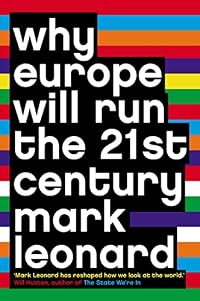
Why Europe Will Run the 21st Century
by Mark Leonard
On This Page
Description
Those who believe Europe to be weak and ineffectual are wrong. Turning conventional wisdom on its head Why Europe Will Run the 21st Century sets out a vision for a century in which Europe will dominate, not America. This is the book that will make your mind up about Europe. Those who believe Europe is weak and ineffectual are wrong. Turning conventional wisdom on its head, Mark Leonard, one of the UK's most visionary thinkers, argues that Europe is remaking the world in its own image. Europe show more only looks dead because it is seen through American eyes. But America's reach is shallow and narrow. It can bribe, bully or impose its will anywhere in the world, but when its back is turned its potency wanes. Europe's reach is broad and deep, spreading its values from Albania to Zambia. It brings other countries into its orbit rather than defining itself against them, and once countries come under the influence of its laws and customs they are changed for ever. This book sets up a challenge: to regard Europe not as a tangle of bureaucracy and regulation, but as a revolutionary model for the future. We cannot afford to forget that Europe was founded to protect us against war and that it is now key to the spread of democracy. 'Why Europe Will Run the 21st Century' addresses Europe's place in the world, looks to the past and the future and argues, provocatively, that it can and will shape a new and better world order. show lessTags
Recommendations


















Member Reviews
Some interesting ideas here - Europe operates as a network of countries rather than a power-house or federation of states; it attracts adherents to "join its club", and hence expands outwards by influence rather than domination; and all countries share the same core objectives: commitment to unilateral action; democrary, human rights and the international rule of law; and negotiation and engagement rather than military force (p. 32). I can't say the writing is the best - some is repetitive, and it's a bit disorganized. But, overall, the ideas are of interest. The end result - nation-states, operating since the mid-1400s, when Florence, Rome, Naples, Venice and Milan dominated the Italian peninsula (p.26), have been superseded by show more regional alliances, and the EU leads the way. It's premise and practices show us how to negotiate this new territory. So, it behooves us to understand what's happening... show less
http://nhw.livejournal.com/922824.html
Leonard's short book is a positive polemic - an assertion that the EU model is not only stable and viable, but that it will prove infectious and beneficial to the rest of the world. He tackles the economics as well, arguing that the demographic crisis is much less grave than some fear, and that the euro will prove a magnet. He writes of the "Eurosphere", the European, Middles Eastern and African states which he believes will naturally look to the EU as their geopolitical centre of gravity, especially as US influence recedes. It's an attractive vision, the kind of thing I always chide Commission officials for failing to produce. One can quibble with the details (eg on Macedonia, where in one brief show more paragraph he doesn't quite get the sequence of events straight) but the overall thrust of the argument is attractive. Since writing the book, Leonard has been made the head of a new think-tank promoting precisely these ideas. show less
Leonard's short book is a positive polemic - an assertion that the EU model is not only stable and viable, but that it will prove infectious and beneficial to the rest of the world. He tackles the economics as well, arguing that the demographic crisis is much less grave than some fear, and that the euro will prove a magnet. He writes of the "Eurosphere", the European, Middles Eastern and African states which he believes will naturally look to the EU as their geopolitical centre of gravity, especially as US influence recedes. It's an attractive vision, the kind of thing I always chide Commission officials for failing to produce. One can quibble with the details (eg on Macedonia, where in one brief show more paragraph he doesn't quite get the sequence of events straight) but the overall thrust of the argument is attractive. Since writing the book, Leonard has been made the head of a new think-tank promoting precisely these ideas. show less
Ratings
Members
- Recently Added By
Author Information
28 Works 385 Members
Mark Leonard is Director of Foreign Policy at the Centre for European Reform, where he works on transatlantic relations, the Middle East and EU-China relations.
Common Knowledge
- Important places
- Europe
- Original language
- English
Classifications
Statistics
- Members
- 146
- Popularity
- 223,501
- Reviews
- 2
- Rating
- (3.21)
- Languages
- 7 — Chinese, Dutch, English, French, German, Spanish, Swedish
- Media
- Paper, Ebook
- ISBNs
- 10
- ASINs
- 1