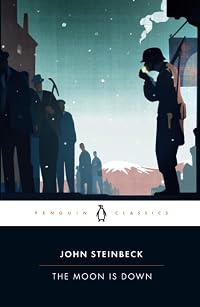
The Moon Is Down
by John Steinbeck
On This Page
Description
This seems a simple -- almost an obvious book -- until its overtones and undertones begin to do their deadly work. Then one realizes that, compact in less than 200 pages, is the story of what is happening to the conquerors and the conquered the world over, today. The yeast of freedom, of democracy, the soul of unconquerable man, is working to destroy those who deny freedom. No country is named -- but it might be Norway. No person nor persons are named -- but their types are truly drawn. show more Mayor Orden stands as a hero with none of the trappings of heroism. Curseling, the traitor, epitomizes the Quislings of the world. And the story? A tale of the unnamed men and women who are breaking the morale of the conquering beast with silence, hate, mass resentment, and the use of weapons forged by imagination and passion while the weapons of the enemy become powerless to break their strength, their unity of anger. An extraordinary achievement. show lessTags
Recommendations


































Member Recommendations


raton-liseur Publiés la même année (1942) et en français par le même éditeur (les Editions de Minuit), ces courts récits portent tous deux un regard original sur la relation entre l’occupant et l’occupé, redonnent un visage humain aux protagonistes du conflit et délivrent, quoique de façon différente, un message de dignité et de fidélité aux principes humanistes.

CGlanovsky Involving the reactions of communities under German occupation
Member Reviews
To hold this book in my hands means something
There was once a time and in many places where having this book would have gotten me shot. It humbles me to think of the people who risked their lives simply to read this slim book by Steinbeck. That was during WW II, when to read it wasn't only a risk under the Nazis but it was also a risk in Italy under Mussolini and in China under the Japanese.
According to the Penguin Classics Introduction by Donald V. Coers, read it they did, by the tens of thousands, in Norway, Denmark, The Netherlands, France, Switzerland, China and anywhere else where people were under totalitarian regimes, or under that fear. They illegally read it, translated it, made clandestine mimeographed copies of it, and with show more great risk they distributed it, and each step had the most frightening of possible consequences.
Those tens of thousands were so inspired that they knew they had to put this book in the hands of others, pass along hope and courage, to strengthen resistance. As spoken by one of the characters in the novel, it was resistance against "thieves of freedom".
Steinbeck's inspiration for The Moon Is Down came when Western Europeans began to flee occupied countries to America, years before Pearl Harbor. He interviewed them and wanted to tell their stories and to educate America. (See also Address Unknown published in 1938.) But something remarkable happened with The Moon Is Down, published in March 1942: this book possibly made its bigger impact on the non-American readers living under those various occupations, the illegal readers. Steinbeck took some American criticism for the book (too naive, they said), but not too naive for the humans around the world directly suffering invasion and oppression. Seems to me they would be best to judge what was naive and what was not and in great numbers they judged it to be right on the money.
I loved reading this book. It was heartening to read about righteousness, especially in a time when racism and violence are touted as "good people on both sides." Hmph. Good people with wicked intentions, is that a thing?
I would like to distribute copies of this book myself, to those who are most recently confused on the the different sides of good and evil. I'd like to send 112 to the now dysfunctional Republicans in the U.S. House of Representatives who voted against supporting Ukraine on Saturday, April 20, 2024. Compare those Nay votes with the votes on December 8, 1941 when apparently all of Congress was a tad clearer on its stance against totalitarian attacks on a Democratic country. There was just 1 Nay vote then.
Or instead maybe I should send 311 copies of The Moon Is Down as a thank you to all those who voted Yea. The bill passed. show less
There was once a time and in many places where having this book would have gotten me shot. It humbles me to think of the people who risked their lives simply to read this slim book by Steinbeck. That was during WW II, when to read it wasn't only a risk under the Nazis but it was also a risk in Italy under Mussolini and in China under the Japanese.
According to the Penguin Classics Introduction by Donald V. Coers, read it they did, by the tens of thousands, in Norway, Denmark, The Netherlands, France, Switzerland, China and anywhere else where people were under totalitarian regimes, or under that fear. They illegally read it, translated it, made clandestine mimeographed copies of it, and with show more great risk they distributed it, and each step had the most frightening of possible consequences.
Those tens of thousands were so inspired that they knew they had to put this book in the hands of others, pass along hope and courage, to strengthen resistance. As spoken by one of the characters in the novel, it was resistance against "thieves of freedom".
Steinbeck's inspiration for The Moon Is Down came when Western Europeans began to flee occupied countries to America, years before Pearl Harbor. He interviewed them and wanted to tell their stories and to educate America. (See also Address Unknown published in 1938.) But something remarkable happened with The Moon Is Down, published in March 1942: this book possibly made its bigger impact on the non-American readers living under those various occupations, the illegal readers. Steinbeck took some American criticism for the book (too naive, they said), but not too naive for the humans around the world directly suffering invasion and oppression. Seems to me they would be best to judge what was naive and what was not and in great numbers they judged it to be right on the money.
I loved reading this book. It was heartening to read about righteousness, especially in a time when racism and violence are touted as "good people on both sides." Hmph. Good people with wicked intentions, is that a thing?
I would like to distribute copies of this book myself, to those who are most recently confused on the the different sides of good and evil. I'd like to send 112 to the now dysfunctional Republicans in the U.S. House of Representatives who voted against supporting Ukraine on Saturday, April 20, 2024. Compare those Nay votes with the votes on December 8, 1941 when apparently all of Congress was a tad clearer on its stance against totalitarian attacks on a Democratic country. There was just 1 Nay vote then.
Or instead maybe I should send 311 copies of The Moon Is Down as a thank you to all those who voted Yea. The bill passed. show less
Pablo Picasso is credited with saying something like, “Art is the lie that reveals the truth.” Literature rises above being just good writing, just a good book, or just a good poem by saying so much more than the literal meaning of its words. It reveals truths, stirs and awakens feelings, captures insight and profound revelation, and alters the ways readers see the world. It is transformative. In addition to, and more than entertaining, it is inspiring.
At its literal level, The Moon Is Down tells the story of an anonymous town “conquered” by an anonymous invader. But Steinbeck’s brilliance shows in the very choice of making both the town and the invader anonymous because to give either the town or the invader names would be to show more tell a specific story rather than to reveal a broader truth: The Moon Is Down is about any town, any conquerer, any war.
The truth Steinbeck reveals is that people can be beaten, be conquered, even be enslaved, but they cannot be defeated. Throughout time, the human spirit has risen to the challenge of conquest again and again. Conquering armies deliver the conquered either tyranny or benevolence, but at the expense of the conquered’s freedom, the freedom of any person to determine his own destiny.
In The Moon Is Down, toward the end of the book, Steinbeck uses the story of the death of Socrates as the clearest articulation of his message. By choosing to tell the story of a philosopher who perished at the hands of tyranny thousands of years ago, Steinbeck emphasizes that the message is not new, it has all been delivered before, and yet it remains unlearned.
Armies continue to invade and defeat enemies and yet in so doing, they only elevate rather than defeat the human spirit. show less
1942 wartime novel where the unnamed enemy invade a British island (I'm thinking Germans on Channel Islands?)
We get to know the Germans- the indoctrinated rule follower, the depressed one, struggling with the silent hatred of the locals.
And, too, the locals- the traitor, the quietly courageous..
And the overarching message that whatever the invaders do to individuals, they can't stop the uprising:
"They know that ten heads lopped off will destroy them, but we have people, and in a time of need leaders pop up among us like mushrooms."
In a time of gov control and censorship...and with more enlightened folk every day refusing to comply with covid lies, this felt a really relevant book...
We get to know the Germans- the indoctrinated rule follower, the depressed one, struggling with the silent hatred of the locals.
And, too, the locals- the traitor, the quietly courageous..
And the overarching message that whatever the invaders do to individuals, they can't stop the uprising:
"They know that ten heads lopped off will destroy them, but we have people, and in a time of need leaders pop up among us like mushrooms."
In a time of gov control and censorship...and with more enlightened folk every day refusing to comply with covid lies, this felt a really relevant book...
Soldiers loyally following their Leader act on the advice of a small coal mining town’s traitor to take it over for the benefit of their ongoing war. The Moon Is Down by John Steinbeck is wartime novella about a how occupying soldiers learn that peaceful townspeople do not like being told what to do.
Taken by surprise, a small coastal town is overrun by an invading army with little resistance. The town is important because it is a port that serves a large coal mine. Colonel Lanser, the head of the invading battalion, along with his staff establishes their HQ in the house of Orden, the democratically elected and popular Mayor. As the reality of occupation sinks in and the weather turns bleak, with the snows beginning earlier than usual, show more the townspeople are getting angry and confused. Lanser, a veteran of many wars, tries to operate under a veil of civility and law, but knows that amongst those whose freedom has been taken away by force there are no peaceful people. A miner quits and when kills an officer who orders him back to work in the mine. After a summary trial, the man is executed by a firing squad, but the incident catalyzes the people of the town to begin resisting. Transportation and communication lines are taken out, mine machinery breaks down often, and whenever soldiers get comfortable, they are killed including a young lieutenant infatuated with the widow of the miner who stabs him to death before escaping to the hills. The cold weather and the constant fear destroy the occupying force’s morale, many of whom wish the war to end so that they can return home. Members of the resistance escape to England and ask the English for explosives so that the townspeople can intensify their efforts. English planes parachute-drop small packages containing dynamite sticks and chocolates all around the town. In a state of panic, Lanser takes the Mayor and his friend Dr. Winter, the town doctor and historian, hostage and lets it be known that any guerilla action will lead to their execution. Mayor Orden knows his people will not stop active resistance and accept his imminent death. Knowing that the townspeople will use the dynamite any moment, Orden and Winter discuss Socrates in front of a stunned Lanser until the first explosion. Orden calmly walks out the door before Lanser can verbally order his execution.
Published in the spring of 1942, Steinbeck wrote this obvious propogandist novella to inspire the Allied war effort and through clandestine publishing in occupied Europe to inspire resistance fighters against their German occupiers as well as collaborators. While the town and country are unnamed, it was not hard to tell it was Norway given the clues Steinbeck sprinkled throughout the text.
The Moon Is Down is also a wonder example of John Steinbeck’s writing that is a quick read for anyone deciding if they want to read his more famous works to learn his style. While written for more political than literary purposes that does not diminish the impact of the narrative nor does Steinbeck not put in his best work. show less
Taken by surprise, a small coastal town is overrun by an invading army with little resistance. The town is important because it is a port that serves a large coal mine. Colonel Lanser, the head of the invading battalion, along with his staff establishes their HQ in the house of Orden, the democratically elected and popular Mayor. As the reality of occupation sinks in and the weather turns bleak, with the snows beginning earlier than usual, show more the townspeople are getting angry and confused. Lanser, a veteran of many wars, tries to operate under a veil of civility and law, but knows that amongst those whose freedom has been taken away by force there are no peaceful people. A miner quits and when kills an officer who orders him back to work in the mine. After a summary trial, the man is executed by a firing squad, but the incident catalyzes the people of the town to begin resisting. Transportation and communication lines are taken out, mine machinery breaks down often, and whenever soldiers get comfortable, they are killed including a young lieutenant infatuated with the widow of the miner who stabs him to death before escaping to the hills. The cold weather and the constant fear destroy the occupying force’s morale, many of whom wish the war to end so that they can return home. Members of the resistance escape to England and ask the English for explosives so that the townspeople can intensify their efforts. English planes parachute-drop small packages containing dynamite sticks and chocolates all around the town. In a state of panic, Lanser takes the Mayor and his friend Dr. Winter, the town doctor and historian, hostage and lets it be known that any guerilla action will lead to their execution. Mayor Orden knows his people will not stop active resistance and accept his imminent death. Knowing that the townspeople will use the dynamite any moment, Orden and Winter discuss Socrates in front of a stunned Lanser until the first explosion. Orden calmly walks out the door before Lanser can verbally order his execution.
Published in the spring of 1942, Steinbeck wrote this obvious propogandist novella to inspire the Allied war effort and through clandestine publishing in occupied Europe to inspire resistance fighters against their German occupiers as well as collaborators. While the town and country are unnamed, it was not hard to tell it was Norway given the clues Steinbeck sprinkled throughout the text.
The Moon Is Down is also a wonder example of John Steinbeck’s writing that is a quick read for anyone deciding if they want to read his more famous works to learn his style. While written for more political than literary purposes that does not diminish the impact of the narrative nor does Steinbeck not put in his best work. show less
John Steinbeck was America's Vercors (The Silence of the Sea). The Moon is Down transformed European Resistance, not with a love story, but by breaking The Silence with dynamite.
He explored the depth of Occupation hatred, not by exposing more brutal German savagery, rather letting the words of both the German soldiers and the Mayor and the people of his town
illuminate both good and evil.
How can we not have learned that life is not about killing?
He explored the depth of Occupation hatred, not by exposing more brutal German savagery, rather letting the words of both the German soldiers and the Mayor and the people of his town
illuminate both good and evil.
How can we not have learned that life is not about killing?
The first thing you should know about “The Moon Is Down” by John Steinbeck is that it was written in March 1942 as Allied propaganda. It tells a story of the invasion and occupation of a small northern European village. The parties are not named, but it’s a clear depiction of the invasion of Norway by SS troops. It was clearly written to bolster the resolve of Allied soldiers and remind them that a larger, more powerful force is no match for the human spirit and our innate desire for freedom.
The second thing you should know is that it was published simultaneously as a novel and a play. The book is written in a manner that makes this clear. Short, impactful episodes with powerful dialogue tell a story of how the villagers resist show more their occupier; how the village mayor negotiates with and debates the decisions of the invading general; and how much of a moral, emotional and physical strain occupation is on the occupier.
I’m an anarcho-pacifist, so wartime propaganda leaves me uninspired, but I think this book is worth reading. The Moon is Down is a short, concise book (barely over 100 pages), but we’re not robbed of Steinbeck’s glorious, soul-inspiring writing style:
“In marching, in mobs, in football games, and in war, outlines become vague; real things become unreal and a fog creeps over the mind. Tension and excitement, weariness, movement–all merge in one great gray dream, so that when it is over, it is hard to remember how it was when you killed men or ordered them to be killed. Then other people who were not there tell you what it was like and you say vaguely, “yes, I guess that’s how it was.” ― John Steinbeck, The Moon Is Down
Second, the book is clear about the corrosive futility of occupation and the resistance of the human spirit, even when ‘conquered’ by outside forces. In this present day, as the world watches another occupation attempt to crush the spirits and destroy the hopes of millions of people in Gaza, we see the truth in statements like, “They know that ten heads lopped off will destroy them, but we are a free people; we have as many heads as we have people, and in a time of need leaders pop up among us like mushrooms.”
I’m not in love with this book, but it’s a fascinating read and there are some very deep, universal truths peppered throughout that are worth consideration 83 years and six milllion “never agains” later. show less
The second thing you should know is that it was published simultaneously as a novel and a play. The book is written in a manner that makes this clear. Short, impactful episodes with powerful dialogue tell a story of how the villagers resist show more their occupier; how the village mayor negotiates with and debates the decisions of the invading general; and how much of a moral, emotional and physical strain occupation is on the occupier.
I’m an anarcho-pacifist, so wartime propaganda leaves me uninspired, but I think this book is worth reading. The Moon is Down is a short, concise book (barely over 100 pages), but we’re not robbed of Steinbeck’s glorious, soul-inspiring writing style:
“In marching, in mobs, in football games, and in war, outlines become vague; real things become unreal and a fog creeps over the mind. Tension and excitement, weariness, movement–all merge in one great gray dream, so that when it is over, it is hard to remember how it was when you killed men or ordered them to be killed. Then other people who were not there tell you what it was like and you say vaguely, “yes, I guess that’s how it was.” ― John Steinbeck, The Moon Is Down
Second, the book is clear about the corrosive futility of occupation and the resistance of the human spirit, even when ‘conquered’ by outside forces. In this present day, as the world watches another occupation attempt to crush the spirits and destroy the hopes of millions of people in Gaza, we see the truth in statements like, “They know that ten heads lopped off will destroy them, but we are a free people; we have as many heads as we have people, and in a time of need leaders pop up among us like mushrooms.”
I’m not in love with this book, but it’s a fascinating read and there are some very deep, universal truths peppered throughout that are worth consideration 83 years and six milllion “never agains” later. show less
The Moon Is Down by John Steinbeck is a small gem of simplification whereby he shows that being the conqueror isn’t quite the pretty picture of victory that many believe. A seemingly easy invasion has this army celebrating it’s victory and making plans for the future. They slowly become aware that although this country has lost the battle, the war goes on. The populace is sullen and proud, and the conquerors dare not turn their backs. Soldiers who go out on their own seldom return. Reprisals only seem to make the people more determined to quietly fight on for the freedom they have lost.
Published in 1942, this propaganda piece tells the story of the military occupation of a small mining town, bringing to mind the invasion of Norway show more by the Germans during World War II. Without specifically naming the Nazi’s, this is obviously a literary work that was meant to inspire and motive the resistance movement throughout Europe.
Steinbeck writes of the trials and tribulations of both the oppressed and the oppressor, and he avoids the trap of making the Germans unnecessarily evil and the Norwegians overly heroic. Yet, evil is present and the heroic quietly stand tall. These are real people caught up in the drama of war, his characters from the gentle, patriotic mayor to the intelligent, conflicted enemy commander are well drawn and vividly portray the anguish and brutality that war and occupation brings to ordinary people. show less
Published in 1942, this propaganda piece tells the story of the military occupation of a small mining town, bringing to mind the invasion of Norway show more by the Germans during World War II. Without specifically naming the Nazi’s, this is obviously a literary work that was meant to inspire and motive the resistance movement throughout Europe.
Steinbeck writes of the trials and tribulations of both the oppressed and the oppressor, and he avoids the trap of making the Germans unnecessarily evil and the Norwegians overly heroic. Yet, evil is present and the heroic quietly stand tall. These are real people caught up in the drama of war, his characters from the gentle, patriotic mayor to the intelligent, conflicted enemy commander are well drawn and vividly portray the anguish and brutality that war and occupation brings to ordinary people. show less
Members
- Recently Added By
Lists

Top Five Books of 2013
1,562 works; 715 members

20th Century Literature
1,161 works; 54 members

Stories of War and Revolution
143 works; 54 members

War Literature
101 works; 19 members

Books about World War II
241 works; 22 members

Publisher's Weekly Bestsellers - Part II - 1940 - 1979
355 works; 5 members

Read
293 works; 4 members
THE WAR ROOM
813 works; 24 members

2023 Reads
26 works; 1 member

Evan's Wish List
86 works; 2 members

Reading LIst
648 works; 1 member

Top Five Books of 2025
954 works; 303 members

el
1,139 works; 1 member
Talk Discussions
Past Discussions
Steinbeckathon 2012: The Moon is Down in 75 Books Challenge for 2012 (May 2012)
Author Information

479+ Works 206,882 Members
In recent years Steinbeck has been elevated to a more prominent status among American writers of his generation. If not quite at the world-class artistic level of a Hemingway or a Faulkner, he is nonetheless read very widely throughout the world by readers of all ages who consider him one of the most "American" of writers. Born in Salinas County, show more California on February 27, 1902, Steinbeck was of German-Irish parentage. After four years as a special student at Stanford University, he went to New York, where he worked as a reporter and as a hod carrier. Returning to California, he devoted himself to writing, with little success; his first three books sold fewer than 3,000 copies. Tortilla Flat (1935), dealing with the paisanos, California Mexicans whose ancestors settled in the country 200 years ago, established his reputation. In Dubious Battle (1936), a labor novel of a strike and strike-breaking, won the gold medal of the Commonwealth Club of California. Of Mice and Men (1937), a long short story that turns upon a melodramatic incident in the tragic friendship of two farm hands, written almost entirely in dialogue, was an experiment and was dramatized in the year of its publication, winning the New York Drama Critics Circle Award. It brought him fame. Out of a series of articles that he wrote about the transient labor camps in California came the inspiration for his greatest book, The Grapes of Wrath (1939), the odyssey of the Joad family, dispossessed of their farm in the Dust Bowl and seeking a new home, only to be driven on from camp to camp. The fiction is punctuated at intervals by the author's voice explaining this new sociological problem of homelessness, unemployment, and displacement. As the American novel "of the season, probably the year, possibly the decade," it won the Pulitzer Prize in 1940. It roused America and won a broad readership by the unusual simplicity and tenderness with which Steinbeck treated social questions. Even today, The Grapes of Wrath remains alive as a vivid account of believable human characters seen in symbolic and universal terms as well as in geographically and historically specific ones. Ma Joad is one of the most memorable characters in twentieth-century American fiction. It is her courage that sustains the family. Steinbeck's best and most ambitious novel after The Grapes of Wrath is East of Eden (1952), a saga of two American families in California from before the Civil War through World War I. Cannery Row (1945), The Wayward Bus (1947), and Sweet Thursday (1955) are lighter works that find Steinbeck returning to the lighthearted tone of Tortilla Flat as he recounts picaresque adventures of modern-day picaros. The Winter of Our Discontent (1961) struck some reviewers as being appropriately titled because of its despairing treatment of humanity's fall from grace in a wasteland world where money is king. Steinbeck also wrote important nonfiction, including Russian Journal (1948) in collaboration with the photographer Robert Capa; Once There Was a War (1958) and America and Americans (1966), which features pictures by 55 leading photographers and a 70-page essay by Steinbeck. His interest in marine biology led to two books primarily about sea life, Sea of Cortez (1941) (with Edward F. Ricketts) and The Log from the Sea of Cortez (1951). Travels with Charley (1962) is an engaging account of his journey of rediscovery of America, which took him through approximately 40 states. Steinbeck was married three times and died in New York City on December 20, 1968 of heart disease and congestive heart failure. He was 66, and had been a life-long smoker. (Bowker Author Biography) show less
Some Editions
Awards and Honors
Distinctions
Series
Belongs to Publisher Series
Diana Reihe (20)
Work Relationships
Is contained in
Has the adaptation
Is abridged in
Has as a study
Has as a student's study guide
Common Knowledge
- Canonical title
- The Moon Is Down
- Original title
- The Moon Is Down
- Original publication date
- 1942
- People/Characters
- Mayor Orden; Doctor Winter; Alexander Morden; Molly Morden; George Corell; Colonel Lanser (show all 12); Captain Bentick; Lieutenant Tonder; Captain Loft; Lieutenant Prackle; Joseph; Annie
- Important places
- Norway
- Important events
- World War II
- Dedication
- To
PAT CONVICI
A Great Editor and
a Great Friend - First words
- By ten-forty-five it was all over.
- Quotations
- ... one of the tendencies of the military mind and pattern is an inability to learn, an inability to see beyond the killing which is its job.
We trained our young men for victory and you've got to admit they're glorious in victory, but they don't quite know how to act in defeat.
They think that just because they have only one leader and one head, we are all like that. They know that ten heads lopped off will destroy them, but we are a free people; we have as many heads as we have people, and in a tim... (show all)e of need leaders pop up among us like mushrooms. - Last words
- (Click to show. Warning: May contain spoilers.)And Winter nodded slowly. "Yes, you remembered. The debt shall be paid."
- Blurbers
- Gunther, John
- Original language
- English
- Canonical LCC
- 9514803
- Disambiguation notice*
- Original title: The Moon is Down
*Some information comes from Common Knowledge in other languages. Click "Edit" for more information.
Classifications
- Genres
- Fiction and Literature, General Fiction, Historical Fiction
- DDC/MDS
- 813.52 — Literature & rhetoric American literature in English American fiction in English 1900-1999 1900-1945
- LCC
- PS3537 .T3234 .M6 — Language and Literature American literature American literature Individual authors 1900-1960
- BISAC
Statistics
- Members
- 3,935
- Popularity
- 3,992
- Reviews
- 122
- Rating
- (3.86)
- Languages
- 19 — Czech, Danish, Dutch, English, Finnish, French, German, Greek, Hungarian, Italian, Norwegian (Bokmål), Polish, Portuguese, Romanian, Croatian, Spanish, Swedish, Thai, Turkish
- Media
- Paper, Audiobook, Ebook
- ISBNs
- 63
- ASINs
- 90