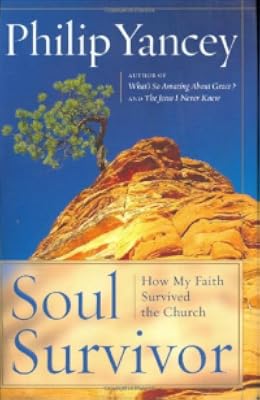
Soul Survivor: How Thirteen Unlikely Mentors Helped My Faith Survive the Church
by Philip Yancey
On This Page
Description
One of America's leading Christian thinkers interweaves the story of his own struggle to reclaim his beliefs with inspiring portraits of people who have succeeded in the pursuit of an authentic faith. In Soul Survivor, Philip Yancey charts his spiritual pilgrimage through the influence of key individuals: "These are the people who ushered me into the Kingdom. In many ways, they are why I remain a Christian today, and I want to introduce them to other spiritual seekers." Yancey interweaves show more his own journey with fascinating stories of those who modeled for him a life-enhancing rather than a life-constricting faith: Dr. Paul Brand, G. K. Chesterton, Annie Dillard, Frederick Buechner, C. Everett Koop, Leo Tolstoy, Fyodor Dostoevsky, Henri Nouwen, John Donne, Mahatma Gandi, Shusaku Endo, Martin Luther King, Jr., Robert COles. Readers will find these inspiring portraits both nurture and challenge for their own understanding of authentic faith. Yancey fans will devour these new glimpses of how he has held onto faith while acknowledging with utter honesty its inherent difficulties. New Yancey readers will be drawn in by the theme of faith versus religion and drawn along a compelling narrative of signposts on a spiritual journey. Soul Survivor offers illuminating and critically important insights into true Christianity, which will enrich the lives of veteran believers and cautious seekers alike. show lessTags
Recommendations




Member Recommendations
pezmedia Brings the bible to life, gives the reader a sense of urgency to preach the gospel and encourages true worship. I benefited from reading it.
Member Reviews
Yancey's "Soul Survivor" presents us with 13 individuals whose lives and writings allowed him to hold on to his faith despite his extreme disappointment with his southern fundamentalist upbringing. His early church's racism and legalism left him with doubts about the very truths of the "good news" of the gospel and the grace of God. He focuses primarily on Christians (among them Martin Luther King, Jr., G.K. Chesterson, Paul Brand, and John Donne), but also includes Mahatma Gandhi who rejected Christianity while adopting many of Christ's teachings. Yancey makes it clear that each "spiritual director" is flawed and yet each held on to his/her faith despite their doubts, sins, rejection, and sometimes severe physical costs. Each of these show more guides strove to have a real relationship with God and to share that grace with others in the best way they knew how. Raised as a fundamentalist, I've been facing my own struggles with the hypocrisy of the Church. I found this book a particularly timely reminder that we must keep our eyes on the God of the Bible, and not those who claim to be Christ's namesakes. Christianity is about grace (unmerited favor), not judgment, sin, patriotism or politics, or business practices. show less
Yancey's writing is a breath of fresh air amidst so many Christian books on doctrine, end times, family dynamics and other hot topics. He doesn't write from a position of authority, but from the point of view of a questioner, learning as he writes.
This particular book gives potted biographies of thirteen men and women who have had profound influences on Yancey's life and faith. They're not great campaigners of the modern church, or even martyrs of old. Instead, these are flawed people of the 20th century, often struggling themselves with questions of life and faith.
One of them, Mahatma Ghandi, never became a Christian at all although his life of peace was in many ways Christlike. Most of them were writers - Tolstoy, Donne, Chesterton, show more for instance - who left behind powerful legacies of the written word, yet whose lives were tormented in various ways, physical or emotional.
I didn't find this as thought-provoking as many of Yancey's books, but it was an interesting read and showed me new ways of looking at the various writers he describes.
If you’re interested by how different kinds of writing can affect someone’s faith profoundly, then this is a good book to read. If you like Yancey’s writing and are interested in some of the background to how he reached his current beliefs, then this fills in some of the picture well. However, as a stand-alone book it’s not particularly inspiring; I’m glad I re-read it, ten years after originally reading it, but it didn’t do anything for me second time around, and I wouldn’t recommend it as an introduction to his work.
I rated it four stars the first time I read it; three-and-a-half would be fairer. show less
This particular book gives potted biographies of thirteen men and women who have had profound influences on Yancey's life and faith. They're not great campaigners of the modern church, or even martyrs of old. Instead, these are flawed people of the 20th century, often struggling themselves with questions of life and faith.
One of them, Mahatma Ghandi, never became a Christian at all although his life of peace was in many ways Christlike. Most of them were writers - Tolstoy, Donne, Chesterton, show more for instance - who left behind powerful legacies of the written word, yet whose lives were tormented in various ways, physical or emotional.
I didn't find this as thought-provoking as many of Yancey's books, but it was an interesting read and showed me new ways of looking at the various writers he describes.
If you’re interested by how different kinds of writing can affect someone’s faith profoundly, then this is a good book to read. If you like Yancey’s writing and are interested in some of the background to how he reached his current beliefs, then this fills in some of the picture well. However, as a stand-alone book it’s not particularly inspiring; I’m glad I re-read it, ten years after originally reading it, but it didn’t do anything for me second time around, and I wouldn’t recommend it as an introduction to his work.
I rated it four stars the first time I read it; three-and-a-half would be fairer. show less
I enjoyed reading this book. Philip Yancey reflects on 13 people who helped him grow spiritually after his walking away from Christianity and then coming back to the faith in his college years. He grew up in church and his family was Christian, so he knew a lot about conservative Christian culture and he could see so many things wrong with it. These 13 people helped him see that there is more to walking in the faith than following the moral rules he grew up with and inspired him to live his life following Christ. He wrote about MLK, G. K. Chesterton, Paul Brandt, Robert Coles, Leo Tolstoy, Fyodor Dostoevsky, Mahatma Gandhi, C. Everett Koop, Henri Nouwen, Shusaku Endo, John Donne, Annie Dillard, and Frederick Buechner. I only knew around show more 5 people on this list, and not well. So I had an eye-opening time learning about their them and what aspects of their lives inspired the author in his Christian walk. I think, because of the author's early negative experience with church people, people who talked or behaved as if they come from that background did not inspire him. In fact, he included some people who many Christians will probably frown upon -- I mean, come on, Gandhi is not even a Christian lol But I can see why the lives of these people have so much appeal to him, and after finishing this book, I share his admiration for them as well. And I'm quite inspired by several of them, including Gandhi, in terms of what the Christian faith should look like. The author is drawn to people who speak out against injustice, who help the poor or the patients with stigmatized illness, who embrace Jesus's teaching of nonviolence and forgiveness, who move "downward" in career for spiritual growth, who humble themselves before the problem of pain and death without lecturing to others about it, who communicate the kingdom of heaven and God's grace and creation in a way that is easy for nonbelievers to understand. (He is also drawn to writers -- 10 writers on this list of 13 people lol. I secretly feel it's a little much :P) Anyways, highly recommend. Really happy the first book I finished in the year of 2022 is such a good book. show less
When I want to revert to my evangelical roots, I turn to the works of Philip Yancey. An editor-at-large for the magazine Christianity Today and the winner of many awards from the conservative Christian camp, he certainly has the credentials of an evangelical. In a book blurb, Billy Graham is quoted as saying, “There is no writer in the evangelical world that I admire and appreciate more.” Yet he speaks with none of that narrow, arrogant, legalistic dogmatism so characteristic of those leaders who represent evangelicals nationally and politically.
When I have read, and been enlightened by, the works of the modernist Marcus Borg, of the Jesus Seminar, I often turn for balance to Yancey. Though they represent what might be considered show more opposite poles of the theological spectrum, in many ways they speak with the same language: unpretentious, personal, candid, clear, stable, spiritual. Along with Borg’s Meeting Jesus Again for the First Time, I read Yancey’s The Jesus I Never Knew; along with Borg’s Reading the Bible Again for the First Time, I read Yancey’s The Bible Jesus Read. Along with Borg’s The God We Never Knew, or even the New Age Conversations with God by Neale Donald Walsch, I read Yancey’s Reaching for the Invisible God. The differences, of course, are readily apparent, but so is a sense of continuity.
In personal accounts of their youth, both Borg and Yancey speak of the narrow institutionalism of the churches in which they grew up and of their struggle with faith and doubt in their young adult years. Indeed, the subtitle of the book I am about to review, perhaps my favorite among Yancey’s works, is How Thirteen Unlikely Mentors Helped My Faith Survive the Church. Surviving the church? That’s hardly what one expects from a Billy Graham evangelical. But for many Christians, it's just what we need: how to survive the church.
The book is Soul Survivor (Galilee Doubleday paperback, 2003). The first edition had been set for release by the publisher just a week or so after September 11, 2001. In his preface to the paperback, Yancey tells how the book will always be associated in his mind with that disastrous day. “I grew up in a cloistered, fundamentalist environment in a South of legislated racism,” he says. Writing this book had helped him do what we all must eventually do: “define ourselves, carve out an identity”: “An event like September 11,” he insists, “speeds up the process by compressing time, chasing away distractions, and forcing us to focus on what matters most.”
The first chapter of Soul Survivor is entitled, “Recovering from Church Abuse.” It speaks frankly but eloquently of the damage churches sometimes do and of his own struggle to overcome the limitations of the religion within which he grew up. Just a few quotations capture his voice and something of his attitude:
“I kept reminding myself that I had nearly abandoned the Christian faith in reaction against this church [of my youth], and I felt deep sympathy for those [like my brother] who had.”
“Although I heard that ‘God is love,’ the image of God I got from sermons more resembled an angry, vengeful tyrant.”
“But alone in my room, controlling every turn of the page, I met other representatives of faith—C. S. Lewis, G. K. Chesterton, John Donne—whose calmer voices traversed time to convince me that somewhere Christians lived who knew grace as well as law, love as well as judgment, reason as well as passion.”
“Sometimes I feel like the most liberal person among conservatives, and sometimes like the most conservative among liberals. How can I fit together my religious past with my spiritual person?”
“The people in this book are select representatives of those I have learned from and am challenged by. . . . Not all are orthodox Christians and one, Mahatma Gandhi, decided against the Christian faith. Yet all were permanently changed by their contact with Jesus.”
“The thirteen people you will meet here have one thing in common: their impact on me. For that reason, in each chapter I have asked myself what difference they made in my life.”
In the book, Yancey traces his own growth and development as a writer and believer, under the influence of his own heroes. Look at his list of thirteen: Martin Luther King, G. K. Chesterton, Dr. Paul Brand, Dr. Robert Coles, Leo Tolstoy and Feodor Dostoevsky, Mahatma Gandhi, Dr. C. Everett Koop, John Donne, Annie Dillard, Frederick Buechner, Shusaku Endo, and Henri Nouwen. If some of those names sound unfamiliar to you, they won’t be when you read Yancey’s chapters devoted to them. You will know and admire them, and want to know more.
On a practical level, each chapter ends with a note for those wanting to get started reading works by and about that mentor. A lifetime of reading and of spiritual growth could be enhanced by these notes. His advice is straight-forward and to the point. For example, of Endo, he says, “Start with Silence, Endo’s acknowledged classic. I deeply admire Scandal also. One of his last novels, Deep River, revisits many of the themes of the earlier novels. . . . Many readers find Endo’s fiction repetitive or difficult to relate to, perhaps because of cultural differences; these might prefer the short stories collected in The Final Martyrs.”
In his epilogue Yancey gives another sound piece of advice: “Make a list of the people who have shaped your life for the better, and try to figure out why.”
The impact of Soul Survivor on me was twofold: (1) It made me keenly aware of the mentors so important in my life. All of us, I think, have surrogate fathers and mothers, who help us discover who we are and encourage us to become who we become. It is important to recognize and credit their impact on us. (2) It helped me articulate for myself the nature of my own faith, its basis in what William James called “our inarticulate feelings of reality”; its persistence in spite of the certainty of uncertainty; the sense of wholeness it sustains, and the calm and confidence it imparts as I contemplate the reaches of infinity and eternity from within my own narrow sphere of time and space. “God is spirit, and they that worship must worship in spirit, indeed.” show less
When I have read, and been enlightened by, the works of the modernist Marcus Borg, of the Jesus Seminar, I often turn for balance to Yancey. Though they represent what might be considered show more opposite poles of the theological spectrum, in many ways they speak with the same language: unpretentious, personal, candid, clear, stable, spiritual. Along with Borg’s Meeting Jesus Again for the First Time, I read Yancey’s The Jesus I Never Knew; along with Borg’s Reading the Bible Again for the First Time, I read Yancey’s The Bible Jesus Read. Along with Borg’s The God We Never Knew, or even the New Age Conversations with God by Neale Donald Walsch, I read Yancey’s Reaching for the Invisible God. The differences, of course, are readily apparent, but so is a sense of continuity.
In personal accounts of their youth, both Borg and Yancey speak of the narrow institutionalism of the churches in which they grew up and of their struggle with faith and doubt in their young adult years. Indeed, the subtitle of the book I am about to review, perhaps my favorite among Yancey’s works, is How Thirteen Unlikely Mentors Helped My Faith Survive the Church. Surviving the church? That’s hardly what one expects from a Billy Graham evangelical. But for many Christians, it's just what we need: how to survive the church.
The book is Soul Survivor (Galilee Doubleday paperback, 2003). The first edition had been set for release by the publisher just a week or so after September 11, 2001. In his preface to the paperback, Yancey tells how the book will always be associated in his mind with that disastrous day. “I grew up in a cloistered, fundamentalist environment in a South of legislated racism,” he says. Writing this book had helped him do what we all must eventually do: “define ourselves, carve out an identity”: “An event like September 11,” he insists, “speeds up the process by compressing time, chasing away distractions, and forcing us to focus on what matters most.”
The first chapter of Soul Survivor is entitled, “Recovering from Church Abuse.” It speaks frankly but eloquently of the damage churches sometimes do and of his own struggle to overcome the limitations of the religion within which he grew up. Just a few quotations capture his voice and something of his attitude:
“I kept reminding myself that I had nearly abandoned the Christian faith in reaction against this church [of my youth], and I felt deep sympathy for those [like my brother] who had.”
“Although I heard that ‘God is love,’ the image of God I got from sermons more resembled an angry, vengeful tyrant.”
“But alone in my room, controlling every turn of the page, I met other representatives of faith—C. S. Lewis, G. K. Chesterton, John Donne—whose calmer voices traversed time to convince me that somewhere Christians lived who knew grace as well as law, love as well as judgment, reason as well as passion.”
“Sometimes I feel like the most liberal person among conservatives, and sometimes like the most conservative among liberals. How can I fit together my religious past with my spiritual person?”
“The people in this book are select representatives of those I have learned from and am challenged by. . . . Not all are orthodox Christians and one, Mahatma Gandhi, decided against the Christian faith. Yet all were permanently changed by their contact with Jesus.”
“The thirteen people you will meet here have one thing in common: their impact on me. For that reason, in each chapter I have asked myself what difference they made in my life.”
In the book, Yancey traces his own growth and development as a writer and believer, under the influence of his own heroes. Look at his list of thirteen: Martin Luther King, G. K. Chesterton, Dr. Paul Brand, Dr. Robert Coles, Leo Tolstoy and Feodor Dostoevsky, Mahatma Gandhi, Dr. C. Everett Koop, John Donne, Annie Dillard, Frederick Buechner, Shusaku Endo, and Henri Nouwen. If some of those names sound unfamiliar to you, they won’t be when you read Yancey’s chapters devoted to them. You will know and admire them, and want to know more.
On a practical level, each chapter ends with a note for those wanting to get started reading works by and about that mentor. A lifetime of reading and of spiritual growth could be enhanced by these notes. His advice is straight-forward and to the point. For example, of Endo, he says, “Start with Silence, Endo’s acknowledged classic. I deeply admire Scandal also. One of his last novels, Deep River, revisits many of the themes of the earlier novels. . . . Many readers find Endo’s fiction repetitive or difficult to relate to, perhaps because of cultural differences; these might prefer the short stories collected in The Final Martyrs.”
In his epilogue Yancey gives another sound piece of advice: “Make a list of the people who have shaped your life for the better, and try to figure out why.”
The impact of Soul Survivor on me was twofold: (1) It made me keenly aware of the mentors so important in my life. All of us, I think, have surrogate fathers and mothers, who help us discover who we are and encourage us to become who we become. It is important to recognize and credit their impact on us. (2) It helped me articulate for myself the nature of my own faith, its basis in what William James called “our inarticulate feelings of reality”; its persistence in spite of the certainty of uncertainty; the sense of wholeness it sustains, and the calm and confidence it imparts as I contemplate the reaches of infinity and eternity from within my own narrow sphere of time and space. “God is spirit, and they that worship must worship in spirit, indeed.” show less
Not exactly what I thought it would be, but Yancey’s profiles of the people who influenced and helped him salvage his faith were really interesting. I learned a lot, and my to-read list got longer. Especially Chesterton. I must get to Chesterton this year.
I love Yancey. This isn’t my favorite of his work, but it’s quite honest—sometimes uncomfortably so—and it’s worth a read.
I love Yancey. This isn’t my favorite of his work, but it’s quite honest—sometimes uncomfortably so—and it’s worth a read.
So what do a former U.S. surgeon general, a poet, two well-known Russian novelists, and a closeted homosexual Catholic priest have in common? These were people who, because of the way they lived their lives according to their beliefs, impacted Yancey profoundly. Yancey, growing up in a very, very legalistic and racist church outside of Atlanta in the early 60s found himself very disillusioned with the church. "When someone tells me yet another horror story about the church, I respond, 'Oh, it's even worse than that. Let me tell you my story.' I have spent most of my life in recovery from the church." The people Yancey writes about here aided him in his recovery. Some of these names are old familiar ones but some people I met in the show more pages here were new to me:
In order of appearance:
Martin Luther King Jr.
G.K. Chesterton
Dr. Paul Brand
Dr. Robert Coles
Leo Tolstoy and Feodor Dostoevsky
Mahatma Gandhi
Dr. C. Everett Koop
John Donne
Annie Dillard
Frederick Buechner
Shusaku Endo
Henri Nouwen
Many times the essays start out a bit autobiographical. Yancey talks about his experience growing up in an extremely legalistic (no movies - "too worldly"), racist church ("... we were taught, {the Ku Klux Klan was}, a last line of defense to preserve the Christian purity of the South.") and world and how that particular experience led him to all but totally abandon his faith. Somehow or another, the list of people above crossed Yancey's path, whether in writing or in person, and instead of Yancey finding himself rejecting his Christian faith more and more found himself introduced to what an amazing force for good in the world faith can be if actually lived out by humble and sincere people. One of the strong points of the essays is the biographical information presented that may stir up some curiosity. There are people presented here that I wanted to find out more about. Fortunately, Yancey provides a list of book recommendations about the people written in each essay for the more curious readers. If I had any criticism it would be that sometimes Yancey doesn't write too clearly about exactly how each of these people impacted his journey home to faith. The reader is left, on many occasions, to simply read between the lines. show less
In order of appearance:
Martin Luther King Jr.
G.K. Chesterton
Dr. Paul Brand
Dr. Robert Coles
Leo Tolstoy and Feodor Dostoevsky
Mahatma Gandhi
Dr. C. Everett Koop
John Donne
Annie Dillard
Frederick Buechner
Shusaku Endo
Henri Nouwen
Many times the essays start out a bit autobiographical. Yancey talks about his experience growing up in an extremely legalistic (no movies - "too worldly"), racist church ("... we were taught, {the Ku Klux Klan was}, a last line of defense to preserve the Christian purity of the South.") and world and how that particular experience led him to all but totally abandon his faith. Somehow or another, the list of people above crossed Yancey's path, whether in writing or in person, and instead of Yancey finding himself rejecting his Christian faith more and more found himself introduced to what an amazing force for good in the world faith can be if actually lived out by humble and sincere people. One of the strong points of the essays is the biographical information presented that may stir up some curiosity. There are people presented here that I wanted to find out more about. Fortunately, Yancey provides a list of book recommendations about the people written in each essay for the more curious readers. If I had any criticism it would be that sometimes Yancey doesn't write too clearly about exactly how each of these people impacted his journey home to faith. The reader is left, on many occasions, to simply read between the lines. show less
A fascinating trip through the different lives Yancey has chosen to highlight. The biographical sketches each illustrate how they impacted the author's life and how he related each of their lives to his own reforming faith. Highly recommended.
Members
- Recently Added By
Lists

The Five Books That Represent Us
391 works; 149 members
Author Information

239+ Works 40,289 Members
Philip Yancey is a journalist and writer who writes a featured column in Christianity Today. The author of more than a dozen books. He is the recipient of a Christianity Today Book of the Year Award, two ECPA Book of the Year Awards, and eleven Gold Medallions. He lives in Evergreen, Colorado. (Publisher Provided) Philip Yancey received graduate show more degrees in communication and English from Wheaton College and the University of Chicago. He worked as a journalist in Chicago for about twenty years, editing the youth magazine Campus Life and writing for a wide variety of magazines including Reader's Digest and the Saturday Evening Post. He is an editor at large of Christianity Today. His Christianity Today column ran from 1985 to 2009. He is the author of numerous books including Disappointment with God, Where Is God When It Hurts?, The Jesus I Never Knew, What's So Amazing About Grace?, The Bible Jesus Read, Reaching for the Invisible God, Rumors of Another World, Prayer: Does It Make Any Difference?, and What Good Is God?: In Search of a Faith That Matters. He has received 13 Gold Medallion Awards from Christian publishers and booksellers. (Bowker Author Biography) show less
Some Editions
Awards and Honors
Distinctions
Series
Belongs to Publisher Series
Common Knowledge
- Canonical title*
- Soul survivor
- Original title
- Soul survivor : how my faith survived the church
- Alternate titles
- 靈魂倖存者; 靈魂倖存者 : 他們助我跨越信仰危機
- Original publication date
- 2001
- First words
- Sometimes in a waiting room or on a plane I strike up conversations with strangers, during the course of which they learn that I write books on spiritual themes.
- Last words
- (Click to show. Warning: May contain spoilers.)As for the present - well, that's the subject of most of my other books...
*Some information comes from Common Knowledge in other languages. Click "Edit" for more information.
Classifications
Statistics
- Members
- 1,878
- Popularity
- 11,474
- Reviews
- 22
- Rating
- (4.08)
- Languages
- 8 — Afrikaans, Dutch, English, German, Portuguese, Spanish, Swedish, Chinese, traditional
- Media
- Paper, Audiobook, Ebook
- ISBNs
- 22
- ASINs
- 12