Sleeping Beauty
by Mahlon F. Craft
On This Page
Description
A beautiful and beloved princess, cursed by the one fairy who was not invited to her christening, pricks her finger on her sixteenth birthday and falls asleep for one hundred years.Tags
Recommendations






Member Reviews
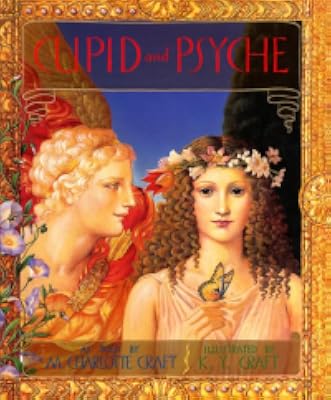
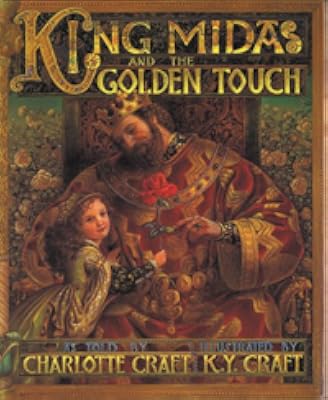
Having explored the world of Greek mythology in Cupid and Psyche, Pegasus, and King Midas and the Golden Touch, the marvelously talented Kinuko Craft has more recently turned her attention to the world of classic European fairy-tales, among them The Adventures of Tom Thumb and Cinderella. In this most recent picture book, she offers a gorgeous version of the famous tale of Sleeping Beauty, with the text arranged by her husband, Mahlon F. Craft.
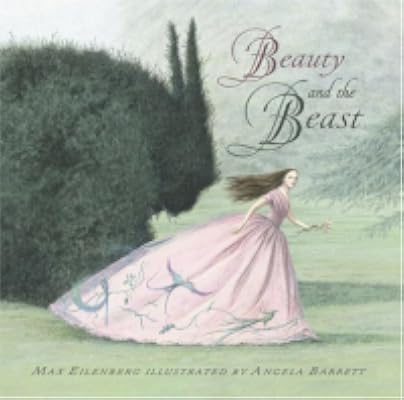
Although the tale of the sleeping beauty holds interest for me as a student of the folktale and its transmuted cousin, the fairy-tale, I have never been able to truly take it to heart. The idea of an enchanted sleep may have appealed to my childish imagination, but the complete passivity of the show more heroine always prevented me from truly empathizing with her. Whatever one thinks of Cinderella's desire to attend the ball, the reader can at least sympathize with her mistreatment at the hands of her step-family. Beauty, of Beauty and the Beast fame, can be admired, both for the sense of honor that compels her to acknowledge that her father's bargain must be kept, and for the devotion that leads her to take her father's place at the Beast's palace. Princess Aurora, on the other hand, is simply unlucky enough to be the target of a vengeful fairy's curse, and faces no personal and/or moral challenges that might elicit a sense of fellow-feeling from the reader.
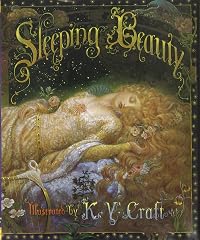
This is not to say that Sleeping Beauty holds no appeal whatsoever, as it can still be enjoyed by on the level of a rather simple fantasy (or in the case of some, as a sort-of sexual paradigm, ala Anne Rice). Kinuko Craft's illustrations are, for me, the main joy of this particularly title. As I noted in my review of her Cupid and Psyche, they are quite romantic, and almost overwhelmingly lush... The first full plate, in which the queen is seen bathing by the pool with the prophesying frog, is full of charm. I often think that Craft is at her most compelling when painting somewhat sinister figures, and here is no exception, as the two-page spread in which the king and queen are confronted by a very displeased fairy reveals. I would have awarded this five stars for the illustrations alone, but I found that the painting depicting the famous kiss scene was somehow flat. This was a real disappointment (one of the few I have ever felt in Craft's work), as this is the iconic scene of the tale. I cannot understand how the cover-illustration, which also depicts Aurora in her enchanted sleep, could appear so dynamic, while the "kissing" scene could look so bloated and unappealing. Oh well...
One other note, for the fairy-tale fan: I have noticed in my perusal of many different editions of Sleeping Beauty, that although this name is taken from the collection of tales by the Frenchman, Charles Perrault, the actual tale which we now more commonly associate with this title is taken from the Brothers Grimm. It is called Briar Rose in their collection, includes the prophetic frog at the beginning, and ends with the fateful kiss and resultant marriage. The Perrault version, sometimes also called The Princess of the Sleeping Wood, includes an entire second section, which takes place after the marriage, and involves the prince's ogreish mother. I have always found it fascinating that although it is the tale of Briar Rose we see so often reproduced, it is almost never called by that name. This version is clearly from the Grimm collection, and although Mahlon F. Craft acknowledges this by mentioning the name Briar Rose in his text, I would have liked to see something more official. Craft may have translated and reshaped the story, but it was written by the Brothers Grimm, and they are not mentioned at all, even on the title page. While I am sure that this is completely legal, as this tale has long been in the public domain, some acknowledgment of origin is in order, I believe... show less
Although the tale of the sleeping beauty holds interest for me as a student of the folktale and its transmuted cousin, the fairy-tale, I have never been able to truly take it to heart. The idea of an enchanted sleep may have appealed to my childish imagination, but the complete passivity of the show more heroine always prevented me from truly empathizing with her. Whatever one thinks of Cinderella's desire to attend the ball, the reader can at least sympathize with her mistreatment at the hands of her step-family. Beauty, of Beauty and the Beast fame, can be admired, both for the sense of honor that compels her to acknowledge that her father's bargain must be kept, and for the devotion that leads her to take her father's place at the Beast's palace. Princess Aurora, on the other hand, is simply unlucky enough to be the target of a vengeful fairy's curse, and faces no personal and/or moral challenges that might elicit a sense of fellow-feeling from the reader.
This is not to say that Sleeping Beauty holds no appeal whatsoever, as it can still be enjoyed by on the level of a rather simple fantasy (or in the case of some, as a sort-of sexual paradigm, ala Anne Rice). Kinuko Craft's illustrations are, for me, the main joy of this particularly title. As I noted in my review of her Cupid and Psyche, they are quite romantic, and almost overwhelmingly lush... The first full plate, in which the queen is seen bathing by the pool with the prophesying frog, is full of charm. I often think that Craft is at her most compelling when painting somewhat sinister figures, and here is no exception, as the two-page spread in which the king and queen are confronted by a very displeased fairy reveals. I would have awarded this five stars for the illustrations alone, but I found that the painting depicting the famous kiss scene was somehow flat. This was a real disappointment (one of the few I have ever felt in Craft's work), as this is the iconic scene of the tale. I cannot understand how the cover-illustration, which also depicts Aurora in her enchanted sleep, could appear so dynamic, while the "kissing" scene could look so bloated and unappealing. Oh well...
One other note, for the fairy-tale fan: I have noticed in my perusal of many different editions of Sleeping Beauty, that although this name is taken from the collection of tales by the Frenchman, Charles Perrault, the actual tale which we now more commonly associate with this title is taken from the Brothers Grimm. It is called Briar Rose in their collection, includes the prophetic frog at the beginning, and ends with the fateful kiss and resultant marriage. The Perrault version, sometimes also called The Princess of the Sleeping Wood, includes an entire second section, which takes place after the marriage, and involves the prince's ogreish mother. I have always found it fascinating that although it is the tale of Briar Rose we see so often reproduced, it is almost never called by that name. This version is clearly from the Grimm collection, and although Mahlon F. Craft acknowledges this by mentioning the name Briar Rose in his text, I would have liked to see something more official. Craft may have translated and reshaped the story, but it was written by the Brothers Grimm, and they are not mentioned at all, even on the title page. While I am sure that this is completely legal, as this tale has long been in the public domain, some acknowledgment of origin is in order, I believe... show less
Mahlon F. Craft and Kinuko Y. Craft did a spectacular job in writing this retelling of the classic sleeping beauty tale. The king and queen finally have a baby girl only for a curse to be placed upon her on her 16th birthday by a fairy. The curse was for her to “prick herself with a spindle and die.” The parents are horrified and the younger fairy explains to them that she will not die but will be sleeping for 100 years. There were some aspects of this book different from the original. For example, I don’t remember the whole castle sleeping with the princess when she is put down on her 16th birthday. The ending consists of the prince saving Aurora and marrying her. I loved the high vocabulary used in the book and I think my show more favorite thing about this wonderful book is the illustrations. Kinuko Y. Craft does a great job. The color, detail, and depth of the illustrations bring the story to life. The artwork alone had me lost in the stories plot. show less
As per usual with retold fariytales, the narrative of this book is nothing really special. The author sticks to a relatively Disney-fied version - only giving the 13th/evil fairy less power outside of her curse and the 12th fairy (who alter the curse) a fancy dragon. The illustrations are quite nice though, and give the story a wonderfully Rennaisance Italy kind of feel. THe princess is typically blonde, but she reminds me very much of the youngest Borgia daughter and therefore fits the scenery quite well. Craft has a definite mastery of her medium since the illustrations are very highly detailed and it is hard not to be impressed by her careful attention to costuming and architecture.
The illustrations are breathtakingly beautiful from a distance, and full of interesting and fantastic details upon closer examination. This book takes the classic story of the enchanted Princess Aurora, setting the tale in a romantic fantasy kingdom, with the artwork combining rennaisance, high baroque and modern artistic styles.In this tale it appears that the prince wants to rescue Aurora, which appears more selfless than in some other retellings: "The thought of a sleeping beauty such as Briar Rose lying unprotected in a thorny prison was more than his good and valiant nature could bear."
I am sure it will come as no surprise that K.Y. Craft has created another breath-takingly beautiful picture book. This retelling of the story of Sleeping Beauty, Princess Aurora or Brair Rose by Mahlon F. Craft, the artist's husband, is romantic and magical, with courtly language and all the drama one expects from this marvelous old tale. It is a delightful read. The illustrations truly make the book the treasure that it is and include lovely illuminated text as well as full page and double page spreads throughout. Craft's characteristic eye for detail is everywhere evident as is her flair for decorative flora and fauna, costumes, jewelry and interiors. The angry 13th fairy, snubbed without an invitation to the princess's christening show more who curses the child is painted with a grand touch of maleficence while the 12th fairy whose magical gift saves the baby's life is uncanny and sparkly with a golden power that eminates from the illustrations. The landscapes have a marvelous Renaissance feel and are brooding and deep and magically enhance the story with a certain wildness. A beautiful Alsatian dog with a fairy collar of light around his neck is a secret guardian in several pictures and I suspect this dog may be a very familair friend to the author and illustrator. show less
The librarian at the school where I teach suggested this book to me. She had a large collection by the illustrator of these books. After reading through the pages I understood why. The pictures looked real. It made this fairy tale no longer a story but a living breathing work. It use various colors, shading, layers, and details to make the story captivating. Sleeping Beauty is by far my least favorite fairy tale but after reading this take on it my feeling changed. If we were discussing story telling I would pull several different renditions of Sleeping Beauty for students to compare and contrast.
Mahlon Craft's enhanced version of Sleeping Beauty affords wide scope for the artist's romanticism. In a new episode at the outset, for example, the queen meets a frog that predicts the birth of her daughter; in the facing art, the queen, dressed in a diaphanous white gown, languidly loosens her hair ribbon, while the frog, brought forward by cunning attention to light and detail, waits to speak to her. The backdrop is a dark forest, and the effect is properly otherworldly. Farther on, when the king and queen discover the evil fairy's handiwork, the good fairy comes to ease their grief; Craft portrays the fairy descending from gilded clouds, driving a chariot drawn by dragons. The fairies are transparent, like spirits; the evil fairy is show more a gothic horror in black draperies. Aurora is ethereally lovely, the landscapes magnificent and the palace splendid. Families aiming to assemble a library of classic fairy tales may well settle on this as the definitive Sleeping Beauty show less
Members
- Recently Added By
Lists

1001 Children's Books You Must Read Before You Grow Up
774 works; 101 members

Best children's picture books
377 works; 85 members

A Child's Book Tour of Germany
76 works; 5 members
Author Information
2+ Works 553 Members
All Editions
Awards and Honors
Awards
Notable Lists
Common Knowledge
- Original publication date
- 2002
- People/Characters
- Sleeping Beauty
Classifications
Statistics
- Members
- 392
- Popularity
- 79,769
- Reviews
- 23
- Rating
- (4.29)
- Languages
- English, French
- Media
- Paper, Ebook
- ISBNs
- 6
- UPCs
- 2
- ASINs
- 3