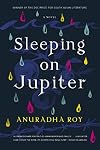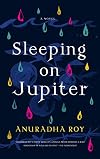
Sleeping on Jupiter
by Anuradha Roy
On This Page
Description
A train stops at a railway station. A young woman jumps off. She has wild hair, sloppy clothes, and a distracted air. She looks Indian, yet she is somehow not. The sudden violence of what happens next leaves the other passengers gasping. The train terminates at Jarmuli, a temple town by the sea. Here, among pilgrims, priests, and ashrams, three old women disembark only to encounter the girl once again. What is someone like her doing in this remote corner, which attracts only worshippers? show more Over the next five days, the old women live out their long planned dream of a holiday together; their temple guide finds ecstasy in forbidden love; and the girl is joined by a photographer battling his own demons. The full force of the evil and violence beneath the serene surface of the town becomes evident when their lives overlap and collide. Unexpected connections are revealed between devotion and violence, friendship and fear as Jarmuli is revealed as a place with a long, dark past that transforms all who encounter it. show lessTags
Recommendations


































Member Reviews
This short, beautifully written, sometimes heartbreaking novel kept calling me back, and I'm in awe of the author's ability to create create living breathing characters and evoke Indian settings and culture such that I almost feel like I've visited the subcontinent myself. I'm not surprised that the book was long listed for the Booker Prize.
As the book opens as Nomi, a documentary filmmaker who experienced a series of personal tragedies as a child, and three older women, all longtime friends, are sharing a train car while traveling to Jarmuli, a temple filled town by the sea. Intense and vivid, the story takes us into Nomi's past and follows the lives of several other characters who Nomi and the three friends encounter.
Though Sleeping show more on Jupiter is short enough that it could be read quickly I didn't want to rush through it. The story is too rich. I'd read one section, then put the book down for a while to give myself time to absorb it. show less
As the book opens as Nomi, a documentary filmmaker who experienced a series of personal tragedies as a child, and three older women, all longtime friends, are sharing a train car while traveling to Jarmuli, a temple filled town by the sea. Intense and vivid, the story takes us into Nomi's past and follows the lives of several other characters who Nomi and the three friends encounter.
Though Sleeping show more on Jupiter is short enough that it could be read quickly I didn't want to rush through it. The story is too rich. I'd read one section, then put the book down for a while to give myself time to absorb it. show less
This book primarily follows Nomi, a young documentary filmmaker who returns to the (fictional) Indian temple town of Jarmuli to confront childhood trauma. Her narrative intersects with several other characters: three older women on a spiritual holiday, a temple guide harboring his own secrets, and a photographer tormented by his recent divorce.
Through these different perspectives, Roy examines societal issues such as violence, abuse, religious exploitation, and the vulnerabilities of women and children. It raises uncomfortable questions about complicity, memory, and trauma. As much as I appreciated the intent, I felt my interest fading due to the fragmented structure. Readers should be aware in advance that it contains many scenes of show more difficult and disturbing content. show less
Through these different perspectives, Roy examines societal issues such as violence, abuse, religious exploitation, and the vulnerabilities of women and children. It raises uncomfortable questions about complicity, memory, and trauma. As much as I appreciated the intent, I felt my interest fading due to the fragmented structure. Readers should be aware in advance that it contains many scenes of show more difficult and disturbing content. show less
Combines in perfect measure the elements of classic storytelling: an opening act of horror seen through a child's eyes, a burning sense of rage and wrong done with a desire for resolution, a comedy trio of characters with hidden depths and heart, a mysterious vanishing from a train, unrequited love between paupers on a beach, a chaï seller with a secret identity and hidden forbidden temples deep in the jungle. Yet the setting and context is utterly contemporary - modern south India, the touristy pilgrimage trail and the personalities rich and poor congregated about it. Traditional gender role and sexuality are subverted effortlessly and without apparent agenda, as unexpected elements of this story.
There are some unforgettably rich show more characters here whose life play vividly in the imagination thanks to the clarity of the writing and vision. The tantalising romance between the beach waiter and the temple tour guide delivered through the latter's wild flights of hope, anticipation and tongue-tied utterances of love as he goes through his daily drudge dreaming of a different life. The three old ladies on the train encounter mishap and memory lapses, grousing and criticising hilariously. And the heroine finds her resolution and fights her demon, even if manifest in a new form of misogynistic drunken letch as opposed to the original paedophile mystic, before retreating to her new life in a perfect crisp, beautiful lakeside forest thousands of miles away. Resolution is incomplete and unassured, not neatly tied up, although without being downbeat or depressing.
A perfectly measured, deftly woven combination of all the elements and characters of great fiction. show less
There are some unforgettably rich show more characters here whose life play vividly in the imagination thanks to the clarity of the writing and vision. The tantalising romance between the beach waiter and the temple tour guide delivered through the latter's wild flights of hope, anticipation and tongue-tied utterances of love as he goes through his daily drudge dreaming of a different life. The three old ladies on the train encounter mishap and memory lapses, grousing and criticising hilariously. And the heroine finds her resolution and fights her demon, even if manifest in a new form of misogynistic drunken letch as opposed to the original paedophile mystic, before retreating to her new life in a perfect crisp, beautiful lakeside forest thousands of miles away. Resolution is incomplete and unassured, not neatly tied up, although without being downbeat or depressing.
A perfectly measured, deftly woven combination of all the elements and characters of great fiction. show less
Beautiful! Three stories going on and all are interconnected. This takes place in a seaside town on the Bay of Bengal. Three matrons, a young man and a young woman are all looking for something they won't find. This will confirm your disappointment in humans, but confirm your conviction that this author has a voice that needs to be heard.
I am not sure quite what to make of this story set in a temple resort on the east coast of India, but it was certainly intriguing.
Nomi is a girl orphaned by war, then brought up in an abusive ashram, who has escaped and eventually been adopted by a British woman. She returns to the resort as a young woman working as a researcher for a film, but really to investigate her own background. Her partner on this trip is Suraj, a spoiled middle aged rich boy who is still haunted by a recent divorce. Then there are the three old women (Gouri, Latika and Vidya) who have come to the town on a holiday. Finally there is Badal, who works as a temple guide who has an unrequited crush on a boy who works for a beach tea seller.
The plot is quite show more complicated, and the paths of these characters cross in all sorts of unexpected ways (with rather too many coincidences for my liking), and the ending is unresolved and rather enigmatic. There are plenty of fine descriptive passages, and Roy can certainly write. show less
Nomi is a girl orphaned by war, then brought up in an abusive ashram, who has escaped and eventually been adopted by a British woman. She returns to the resort as a young woman working as a researcher for a film, but really to investigate her own background. Her partner on this trip is Suraj, a spoiled middle aged rich boy who is still haunted by a recent divorce. Then there are the three old women (Gouri, Latika and Vidya) who have come to the town on a holiday. Finally there is Badal, who works as a temple guide who has an unrequited crush on a boy who works for a beach tea seller.
The plot is quite show more complicated, and the paths of these characters cross in all sorts of unexpected ways (with rather too many coincidences for my liking), and the ending is unresolved and rather enigmatic. There are plenty of fine descriptive passages, and Roy can certainly write. show less
This is one of those beautifully written books that I'm going to totally forget about six months from now. The writing is lovely, I'm all about books set in India, everything about it is just fine, but nothing really stood out as special to me.
This is one of those beautifully written books that I'm going to totally forget about six months from now. The writing is lovely, I'm all about books set in India, everything about it is just fine, but nothing really stood out as special to me.
Members
- Recently Added By
Published Reviews
ThingScore 100
The themes of innocence stolen, the refuge of the imagination, and the inclination to look away are handled with sensitivity and subtlety in some of the best prose of recent years encountered by this reader. Roy brings a painterly eye, her choice of detail bringing scenes to sensual life, while eschewing floridness: a masterclass rather in the art of restraint, the pared-back style enabling show more violence close to the surface to glint of its own accord.....An important contribution to an essential debate, Anuradha Roy's poetic work of luminous prose deserves a wide readership in India and beyond. show less
added by vancouverdeb
Roy’s chiselled prose allows her to expose the endless, treacherous hypocrisies of Indian society: ...As in her previous novels, An Atlas of Impossible Longing and The Folded Earth, Roy viscerally captures atmosphere: a train sways and moves faster, “as if lighter from shedding the girl”;....India is evoked in the ginger and crushed cloves of a seaside tea-stall, the poetry of show more Jibanananda Das, the scent of grapefruit and above all, in the shame of speaking about sexual violence. There are allusions to the Mahabharata – the Indian epic where good triumphs over evil – but what emerges in Sleeping on Jupiter is the story of entrenched evil, an evil against women and children that cannot be challenged, only escaped...
Roy’s narrative raises many burning questions. show less
Roy’s narrative raises many burning questions. show less
added by vancouverdeb
Lists

Man Booker Prize Longlist 2015
13 works; 9 members
Author Information

14 Works 1,226 Members
Anuradha Roy is an Indian novelist who has won the 2016 DSC Prize for South Asian Literature for her novel Sleeping on Jupiter. Roy's novel was selected from a shortlist of six to win the US$50,000 (A$72,907) prize, which is awarded annually to the best work of fiction pertaining to the South Asian region published in English. Her other novels show more include An Atlas of Impossible Longing and The Folded Earth. Her previous awards include the Crossword Book Award, the 2015 Man Booker Prize longlist, and the Hindu Literary Prize 2015 shortlist. (Bowker Author Biography) show less
Awards and Honors
Common Knowledge
- Original title
- Sleeping on Jupiter
- Original publication date
- 2015
- People/Characters
- Nomi; Vidya; Latika; Gouri; Suraj (Latika's son/Nomi's guide); Guruji - Guru of Ashram (show all 11); Badal (Guide); Raghu (street urchin); Ayesha (Suri's estranged wife); Johnny Toppo (Tea vendor); Champa (ward of Ashram)
- Important places
- Jarmuli, India
- Epigraph
- "Would a circling surface vulture
know such depths of sky
as the moon would know?"
AKKA MAHADEVI, 12th century - Dedication
- for three beloved tyrants
Biscoot
Rukun
Christopher - First words
- The year the war came closer I was six or seven and it did not matter to me.
- Last words
- (Click to show. Warning: May contain spoilers.)She swivels the spindle until its arrow points north
- Original language
- English
Classifications
Statistics
- Members
- 259
- Popularity
- 124,446
- Reviews
- 10
- Rating
- (3.45)
- Languages
- Dutch, English, French
- Media
- Paper, Audiobook, Ebook
- ISBNs
- 18
- ASINs
- 4