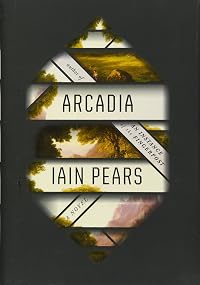
Arcadia
by Iain Pears
On This Page
Description
In 1960s Oxford, Professor Henry Lytten is attempting to write a fantasy novel that forgoes the magic of his predecessors, J.R.R. Tolkien and C.S. Lewis. He finds an unlikely confidante in his quick-witted, inquisitive young neighbor Rosie. One day, while chasing Lytten's cat, Rosie encounters a doorway in his cellar. She steps through and finds herself in an idyllic, pastoral land where Storytellers are revered above all others. There she meets a young man who is about to embark on a quest show more of his own--and may be the one chance Rosie has of returning home. These breathtaking adventures ultimately intertwine with the story of an eccentric psychomathematician whose breakthrough discovery will affect all of these different lives and worlds. show lessTags
Recommendations




Member Recommendations
Member Reviews
Arcadia tells three intertwining stories: (1) of Anterworld and apparently a story come to life of Henry Lytten who (2) lives in 1960s England and is sort of continuing the Inklings' legacy while (3) a woman named Angela Meerson a brilliant mathematician somewhere in the future discovers the ability to either jump into alternate universes or back and forth in time, and must protect her project from other scientists who want to get their grubby mitts on her data.
If that all sounds confusing, it is. This is an ambitious, convoluted story and I loved it. There's a fantasy world and lots of story references and heady scientific discussions all mixed in, and the storytelling is such that there's just enough of a cliffhanger or "aha!" moment show more at the end of the chapter that made me want to keep reading. It sort of reminded me of Thursday Next without all the most madcap elements, but it's an original story all its own and I plan on reading more of this author soon. show less
If that all sounds confusing, it is. This is an ambitious, convoluted story and I loved it. There's a fantasy world and lots of story references and heady scientific discussions all mixed in, and the storytelling is such that there's just enough of a cliffhanger or "aha!" moment show more at the end of the chapter that made me want to keep reading. It sort of reminded me of Thursday Next without all the most madcap elements, but it's an original story all its own and I plan on reading more of this author soon. show less
Fantasy and science fiction? What? Did I fall and hit my head? What possessed me to read this? Iain Pears. Having read 4 of his other books, I knew he wouldn’t leave me with a pile of stupid in the end (Connie Willis, I’m looking at you). And for the most part he didn’t. Even though Pears wrote this book to be read electronically, I decided to get the hardcover. I think the ebook has multiple endings and some other features that are harder to do as a physical book, and one of these days I’ll try it that way if I see a sale copy somewhere. That said, I don’t think being confined to a single ending was a drawback, although there is one big hole in the plot that kept this from being a 5-star book for me.
Another thing that kept show more it a 4-star book was that it dragged out a little too long in the final third. I can’t really blame the author though because there were so many time and storylines to finish. Everything connects in this book. Sometimes more than connects; the situations, characters and events sort of fold over and become enmeshed. It’s neat though and almost everything checks up well. It’s the kind of clever plotting that, if you like this kind of thing, will light up your brain when you discover exactly how things/people are related. If you don’t like “author is so clever” books, skip it.
Also skip it if you can’t keep a lot of stuff straight - characters, their relationships, time frames, allegoric parallels, backstory, etc. There is a lot going on and I took notes just so I could relax into the story and not worry about who was who and what was what.
One thing that’s interesting is that while Pears is English, he chose to hinge a lot of the time travel variables on US history; specifically Richard Nixon v. John F. Kennedy and the threat of nuclear war with Cuba. It’s an interesting choice, but since I’m American it worked. I wonder if different editions got different situations to document time travel issues and outcomes.
Not being an aficionado of either genre, I think both the fantasy and the science fiction parts worked. There’s a lot of explanation about how Angela’s machine works and what the difference is between travel to parallel universes and time travel. Angela’s world is satisfyingly horrible, hierarchical and rigid in its governance. It reminded me a bit of Oryx & Crake in terms of corporate compounds and how some are better than others. There are also the equivalent of the Pleblands; the spaces between compounds where societal rejects are corralled. In terms of the fantasy world it’s agrarian as you would expect and it has lords and ladies, pre-industrial revolution technology and similar trappings. It’s pastoral, slightly Utopian and a sharp contrast with the world Angela comes from. Nothing new except the absence of mythical beasts or magic/religion, although there is a bit of that toward the end since a world without science has to explain stuff somehow.
Anyway, if you’re a huge fan of either science fiction or fantasy, this book might ring your bells, but I can also see how it might really bug you, too, because it does have an “author is so clever” aspect about it and it probably does borrow heavily from books in both genres. Those more familiar with the canon(s) might find it too derivative, but I really like Iain Pears and how he writes and specifically how tightly wound/plotted his books are so it’s a winner despite a hole in the end. show less
Another thing that kept show more it a 4-star book was that it dragged out a little too long in the final third. I can’t really blame the author though because there were so many time and storylines to finish. Everything connects in this book. Sometimes more than connects; the situations, characters and events sort of fold over and become enmeshed. It’s neat though and almost everything checks up well. It’s the kind of clever plotting that, if you like this kind of thing, will light up your brain when you discover exactly how things/people are related. If you don’t like “author is so clever” books, skip it.
Also skip it if you can’t keep a lot of stuff straight - characters, their relationships, time frames, allegoric parallels, backstory, etc. There is a lot going on and I took notes just so I could relax into the story and not worry about who was who and what was what.
One thing that’s interesting is that while Pears is English, he chose to hinge a lot of the time travel variables on US history; specifically Richard Nixon v. John F. Kennedy and the threat of nuclear war with Cuba. It’s an interesting choice, but since I’m American it worked. I wonder if different editions got different situations to document time travel issues and outcomes.
Not being an aficionado of either genre, I think both the fantasy and the science fiction parts worked. There’s a lot of explanation about how Angela’s machine works and what the difference is between travel to parallel universes and time travel. Angela’s world is satisfyingly horrible, hierarchical and rigid in its governance. It reminded me a bit of Oryx & Crake in terms of corporate compounds and how some are better than others. There are also the equivalent of the Pleblands; the spaces between compounds where societal rejects are corralled. In terms of the fantasy world it’s agrarian as you would expect and it has lords and ladies, pre-industrial revolution technology and similar trappings. It’s pastoral, slightly Utopian and a sharp contrast with the world Angela comes from. Nothing new except the absence of mythical beasts or magic/religion, although there is a bit of that toward the end since a world without science has to explain stuff somehow.
Anyway, if you’re a huge fan of either science fiction or fantasy, this book might ring your bells, but I can also see how it might really bug you, too, because it does have an “author is so clever” aspect about it and it probably does borrow heavily from books in both genres. Those more familiar with the canon(s) might find it too derivative, but I really like Iain Pears and how he writes and specifically how tightly wound/plotted his books are so it’s a winner despite a hole in the end. show less
This is a mind-bender of a book. It is so many things. It is a literary masterpiece as Iain Pears is a master at writing and storytelling. He has created a world here with outstanding characters that embraces numerous time frames. These points in time are like stopping points on the journey and we move seamlessly back and forth. The dates that are encompassed in the story are 18 century England, early 1960's England in the hear of the Cold war, a fantasy land that seems timeless and is not dated and somewhere far in the future, but millenniums away from our current one. This is not a book that you can read for awhile and then let it sit. Once you begin It is a commitment. Not only was it compulsion for me to keep on reading, I had to show more keep moving in order to keep everything straight in my head. The book is a mixture of great literature, stupendous time travel, science fiction, fantasy, a dystopian and scary world and a spy thriller and a mystery that encompasses the ages. Somehow, Pears manages to hook all of this together. The glue that cements the book is all the wonderful characters. Secretive Henry Lytten, brilliant Angela Meerson, precocious 15-year-old Rosie (Rosalind), a beautiful and imperious leader and an evil and omnipotent megalomaniac who is determined to take over the world. I almost didn't read this book that has been on my shelves for awhile because it's so far out of my wheelhouse, but that would have been a shame. I loved it, and it is easily the best book that I've read this year. It was a wild ride and it turned me upside down, but it was well worth it. If you want a great rollicking story with lots of tension, suspense and mystery and a massive cast of believable characters, as well as a book that causes you to rethink everything about fiction, this is the book for you. I anticipate a massive book hangover after reading this one. show less
A complex book, whose plot is based on many narrative lines, from what seems to be a bucolic fantasy-style past to a technological dystopian future passing through 1960s England, struggling with the Cold War. With a truly masterly hand Ian Pears guides the reader through all these worlds; knotting and unravelling the relationships between the characters; often making the reader doubt that the events are the product of the literary imagination of a possible Tolkien copycat, only to remove this doubt and bring everything back to a completely realistic frame of reference.
I must say that I approached the reading as if it were a normal fantasy and then, overwhelmed by the number of characters and the changes of scene, I started again with show more more attention, and at that point the pages began to turn by themselves.
I've never been a big fan of Pears, but with this novel I was completely captivated.
A small note: the text includes a rather harsh judgement about the work of C. S. Lewis, a judgement I fully share. show less
I must say that I approached the reading as if it were a normal fantasy and then, overwhelmed by the number of characters and the changes of scene, I started again with show more more attention, and at that point the pages began to turn by themselves.
I've never been a big fan of Pears, but with this novel I was completely captivated.
A small note: the text includes a rather harsh judgement about the work of C. S. Lewis, a judgement I fully share. show less
There are so many ways I'm tempted to tackle this review, nearly as many ways as there is to read this novel, and that's not a bad thing. Indeed, it means that there's so much going on in here that I simply want to keep talking about.
I could simply say that I was delighted and I can continue to be enthusiastic about this novel for ages, but instead I'll try a few of my ideas out, perhaps calling it the Cloud Atlas that's better than Cloud Atlas, pulling together a narrative that is not only interesting but actually makes a lot of sense in the final pull-through, unlike Mitchell's rather overhyped (mainstream) SF.
Indeed, Pears points us right at potential problems and says, hey, look at this, I'm going meta, but rather than just dancing show more around the issue, I'm going to give you background, reason, plot development, and even more foundation as to WHY this meta is not only necessary... but why it is delightful to the crafting of the entire tale. And it is. Very much so.
Because what we've got is a fine literary blending of the key and core beauties of what made up pastoral literature back in its heyday, its beauty, its undercurrents of politics, its transpositions of topics both obvious and subtle, with what turns out to be a detailed historical spy novel couched within the omnipresent and omniscient black machine of a dystopian future society getting caught up in the potential nightmare of having just discovered time-travel.
So let's look at this: pastoral, historical spy fiction, hard-SF.
Come on. Who can't appreciate this? It's not only literary... it's beautifully drawn and interesting, with great characters, and an inherent time-travel potential paradox tragedy that threatens to destroy all universes. I'm not joking. This is the kind of thing I live for. And you know what's great? It takes its time, showing the wonder and the beauty of all the things we should care about or hate, even as we slowly realize just how much is at stake. It just gets worse because we're in the slowly boiling pot, getting to know everyone and everything as if we just don't need to worry about speed.
And we don't. This isn't a plot-driven novel. Or rather, it is a plot-driven novel just so long as you are a spider placing a rather large web, creating outer circles along different characters and settings and slowly moving inward until a razor-like focus pinpoints the little monster of a fly threatening to unravel the entire web. And by then you're invested in that web. :)
As for characters, I really enjoyed them all, but the ones I really focused on was Angela and Lytten. We could say that Lytten is the main Main Character, even if he's the unconscious spider, but I have to make an addendum to my estimation and point the Main Character finger fully at Rosalind, the inestimable and glorious pastoral fairy queen, the most perfect of Shakespeare's women... otherwise known as that mischievous kid next door who sometimes takes care of Lytten's fat cat.
What a surprise.
As for the SF parts, all of which usually get my engines moving, I rather enjoyed this take on time travel. It really kicks the legs out on a lot of the paradoxical struts and mainstays of the physics and makes for a really cool tale.
Am I reminded of Heinlein's Number of the Beast? Maybe. And as for all you people who love to see your favorite works of the imagination come to life, you're in for a sweet ride, too. This one caught me, too.
I will be rather sad if this book doesn't eventually get the kind of cult-recognition it deserves. Remember, even Dune went pretty much unrecognized for five years before the cult following blew it out of the water. This isn't the same kind of book, mind you, but it really needs that cult following. It's clever, complicated, literary, very imaginative, and its blurb doesn't come close to doing it any justice at all.
Why aren't you reading it??? show less
I could simply say that I was delighted and I can continue to be enthusiastic about this novel for ages, but instead I'll try a few of my ideas out, perhaps calling it the Cloud Atlas that's better than Cloud Atlas, pulling together a narrative that is not only interesting but actually makes a lot of sense in the final pull-through, unlike Mitchell's rather overhyped (mainstream) SF.
Indeed, Pears points us right at potential problems and says, hey, look at this, I'm going meta, but rather than just dancing show more around the issue, I'm going to give you background, reason, plot development, and even more foundation as to WHY this meta is not only necessary... but why it is delightful to the crafting of the entire tale. And it is. Very much so.
Because what we've got is a fine literary blending of the key and core beauties of what made up pastoral literature back in its heyday, its beauty, its undercurrents of politics, its transpositions of topics both obvious and subtle, with what turns out to be a detailed historical spy novel couched within the omnipresent and omniscient black machine of a dystopian future society getting caught up in the potential nightmare of having just discovered time-travel.
So let's look at this: pastoral, historical spy fiction, hard-SF.
Come on. Who can't appreciate this? It's not only literary... it's beautifully drawn and interesting, with great characters, and an inherent time-travel potential paradox tragedy that threatens to destroy all universes. I'm not joking. This is the kind of thing I live for. And you know what's great? It takes its time, showing the wonder and the beauty of all the things we should care about or hate, even as we slowly realize just how much is at stake. It just gets worse because we're in the slowly boiling pot, getting to know everyone and everything as if we just don't need to worry about speed.
And we don't. This isn't a plot-driven novel. Or rather, it is a plot-driven novel just so long as you are a spider placing a rather large web, creating outer circles along different characters and settings and slowly moving inward until a razor-like focus pinpoints the little monster of a fly threatening to unravel the entire web. And by then you're invested in that web. :)
As for characters, I really enjoyed them all, but the ones I really focused on was Angela and Lytten. We could say that Lytten is the main Main Character, even if he's the unconscious spider, but I have to make an addendum to my estimation and point the Main Character finger fully at Rosalind, the inestimable and glorious pastoral fairy queen, the most perfect of Shakespeare's women... otherwise known as that mischievous kid next door who sometimes takes care of Lytten's fat cat.
What a surprise.
As for the SF parts, all of which usually get my engines moving, I rather enjoyed this take on time travel. It really kicks the legs out on a lot of the paradoxical struts and mainstays of the physics and makes for a really cool tale.
Am I reminded of Heinlein's Number of the Beast? Maybe. And as for all you people who love to see your favorite works of the imagination come to life, you're in for a sweet ride, too. This one caught me, too.
I will be rather sad if this book doesn't eventually get the kind of cult-recognition it deserves. Remember, even Dune went pretty much unrecognized for five years before the cult following blew it out of the water. This isn't the same kind of book, mind you, but it really needs that cult following. It's clever, complicated, literary, very imaginative, and its blurb doesn't come close to doing it any justice at all.
Why aren't you reading it??? show less
How can a novel be shelved as historical fiction, fantasy, and dystopian sci-fi? If it has a storyline in each genre that all meld together in the end. Sounds complicated? It is. The first 100 pages or so hurt my brain.
First, we're introduced to Anterworld, a technologically primitive society with strange customs. An eleven-year-old boy named Jay wanders away on his own and meets what he assumes to be a fairy. We quickly learn that Anterworld is the brainchild of Henry Lytten, an Oxford professor who wants to create a fantasy world more plausible and stable than those imagined by his contemporaries, such as Tolkien and Lewis. We meet Henry's 15-year-old neighbor girl, Rosie, who has adopted him and his obese cat, Professor Jenkins. show more Here in 1960, Rosie somehow finds her way into Anterworld, and we realize that she is the "fairy" that Jay saw.
And just as things are beginning to become clear, we jump forward to a scientific institute on the island of Mull in 2222, where a brilliant, but unstable psychomathematician (A WHAT???) has invented a machine that is supposed to open portals to alternate universes, but may actually be a time machine. The scientific elite try to stretch Earth's resources to feed a population of 30 billion, who are controlled with mood-altering drugs. As if this isn't enough to take in, the narrative p.o.v. jumps between 3rd person limited and the 1st person of Angela Meerson, aforementioned mad scientist.
Moving back and forth amongst these three storylines is initially disjointing, until their connections become clearer. Each world has its own cast of characters and conflicts galore. Anterworld has political intrigues and a heirarchy of "story tellers." In 1960, Professor Lytten, who works on the side for British Intelligence, deals with defectors and possible double agents. Plus, his old friend, Angela Meerson, has stored a few things in his basement. And in 2222, the search is on for the vanished Angela and the plans for her wonderful, terrible machine.
Some novels make you think, some make you feel, and the best do both. As I said, in the beginning, this one just made my brain hurt, but eventually everything came together and I started to really enjoy myself. I loved the many nods to Shakespeare, Greco Roman mythology, and even Agatha Christie. While this is mostly a thinking novel, the characters grew on me and I didn't want to say goodbye. show less
First, we're introduced to Anterworld, a technologically primitive society with strange customs. An eleven-year-old boy named Jay wanders away on his own and meets what he assumes to be a fairy. We quickly learn that Anterworld is the brainchild of Henry Lytten, an Oxford professor who wants to create a fantasy world more plausible and stable than those imagined by his contemporaries, such as Tolkien and Lewis. We meet Henry's 15-year-old neighbor girl, Rosie, who has adopted him and his obese cat, Professor Jenkins. show more Here in 1960, Rosie somehow finds her way into Anterworld, and we realize that she is the "fairy" that Jay saw.
And just as things are beginning to become clear, we jump forward to a scientific institute on the island of Mull in 2222, where a brilliant, but unstable psychomathematician (A WHAT???) has invented a machine that is supposed to open portals to alternate universes, but may actually be a time machine. The scientific elite try to stretch Earth's resources to feed a population of 30 billion, who are controlled with mood-altering drugs. As if this isn't enough to take in, the narrative p.o.v. jumps between 3rd person limited and the 1st person of Angela Meerson, aforementioned mad scientist.
Moving back and forth amongst these three storylines is initially disjointing, until their connections become clearer. Each world has its own cast of characters and conflicts galore. Anterworld has political intrigues and a heirarchy of "story tellers." In 1960, Professor Lytten, who works on the side for British Intelligence, deals with defectors and possible double agents. Plus, his old friend, Angela Meerson, has stored a few things in his basement. And in 2222, the search is on for the vanished Angela and the plans for her wonderful, terrible machine.
Some novels make you think, some make you feel, and the best do both. As I said, in the beginning, this one just made my brain hurt, but eventually everything came together and I started to really enjoy myself. I loved the many nods to Shakespeare, Greco Roman mythology, and even Agatha Christie. While this is mostly a thinking novel, the characters grew on me and I didn't want to say goodbye. show less
Some books are so amazing that you feel like you're racing to the finish line because you just can't bear to wait one more moment to find out how it's going to end. Then there are others that must be savored. You need to take your time with these books. In fact, you might even set them to the side for days on end because you want to stretch out your time with the characters. Arcadia by Iain Pears is one of those books. It's truly a story within a story within a story within a story. (I hope I didn't leave any of them out.) It's about time, cause and effect, and above all storytelling. Henry Lytten is a professor, part-time member of the British Intelligence, a wannabe fantasy author, and the owner of a cantankerous fat cat named Mr. show more Jenkins. (That right there should be the tagline.) It's also about Anterwold and the student Jay who is just trying to understand where the Story began and how he fits into it. Not to mention John More and his quest to find a document buried for hundreds of years which may or may not hold great significance to the human race. Of course, it's also about Angela Meerson and her invention which is most certainly going to change the course of history the future all of time. Do you see what I mean about nesting dolls? In the same way that it's obvious how the nesting dolls have a relation to one another, Arcadia is laid out bit by bit so the reader can discover how each of these seemingly disparate stories and characters are related to one another in a seamless narrative that is mindboggling in its intricacies. What I'm trying to say is that this is a must read for 2016. GO, GO, GO! show less
Members
- Recently Added By
Published Reviews
ThingScore 81
"But as Pears steadily builds his multiplicity of stories, his orchestrations become something far more ambitious, a calculated and at times quite droll assault on the very nature of narrative itself."
added by bookfitz
"Nonetheless, Pears excels at stage-managing the multiple sets as the actors leap from the dystopian future, to England in the grips of the Cold War, to whenever Anterworld could be said to exist, altering history as they go. A fun, immersive, genre-bending ride."
added by bookfitz
"A head-scratcher but an ambitious pleasure. When puzzled, press on: Pears’ yarn is worth the effort."
added by bookfitz
Lists

Recommend the 20 best books you've read in the last five years
2,168 works; 607 members

Top Five Books of 2018
802 works; 265 members

Top Five Books of 2016
795 works; 229 members

Top Five Books of 2015
811 works; 241 members

Books Read in 2016
4,666 works; 199 members

Arthur C. Clarke Award Winners and Shortlisted Books
219 works; 14 members

Books Read in 2022
5,226 works; 112 members

Fantasy Fiction
69 works; 3 members

Same Title
115 works; 3 members

Schools...high school to college
65 works; 2 members

Adventure and Intrigue
76 works; 2 members

Books We Love to Reread
695 works; 298 members

Books We Want To Read Again For The First Time
384 works; 160 members

Favorite Science Fiction
457 works; 220 members
Talk Discussions
Past Discussions
Group Read: Arcadia Part 6, Chapters 56-66 (End) in The Green Dragon (April 2022)
Group Read: Arcadia Part 5, Chapters 45-55 in The Green Dragon (March 2022)
Group Read: Arcadia Part 4, Chapters 34-44 in The Green Dragon (March 2022)
Group Read: Arcadia Part 3, Chapters 23-33 in The Green Dragon (March 2022)
Group Read: Arcadia Part 1, Chapters 1-11 in The Green Dragon (March 2022)
Group Read: Arcadia by Iain Pears in The Green Dragon (March 2022)
Group Read: Arcadia Part 2, Chapters 12-22 in The Green Dragon (March 2022)
Author Information

18+ Works 16,834 Members
Iain Pears was born in England in 1955. He has worked as an art historian, a TV consultant and a journalist. After several years working for Reuters, he went to Yale University to complete his book on eighteenth-century British art entitled The Discovery of Painting. He has written several novels include An Instance of the Fingerpost, The Dream of show more Scipio, Stone's Fall, Arcadia, and the Jonathan Argyll series. (Bowker Author Biography) show less
Awards and Honors
Common Knowledge
- Canonical title
- Arcadia
- Original title
- Arcadia
- Original publication date
- 2015
- People/Characters
- Henry Lytten; Rosie Wilson
- Important places
- Oxford, Oxfordshire, England, UK
- Dedication
- To Ruth, as ever
- First words
- Imagine a landscape. Bathed in sunshine, sweet-smelling from the gentle shower that fell overnight then stopped as dawn broke.
- Last words
- (Click to show. Warning: May contain spoilers.)"It is beautiful here, you know," she said quietly. "We can make something truly wonderful of it, this time."
- Blurbers
- Simmons, Dan; Harkness, Deborah; Poole, Steven; Halligan, Marion; Davidson, Max
- Original language
- English
Classifications
Statistics
- Members
- 927
- Popularity
- 28,851
- Reviews
- 41
- Rating
- (3.90)
- Languages
- English, Spanish
- Media
- Paper, Audiobook, Ebook
- ISBNs
- 16
- ASINs
- 7