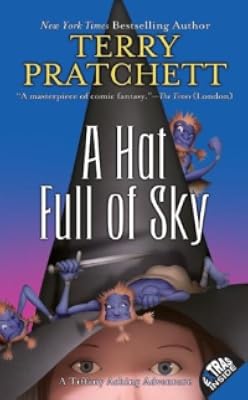
A Hat Full of Sky
by Terry Pratchett
Discworld: Young Adult (3), Discworld: Tiffany Aching (2), Discworld (32)
On This Page
Description
Tiffany Aching, a young witch-in-training, learns about magic and responsibility as she battles a disembodied monster with the assistance of the six-inch-high Wee Free Men and Mistress Weatherwax, the greatest witch in the world.Tags
Recommendations
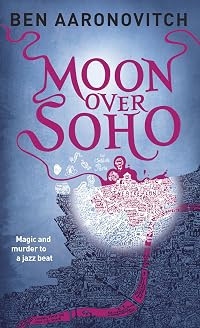
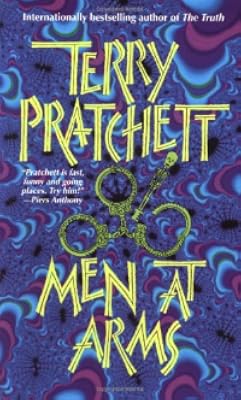
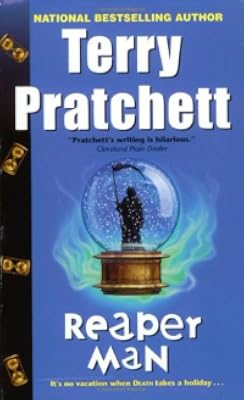
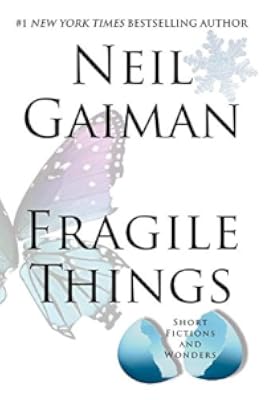
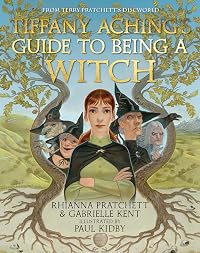

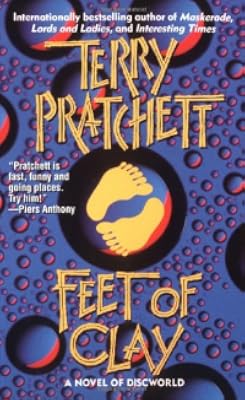
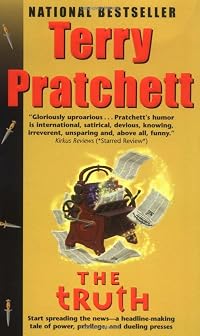
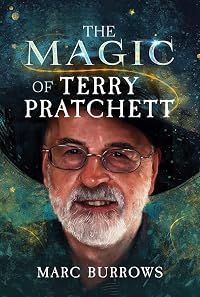
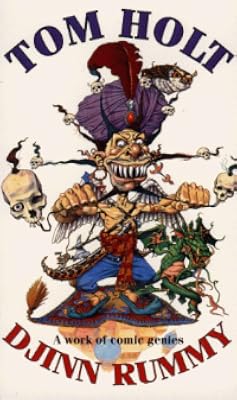


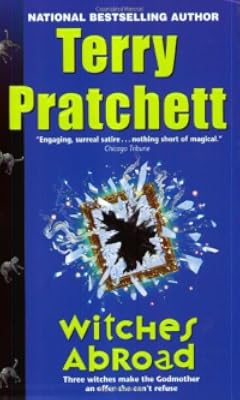
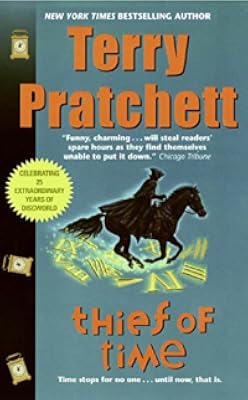

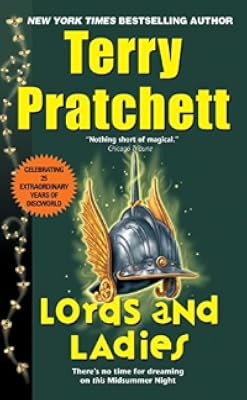
Member Recommendations
bibliovermis The third Tiffany Aching book. Even better than the first two.
110
LongDogMom Similar style of writing - whimsical and magical
31
Member Reviews
First read: 2004
Re-read: August 2015
The plot: Almost two years have passed since the events of The Wee Free Men and the now eleven year old Tiffany leaves the chalk to become an apprentice witch to Miss Level.
However she is not alone; she has attracted the attention of the 'hiver' - a wandering, conquering mind that is desperatly searching for its next body - and it has set its sights on Tiffany.
There is so much to love in this book. Pratchett has based his ideas of witchcraft on the historical 'wise-women' who were persecuted in the sixteenth and seventeeth century as witches. These wise women delivered babies, visited the sick and laid out the dead. They knew local folklore, traditional herbal medicene and were generally well thought show more of and respected in their local towns and villages. (Until the church basically declared war on female intellect and authority by declaring them witches and burning them at the stake or drowning them in ponds and rivers - but that is a whole other rant.)
Pratchett has used the wise women as a basis for his witches and combines their traditions with real magical powers which means that on the Disc, witches are feared and respected in equal measure.
The Nac Mac Feegles also make an appearance, along with their new Kelda (or Queen), and Granny Weatherwax (my favourite character in the entire Discworld series) is heavily featured in this instalment as well.
My favourite quote:
"Tiffany made a hat out of the sky and sat on the old pot-bellied stove, listening to the wind around the horizons while the sun went down [...] The sun set, which is everyday magic, and warm night came. The hat filled up with stars..." pg 350 show less
Re-read: August 2015
The plot: Almost two years have passed since the events of The Wee Free Men and the now eleven year old Tiffany leaves the chalk to become an apprentice witch to Miss Level.
However she is not alone; she has attracted the attention of the 'hiver' - a wandering, conquering mind that is desperatly searching for its next body - and it has set its sights on Tiffany.
There is so much to love in this book. Pratchett has based his ideas of witchcraft on the historical 'wise-women' who were persecuted in the sixteenth and seventeeth century as witches. These wise women delivered babies, visited the sick and laid out the dead. They knew local folklore, traditional herbal medicene and were generally well thought show more of and respected in their local towns and villages. (Until the church basically declared war on female intellect and authority by declaring them witches and burning them at the stake or drowning them in ponds and rivers - but that is a whole other rant.)
Pratchett has used the wise women as a basis for his witches and combines their traditions with real magical powers which means that on the Disc, witches are feared and respected in equal measure.
The Nac Mac Feegles also make an appearance, along with their new Kelda (or Queen), and Granny Weatherwax (my favourite character in the entire Discworld series) is heavily featured in this instalment as well.
My favourite quote:
"Tiffany made a hat out of the sky and sat on the old pot-bellied stove, listening to the wind around the horizons while the sun went down [...] The sun set, which is everyday magic, and warm night came. The hat filled up with stars..." pg 350 show less
We're all familiar with Alice going through the looking-glass into a topsy-turvy world, a world where she is able to look at things in a different way. Unexpectedly, Alice makes no attempt to find her own reflection: "The very first thing she did was to look whether there was a fire in the fireplace, and she was quite pleased to find that there was a real one." For a child who could make the observation "Curiouser and curiouser!" she is singularly incurious about her own reflection; perhaps she is not as prone to self-reflection as we have thought.
This is not the case however with the heroine of this Terry Pratchett novel when she finds that she has no mirror in which to check her appearance, for when she devises a way to observe show more herself without one she finds she has to indulge in self-reflection of a different kind. A Hat Full of Sky is the second of the Tiffany Aching novels, set on Discworld. We not only get to meet the Nac Mac Feegles, Granny Weatherwax and lesser witch Miss Tick all over again but also to encounter new characters, especially Miss Level and her neighbours. But really the focus is Tiffany herself, how she is growing into her powers and how she's becoming more mature (although, to be sure, she has already shown herself to the equal of many adults in maturity).
Tiffany we learn is a very self-possessed eleven-year-old witch. Except when she's possessed by another entity with a preternatural greed for power. This entity, this hiver, waits for Tiffany to, as it were, stand outside herself so that it can take over the body that she has left empty -- and then what is she to do, what can she do? Initially she can count on friends to help her to regain some control, but to finally banish this Beelzebub she has to draw on all her courage and not a little compassion. In amongst all the expected humour (the doubly enigmatic Miss Level, Oswald the helpful poltergeist, and of course the Nac Mac Feegles) Pratchett is as is his wont revealing deep human truths to us.
The first is that we should be respectful to people who appear to lack ambition, or gumption, or self-awareness, indeed anything that might suggest they are not worthy of much respect: principally because they are fellow humans, but also because they may yet offer you a pleasant surprise. Tiffany is initially confused that she isn't learning formal magic but is expected to help minister to her sometimes ungrateful neighbours; she then, under the influence of the parasitic hiver, gives in to rudeness, blunt speaking and showing-off, a path not guaranteed to win people over. Expunging such promptings -- uncharitable thoughts, words and deeds -- comes with banishing the hiver, a uphill struggle for the youngster but one she has to largely face on her own.
The second lesson she has to learn is how to deal with the negative aspects that arise in her, aspects that many of us have to face up to at stages in our lives. Pratchett deals with this in a typically vivid way: Tiffany is able to observe herself from outside her body with the simple command See me. This is the mechanism by which the hiver infests her body and mind but it's also the way that Pratchett alludes to philosophical conundrums. Can we stand apart from ourselves? Does that allow us to gain or lose control? Can we really see ourselves as others see us? (Can I really believe that person I can see in the CCTV monitor is truly me?) And how does that affect the process of individuation -- does it encourage alienation instead?
Hard lessons for anyone to learn, let alone an eleven-year-old away from home. For Tiffany that means the chalk downs, with their sheep and their shepherds, and the ancient chalk figure of a horse cut into the green turf, echoed in the necklet that young Roland gives her at the beginning of the novel. As with all the Discworld novels I've so far read, A Hat Full of Sky is crammed full of ideas, fizzing and popping out of the pages, too many for me to allude to in a short review. Here instead are a few things that I particularly enjoyed.
The hiver is an interesting literary construct: originally a term for a beekeeper, this particular hiver is like a swarm of insects looking for an empty vessel to be contained in. We talk about a 'hive mentality' and so it is with this entity, its only concern being to survive; until Tiffany realises it is frightened, and can summon up compassion for it, she will never be free of its fears feeding her own. In a way (as I've argued elsewhere) Tiffany's experience is like that of young wizard Ged in Ursula Le Guin's A Wizard of Earthsea: as a result of a costly mistake -- comparable to that of the apprentice in the Sorcerer's Apprentice story -- each protagonist has conjured up a shadow creature that pursues them and threatens to take over them. Until they turn and face the pursuer they are unable to achieve the peace of mind or even the life that they earnestly seek; in this they show themselves to be unlike Victor who fails to properly address both his culpability and his responsibilities in Mary Shelley's Frankenstein.
Another theme that has struck me is how Pratchett incorporates the concept of witch trials. In reality these were in the High Middle Ages horrific persecutions of innocent victims for the crime of appearing different; in A Hat Full of Sky it is a relief to find that these horrors are appropriately transmuted into the equivalent of sheepdog trials and given a more rustic character like that of a village fair or folk festival. Fortunately for Tiffany she is able to 'prove' herself against the accusations laid against her by her contemporaries.
"What exactly happened just then?" Tiffany asks Granny Weatherwax near the end of the novel. "What do you think happened?" is the answer, although that is no real answer. There is of course no simple reply, we realise, in a tale that encourages us to contemplate deep philosophical issues. If at times A Hat Full of Sky seems too full of unanswered questions then that paradoxically seems to be to its advantage, for without wonder where would we be? We can console ourselves with the thought that Pratchett's enigmatic titles reflect the wonder that feeds our imagination (a later novel I Shall Wear Midnight is actually anticipated in a offhand statement in these pages) -- for what exactly is a hat full of sky?
https://wp.me/s2oNj1-hat show less
This is not the case however with the heroine of this Terry Pratchett novel when she finds that she has no mirror in which to check her appearance, for when she devises a way to observe show more herself without one she finds she has to indulge in self-reflection of a different kind. A Hat Full of Sky is the second of the Tiffany Aching novels, set on Discworld. We not only get to meet the Nac Mac Feegles, Granny Weatherwax and lesser witch Miss Tick all over again but also to encounter new characters, especially Miss Level and her neighbours. But really the focus is Tiffany herself, how she is growing into her powers and how she's becoming more mature (although, to be sure, she has already shown herself to the equal of many adults in maturity).
Tiffany we learn is a very self-possessed eleven-year-old witch. Except when she's possessed by another entity with a preternatural greed for power. This entity, this hiver, waits for Tiffany to, as it were, stand outside herself so that it can take over the body that she has left empty -- and then what is she to do, what can she do? Initially she can count on friends to help her to regain some control, but to finally banish this Beelzebub she has to draw on all her courage and not a little compassion. In amongst all the expected humour (the doubly enigmatic Miss Level, Oswald the helpful poltergeist, and of course the Nac Mac Feegles) Pratchett is as is his wont revealing deep human truths to us.
The first is that we should be respectful to people who appear to lack ambition, or gumption, or self-awareness, indeed anything that might suggest they are not worthy of much respect: principally because they are fellow humans, but also because they may yet offer you a pleasant surprise. Tiffany is initially confused that she isn't learning formal magic but is expected to help minister to her sometimes ungrateful neighbours; she then, under the influence of the parasitic hiver, gives in to rudeness, blunt speaking and showing-off, a path not guaranteed to win people over. Expunging such promptings -- uncharitable thoughts, words and deeds -- comes with banishing the hiver, a uphill struggle for the youngster but one she has to largely face on her own.
The second lesson she has to learn is how to deal with the negative aspects that arise in her, aspects that many of us have to face up to at stages in our lives. Pratchett deals with this in a typically vivid way: Tiffany is able to observe herself from outside her body with the simple command See me. This is the mechanism by which the hiver infests her body and mind but it's also the way that Pratchett alludes to philosophical conundrums. Can we stand apart from ourselves? Does that allow us to gain or lose control? Can we really see ourselves as others see us? (Can I really believe that person I can see in the CCTV monitor is truly me?) And how does that affect the process of individuation -- does it encourage alienation instead?
Hard lessons for anyone to learn, let alone an eleven-year-old away from home. For Tiffany that means the chalk downs, with their sheep and their shepherds, and the ancient chalk figure of a horse cut into the green turf, echoed in the necklet that young Roland gives her at the beginning of the novel. As with all the Discworld novels I've so far read, A Hat Full of Sky is crammed full of ideas, fizzing and popping out of the pages, too many for me to allude to in a short review. Here instead are a few things that I particularly enjoyed.
The hiver is an interesting literary construct: originally a term for a beekeeper, this particular hiver is like a swarm of insects looking for an empty vessel to be contained in. We talk about a 'hive mentality' and so it is with this entity, its only concern being to survive; until Tiffany realises it is frightened, and can summon up compassion for it, she will never be free of its fears feeding her own. In a way (as I've argued elsewhere) Tiffany's experience is like that of young wizard Ged in Ursula Le Guin's A Wizard of Earthsea: as a result of a costly mistake -- comparable to that of the apprentice in the Sorcerer's Apprentice story -- each protagonist has conjured up a shadow creature that pursues them and threatens to take over them. Until they turn and face the pursuer they are unable to achieve the peace of mind or even the life that they earnestly seek; in this they show themselves to be unlike Victor who fails to properly address both his culpability and his responsibilities in Mary Shelley's Frankenstein.
Another theme that has struck me is how Pratchett incorporates the concept of witch trials. In reality these were in the High Middle Ages horrific persecutions of innocent victims for the crime of appearing different; in A Hat Full of Sky it is a relief to find that these horrors are appropriately transmuted into the equivalent of sheepdog trials and given a more rustic character like that of a village fair or folk festival. Fortunately for Tiffany she is able to 'prove' herself against the accusations laid against her by her contemporaries.
"What exactly happened just then?" Tiffany asks Granny Weatherwax near the end of the novel. "What do you think happened?" is the answer, although that is no real answer. There is of course no simple reply, we realise, in a tale that encourages us to contemplate deep philosophical issues. If at times A Hat Full of Sky seems too full of unanswered questions then that paradoxically seems to be to its advantage, for without wonder where would we be? We can console ourselves with the thought that Pratchett's enigmatic titles reflect the wonder that feeds our imagination (a later novel I Shall Wear Midnight is actually anticipated in a offhand statement in these pages) -- for what exactly is a hat full of sky?
https://wp.me/s2oNj1-hat show less
Имаше една много поучителна карикатура, в която на малкото момченце от началото на живота му дават да си играе с колички и конструктори, а на малкото момиченце – с кукли. И после няколко мъже се чудят защо толкова малко жени стават инженери. Тери Пратчет отдавна се занимава с жените и тяхното място в мъжкия свят на Диска, а Шапка пълна с небе е втората „книга за млади читатели“ от поредицата за малката show more вещица Тифани Сболки.
В едно интервю за блога на отворената феминистка, което тя май няма да публикува по други причини, обяснявам защо филмите с принцеси, книжките с принцеси и изобщо цялата „принцесна“, розова, приказна индустрия, която владее малките момичета практически от раждането им, е изключително вредна за изграждането им като мислещи, самостоятелни хора.
Принцесите са еманацията на идеята за жената като безпомощна, глупава кукла, която няма друга цел в живота, освен да бъде красива и да чака някой принц да я спаси. Как едно момиче ще има желанието и амбицията да учи, да направи нещо със себе си, ако през първите 15 години от живота й я заливат филми, книги, комикси и списания с принцеси и барбита, а според всички хора около нея тя трябва най-вече да е „послушна“, „добро момиче“ и най-вече „красива“?
Тъй като в днешния свят принцеси няма, голяма част от момичетата израстват с желанието да приличат на идола си Парис Хилтън и се превтъщат в коври, чиято цел в живота е да се гримират и да се заловят за някой „принц“ който да ги издържа.
Поредицата за Тифани Сболки на Тери Пратчет е само един малък спасителен сал в океана от розово, който владее света на малките момичета. Шапка пълна с небе е предназначена колкото за тях, толкова и за техните майки и се опитва с всички сили да покаже, че не е толкова важно как изглеждаш, а по-скоро какво правиш, и че да мислиш самостоятелно не е толкова лошо (всъщност никак лошо не е). show less
В едно интервю за блога на отворената феминистка, което тя май няма да публикува по други причини, обяснявам защо филмите с принцеси, книжките с принцеси и изобщо цялата „принцесна“, розова, приказна индустрия, която владее малките момичета практически от раждането им, е изключително вредна за изграждането им като мислещи, самостоятелни хора.
Принцесите са еманацията на идеята за жената като безпомощна, глупава кукла, която няма друга цел в живота, освен да бъде красива и да чака някой принц да я спаси. Как едно момиче ще има желанието и амбицията да учи, да направи нещо със себе си, ако през първите 15 години от живота й я заливат филми, книги, комикси и списания с принцеси и барбита, а според всички хора около нея тя трябва най-вече да е „послушна“, „добро момиче“ и най-вече „красива“?
Тъй като в днешния свят принцеси няма, голяма част от момичетата израстват с желанието да приличат на идола си Парис Хилтън и се превтъщат в коври, чиято цел в живота е да се гримират и да се заловят за някой „принц“ който да ги издържа.
Поредицата за Тифани Сболки на Тери Пратчет е само един малък спасителен сал в океана от розово, който владее света на малките момичета. Шапка пълна с небе е предназначена колкото за тях, толкова и за техните майки и се опитва с всички сили да покаже, че не е толкова важно как изглеждаш, а по-скоро какво правиш, и че да мислиш самостоятелно не е толкова лошо (всъщност никак лошо не е). show less
Absolutely masterful. This is what a sequel should be. Tiffany's inner journey in this story was not a rehashing of her journey in The Wee Free Men, or even the continuation of it. It felt real and important and complete in itself. Amazing!
When I read The Wee Free Men, my daughter was the same age as Tiffany (9), and I remember thinking that she could really benefit from learning what Tiffany learned in that story. It was like he wrote the thing to teach just the kind of girl my daughter is. And now, when she's almost 11, I read about an 11-year-old Tiffany Aching and have the same feeling with a different lesson!
I don't want to make it sound like only young girls should read this, of course. It connected with several ideas I've been show more rolling around in my head for years and never heard expressed before. It was just beautiful and oh-so-satisfying.
In my opinion, the real point of the book, the soul and center of it, was about how to treat the world and the people we share it with. Things aren't important; people are! You've got to keep yourself grounded by doing ordinary work every day. When it rains on you, be thankful you'll be dry later. You've got to decide for yourself who you're going to be. So many gems in this one! And he doesn't just tell you these things; he illustrates them with the story in such a way that you feel you're learning from experience.
But I guess that's Terry Pratchett for you. Having read only his very early pre-Discworld work and these two Tiffany Aching books, I'm no authority, but I'd have to assume this is one of the better Discworld novels. I mean, I don't see how they could get much better than this one. show less
When I read The Wee Free Men, my daughter was the same age as Tiffany (9), and I remember thinking that she could really benefit from learning what Tiffany learned in that story. It was like he wrote the thing to teach just the kind of girl my daughter is. And now, when she's almost 11, I read about an 11-year-old Tiffany Aching and have the same feeling with a different lesson!
I don't want to make it sound like only young girls should read this, of course. It connected with several ideas I've been show more rolling around in my head for years and never heard expressed before. It was just beautiful and oh-so-satisfying.
In my opinion, the real point of the book, the soul and center of it, was about how to treat the world and the people we share it with. Things aren't important; people are! You've got to keep yourself grounded by doing ordinary work every day. When it rains on you, be thankful you'll be dry later. You've got to decide for yourself who you're going to be. So many gems in this one! And he doesn't just tell you these things; he illustrates them with the story in such a way that you feel you're learning from experience.
But I guess that's Terry Pratchett for you. Having read only his very early pre-Discworld work and these two Tiffany Aching books, I'm no authority, but I'd have to assume this is one of the better Discworld novels. I mean, I don't see how they could get much better than this one. show less
All the recommendations for the Tiffany Aching books are 100% correct. I am loving them so far! There will be lots of quotes in this little review because it’s Pratchett, and everything he writes is insanely quotable!
In the first book, Tiffany was 9 and had just discovered that she was a witch. In this second book, she is 11 and leaves her village on the Chalk to go to Lancre and start training with the slightly odd Miss Level, and meet the other young witches-in-training in the community. Unfortunately, she also falls prey to the parasitic hiver, which brings out the very worst in her.
Why do you go away? So that you can come back. So that you can see the place you came from with new eyes and extra colors. And the people there see you show more differently, too. Coming back to where you started is not the same as never leaving.
One of the numerous things I appreciate about Pratchett’s writing is that he is so good with themes. A Hat Full of Sky is primarily concerned with identity. On the most relatable level, Tiffany is away from home for the first time in her life, she is learning what it means to be a witch, and must navigate the social maze of teenage witches. Then, on a more dramatic level, to free herself from the hiver, she has to come to understand herself and confront the darkest and most dangerous aspects of her own character. And things do get dark! (All I’m going to say is… pink flesh balloon).
It was too easy to slip into careless little cruelties because you had power and other people hadn’t, too easy to think other people didn’t matter much, too easy to think that ideas like right and wrong didn’t apply to you. At the end of that road was you drooling and cackling to yourself all alone in a gingerbread house, growing warts on your nose.
There are a lot of parallels between Tiffany and Granny Weatherwax, and happily, Granny is much more physically present in this story! Tiffany is very clever – and knows it – and is quickly showing herself to be a very powerful witch, and also, like Granny, her greatest flaw is her own pride. Pride and unchecked ambition can be a vulnerability, and in this case, the hiver is specifically drawn to the talented and ambitious.
Witches are always afraid of ‘going to the bad’, which often starts with a cackle. Tiffany learns the true nature of witchcraft through her time with Miss Level, as well as the crueller wisdom of Granny. It isn’t spells and magic, it’s hard work, responsibility, and caring for the community. She was sent to Miss Level because she is the embodiment of this and has dedicated both of her selves to helping, healing and doing all the unglamorous work for the elderly and the vulnerable. It’s difficult to get too full of yourself when you spend each week filing down an old man’s toenails.
“That’s why we do all the tramping around and doctorin’ and stuff,” said Mistress Weatherwax. “Well, and because it makes people a bit better, of course. But doing it moves you into your center, so’s you don’t wobble. It anchors you. Keeps you human, stops you cackling. Just like your granny with her sheep, which are to my mind as stupid and wayward and ungrateful as humans. You think you’ve had a sight of yourself and found out you’re bad? Hah! I’ve seen bad, and you don’t get near it.
The Chalk is also still an important part of Tiffany’s story; she is away for now, but she is kept anchored by her ties to the place, especially her memories of Granny Aching. I found this quite beautiful. She is also followed by Rob Anybody and a small crew of the Nac Mac Feegle, though they play a much smaller role in this story; they are still there to back her up because she is the hag of homeland, and she is important to tell the land what it is.
Another element I appreciated about this book was Pratchett’s dedication to teaching children the definition of the word ‘egress’! This was a very cute running gag through the book.
“I know I wouldn’t pay money to see the egress,” said Tiffany. “It just means ‘the way out.’”
“Clever!” said Miss Level. “Monty put that on a sign to keep people moving though the Believe-It-or-Not tent. ‘This way to the Egress!’ Of course, people thought it was a female eagle or something, so Monty had a big man with a dictionary outside to show them they got exactly what they paid for! Have you ever been to a circus?”
And finally, I love Pratchett’s concepts of first, second and third thoughts. This was introduced in the first book, and I think it’s brilliant. Especially in a book for a younger audience.
First Thoughts are the everyday thoughts. Everyone has those. Second Thoughts are the thoughts you think about the way you think. People who enjoy thinking have those. Third Thoughts are thoughts that watch the world and think all by themselves. They’re rare, and often troublesome. Listening to them is part of witchcraft.
I am trying hard these days to pay attention to my second thoughts, and hoping my third thoughts will get a bit louder.
For the law of fives, this one is the second in a series, a Locus award winner, has goats in it (animals), and I can count either the hiver or Death as a fantastic creature. show less
In the first book, Tiffany was 9 and had just discovered that she was a witch. In this second book, she is 11 and leaves her village on the Chalk to go to Lancre and start training with the slightly odd Miss Level, and meet the other young witches-in-training in the community. Unfortunately, she also falls prey to the parasitic hiver, which brings out the very worst in her.
Why do you go away? So that you can come back. So that you can see the place you came from with new eyes and extra colors. And the people there see you show more differently, too. Coming back to where you started is not the same as never leaving.
One of the numerous things I appreciate about Pratchett’s writing is that he is so good with themes. A Hat Full of Sky is primarily concerned with identity. On the most relatable level, Tiffany is away from home for the first time in her life, she is learning what it means to be a witch, and must navigate the social maze of teenage witches. Then, on a more dramatic level, to free herself from the hiver, she has to come to understand herself and confront the darkest and most dangerous aspects of her own character. And things do get dark! (All I’m going to say is… pink flesh balloon).
It was too easy to slip into careless little cruelties because you had power and other people hadn’t, too easy to think other people didn’t matter much, too easy to think that ideas like right and wrong didn’t apply to you. At the end of that road was you drooling and cackling to yourself all alone in a gingerbread house, growing warts on your nose.
There are a lot of parallels between Tiffany and Granny Weatherwax, and happily, Granny is much more physically present in this story! Tiffany is very clever – and knows it – and is quickly showing herself to be a very powerful witch, and also, like Granny, her greatest flaw is her own pride. Pride and unchecked ambition can be a vulnerability, and in this case, the hiver is specifically drawn to the talented and ambitious.
Witches are always afraid of ‘going to the bad’, which often starts with a cackle. Tiffany learns the true nature of witchcraft through her time with Miss Level, as well as the crueller wisdom of Granny. It isn’t spells and magic, it’s hard work, responsibility, and caring for the community. She was sent to Miss Level because she is the embodiment of this and has dedicated both of her selves to helping, healing and doing all the unglamorous work for the elderly and the vulnerable. It’s difficult to get too full of yourself when you spend each week filing down an old man’s toenails.
“That’s why we do all the tramping around and doctorin’ and stuff,” said Mistress Weatherwax. “Well, and because it makes people a bit better, of course. But doing it moves you into your center, so’s you don’t wobble. It anchors you. Keeps you human, stops you cackling. Just like your granny with her sheep, which are to my mind as stupid and wayward and ungrateful as humans. You think you’ve had a sight of yourself and found out you’re bad? Hah! I’ve seen bad, and you don’t get near it.
The Chalk is also still an important part of Tiffany’s story; she is away for now, but she is kept anchored by her ties to the place, especially her memories of Granny Aching. I found this quite beautiful. She is also followed by Rob Anybody and a small crew of the Nac Mac Feegle, though they play a much smaller role in this story; they are still there to back her up because she is the hag of homeland, and she is important to tell the land what it is.
Another element I appreciated about this book was Pratchett’s dedication to teaching children the definition of the word ‘egress’! This was a very cute running gag through the book.
“I know I wouldn’t pay money to see the egress,” said Tiffany. “It just means ‘the way out.’”
“Clever!” said Miss Level. “Monty put that on a sign to keep people moving though the Believe-It-or-Not tent. ‘This way to the Egress!’ Of course, people thought it was a female eagle or something, so Monty had a big man with a dictionary outside to show them they got exactly what they paid for! Have you ever been to a circus?”
And finally, I love Pratchett’s concepts of first, second and third thoughts. This was introduced in the first book, and I think it’s brilliant. Especially in a book for a younger audience.
First Thoughts are the everyday thoughts. Everyone has those. Second Thoughts are the thoughts you think about the way you think. People who enjoy thinking have those. Third Thoughts are thoughts that watch the world and think all by themselves. They’re rare, and often troublesome. Listening to them is part of witchcraft.
I am trying hard these days to pay attention to my second thoughts, and hoping my third thoughts will get a bit louder.
For the law of fives, this one is the second in a series, a Locus award winner, has goats in it (animals), and I can count either the hiver or Death as a fantastic creature. show less
I sort of struggled with the first Tiffany Aching book, but I blame that on the fairies. I don't know what it is about fairies, but they kill my interest in anything stone dead. Therefore, I was open to enjoying the later ones more—and thankfully I did.
A Hat Full of Sky sees Tiffany begin her education as a witch, taken on as an apprentice and leaving home for the first time. It begins to delve into what it actually means to do witchcraft, as Tiffany comes into conflict with other apprentice witches who are more into it for the glamour than for helping other people. There's a lot of good comedy with the Feegles, the little blue men who in this one travel across country to warn Tiffany about impending danger by working as a group to show more operate a suit of clothes. Good jokes, good themes; I did feel (as I often do with Pratchett) that the end was a bit of a fizzle, in this case a bit drawn out, but otherwise this has a lot to recommend it.
I think what distinguishes the later Tiffany books from The Wee Free Men is that Pratchett figured out what he wanted to say through Tiffany by the time he wrote Hat Full of Sky, about what it means to be a witch: to do the hard work that needs doing because it helps others, and for no other reason. show less
A Hat Full of Sky sees Tiffany begin her education as a witch, taken on as an apprentice and leaving home for the first time. It begins to delve into what it actually means to do witchcraft, as Tiffany comes into conflict with other apprentice witches who are more into it for the glamour than for helping other people. There's a lot of good comedy with the Feegles, the little blue men who in this one travel across country to warn Tiffany about impending danger by working as a group to show more operate a suit of clothes. Good jokes, good themes; I did feel (as I often do with Pratchett) that the end was a bit of a fizzle, in this case a bit drawn out, but otherwise this has a lot to recommend it.
I think what distinguishes the later Tiffany books from The Wee Free Men is that Pratchett figured out what he wanted to say through Tiffany by the time he wrote Hat Full of Sky, about what it means to be a witch: to do the hard work that needs doing because it helps others, and for no other reason. show less
I am so glad that my friend forced The Wee Free Men on me, because this series continues to delight my entire family. In this second book, Tiffany leaves the chalk to more or less apprentice herself to another witch, where she encounters The Hiver -- a menace so dark that I sometimes worried it would overwhelm the fragile balance of this book. But Pratchett works true magic here -- juggling humor, hopelessness, empathy, usefulness, fear, love, and death, all wrapped up in a charming little adventure story.
Another thing I loved about this one is that the cast of characters (other than the wee free men), is almost entirely women and girls -- none of them perfect. Sometimes some of them are vain, boring, timid, flighty, arrogant, or take show more themselves too seriously. But they are also powerful, kind, staggeringly confident, brave, charitable, and clever.
I need to order the next one immediately. show less
Another thing I loved about this one is that the cast of characters (other than the wee free men), is almost entirely women and girls -- none of them perfect. Sometimes some of them are vain, boring, timid, flighty, arrogant, or take show more themselves too seriously. But they are also powerful, kind, staggeringly confident, brave, charitable, and clever.
I need to order the next one immediately. show less
Members
- Recently Added By
Lists

Best Fantasy Novels
821 works; 361 members

NPRs your favorites: 100 Best Ever Teen Novels
237 works; 49 members

Fantasy novels with a female protagonist
76 works; 15 members

Female Protagonist
1,056 works; 57 members

Books for Reluctant Readers
18 works; 3 members

Introduction to Fantasy and Science Fiction (Proposed Reading List)
28 works; 6 members

Genre Benders: Comic Fantasy
97 works; 16 members
Speculative Fiction to Read
706 works; 32 members

Mind Expanding Books by hackerkid
581 works; 8 members

Mythopoeic fantasy award winners - children literature
24 works; 1 member

Fêtes worse than death? — Village festivals in fiction
37 works; 7 members

Allie's Wishlist
217 works; 2 members

KayStJ's to-read list
1,616 works; 11 members

Books Read in 2015
3,299 works; 129 members

Read in 2014
334 works; 11 members

Books Read in 2017
4,249 works; 130 members

children's/y.a. reclist
43 works; 2 members

Books Read in 2014
2,343 works; 89 members

Books Read in 2019
4,052 works; 110 members

Books Read in 2011
684 works; 20 members

Carole's List
445 works; 13 members

Books Read in 2013
1,630 works; 51 members

Books Read in 2022
5,168 works; 114 members

Witches and Wizards Oh My
135 works; 12 members

Books Read in 2025
4,091 works; 97 members

Read in 2019
48 works; 1 member
Books Read in 2016
4,666 works; 199 members
Author Information

422+ Works 580,612 Members
Terry Pratchett was on born April 28, 1948 in Beaconsfield, United Kingdom. He left school at the age of 17 to work on his local paper, the Bucks Free Press. While with the Press, he took the National Council for the Training of Journalists proficiency class. He also worked for the Western Daily Press and the Bath Chronicle. He produced a series show more of cartoons for the monthly journal, Psychic Researcher, describing the goings-on at the government's fictional paranormal research establishment, Warlock Hall. In 1980, he was appointed publicity officer for the Central Electricity Generating Board with responsibility for three nuclear power stations. His first novel, The Carpet People, was published in 1971. His first Discworld novel, The Colour of Magic, was published in 1983. He became a full-time author in 1987. He wrote more than 70 books during his lifetime including The Dark Side of the Sun, Strata, The Light Fantastic, Equal Rites, Mort, Sourcery, Truckers, Diggers, Wings, Dodger, Raising Steam, Dragons at Crumbling Castle: And Other Tales, and The Shephard's Crown. He was diagnosis with early onset Alzheimer's disease in 2007. He was knighted for services to literature in 2009 and received the World Fantasy award for life achievement in 2010. He died on March 12, 2015 at the age of 66. (Bowker Author Biography) show less
Some Editions
Awards and Honors
Awards
Distinctions
Notable Lists
Series


Belongs to Publisher Series
Work Relationships
Common Knowledge
- Canonical title
- A Hat Full of Sky
- Original title
- A Hat Full of Sky
- Original publication date
- 2004-04
- People/Characters
- Tiffany Aching; Rob Anybody; Awf'ly Wee Billy Bigchin; Petulia Gristle; Annagramma Hawkin; Jeannie of the Long Lake (kelda of the Chalk Hill clan) (show all 12); Miss. Level; Nanny Ogg; Perspicacia Tick (Miss); Granny Weatherwax (Esme Weatherwax); Daft Wullie; Big Yan
- Important places
- The Chalk, Discworld; The Ramtops, Discworld; Discworld
- First words
- It came crackling over the hills, like an invisible fog.
- Quotations
- "Your eyes are not in possession of all the facts."
"There isn't a way things should be. There's just what happens, and what we do.”
Joy is to fun what the deep sea is to a puddle.
Why do you go away? So that you can come back. So that you can see the place you came from with new eyes and extra colors. And the people there see you differently, too.
She [Mistress Weatherwax] knew about silence. - Last words
- (Click to show. Warning: May contain spoilers.)The hat filled up with stars. . .
- Original language
- English
Classifications
- Genres
- Fantasy, Fiction and Literature, Teen, Young Adult
- DDC/MDS
- 823.914 — Literature & rhetoric English & Old English literatures English fiction 1900- 1901-1999 1945-1999
- LCC
- PZ7 .P8865 .H — Language and Literature Fiction and juvenile belles lettres Fiction and juvenile belles lettres Juvenile belles lettres
- BISAC
Statistics
- Members
- 9,032
- Popularity
- 1,187
- Reviews
- 161
- Rating
- (4.21)
- Languages
- 19 — Bulgarian, Chinese, Czech, Danish, Dutch, English, Estonian, Finnish, French, German, Hebrew, Hungarian, Indonesian, Italian, Lithuanian, Polish, Portuguese, Spanish, Turkish
- Media
- Paper, Audiobook, Ebook
- ISBNs
- 77
- UPCs
- 1
- ASINs
- 42