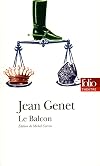
The Balcony
by Jean Genet
On This Page
Description
Book jacket/back: The setting of Jean Genet's celebrated play is a brothel that caters to refined sensibilities and peculiar tastes. Here men from all walks of life don the garb of their fantasies and act them out: a man from the gas company wears the robe and mitre of a bishop; another customer becomes a flagellant judge, and still another a victorious general, while a bank clerk defiles the Virgin mary. These costumed diversions take place while outside a revolution rages which has show more isolated the brothel from the rest of the rebel-controlled city. In a stunning series of macabre, climactic scenes, Genet presents his caustic view of man and society. show lessTags
Recommendations









































Member Reviews
A strange play, but what do you expect from absurdist theatre? Like much absurdism, nothing means what you think it means, nothing happens like you expect it to happen, and the ending just sort of...ends. It is a darkly humorous look at a world where rebels threaten outside, while inside revels occur. The Balcony refers to the grand balcony of a house of ill repute, and most of the play takes place inside the walls of the house. The scene that moves out of the house into the world of the rebels for a brief glimpse is jarring; it doesn't feel like it fits. It isn't part of the world of the play, which is a play of illusions. Though I suppose in this play, the rebellion itself is a form of illusion. Genet appears to be suggesting that we show more all are, in fact, living in illusion. He could be right. show less
Genet, ever the expert observor of social relations as determined by power roles, takes a look at them here in the context of a brothel where people can enact their sexual fantasies by donning the garb of a bishop or a general, etc. Meanwhile, outside the brothel, a rebellion rages. Genet manages to concentrate many levels of reality here & many levels of disatisfaction. Like everything Genet ever wrote, this is great. Maybe I hold back from giving it a 5 star rating just so I can contrast it to other Genet bks that I like even more, maybe b/c I'm not such an enthusiast for plays - preferring more radical forms: such as guerrilla actions.
Would it perturb you to see things as they are? To gaze at the world tranquilly and accept responsibility for your gaze, whatever it might see?
I found this less Brecht and more Passolini. Revolution became chic at some point. This is about assuming roles in tumultuous times. I found the endearing aspect to be the role of the siren or chanteuse.
The pimp has a grin, never a smile
Much as Steven Godin asserted on GR today I think the experience would have been enhanced by viewing this staged. I don't feel that when I read Brecht or Beckett.
I found this less Brecht and more Passolini. Revolution became chic at some point. This is about assuming roles in tumultuous times. I found the endearing aspect to be the role of the siren or chanteuse.
The pimp has a grin, never a smile
Much as Steven Godin asserted on GR today I think the experience would have been enhanced by viewing this staged. I don't feel that when I read Brecht or Beckett.
Genet manages to play magically with the real/unreal in the context of a brothel in the middle of a revolution. Suddenly the customers of the brothel play the roles of the real life judge, bishop, general and queen (killed in the revolution?), and the revolutionary comes to the brothel to achieve his fantasy of being an hero buried eternally in a mausoleum. The play ends with Irma, the owner of the brothel, addressing the audience and warning them that the live they live outside the theater is even more false than within.
Read and re-read to fully enjoy!
PS: the wikipedia article is comprehensive and helpful for understanding and appreciating the play
Read and re-read to fully enjoy!
PS: the wikipedia article is comprehensive and helpful for understanding and appreciating the play
nah. too existential for me. and a bit too confusing with the double talk.
The Balcony is probably the most stunning subversive work of literature to be created since the writings of the famous Marquis.... A major dramatic achievement. -- Robert Brustein, The New Republic
Ratings
Members
- Recently Added By
Lists

Literary Works Read in College
316 works; 15 members

Harold Bloom - The Western Canon: D. The Chaotic Age
833 works; 24 members

Favourite Books
1,819 works; 308 members

Books Read in 2017
4,249 works; 130 members

Best 20th Century French Plays
30 works; 4 members
Favourite Theatre of the Absurd
30 works; 4 members

1950s
340 works; 22 members

20th Century Literature
1,161 works; 54 members

Next Plays / 2025
352 works; 1 member
Author Information

146+ Works 10,245 Members
Jean Genet was born in Paris, France on December 19, 1910. He was an illegitimate child abandoned by his mother, raised by Public Assistance, and sent to live with foster parents at the age of seven. At the age of 10 he was accused of stealing. He spent five years at the Mettray Reformatory and as a young adult spent time in various European show more prisons for vagrancy, homosexuality, theft, and smuggling. He began writing in 1942, while in prison. His works include Our Lady of the Flowers, Miracle of the Rose, and The Thief's Journal. In 1948, he was convicted of burglary for the 10th time and condemned to automatic life imprisonment. However, by 1947, his works had gained attention from such writers as Jean-Paul Sartre, André Gide, and Jean Cocteau. After the sentence, they petitioned for his release and a pardon was granted. In the late 1940s, Genet began to write for the theatre, but several of his plays were too controversial to be performed in France. His plays included The Maids, Deathwatch, The Blacks, and The Balcony. He died on April 15, 1986. (Bowker Author Biography) show less
Some Editions
Series
Belongs to Publisher Series
Work Relationships
Is contained in
Has the adaptation
Has as a student's study guide
Common Knowledge
- Original title
- Le balcon
- Alternate titles
- The Balcony: A Play
- Original publication date
- 1956
- People/Characters
- Irma
- Important places
- France
- Related movies
- The Balcony (1963 | IMDb)
- Last words*
- (Click to show. Warning: May contain spoilers.)"Irma: (chama, voltada para os bastidores) Carmen!... Camen!... Fecha bem as portas, rapariga, e põe as coberturas... (continua a apagar as luzes). Daqui a pouco é preciso começar tudo outra vez... acender novamente tudo... vestir tudo de novo... (ouve-se o canto de um galo) Ah! todo este vestuário, todos estes disfarces! Voltar a distribuir os papéis... enfiar o meu... (pára a meio do palco, virada para o público)... preparar o vosso... juízes, generais, bispos, camareiros, revoltosos que deixaram fugir a revolta, preciso de preparar o guarda-roupa e os salões para amanhã... e vocês precisam de voltar às vossas casas, onde tudo, tenham a certeza, será ainda mais falso do que aqui... Têm de se ir embora... Podem sair pela direita, que dá para a viela,,, (Irma apaga a última luz) Está a amanhecer. (Rajada de metralhadora). PANO”
- Blurbers
- Brustein, Robert
- Original language
- French
*Some information comes from Common Knowledge in other languages. Click "Edit" for more information.
Classifications
Statistics
- Members
- 944
- Popularity
- 28,213
- Reviews
- 6
- Rating
- (3.78)
- Languages
- 9 — Danish, Dutch, English, Finnish, French, German, Italian, Portuguese, Spanish
- Media
- Paper, Ebook
- ISBNs
- 21
- ASINs
- 32