

The Birth Order Book: Why You Are the Way You Are
by Kevin Leman
On This Page
Description
Firstborn? Only child? Middle child? Baby of the family? Find out what it means to you, your relationships, and your career. Do you realize that of the first twenty-three astronauts in space, twenty-one were firstborns and the other two were the only child in their family? Are you aware that many successful entrepreneurs are middle children? Is it any surprise that most comedians are the youngest child in their family? It's all about birth order. Birth order powerfully influences who you show more are, whom you marry, the job you choose, and the kind of parent you are. And Dr. Kevin Leman's The Birth Order Book will help you understand yourself, get along better with others, overcome ingrained tendencies you never thought you could get rid of, and be more successful in the workplace. This revised and updated audio edition of Dr. Leman's classic book includes more than thirty years of experience and research, current examples, and fascinating stories to show how birth order impacts your life. Thousands of people have unlocked the secrets of birth order already. Shouldn't you be one of them?. show less
Tags
Recommendations




























Member Reviews
Psychologist Kevin Leman believes that birth order strongly affects adult personality attributes, a person's relationships with their spouse and children, and even one's occupational choice. In this book, he characterizes attributes of first- borns, middle children, last- borns, and only - children. Leman offers advice to adults to help them understand their personality attributes and how to make their birth order work best for them. Likewise, he advises parents on how to meet the particular needs of siblings that reflect their birth order.
This book relies heavily on sweeping generalizations. For example, first - borns are said to be more highly motivated to achieve than are younger siblings. They tend to be "perfectionist, reliable, show more conscientious, list makers, well – organized, critical, serious, and scholarly", and "known for their strong powers of concentration, tolerance, and patience." Of US presidents (we are informed), 52% were first borns, as were 21 of the first 23 astronauts sent to space. (Is this actually true? How many were only - children, and how many merely the first born male -- given that such careers were long not open to females?) Regardless, Leman considers that such numbers reflect the fact that first borns seek careers that require "precision, strong powers of concentration, and dogged mental discipline." In contrast, "middle" children are said to have lacked sufficient attention, and as adults, try to avoid conflict at any price, and tend to be secretive, prone to embarassment, and to have (despite a calm exterior) "all kinds of storms" brewing beneath the surface. Similar sorts of generalizations are offered about last- borns and those who have been the "only child."
Much of this information will sound familiar to readers of books on pop psychology, where it has been repeated over the decades. However, because this book cites no empirical studies and refers to very little of the social science literature, its glib assertions remain uncorroborated and difficult to assess. One potential criticism of the birth- order hypothesis -- that it is somehow like astrology -- is (as Leman notes) entirely unfair. Under the birth - order hypothesis, children respond to their early environment (including siblings) by forming personalities that reflect parental expecations and styles of supervision, as well as sibling ties and rivalries. Accordingly, birth order attributes are purported to reflect responses of flexible potentials to particular circumstances, while having nothing to do with genetics (or the supernatural).
Nevertheless, as Leman readily acknowledges, there are many variables other than strict birth order that can affect a given child's personality. Among the confounding variables are gender -- thus (he notes) that a girl with two older brothers may show attributes of a first born, since she is the first girl. Another variable is body type -- when a boy is physically larger and more powerful than his older brother, the result may be a role reversal. Another variable is size of the age gaps between siblings; a larger gap may yield a set of siblings that restart the birth order count. Other variables include family size, presence of twins (who attract special attention whatever their position in the age hierarchy), children with special needs, and blended families (siblings of different parentage). To this list we can add features Leman never considers but which are very much attributes of the US social scene, such as single parent households, spousal abuse, alcoholism, divorce, and poverty. Further, Leman's facile generalizations about career choices entirely ignore the impact of social class -- as if all individuals have equal access to professional careers -- not to mention the significant issues of race and gender. Thus, the book implicitly ignores the ways personalities and potentials are reflections of the social, political, and economic features of the society at large. Leman's account may or may not apply to middle and upper class US society in the 1980s, but they can hardly be assumed to apply to other time periods or to the world at large. (The situation is analogous to Freud's parochial focus on upper class women of Vienna).
Finally, one ought not overlook the important role of heredity on personality, manifested in attributes that have nothing to do with birth order. For example, much recent research has shown that features ranging from risk- taking behavior to religiosity to homosexuality have strong heritable components.
In response to those complexities that he does recognize, Leman seems to stretch his explanations to fit any circumstances. In his anecdotes, there is always a convenient explanation to account for why a given individual has turned out a particular way that doesn't conform to predictions based solely on birth order. Thus, Leman's Procrustean explanations take on attributes of the very astrology he justifiably dismisses.
How reliable is this book then? To the critical reader, unfortunately, not very reliable at all. The many variables that are and are not recognized in Leman's book surely have the potential to interact in complex ways to determine personality attributes. Teasing out their relative contributions would require a highly sophisticated statistical analysis of a very large data set. What's more, the personality attributes need to be operationalized in quantifiable ways. For these and other reasons, the subdiscipline of personality psychology has yielded a large and complex literature. Little wonder that professional psychologists are skeptical of simplistic birth-order explanations for personality attributes.
Readers may enjoy this book, and find nuggets of information that seem to give insight into a particular circumstance. However, anecdotes are too easily chosen to fit one's pet hypotheses, and counter - examples can be all-too- readily dismissed or explained away. In short, this book offers no reliable empirical support for its facile generalizations and pat assertions. In view of the complexities, readers who are seriously interested in whether and how birth order affects personality will have to seek elsewhere. show less
This book relies heavily on sweeping generalizations. For example, first - borns are said to be more highly motivated to achieve than are younger siblings. They tend to be "perfectionist, reliable, show more conscientious, list makers, well – organized, critical, serious, and scholarly", and "known for their strong powers of concentration, tolerance, and patience." Of US presidents (we are informed), 52% were first borns, as were 21 of the first 23 astronauts sent to space. (Is this actually true? How many were only - children, and how many merely the first born male -- given that such careers were long not open to females?) Regardless, Leman considers that such numbers reflect the fact that first borns seek careers that require "precision, strong powers of concentration, and dogged mental discipline." In contrast, "middle" children are said to have lacked sufficient attention, and as adults, try to avoid conflict at any price, and tend to be secretive, prone to embarassment, and to have (despite a calm exterior) "all kinds of storms" brewing beneath the surface. Similar sorts of generalizations are offered about last- borns and those who have been the "only child."
Much of this information will sound familiar to readers of books on pop psychology, where it has been repeated over the decades. However, because this book cites no empirical studies and refers to very little of the social science literature, its glib assertions remain uncorroborated and difficult to assess. One potential criticism of the birth- order hypothesis -- that it is somehow like astrology -- is (as Leman notes) entirely unfair. Under the birth - order hypothesis, children respond to their early environment (including siblings) by forming personalities that reflect parental expecations and styles of supervision, as well as sibling ties and rivalries. Accordingly, birth order attributes are purported to reflect responses of flexible potentials to particular circumstances, while having nothing to do with genetics (or the supernatural).
Nevertheless, as Leman readily acknowledges, there are many variables other than strict birth order that can affect a given child's personality. Among the confounding variables are gender -- thus (he notes) that a girl with two older brothers may show attributes of a first born, since she is the first girl. Another variable is body type -- when a boy is physically larger and more powerful than his older brother, the result may be a role reversal. Another variable is size of the age gaps between siblings; a larger gap may yield a set of siblings that restart the birth order count. Other variables include family size, presence of twins (who attract special attention whatever their position in the age hierarchy), children with special needs, and blended families (siblings of different parentage). To this list we can add features Leman never considers but which are very much attributes of the US social scene, such as single parent households, spousal abuse, alcoholism, divorce, and poverty. Further, Leman's facile generalizations about career choices entirely ignore the impact of social class -- as if all individuals have equal access to professional careers -- not to mention the significant issues of race and gender. Thus, the book implicitly ignores the ways personalities and potentials are reflections of the social, political, and economic features of the society at large. Leman's account may or may not apply to middle and upper class US society in the 1980s, but they can hardly be assumed to apply to other time periods or to the world at large. (The situation is analogous to Freud's parochial focus on upper class women of Vienna).
Finally, one ought not overlook the important role of heredity on personality, manifested in attributes that have nothing to do with birth order. For example, much recent research has shown that features ranging from risk- taking behavior to religiosity to homosexuality have strong heritable components.
In response to those complexities that he does recognize, Leman seems to stretch his explanations to fit any circumstances. In his anecdotes, there is always a convenient explanation to account for why a given individual has turned out a particular way that doesn't conform to predictions based solely on birth order. Thus, Leman's Procrustean explanations take on attributes of the very astrology he justifiably dismisses.
How reliable is this book then? To the critical reader, unfortunately, not very reliable at all. The many variables that are and are not recognized in Leman's book surely have the potential to interact in complex ways to determine personality attributes. Teasing out their relative contributions would require a highly sophisticated statistical analysis of a very large data set. What's more, the personality attributes need to be operationalized in quantifiable ways. For these and other reasons, the subdiscipline of personality psychology has yielded a large and complex literature. Little wonder that professional psychologists are skeptical of simplistic birth-order explanations for personality attributes.
Readers may enjoy this book, and find nuggets of information that seem to give insight into a particular circumstance. However, anecdotes are too easily chosen to fit one's pet hypotheses, and counter - examples can be all-too- readily dismissed or explained away. In short, this book offers no reliable empirical support for its facile generalizations and pat assertions. In view of the complexities, readers who are seriously interested in whether and how birth order affects personality will have to seek elsewhere. show less
My ladies' Book Club selected this as a change of pace to start 2021 and we had a good time with it. The vast majority of the group were firstborns with a few middleborns and one baby in the mix. Mostly the group felt that the analysis stated was spot on with only a few disagreements. I, personally, didn't feel that I fit my birth order category, but everyone else said that it was definitely me. The discussion was lively and a great deal of fun and laughter ensued.
The style of writing for such a "serious" topic was light and friendly making us all feel as if Dr. Leman was speaking directly to us. Including his own family made3 it more personal however, he did seem to be trying to sell a bunch of other books at the same time. It was a show more good book for a book club to help getting to know each other better. show less
The style of writing for such a "serious" topic was light and friendly making us all feel as if Dr. Leman was speaking directly to us. Including his own family made3 it more personal however, he did seem to be trying to sell a bunch of other books at the same time. It was a show more good book for a book club to help getting to know each other better. show less
My feelings about this book swing wildly as I read the different chapters and find some really good stuff in between all the glib generalisations.
Mostly I have to say I want to tell Kevin that people are really not that simple. You can't categorise me as a "middle child" or anyone else for that matter.
If you have an unconvential family you will be particularly disappointed as he focuses on the typical 2 or 3 children. As one of 6 I really stuggled to apply much of what he said to my own childhood. I think some generalisations about first children may hold as whatever comes after they do hold a particular place in the family. Even having said that as I'm married to a first born who doesn't fit the mould at all, it looks like he failed show more again there.
It's kind of insulting to boil us down to a set of characteristics determined by our position in the family, actually pretty preposterous for him to apply his middle class 2-3 children to all of us and expect us to fit his cookie cutter world. show less
Mostly I have to say I want to tell Kevin that people are really not that simple. You can't categorise me as a "middle child" or anyone else for that matter.
If you have an unconvential family you will be particularly disappointed as he focuses on the typical 2 or 3 children. As one of 6 I really stuggled to apply much of what he said to my own childhood. I think some generalisations about first children may hold as whatever comes after they do hold a particular place in the family. Even having said that as I'm married to a first born who doesn't fit the mould at all, it looks like he failed show more again there.
It's kind of insulting to boil us down to a set of characteristics determined by our position in the family, actually pretty preposterous for him to apply his middle class 2-3 children to all of us and expect us to fit his cookie cutter world. show less
THE BIRTH ODER BOOK would have been much better if the first three chapters were taken away. There was a lot of self promotion for the book in these first four chapters, and I became a bit frustrated with the author telling us how great this book was and how important it was that we read it. While he did make some pretty interesting statements in the book, and parts of the book really were great, the author’s sales tactics were applied in the incorrect setting. The people that need to be told to read the book are not the ones, like me, who are already reading it. The concept of birth order is certainly interesting, and the author gave some easy to understand examples and “tests” to help get his point across, but you can probably show more just skim the first few chapters and not miss very much…..but what do I know, I am just a first born. show less
Definitely could have done without the underlying religious tones, but overall an interesting look at family psychology and dynamics.
Good insights. Most people have caught on to the basics, but I like the suggestions for marriage, parenting and employment situations. Also, he's Christian so his approach to changing perfectionism tackled the lovely verse "Be ye therefore perfect."
So spot on! As I read each chapter, I just kept thinking "OMG, I am such a typical first born daughter!" & "Wow, these descriptions of the middle child & the last born describe my brothers exactly."
Members
- Recently Added By
Lists

Non-Fiction Worth Reading
1,015 works; 256 members
Author Information

171 Works 11,144 Members
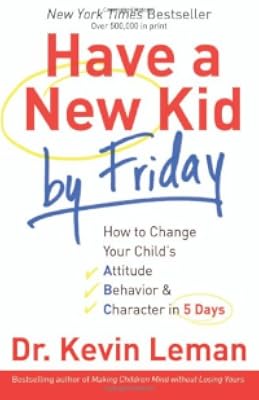
Dr. Kevin Leman is an internationally known psychologist, radio and television personality, speaker, and educator who has taught and entertained audiences worldwide with his wit and commonsense psychology. The New York Times bestselling and award-winning author of more than 50 books, including The Birth Order Book, and Have a New Kid by Friday, show more Dr. Leman has made thousands of house calls through radio and television programs, such as FOX Friends. The Real Story, The View, FOX's The Morning Show, Today, Morning in America, CBS's The Early Show, The 700 Club, Focus on the Family, and CNN. A former contributing family psychologist to Good Morning America, Dr. Leman lives with his wife, Sande, in Tucson, Arizona. They have five children and four grandchildren. show less
Some Editions
Awards and Honors
Awards
Common Knowledge
- Original title
- The Birth Order Book
- Alternate titles
- Birth Order Book
- Original publication date
- 1985; 1998; 2009
- Original language
- English
Classifications
- Genres
- Nonfiction, General Nonfiction
- DDC/MDS
- 155.924 — Philosophy & psychology Psychology Differential and developmental psychology Environmental psychology Social Influences Interpersonal relations with family members
- LCC
- BF723 .B5 .L46 — Philosophy, Psychology and Religion Psychology Psychology Developmental psychology
- BISAC
Statistics
- Members
- 1,198
- Popularity
- 20,714
- Reviews
- 14
- Rating
- (3.52)
- Languages
- 6 — Czech, English, German, Hungarian, Norwegian (Bokmål), Norwegian
- Media
- Paper, Audiobook, Ebook
- ISBNs
- 24
- UPCs
- 1
- ASINs
- 13