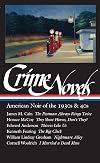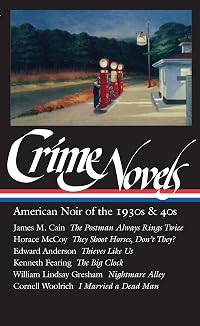
Crime Novels: American Noir of the 1930s and 40s
by Robert Polito (Editor)
On This Page
Description
"This adventurous volume, with its companion devoted to the 1950s, presents a rich vein of modern American writing too often neglected in mainstream literary histories. Evolving out of the terse and violent hardboiled style of the pulp magazines, noir fiction expanded over the decades into a varied and innovative body of writing. Tapping deep roots in the American literary imagination, the novels in this volume explore themes of crime, guilt, deception, obsessive passion, murder, and the show more disintegrating psyche. With visionary and often subversive force they create a dark and violent mythology out of the most commonplace elements of modern life. The raw power of their vernacular style has profoundly influenced contemporary American culture and writing. Far from formulaic, they are ambitious works which bend the rules of genre fiction to their often experimental purposes"--Jacket. show lessTags
Recommendations
Member Reviews
Here is the first sentence: "“They threw me off the hay truck about noon” — James M. Cain’s The Postman Always Rings Twice. A fine beginning. But afterwards, perhaps fifty pages in, I was ready for a shower. This is one depraved story about two sociopathic misfits who are made for each other, Frank and Cora. Maybe the two of them do not exactly feel 'love at first sight,' but 'lust' could replace 'love' and the tortured reader, not to mention everyone who comes across this star-crossed couple, gets pulled into a vortex of depravity. The story takes place, say, in 1934, the Great Depression, and is located mostly in a greasy-spoon diner on a traveled highway about twenty miles above LA, maybe the Montrose area going into the show more mountains or the old 101 between Sherman Oaks and Thousand Oaks. And the miscreants and reprobates and grifters who populate its pages, as they lord it over the 'Mexs,' and the 'Wops' and the 'dirty' Greeks, make today's reader realize where our compatriots who wish "to make America great again" want us to return to: a world where brute force and misogyny bully and beat the rest of the populace into its place. There can be no denial, however, that Cain's compelling and terse narrative, without one single wasted word, is masterful. Were the book longer, a back story as to how these two grifters morphed into who they were, would be as gripping as a Dreiser novel; Dreiser would leave no anecdote behind if given the chance to demonstrate why his people would behave as they did. For the rest of us, Thoreau's remark, that "the mass of men live lives of quiet desperation" will have to suffice. Now for a shower! show less
What can you say about a book this good? For $25 you get 6, count 'em 6 of the very best classic American noir novels of all time: The Postman Always Rings Twice; They Shoot Horses, Don't They?; Thieves Like Us; The Big Clock; Nightmare Alley; and I Married a Dead Man. All this with a real cloth-bound hardcover, sewn in numbers, headbands, a beautiful book. Author notes, footnotes, chronology.
If you think noir is all about private dicks and dames, well think again, there isn't a detective protagonist in the bunch. These novels are more about life in the gritty years of the Great Depression and the effects it had on the physical and psychological conditions of people. Sure there are con men, bank robbers, blackmailers, murderers, show more prostitutes, but this isn't about psychopaths like a Jim Thompson novel, its about people trying to make it and stay alive when hope is gone. A lot of these writers were just trying to make it themselves, so they know what they are writing about. Some of the prose and writing is quite experimental, not always what you think of in dime crime novels. A lot of times the writing is on edge with the best stuff being written even today. This is classic American literature disguised as pulp crime fiction.
I Married a Dead Man is by Cornell Woolrich one of the greatest character writers of all time. show less
If you think noir is all about private dicks and dames, well think again, there isn't a detective protagonist in the bunch. These novels are more about life in the gritty years of the Great Depression and the effects it had on the physical and psychological conditions of people. Sure there are con men, bank robbers, blackmailers, murderers, show more prostitutes, but this isn't about psychopaths like a Jim Thompson novel, its about people trying to make it and stay alive when hope is gone. A lot of these writers were just trying to make it themselves, so they know what they are writing about. Some of the prose and writing is quite experimental, not always what you think of in dime crime novels. A lot of times the writing is on edge with the best stuff being written even today. This is classic American literature disguised as pulp crime fiction.
I Married a Dead Man is by Cornell Woolrich one of the greatest character writers of all time. show less
“Them politicians are thieves just like us,” T-Dub said. “Only they got more sense and use their damned tongues instead of a gun.”
6 noir stories from the 40's and 50's. The first, "The Postman Always Rings Twice" is a classic, and one that I had already read.
The second, Horace McCoy’s "They Shoot Horses, Don’t They?" is a really good read, and one that I had always thought was a western, due to the title. I love the way the story is written between the words of a judge who is sentencing the main character to death! Totally original! And I didn't know much of anything about dance marathons, so I learned a lot too! Super creepy last sentence.
“Thieves LikeUs” follows three fellas that’ve escaped from prison and start show more robbing banks. It was a very slow read for me.
“The Big Clock” was a ‘big’ thumbs down.
“Nightmare Alley” is a story about a carnival sideshow. I really liked Molly’s backstory!
“I Married A Dead Man” was another thumbs down.
So, overall, an uneven collection of stories. It almost goes from best to worst, with the decline beginning in the middle of the third story. I'd really only recommend reading the first two. show less
6 noir stories from the 40's and 50's. The first, "The Postman Always Rings Twice" is a classic, and one that I had already read.
The second, Horace McCoy’s "They Shoot Horses, Don’t They?" is a really good read, and one that I had always thought was a western, due to the title. I love the way the story is written between the words of a judge who is sentencing the main character to death! Totally original! And I didn't know much of anything about dance marathons, so I learned a lot too! Super creepy last sentence.
“Thieves LikeUs” follows three fellas that’ve escaped from prison and start show more robbing banks. It was a very slow read for me.
“The Big Clock” was a ‘big’ thumbs down.
“Nightmare Alley” is a story about a carnival sideshow. I really liked Molly’s backstory!
“I Married A Dead Man” was another thumbs down.
So, overall, an uneven collection of stories. It almost goes from best to worst, with the decline beginning in the middle of the third story. I'd really only recommend reading the first two. show less
The Postman Always Rings Twice (read, but not rated)
They Shoot Horses Don't They **** 1/2
Reminiscent in style and attitude of Thieves Like Us, this is a tersely told, very short novel about a young man who meets a girl accidentally on the streets of Hollywood and enters a dance marathon with her, leading to tragic consequences. There's no mystery - you know from the first page that he has killed his partner with a shot to the head. The chapters of the book take place in between the words of the judge's sentence at his trial. McCoy's triumph as a writer, then, is not sucking you into a mystery, but in justifying the event the reader knows is coming. He succeeds brilliantly, with hardly a false note, in a novel that will shock you from show more time to time with its blunt language. After reading this (again, like Thieves Like Us), it will forever color your feelings about the Depression-era 1930s.
Thieves Like Us **** 1/2 (repeated from my review of a separate copy of this book)
Very compelling story of a group of bank robbers and murderers who escape from an Oklahoma prison and what happens to them afterward as they start a new crime spree across the Southwest during the Depression. Especially effective when the focus shifts to the youngest and smartest, Bowie, as he tries but fails to put the past behind him with his new love, Keetchie. Inevitably sad and bittersweet, Anderson tells the story simply and totally effectively, so that it will linger in your mind long after you turn the last page.
Certainly has its relevance in these times, as well. Thieves Like Us, indeed.
The Big Clock *** (repeated from my review of a separate copy of this book)
This is a cleverly plotted novel that holds your attention until the disappointing ending, when the author just seems to stop caring. While "The Big Clock" is better plotted than the other Fearing novel I have reviewed, "Dagger of the Mind", both suffer from a cast of characters who are almost uniformly unlikable. Fearing delights in showing the quirks and weaknesses of his cast, and he does it in an ironic matter that lends an air of unreality to the whole proceedings, even though the flawed characters he depicts are much closer to reality than the cut and dried black or white characters usually found in noir fiction or pulp novels. He also goes in for stunts such as having the main character named "George", his wife named "Georgette" and their daughter being called "Georgia". As a result, neither book ever really affects you emotionally - they are written at a purely intellectual level, reflecting the type of cerebral person Fearing probably was. I wouldn't be surprised if some of the characters were modeled on people he knew.
In any case, despite these weaknesses, everything hums along nicely and you wonder how the main character, George Stroud, is ever going to get out of his predicament. Either he winds up on somebody's hit list or he loses his marriage. Perhaps Fearing couldn't figure out a good ending either. He used impeccable logic to hem his character in with no escape - then he drops in a deus ex machina type ending that leaves far too many loose ends - such as whatever happened to the ongoing police investigation. Truly annoying - I'm tempted to go back and remove another half star....
Nightmare Alley **** 1/2
I’m not sure there is any such thing as an epic noir novel, which is why the inclusion of William Lindsay Gresham’s Nightmare Alley in this volume seems a bit wrong. Noir tends to be focused, often on the quest of a single individual to solve a crime (or commit one), and even a fairly lengthy noir novel like Chandler’s The Long Goodbye, while it may ramble a bit, is still tightly focused since the story unfolds through the eyes of a single character.
Nightmare Alley, however, has everything in it, including a few scenes with sinks, though perhaps not a kitchen one. Lots of the elements of the story are noir staples, of course, particularly the early scenes in a carnival. Gresham’s story is much more ambitious than that, however. It morphs from a carny story to a story of mind reading and fortune telling to a detailed story of a fake spiritualist, with love triangles, dogs, and a hobo jungle thrown in for good measure. It is like reading at least three novels rolled into one. The thread linking it all together is Stanton Carlisle, a fair haired 21 year old with an Oedipus complex who, as the story begins, has just joined a traveling carnival as a sleight of hand artist as well as a talker and helper for a few other acts. Through a series of recollections, however, Gresham fills us in on Carlisle's childhood up until he left home. As a result, the story begins to take on the tragic aspect Gresham no doubt intended. But Carlisle is only occasionally a sympathetic character, and he becomes more and more depraved (perhaps base is a better word) as the story goes on.
I won’t spoil the details for you, just say that about when you think Gresham has gone along long enough, he comes up with a few paragraphs or an entire chapter that makes you nod your head in admiration. In addition, there are several other memorable characters in the book, mostly friends and acquaintances from his carnival days that turn up throughout the story. The novel is very gritty in its descriptions of people and the things people do with and to other people. While the world it depicts doesn’t seem like something we could step out of our front door into, it is frighteningly real, nevertheless. The book may be a bit of a period piece—but the aspirations and emotions it depicts are completely modern.
So, the bottom line is that I’m very happy the Library of America decided to print this book, even if I think calling it noir is a bit misleading. Just find it – in whatever edition – and read it. It deserves all the exposure it can get.
I Married a Dead Man ** 1/2 (repeated from my review of a separate copy of this book)
This book has a clever premise, which I won't give away, but suffers throughout - particularly at the beginning and end - from an overly melodramatic narrative that definitely dulls the fascination of seeing how the sort-of-heroine deals with her unique situation and the threats to the future of her and her child. It's like reading some sort of out of control romance novel. Woolrich could, and did, write a lot better than this in other books and stories. In the end, the resolution depends on the weakness of character of the two main characters to perpetuate the whole melodramatic business. Or maybe Woolrich couldn't think up a better ending. This is based on an earlier short story, which had a different ending. show less
They Shoot Horses Don't They **** 1/2
Reminiscent in style and attitude of Thieves Like Us, this is a tersely told, very short novel about a young man who meets a girl accidentally on the streets of Hollywood and enters a dance marathon with her, leading to tragic consequences. There's no mystery - you know from the first page that he has killed his partner with a shot to the head. The chapters of the book take place in between the words of the judge's sentence at his trial. McCoy's triumph as a writer, then, is not sucking you into a mystery, but in justifying the event the reader knows is coming. He succeeds brilliantly, with hardly a false note, in a novel that will shock you from show more time to time with its blunt language. After reading this (again, like Thieves Like Us), it will forever color your feelings about the Depression-era 1930s.
Thieves Like Us **** 1/2 (repeated from my review of a separate copy of this book)
Very compelling story of a group of bank robbers and murderers who escape from an Oklahoma prison and what happens to them afterward as they start a new crime spree across the Southwest during the Depression. Especially effective when the focus shifts to the youngest and smartest, Bowie, as he tries but fails to put the past behind him with his new love, Keetchie. Inevitably sad and bittersweet, Anderson tells the story simply and totally effectively, so that it will linger in your mind long after you turn the last page.
Certainly has its relevance in these times, as well. Thieves Like Us, indeed.
The Big Clock *** (repeated from my review of a separate copy of this book)
This is a cleverly plotted novel that holds your attention until the disappointing ending, when the author just seems to stop caring. While "The Big Clock" is better plotted than the other Fearing novel I have reviewed, "Dagger of the Mind", both suffer from a cast of characters who are almost uniformly unlikable. Fearing delights in showing the quirks and weaknesses of his cast, and he does it in an ironic matter that lends an air of unreality to the whole proceedings, even though the flawed characters he depicts are much closer to reality than the cut and dried black or white characters usually found in noir fiction or pulp novels. He also goes in for stunts such as having the main character named "George", his wife named "Georgette" and their daughter being called "Georgia". As a result, neither book ever really affects you emotionally - they are written at a purely intellectual level, reflecting the type of cerebral person Fearing probably was. I wouldn't be surprised if some of the characters were modeled on people he knew.
In any case, despite these weaknesses, everything hums along nicely and you wonder how the main character, George Stroud, is ever going to get out of his predicament. Either he winds up on somebody's hit list or he loses his marriage. Perhaps Fearing couldn't figure out a good ending either. He used impeccable logic to hem his character in with no escape - then he drops in a deus ex machina type ending that leaves far too many loose ends - such as whatever happened to the ongoing police investigation. Truly annoying - I'm tempted to go back and remove another half star....
Nightmare Alley **** 1/2
I’m not sure there is any such thing as an epic noir novel, which is why the inclusion of William Lindsay Gresham’s Nightmare Alley in this volume seems a bit wrong. Noir tends to be focused, often on the quest of a single individual to solve a crime (or commit one), and even a fairly lengthy noir novel like Chandler’s The Long Goodbye, while it may ramble a bit, is still tightly focused since the story unfolds through the eyes of a single character.
Nightmare Alley, however, has everything in it, including a few scenes with sinks, though perhaps not a kitchen one. Lots of the elements of the story are noir staples, of course, particularly the early scenes in a carnival. Gresham’s story is much more ambitious than that, however. It morphs from a carny story to a story of mind reading and fortune telling to a detailed story of a fake spiritualist, with love triangles, dogs, and a hobo jungle thrown in for good measure. It is like reading at least three novels rolled into one. The thread linking it all together is Stanton Carlisle, a fair haired 21 year old with an Oedipus complex who, as the story begins, has just joined a traveling carnival as a sleight of hand artist as well as a talker and helper for a few other acts. Through a series of recollections, however, Gresham fills us in on Carlisle's childhood up until he left home. As a result, the story begins to take on the tragic aspect Gresham no doubt intended. But Carlisle is only occasionally a sympathetic character, and he becomes more and more depraved (perhaps base is a better word) as the story goes on.
I won’t spoil the details for you, just say that about when you think Gresham has gone along long enough, he comes up with a few paragraphs or an entire chapter that makes you nod your head in admiration. In addition, there are several other memorable characters in the book, mostly friends and acquaintances from his carnival days that turn up throughout the story. The novel is very gritty in its descriptions of people and the things people do with and to other people. While the world it depicts doesn’t seem like something we could step out of our front door into, it is frighteningly real, nevertheless. The book may be a bit of a period piece—but the aspirations and emotions it depicts are completely modern.
So, the bottom line is that I’m very happy the Library of America decided to print this book, even if I think calling it noir is a bit misleading. Just find it – in whatever edition – and read it. It deserves all the exposure it can get.
I Married a Dead Man ** 1/2 (repeated from my review of a separate copy of this book)
This book has a clever premise, which I won't give away, but suffers throughout - particularly at the beginning and end - from an overly melodramatic narrative that definitely dulls the fascination of seeing how the sort-of-heroine deals with her unique situation and the threats to the future of her and her child. It's like reading some sort of out of control romance novel. Woolrich could, and did, write a lot better than this in other books and stories. In the end, the resolution depends on the weakness of character of the two main characters to perpetuate the whole melodramatic business. Or maybe Woolrich couldn't think up a better ending. This is based on an earlier short story, which had a different ending. show less
only read the first novel, the postman always rings twice. i think i may be missing some huge allegory or insight or something. there was no postman, no doorbell, and no one ringing twice. i kept waiting but . . .
couldn't have been a starker contrast between this book and the last one i read. not much character development, never got to really dig into the main characters head--though it would have been very interesting. story carried mainly by the interesting dialogue and sudden twists and turns. loved the ironic ending.
moral of the story: murder is not a good foundation to build a romantic relationship on. oddly enough though, i became so wrapped up in the love affair and them getting together that when the first attempt failed, i was show more disappointed. then when they succeeded and they were going through the trial, i just wanted them to be free in their love. their love quickly turned to jealousy and suspicion and crumbled. i guess this could be taken as a parable for adultery. for by the end, the justice i was warding off became the justice i needed. show less
couldn't have been a starker contrast between this book and the last one i read. not much character development, never got to really dig into the main characters head--though it would have been very interesting. story carried mainly by the interesting dialogue and sudden twists and turns. loved the ironic ending.
moral of the story: murder is not a good foundation to build a romantic relationship on. oddly enough though, i became so wrapped up in the love affair and them getting together that when the first attempt failed, i was show more disappointed. then when they succeeded and they were going through the trial, i just wanted them to be free in their love. their love quickly turned to jealousy and suspicion and crumbled. i guess this could be taken as a parable for adultery. for by the end, the justice i was warding off became the justice i needed. show less
The Big Clock is a short book which is one of the five novels in this volume
I first read Kenneth Fearing's poetry in the American Poet Project's edition. I enjoyed it very much. He has a working class frame of mind and writes very well. Then I discovered in the Library of America's American Noir 1930's and 40's this book. It is crime suspense and I read the last 20 pages very fast because I had to find out how it was going to end. The twist of the story is the protagonist knows his boss murdered someone because he saw him with her right before the murder. The boss saw him but couldn't identify him and the boss assigns him to find the person who saw him with the victim. It is beyond a page turner and the end was very satisfying.
I first read Kenneth Fearing's poetry in the American Poet Project's edition. I enjoyed it very much. He has a working class frame of mind and writes very well. Then I discovered in the Library of America's American Noir 1930's and 40's this book. It is crime suspense and I read the last 20 pages very fast because I had to find out how it was going to end. The twist of the story is the protagonist knows his boss murdered someone because he saw him with her right before the murder. The boss saw him but couldn't identify him and the boss assigns him to find the person who saw him with the victim. It is beyond a page turner and the end was very satisfying.
1948. Woolrich is best known for having written the short stories on which the movies Rear Window and Phantom Lady are based, the latter which when made into a movie starred Ella Raines and Elisha Cooke, Jr. Although credited with writing compelling noir, this novel was pretty ho hum. Helene, a single pregnant woman, meets Patrice, a married pregnant woman and her husband. The train they are on crashes, and only Helene survives. The husband's family has never met the now dead wife, so Helene passes herself off as Patrice so she can have a family for her son. Murder, blackmail, and stilted writing follow. If Woolrich interests you, I'd say stick to the short stories. He runs out of steam in this novel.
Members
- Recently Added By
Author Information

Robert Polito is the author of Savage Art: A Biography of Jim Thompson, which won the National Book Critics Circle Award and an Edgar Award. (Bowker Author Biography)
All Editions
Series
Belongs to Publisher Series
Library of America (094)
Work Relationships
Is contained in
Common Knowledge
- Canonical title
- Crime Novels: American Noir of the 1930s and 40s
- Original publication date
- 1997-09-01
- People/Characters
- Frank Chambers; Cora Papadakis; Nick Papadakis; Robert Syverten; Gloria Beatty; Frank Borzage (show all 25); Mrs. Layden; Bowie; Chicamaw; T-Dub; George Stroud; Pauline; Louise Patterson; Earl Janoth; Steve Hagen; Stan Carlisle; Clem Hoately; Zeena; Lilith Ritter; Ezra Grindle; Dorrie; Molly Cahill; Helen Georgesson; Patrice Hazzard; Hugh Hazzard
- Important places
- Hollywood, Los Angeles, California, USA; Santa Monica, California, USA; Dallas, Texas, USA; New York, New York, USA; Manhattan, New York, New York, USA; Ten-in-One (show all 7); San Francisco, California, USA
- Related movies
- The Postman Always Rings Twice (1946 | IMDb); The Postman Always Rings Twice (1981 | IMDb); They Shoot Horses, Don't They? (1969 | IMDb); Thieves Like Us (1974 | IMDb); Nightmare Alley (1947 | IMDb); The Big Clock (1948 | IMDb) (show all 10); Thieves Like Us (2007 | IMDb); Thieves Like Us (2009 | IMDb); Thieves Like Us (1989 | IMDb); Nightmare Alley (2021 | IMDb)
- Publisher's editor
- Polito, Robert
- Disambiguation notice
- This is an omnibus unique to the Library of America; therefore, all CK facts apply to this publication only.
Classifications
- Genres
- Fiction and Literature, Mystery
- DDC/MDS
- 813.087208052 — Literature & rhetoric American literature in English American fiction in English By type Genre fiction Adventure fiction Mystery fiction Collections
- LCC
- PS648 .D4 .C695 — Language and Literature American literature American literature Collections of American literature Prose (General)
- BISAC
Statistics
- Members
- 723
- Popularity
- 39,319
- Reviews
- 12
- Rating
- (4.39)
- Languages
- English
- Media
- Paper
- ISBNs
- 1