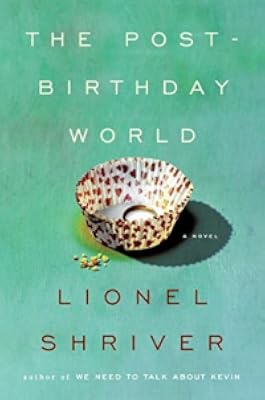
The Post-Birthday World
by Lionel Shriver
On This Page
Description
A tale told from the parallel perspectives of two possible timelines considers the life of American expatriate Irina McGovern, who in one reality stays faithful to her disciplined American intellectual partner, and in the other runs off with an exuberant British friend.Tags
Recommendations














Member Recommendations


Member Reviews
This book was weird - but in a good way, I guess. The book alternates two views of the future - what happened when Irina acted on her impulse to be unfaithful and what happened when she didn't. Neither outcome was all roses and champagne - but I found myself leaning to the future where she left her safe but boring life for passion. It wasn't all fun but it felt more authentic. Irina's life with Lawrence felt fake - where they both sacrificed authenticity to be with each other. But the alternate views somehow made me feel removed from the characters and more connected with the "what if?' part of the novel.
I didn't know anything about this book or the author (a woman, by the way) when I got it. The thing that hooked me was the description in the Quality Paperback Book Club blurb--"the book version of the movie Sliding Doors." If you enjoyed that movie, the concept is much the same: A woman reaches a crossroads in life and then you get to see the "parallel universes" that unfold based on the decision she makes at the critical time. In the movie, the pivotal moment was whether or not she got on a train at a precise time. In the book, the pivotal moment takes place after a birthday dinner (hence, the title.) The woman making the choice is Irina McGovern--a children's book illustrator (a choice of profession that I immensely enjoyed reading show more about). Irina's crossroads comes in her choice of man. What happens if she stays with Lawrence--her tried and true live-in love? What happens if she chooses Ramsey--the dashing and exciting snooker player? After a few "linear" chapters, the book's chapters alternate between life with Lawrence and life with Ramsey. The author does a brilliant job of intertwining the two just enough that you get a real sense of connection between the two universes. I loved the choices she made for each parallel universe--just when I think I know where one of the stories is going, she changes it up. I really struggled with what I thought was Irina's "right" choice. (Don't we all when faced with choosing a mate?) I love that she made it so gray--just like real life. The ending is very satisfying, and I think it allows each reader to project their own "reality" onto Irina's life. I know who I felt Irina ultimately chose, but I definitely think another reader could go another way. That is the fun and brilliance of this book! show less
Irina and her partner, Lawrence, have slowly developed the tradition of having dinner with snooker star Ramsey Acton and his wife, Jude, every year on Ramsey's birthday. Even after Ramsey's divorce from Jude, the tradition continues even though Jude was the person that connected them. But one year, Lawrence is away on the usual date. As a snooker fan he's unwilling to let the connection go and so he pushes Irina to have dinner with Ramsey solo. On that fateful evening Irina finds herself with a rogue impulse to kiss Ramsey. What will happen if she gives in to the impulse or if she remains true to Lawrence?
The friend who recommended this novel to me got me to pick it up by comparing it to the film Sliding Doors (highly underrated flick). show more The novel takes a parallel universe approach exploring what becomes of Irina when she makes the choice to kiss Ramsey and when she refrains. In alternating chapters we see how Irina's life unfolds with all its differences and strange parallels. There's a lot of fun in seeing how Shriver plays with the two timelines and uses them to comment on each other. While the novel is worth picking up just to enjoy the narrative structure, the prose itself is beautiful. A fascinating exploration of how our choices make us who we are. show less
The friend who recommended this novel to me got me to pick it up by comparing it to the film Sliding Doors (highly underrated flick). show more The novel takes a parallel universe approach exploring what becomes of Irina when she makes the choice to kiss Ramsey and when she refrains. In alternating chapters we see how Irina's life unfolds with all its differences and strange parallels. There's a lot of fun in seeing how Shriver plays with the two timelines and uses them to comment on each other. While the novel is worth picking up just to enjoy the narrative structure, the prose itself is beautiful. A fascinating exploration of how our choices make us who we are. show less
I don't know why I haven't read another of Shriver's books since loving We Need to Talk About Kevin. I'd forgotten what an insightful author she is with characterisation.
The premise behind this novel isn't new - akin to the Sliding Doors movie and more than a few novels, the book hinges around the two different lives the protagonist goes on to lead following a pivotal fork in the road moment. Irina, a children's illustrator, lives with her intellectual steady Eddy partner who is part of an important political think tank. Through Irina's work the couple become friends with an author and her husband Ramsay, a famous East End snooker player. Circumstances eventually collide to create a situation where Irina ends up having to take Ramsay show more out for his birthday by herself, and an unexpected frisson of sexual chemistry creates an out-of-the-blue do I / don't I decision point with this man who is the complete antithesis of her partner Lawrence in every way. Is passion, and with it the extreme lows that inevitably come as well as the euphoric highs, worth more than a steady but unexciting life of anticipated security and steadfastness?
This novel hooked me from the beginning. I initially questioned why Shriver had written a chick lit type romance book, but the more I got into it the cleverer it became. As a reader we get to see her live out similar events through the two opposing life paths, neither of which turn out out as she had expected. It's a clever interpretation of how the grass always looks greener from the other side, with Irina constantly questioning the other life choice she could have taken, and thinking it would have been something very different to actually how we see it pan out. Life never turns out as you expect it, and in Irina's world people are not necessarily who you thought they were.
A thoroughly enjoyable read, I lost myself in this novel for hours this weekend. It's not perfect - for one I hate the title, and the cover is most definitely chick lit. More annoyingly, Shriver often misses the mark quite considerably with Ramsay's Cockney dialogue, confusing Northern colloquial sayings for Cockney slang and using phrases more at home in the old film adaptation of Oliver or the Carry On films than on the real streets of the East End. Having said that, Shriver portrays the two opposing romantic relationships and the complexities of leaving a relationship but still emotionally hanging on to part of it very cleverly. A tale of romance it may be, but romance from the twin perspectives of outside in and inside out.
4.5 stars - the critics may have panned it, but for me this was a great read. show less
The premise behind this novel isn't new - akin to the Sliding Doors movie and more than a few novels, the book hinges around the two different lives the protagonist goes on to lead following a pivotal fork in the road moment. Irina, a children's illustrator, lives with her intellectual steady Eddy partner who is part of an important political think tank. Through Irina's work the couple become friends with an author and her husband Ramsay, a famous East End snooker player. Circumstances eventually collide to create a situation where Irina ends up having to take Ramsay show more out for his birthday by herself, and an unexpected frisson of sexual chemistry creates an out-of-the-blue do I / don't I decision point with this man who is the complete antithesis of her partner Lawrence in every way. Is passion, and with it the extreme lows that inevitably come as well as the euphoric highs, worth more than a steady but unexciting life of anticipated security and steadfastness?
This novel hooked me from the beginning. I initially questioned why Shriver had written a chick lit type romance book, but the more I got into it the cleverer it became. As a reader we get to see her live out similar events through the two opposing life paths, neither of which turn out out as she had expected. It's a clever interpretation of how the grass always looks greener from the other side, with Irina constantly questioning the other life choice she could have taken, and thinking it would have been something very different to actually how we see it pan out. Life never turns out as you expect it, and in Irina's world people are not necessarily who you thought they were.
A thoroughly enjoyable read, I lost myself in this novel for hours this weekend. It's not perfect - for one I hate the title, and the cover is most definitely chick lit. More annoyingly, Shriver often misses the mark quite considerably with Ramsay's Cockney dialogue, confusing Northern colloquial sayings for Cockney slang and using phrases more at home in the old film adaptation of Oliver or the Carry On films than on the real streets of the East End. Having said that, Shriver portrays the two opposing romantic relationships and the complexities of leaving a relationship but still emotionally hanging on to part of it very cleverly. A tale of romance it may be, but romance from the twin perspectives of outside in and inside out.
4.5 stars - the critics may have panned it, but for me this was a great read. show less
Could a single kiss change your life?
No, not for Sleeping Beauty, but for Irina Galina McGovern a children’s book illustrator living with her long-time boyfriend in London. Much is made of the fact that after 9 years she and Lawrence have not married. They have a mutual friend, Ramsey Acton and his wife Jude and on Ramsey’s birthday the couples have gone out to dinner. No one particularly has a good time, but the tradition remains even after Jude and Ramsey divorce (and Jude and Irina have a huge fight themselves). One year, Lawrence is out of town and encourages Irina to go out with Ramsey solo. After too much to drink they repair to his house for a wee joint. There, over the snooker table, comes the kiss.
Or does it? Shriver show more presents us with two alternatives; yes they kiss, no they don’t. Each chapter covers one particular scenario (with shaded or unshaded chapter number colophons to go with, a device used a bit cleverly for the last chapter). The same basic events occur in each scenario only in a lot of cases they are completely reversed. One person starts a particular fight and takes a particular side, in the other timeline those words are in the other person’s mouth. There are incidents, setbacks and triumphs; all standing opposite each other.
For the most part it works. I was quite interested in seeing how Shriver could spin the same argument for different sides. The writing is very strong and there are some good insights and the characterizations are all sharp and, at least for me, believable. If you pay attention though, some of the things that take place aren’t surprises if you can deduce the opposite from what came before. And truthfully I got tired of all the fighting; Irina v. Ramsey and Irina v. mom. I almost skimmed the Christmas scenes with her family in Brighton Beach. But it passed and things came to a head. It wraps with a bit more optimism than is warranted given how much of a downer a lot of the book is, but I guess Irina could use a break. show less
No, not for Sleeping Beauty, but for Irina Galina McGovern a children’s book illustrator living with her long-time boyfriend in London. Much is made of the fact that after 9 years she and Lawrence have not married. They have a mutual friend, Ramsey Acton and his wife Jude and on Ramsey’s birthday the couples have gone out to dinner. No one particularly has a good time, but the tradition remains even after Jude and Ramsey divorce (and Jude and Irina have a huge fight themselves). One year, Lawrence is out of town and encourages Irina to go out with Ramsey solo. After too much to drink they repair to his house for a wee joint. There, over the snooker table, comes the kiss.
Or does it? Shriver show more presents us with two alternatives; yes they kiss, no they don’t. Each chapter covers one particular scenario (with shaded or unshaded chapter number colophons to go with, a device used a bit cleverly for the last chapter). The same basic events occur in each scenario only in a lot of cases they are completely reversed. One person starts a particular fight and takes a particular side, in the other timeline those words are in the other person’s mouth. There are incidents, setbacks and triumphs; all standing opposite each other.
For the most part it works. I was quite interested in seeing how Shriver could spin the same argument for different sides. The writing is very strong and there are some good insights and the characterizations are all sharp and, at least for me, believable. If you pay attention though, some of the things that take place aren’t surprises if you can deduce the opposite from what came before. And truthfully I got tired of all the fighting; Irina v. Ramsey and Irina v. mom. I almost skimmed the Christmas scenes with her family in Brighton Beach. But it passed and things came to a head. It wraps with a bit more optimism than is warranted given how much of a downer a lot of the book is, but I guess Irina could use a break. show less
Capítulo a capítulo, Lionel Shriver nos oferece dois desdobramentos do futuro dessa mulher sob a influência de dois homens radicalmente diferentes, e assim escreve duas histórias. A partir daquele único beijo, retrata alternativas para união e rompimento, e explora as consequências e as motivações mais íntimas de uma escolha.
Determinar qual seria o melhor caminho não é óbvio nem fácil, mas a análise dos dois destinos em que a autora enreda os personagens e os leitores é memorável. Escrito com a sutileza e a sagacidade que são as marcas registradas da obra de Lionel Shriver, O mundo pós-aniversário é um apelo para aquele "talvez" que intriga e provoca todos nós.
Determinar qual seria o melhor caminho não é óbvio nem fácil, mas a análise dos dois destinos em que a autora enreda os personagens e os leitores é memorável. Escrito com a sutileza e a sagacidade que são as marcas registradas da obra de Lionel Shriver, O mundo pós-aniversário é um apelo para aquele "talvez" que intriga e provoca todos nós.
An amazingly creative, enthralling, entertaining novel.
The first chapter sees the protagonist having a birthday dinner with a male friend while her (live-in) boyfriend (of 10 years) is out of town. It ends with her having a nearly overwhelming desire to kiss him.
From then on, chapters alternate between two worlds: one where she kissed him, and one where she didn’t.
I have a thing for parallel lives. Whenever I pass some town or block where I once lived, I wonder how my parallel self is doing, the self that stayed living there. I often think about the self that stayed with my high school boyfriend. Or about the self that stayed single. And so on. Hence, I absolutely loved the book’s gimmick.
And Irina, the protagonist, was just my show more type. Like me, 40-something and child-free. Like me, loves to cook, especially for the one she loves; her live-in (or, let’s call him her husband – she often does so in the novel) gives her full autonomy in this area, like mine. I loved the scene where she goes food shopping with her new lover for the first time, in the parallel life where she takes up with him; she’s taken aback when he throws a head of broccoli into the cart. “She had nothing against broccoli, but it wasn’t on the menu.” She’s so used to her husband having no input into the shopping at all, she doesn’t realize that joint decision-making in this area is, well, kind of normal.
And Lionel Shriver is 2 for 2 with me so far. I started with THE MANDIBLES based on a book review; loved it so much, I ended up with this one by deciding I’d be happy to read a book about basket-weaving by her, so I picked it at random from Paperback Swap. I went in knowing nothing of the plot (that’s how I prefer to read fiction). I liked it even better than THE MANDIBLES, to which I think I had given 5 stars.
I thought I knew where the book might be heading, at first – these two parallel stories were winding along such different paths, yet with such similarities, I thought that the heroine might just end up in the same place at the end, no matter which path she had chosen. A note on those similarities – they are one of the other fun parts. Similar events happen in both branches – sometimes the same historical events, obviously, like the death of Princess Di or 9/11 – sometimes things in peripheral characters’ lives or behavior. Sometimes a similar conversation will take place in both branches, but with the speakers reversed, or changed to other characters. It’s such a great read.
At one point midway to late in the story, Irina authors a children’s book with a gimmick: it can be read two ways. Read it in one direction, you get one story; turn it upside down and read it, and you get a different story. In one, a boy takes one direction in life; and in the other… you get the idea! In Irina’s story, the boy’s life turns out basically OK, no matter which path he chooses, with lots of similarities, although with lots of drastic differences as well.
SPOILERS!!
Hence, I changed my mind about where the book was headed – obviously, that would be the lesson. Irina’s life would stay drastically different in both branches, but she’d end up basically OK, no matter which path she had chosen. I liked that idea very much.
But it doesn’t end that way. In fact, one of the stories seems to end much better than the other. There was kind of a “right” choice for Irina, after all.
I certainly read it that way. In story arc 1, things certainly end with a tragedy, but Irina is really doing splendidly. In the other, well, she’s wandering the streets of London pathetically morose. In a way, you could blame Shriver for leaving the story in arc 2 at this particular juncture. If she’d gone a little further, surely Irina would eventually pull herself together, and be “OK”, wouldn’t she?
Dialogues that take place at the end of both stories, however, strongly insinuate that there was a right choice, and arc 2 wasn’t it.
I didn’t like it that way. SUPER SPOILER – maybe I didn’t like it because the “right” decision was to leave her long-term s.o., and I personally have been married for 20 years. I was very charmed by the lover that tempted her, and loved those chapters, don’t get me wrong; but I felt such a warm glow in chapters where she looked at her s.o. with love, or in the alternate chapters where she missed her cooking equipment. Maybe I just didn’t want that story to end so badly. show less
The first chapter sees the protagonist having a birthday dinner with a male friend while her (live-in) boyfriend (of 10 years) is out of town. It ends with her having a nearly overwhelming desire to kiss him.
From then on, chapters alternate between two worlds: one where she kissed him, and one where she didn’t.
I have a thing for parallel lives. Whenever I pass some town or block where I once lived, I wonder how my parallel self is doing, the self that stayed living there. I often think about the self that stayed with my high school boyfriend. Or about the self that stayed single. And so on. Hence, I absolutely loved the book’s gimmick.
And Irina, the protagonist, was just my show more type. Like me, 40-something and child-free. Like me, loves to cook, especially for the one she loves; her live-in (or, let’s call him her husband – she often does so in the novel) gives her full autonomy in this area, like mine. I loved the scene where she goes food shopping with her new lover for the first time, in the parallel life where she takes up with him; she’s taken aback when he throws a head of broccoli into the cart. “She had nothing against broccoli, but it wasn’t on the menu.” She’s so used to her husband having no input into the shopping at all, she doesn’t realize that joint decision-making in this area is, well, kind of normal.
And Lionel Shriver is 2 for 2 with me so far. I started with THE MANDIBLES based on a book review; loved it so much, I ended up with this one by deciding I’d be happy to read a book about basket-weaving by her, so I picked it at random from Paperback Swap. I went in knowing nothing of the plot (that’s how I prefer to read fiction). I liked it even better than THE MANDIBLES, to which I think I had given 5 stars.
I thought I knew where the book might be heading, at first – these two parallel stories were winding along such different paths, yet with such similarities, I thought that the heroine might just end up in the same place at the end, no matter which path she had chosen. A note on those similarities – they are one of the other fun parts. Similar events happen in both branches – sometimes the same historical events, obviously, like the death of Princess Di or 9/11 – sometimes things in peripheral characters’ lives or behavior. Sometimes a similar conversation will take place in both branches, but with the speakers reversed, or changed to other characters. It’s such a great read.
At one point midway to late in the story, Irina authors a children’s book with a gimmick: it can be read two ways. Read it in one direction, you get one story; turn it upside down and read it, and you get a different story. In one, a boy takes one direction in life; and in the other… you get the idea! In Irina’s story, the boy’s life turns out basically OK, no matter which path he chooses, with lots of similarities, although with lots of drastic differences as well.
SPOILERS!!
Hence, I changed my mind about where the book was headed – obviously, that would be the lesson. Irina’s life would stay drastically different in both branches, but she’d end up basically OK, no matter which path she had chosen. I liked that idea very much.
But it doesn’t end that way. In fact, one of the stories seems to end much better than the other. There was kind of a “right” choice for Irina, after all.
I certainly read it that way. In story arc 1, things certainly end with a tragedy, but Irina is really doing splendidly. In the other, well, she’s wandering the streets of London pathetically morose. In a way, you could blame Shriver for leaving the story in arc 2 at this particular juncture. If she’d gone a little further, surely Irina would eventually pull herself together, and be “OK”, wouldn’t she?
Dialogues that take place at the end of both stories, however, strongly insinuate that there was a right choice, and arc 2 wasn’t it.
I didn’t like it that way. SUPER SPOILER – maybe I didn’t like it because the “right” decision was to leave her long-term s.o., and I personally have been married for 20 years. I was very charmed by the lover that tempted her, and loved those chapters, don’t get me wrong; but I felt such a warm glow in chapters where she looked at her s.o. with love, or in the alternate chapters where she missed her cooking equipment. Maybe I just didn’t want that story to end so badly. show less
Members
- Recently Added By
Published Reviews
ThingScore 61
There's a sense of events playing out in neat, parallel tracks, as if predetermined - which you might want them to do, under certain circumstances. But a bit of chaos is much more fun, both in life and in fiction.
added by DieFledermaus — edited by Nevov
The writing is all over the place: cliched, pretentious and, when Shriver relies on using dialogue to explain - for the benefit of American readers? - the recent history of tournament snooker, tragically laboured [...]
added by Nevov
In alternating chapters, Shriver allows her heroine both futures, and the result is a playful, psychologically acute, and luxuriously textured meditation on the nature of love.
added by DieFledermaus
Lists

Llibres que he llegit el 2014
23 works; 1 member

Books Read in 2016
4,666 works; 199 members

Mooie titels
80 works; 1 member

KayStJ's to-read list
1,616 works; 11 members

Books With the Most Memorable Titles
478 works; 158 members
Author Information

25+ Works 15,532 Members
Lionel Shriver was born Margaret Ann Shriver on May 18, 1957 in Gastonia, North Carolina. She changed her first name because of her preference for it. She was educated at Barnard College, and Columbia University (BA, MFA). She has lived in Nairobi, Bangkok and Belfast, and currently lives in London. Shriver wrote seven novels and published six show more (one novel could not find a publisher) before writing We Need to Talk About Kevin, which she called her "make or break" novel. She won the 2005 Orange Prize for her eighth published novel, We Need to Talk About Kevin, a thriller and close study of maternal ambivalence, and the role it might have played in the title character's decision to murder nine people at his high school. The book created a lot of controversy, and achieved success through word of mouth. The Mandibles: A Family, 2029-2047 was published in May 2016. (Bowker Author Biography) show less
Awards and Honors
Distinctions
Notable Lists
Series
Belongs to Publisher Series
Work Relationships
Is contained in
Common Knowledge
- Canonical title
- The Post-Birthday World
- Original title
- The post-birthday world
- Original publication date
- 2007
- People/Characters
- Irina McGovern; Ramsey Acton; Lawrence Trainer; Bethany Anders; Jude Hartford; Raisa McGovern
- Important places
- London, England, UK; New York, New York, USA
- Important events
- Death of Diana, Princess of Wales (1997-08-31); September 11 Attacks (2001-09-11); Good Friday Agreement, Belfast ( 1998-04-10)
- Epigraph
- Nobody's perfect.
-- known fact - First words
- What began as a coincidence had crystallized into tradition: on the sixth of July, they would have dinner with Ramsey Acton on his birthday.
- Last words
- (Click to show. Warning: May contain spoilers.)"Yes," she determined, with a little frown. "I think so."
Classifications
Statistics
- Members
- 1,898
- Popularity
- 11,295
- Reviews
- 62
- Rating
- (3.54)
- Languages
- 11 — Chinese, Dutch, English, Finnish, French, German, Hungarian, Italian, Spanish, Swedish, Portuguese (Portugal)
- Media
- Paper, Audiobook, Ebook
- ISBNs
- 50
- ASINs
- 10