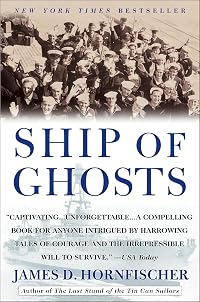
Ship of Ghosts: The Story of the USS Houston, FDR's Legendary Lost Cruiser, and the Epic Saga of Her Survivors
by James D. Hornfischer
On This Page
Description
NEW YORK TIMES BESTSELLER"Son, we’re going to Hell."
The navigator of the USS Houston confided these prophetic words to a young officer as he and his captain charted a course into U.S. naval legend. Renowned as FDR’s favorite warship, the cruiser USS Houston was a prize target trapped in the far Pacific after Pearl Harbor. Without hope of reinforcement, her crew faced a superior Japanese force ruthlessly committed to total conquest. It wasn’t a fair fight, but the men of the Houston show more would wage it to the death.
Hornfischer brings to life the awesome terror of nighttime naval battles that turned decks into strobe-lit slaughterhouses, the deadly rain of fire from Japanese bombers, and the almost superhuman effort of the crew as they miraculously escaped disaster again and again–until their luck ran out during a daring action in Sunda Strait. There, hopelessly outnumbered, the Houston was finally sunk and its survivors taken prisoner. For more than three years their fate would be a mystery to families waiting at home.
In the brutal privation of jungle POW camps dubiously immortalized in such films as The Bridge on the River Kwai, the war continued for the men of the Houston—a life-and-death struggle to survive forced labor, starvation, disease, and psychological torture. Here is the gritty, unvarnished story of the infamous Burma–Thailand Death Railway glamorized by Hollywood, but which in reality mercilessly reduced men to little more than animals, who fought back against their dehumanization with dignity, ingenuity, sabotage, will–power—and the undying faith that their country would prevail.
Using journals and letters, rare historical documents, including testimony from postwar Japanese war crimes tribunals, and the eyewitness accounts of Houston’s survivors, James Hornfischer has crafted an account of human valor so riveting and awe-inspiring, it’s easy to forget that every single word is true.
BONUS: This edition contains an excerpt from James D. Hornfischer's Neptune's Inferno. show less
Tags
Recommendations


























Member Reviews
Non-fiction account of one of the lesser known events in WWII: the sinking of the USS Houston, covering the history of the ship itself, first-person accounts of its battles, and the crew’s harrowing experiences as prisoners of war after its sinking. The ship was part of the U.S. Asiatic Fleet in 1942, when the Allies were organizing into a joint fighting force of American, Australian, British, and Dutch. While navigating the Sunda Strait, the USS Houston and HMAS Perth interrupted a large-scale Japanese invasion of Java, were involved in a terrifying night-time battle, and were both sunk. The bulk of the narrative then follows the survivors, who are eventually captured and sent to various POW camps. Many are used as forced labor to show more build (by hand) the Thai-Burma Railway. The final portions of the book cover the end of the war and how the remaining survivors fared upon returning home.
Hornfischer excels at describing the sounds, sights, smells of the battle scenes:
He brings the fears of the sailors to the forefront as they struggle to survive the sinking:
He vividly describes their horrific ordeal on the Thai-Burma Railway, where they endure forced labor, starvation, disease, brutality, and the perils of the jungle:
Hornfischer has assembled a cohesive and compelling narrative based upon official documents, a compiled library of participants’ voice recordings, and the author’s own interviews many years later. Both the small details of personal stories and the larger context of military strategy are covered. I appreciated the author’s inclusion of insights into how these courageous captives survived such inhumane conditions. The account becomes more fragmented as it progresses. It may have been more cohesive if the author had focused on a more limited number of personal stories in each section. It could also have benefitted by the inclusion of more photos and maps. This book is an absorbing tribute to the men of the USS Houston. Though it can be gut-wrenching to read about the horrors of war, it is ultimately a testament to the triumph of the human spirit in the face of extreme adversity. show less
Hornfischer excels at describing the sounds, sights, smells of the battle scenes:
“The Houston took her first hit when a projectile struck the forecastle, starting fires in the paint locker that danced brightly for about a quarter of an hour. The night air was rancid with cordite. Though the winds were still, the wisps of gray-white muzzle smoke flying from the Houston’s guns fell quickly away, left behind like an airborne wake covering her trail of foam.”
He brings the fears of the sailors to the forefront as they struggle to survive the sinking:
“Lungs burning, Gillan felt himself bump up against the ship’s rail. He was finally free of the enclosed torpedo space. The cord to his miner’s lamp snagged momentarily on the rail, but then he was floating again, being washed up and down, unsure of which direction the surface was. He felt currents whirlpooling around him. The sensation evoked an amusement park ride before the flashing of red, green, and purple lights marked the possibility that his brain was starving for oxygen as he drowned.”
He vividly describes their horrific ordeal on the Thai-Burma Railway, where they endure forced labor, starvation, disease, brutality, and the perils of the jungle:
“Pressured to perform five years of work in twelve short months, they would be given over to the jungle and left to wrestle it toward civilization. They would contend with all its elements—its hardwoods, rocks, and vines, its predators both mammalian and bacterial, under the lash of their enemy and assault from the elements. The work would harden some and consume others. They would forget all but the most basic memories of home, picking their way through a life in captivity that would become the grist for sleepless nights ever afterward.”
Hornfischer has assembled a cohesive and compelling narrative based upon official documents, a compiled library of participants’ voice recordings, and the author’s own interviews many years later. Both the small details of personal stories and the larger context of military strategy are covered. I appreciated the author’s inclusion of insights into how these courageous captives survived such inhumane conditions. The account becomes more fragmented as it progresses. It may have been more cohesive if the author had focused on a more limited number of personal stories in each section. It could also have benefitted by the inclusion of more photos and maps. This book is an absorbing tribute to the men of the USS Houston. Though it can be gut-wrenching to read about the horrors of war, it is ultimately a testament to the triumph of the human spirit in the face of extreme adversity. show less
Ship of Ghosts is both smaller and bigger than Last Stand of the Tin Can Sailors. Hornfisher focuses on the men of the USS Houston, a heavy cruiser assigned to the Asiatic Fleet at the start of the Second World War. Previously President Roosevelt's favorite cruiser, in the dark days of the initial Japanese assaults, the Houston was the lynchpin of the defense of the island of Java.
Part of an ad hoc American-Dutch-British-Australian command, the Houston and the other defenders of Java faced terrible odds against an enemy with absolute air superiority. The Houston dodged bombs and fought a single significant engagement at the Battle of the Java Sea. The Allies didn't have the strength to resist a multipronged Japanese invasion, and in show more retreating the USS Houston and HMAS Perth sailed right into one of the landing fleets. Houston and Perth gave their best before sinking, but the long ordeal of the survivors had only just begun.
Captured by the Japanese along with the 131st Field Artillery (the Lost Battalion) and the other defenders of Java, the crew of the Houston were shipped to Singapore and an archipelago of Japanese POW camps. The worst of these were along the Railway of Death, a roughly 200 km cut through untracked jungle between Thailand and Burma that would be immortalized (and thoroughly fictionalized) as The Bridge Over The River Kwai. Roughly 20% of the men died of starvation, disease, beatings administered by their captors, and simple hopelessness. Perhaps 200,000 people in total died, mostly native laborers without military discipline to help them maintain field sanitation. Other survivors were dispatched to Japan, and some suffered the supreme misfortune of being killed by Allied bombs and torpedoes, as Japan did not mark their POW transports, one final mark in a litany of Geneva Code violations.
Hornfischer gives his all in commemorating these old veterans, in the years when the WW2 generation passed out of life and into memory. The prose gets a little purple at times, but serves to convey the pride of the pre-War Houston, the desperation of its last battle, and the endurance of its crew in captivity. show less
Part of an ad hoc American-Dutch-British-Australian command, the Houston and the other defenders of Java faced terrible odds against an enemy with absolute air superiority. The Houston dodged bombs and fought a single significant engagement at the Battle of the Java Sea. The Allies didn't have the strength to resist a multipronged Japanese invasion, and in show more retreating the USS Houston and HMAS Perth sailed right into one of the landing fleets. Houston and Perth gave their best before sinking, but the long ordeal of the survivors had only just begun.
Captured by the Japanese along with the 131st Field Artillery (the Lost Battalion) and the other defenders of Java, the crew of the Houston were shipped to Singapore and an archipelago of Japanese POW camps. The worst of these were along the Railway of Death, a roughly 200 km cut through untracked jungle between Thailand and Burma that would be immortalized (and thoroughly fictionalized) as The Bridge Over The River Kwai. Roughly 20% of the men died of starvation, disease, beatings administered by their captors, and simple hopelessness. Perhaps 200,000 people in total died, mostly native laborers without military discipline to help them maintain field sanitation. Other survivors were dispatched to Japan, and some suffered the supreme misfortune of being killed by Allied bombs and torpedoes, as Japan did not mark their POW transports, one final mark in a litany of Geneva Code violations.
Hornfischer gives his all in commemorating these old veterans, in the years when the WW2 generation passed out of life and into memory. The prose gets a little purple at times, but serves to convey the pride of the pre-War Houston, the desperation of its last battle, and the endurance of its crew in captivity. show less
First Line: "This is the ancient history of a forgotten ship, forgotten
because history is story, because memory is fragile, and because the human mind--and thus the storytellers who write the history--generally accepts only so much sorrow before the impulse prevails to put the story on a brighter path."
If I read a book this year that knocks Ship of Ghosts off my Top Ten list, I'm going to have a fabulous year of reading. The USS Houston was FDR's favorite ship. He used it to travel around the world. He used it to take him fishing when he needed some time off. The USS Houston became the mainstay of the skimpy Allied fleet which tried to oppose the Japanese as the Imperial Navy, Air Force and Army leapfrogged from island to island in the show more Pacific. During the darkest of nights, the USS Houston found itself surrounded by Japanese ships and was sunk. What men survived wound up in POW camps--many of them in labor camps along the Burma-Thailand Railway made famous by Hollywood in "The Bridge Over the River Kwai". (As usual, Hollyrock got a lot of it wrong.) Hornfischer makes history live in these pages. The comradery between American, Scottish and Australian POWs made me laugh--while so much more brought tears to my eyes. From one page to the next, I read of how low--and how high--the human being can go. I read books like this to understand better what my grandfather survived. To realize what the Novota brothers in my tiny hometown lived through when they were in Japanese POW camps. To find out why and how it happened. To know.
May it never be repeated...in my lifetime or anyone else's. show less
because history is story, because memory is fragile, and because the human mind--and thus the storytellers who write the history--generally accepts only so much sorrow before the impulse prevails to put the story on a brighter path."
If I read a book this year that knocks Ship of Ghosts off my Top Ten list, I'm going to have a fabulous year of reading. The USS Houston was FDR's favorite ship. He used it to travel around the world. He used it to take him fishing when he needed some time off. The USS Houston became the mainstay of the skimpy Allied fleet which tried to oppose the Japanese as the Imperial Navy, Air Force and Army leapfrogged from island to island in the show more Pacific. During the darkest of nights, the USS Houston found itself surrounded by Japanese ships and was sunk. What men survived wound up in POW camps--many of them in labor camps along the Burma-Thailand Railway made famous by Hollywood in "The Bridge Over the River Kwai". (As usual, Hollyrock got a lot of it wrong.) Hornfischer makes history live in these pages. The comradery between American, Scottish and Australian POWs made me laugh--while so much more brought tears to my eyes. From one page to the next, I read of how low--and how high--the human being can go. I read books like this to understand better what my grandfather survived. To realize what the Novota brothers in my tiny hometown lived through when they were in Japanese POW camps. To find out why and how it happened. To know.
May it never be repeated...in my lifetime or anyone else's. show less
Directly after the attack on Pearl Harbor, the USS Houston is on the far side of the globe, staring down the barrel of the Japanese navy invasion. Their orders are to do all they can to defend the nearby island nations and repel the Japanese for as long as possible. Against such odds they cannot long succeed. After several daring engagements the ship sinks and much of the crew is killed. Those that survive are taken captive and spend the rest of the war in a prison camp. Essentially enslaved by their Japanese jailers, they are forced to build a railroad through the heart of the Burmese jungle. Deprived of proper food and medical attention, many will die of starvation, disease, and despair.
But the story of the USS Houston doesn't end in show more the death camps. Instead, many of the men survive to tell their stories of torture isolation. Their testimonies would help to bring some of the worst offenders to justice. show less
But the story of the USS Houston doesn't end in show more the death camps. Instead, many of the men survive to tell their stories of torture isolation. Their testimonies would help to bring some of the worst offenders to justice. show less
I picked this book because it tells a part of the WWII story that is seldom told and it happened in a place I have some familiarity with from my own experiences. Having read Unbroken and Ghost Soldiers I was expecting a history of similar grit, something I think the story deserves and for which there was ample material. Hornfischer, however, tells a gentler kind of tale; one that touches the surface of a lot but rarely digs deep. That said, I learned a lot about the east Asia campaign (and came away with a particularly poor image of the Dutch performance).
By way of full disclosure I should mention that I listened to the unabridged audible version of the book, which is how I do 90% of my "reading." In this instance the reader was a poor show more choice in my opinion. The book deserves a certain edge, not a flat reading. That definitely affected my experience, but I do not believe it affected my evaluation of the content. show less
By way of full disclosure I should mention that I listened to the unabridged audible version of the book, which is how I do 90% of my "reading." In this instance the reader was a poor show more choice in my opinion. The book deserves a certain edge, not a flat reading. That definitely affected my experience, but I do not believe it affected my evaluation of the content. show less
Unforgetable. Indeed the experiences of the crew members of the USS Houston should never be forgotten and Hornfischer does these men great service in telling their story of heroism and sacrifice. This was a compelling read that displayed the full range of human character, from the greatest virtues of self-sacrificing love and bravery,to the depths of cruelty and depravity. Whenever civilization clashes with barbarism, may we strive to live up to the example of the Houston's brave crew.
Outstanding reading. Packed with detail and really well constructed. Fills an need in the library of any avid reader of the second world war. The triumph of spirit by the survivors is as uplifting a story as could be asked.
Members
- Recently Added By
Author Information

9+ Works 3,158 Members
James D. Hornfischer, an American literary agent, naval historian and author, was born in Massachusetts in 1965. He attended Colgate University, where he was elected to the Phi Beta Kappa Society, and graduated in 1987. He received his law degree from the University of Texas at Austin in 2001, and is a non-practicing member of the State Bar of show more Texas. Hornfischer, a former editor at HarperCollins, is currently a literary agent, representing non-fiction authors in a myriad of subject areas. Hornfischer's lifelong interest in the Pacific Theater during World War II led to his writing numerous books on the subject. His titles include: Neptune's Inferno: The U.S. Navy at Guadalcanal, The Last Stand of the Tin Can Sailors and Ship of Ghosts. He also co-wrote Service: A Navy Seal at War with Marcus Luttrell, the author of Lone Survivor. Hornfischer's title The Fleet at Flood Tide: America at Total War in the Pacific, 1944-1945 made the New York Times bestseller list in 2016. (Bowker Author Biography) show less
Some Editions
Awards and Honors
Common Knowledge
- Original publication date
- 2006
- People/Characters
- Albert H. Rooks
- Important events
- World War II (1939 | 1945); World War II, Pacific Theater (1941-12-07 | 1945-09-02); Battle of the Java Sea (1942-02-27)
- Epigraph
- The day will come when even this ordeal will be a sweet thing to remember. -Virgil, the aeneid
- Dedication
- for Sharon
- First words
- This is the ancient history of a forgotten ship, forgotten because history is story, because memory is fragile, and because the human mind-and this the storytellers who write the history-generally accepts only so much sorrow ... (show all)before the impulse prevails to put the story on a brighter path.
Classifications
- Genres
- History, Nonfiction, General Nonfiction
- DDC/MDS
- 940.54 — History & geography History of Europe History of Europe 1918- Military history of World War II
- LCC
- VA65 .H66 .H67 — Naval Science Navies: Organization, distribution, naval situation Navies: Organization, distribution, naval situation United States
- BISAC
Statistics
- Members
- 597
- Popularity
- 48,928
- Reviews
- 14
- Rating
- (3.86)
- Languages
- English, German
- Media
- Paper, Audiobook, Ebook
- ISBNs
- 7
- ASINs
- 4