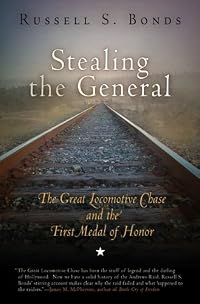
Stealing the General
by Russell S. Bonds 
On This Page
Description
On April 12, 1862—one year to the day after Confederate guns opened on Fort Sumter and started the Civil War—a tall, mysterious smuggler and self-appointed Union spy named James J. Andrews and nineteen infantry volunteers infiltrated Georgia and stole a steam engine called the General. Racing northward at speeds near sixty miles an hour, cutting telegraph lines, and destroying track along the way, Andrews planned to open East Tennessee to the Union army, cutting off men and materiel from show more the Confederate forces in Virginia. If they succeeded, Andrews and his raiders could change the course of the war.But the General's young conductor, William A. Fuller, chased the stolen train first on foot, then by handcar, and finally aboard another engine, the Texas. He pursued the General until, running out of wood and water, Andrews and his men abandoned the doomed locomotive, ending the adventure that would soon be famous as "The Great Locomotive Chase." But the ordeal of the soldiers involved was just beginning.
In the days that followed, the raiders were hunted down and captured. Eight were tried and executed as spies, including Andrews. Eight others made a daring escape, including two assisted by a network of slaves and Union sympathizers. For their actions, before a personal audience with President Abraham Lincoln, six of the raiders became the first men in American history to be awarded the Medal of Honor—the nation's highest decoration for gallantry. Americans north and south, both at the time and ever since, have been astounded and fascinated by this daring raid. But until now, there has not been a complete history of the entire episode and the fates of all those involved.
Based on eyewitness accounts, as well as correspondence, diaries, military records, newspaper reports, deposition testimony, and other primary sources, Stealing the General is a blend of meticulous research and compelling narrative that is destined to become the definitive history of "the boldest adventure of the war."
. show less
Tags
Recommendations












Member Recommendations
Reign of Iron: The Story of the First Battling Ironclads, the Monitor and the Merrimack by James L. Nelson
John_Vaughan The other Iron Monsters - at sea.
Also recommended by John_Vaughan


Member Reviews
This is a most compelling book, history that moves at the pace of a novel.
Since I was a kid and saw a Walt Disney production of "The Great Locomotive Chase" (starring Fess Parker, no less!), I have had an interest in the Civil War story of the Andrews raid, in which a group of Union soldiers went behind enemy lines to steal a train for the purpose of disrupting Confederate railroad traffic. What the raiders had counted on was a conductor on the train they stole, so offended by their act that he took off in pursuit of them, first on foot(!), then by securing another train. What excitement! What drama! Even better than most fiction!
As a child I also had a book about Medal of Honor winners, the "Great Locomotive Chase" was covering in its show more first chapter. (The raiders were the first recipients of the Medal of Honor.) I couldn't get enough of the story.
What I didn't know, however, is that the excitement and drama didn't end with the chase itself. The raiders were caught and imprisoned and what followed was a story of endurance during their imprisonment, as well as an incredible escape by some of them that required them to negotiate many hundreds of miles through enemy territory in order to get back to Union lines.
"Stealing the General" has to be by far the DEFINITIVE account of the Andrews Raid. It is extremely well-written, an absorbing true-story page-turner.
I'm surprised the book hasn't gotten much visibility, but that's likely because the author is without formal credentials as a historian (he's a lawyer on staff with the Coca-Cola Company), and the book comes from an obscure publishing house (Westholme Publishers of Yardley, PA). It has been a selection of the Book of the Month Club, the History Book Club, and the Military Book Club, so some have recognized its excellence. It really deserves more readers. show less
Since I was a kid and saw a Walt Disney production of "The Great Locomotive Chase" (starring Fess Parker, no less!), I have had an interest in the Civil War story of the Andrews raid, in which a group of Union soldiers went behind enemy lines to steal a train for the purpose of disrupting Confederate railroad traffic. What the raiders had counted on was a conductor on the train they stole, so offended by their act that he took off in pursuit of them, first on foot(!), then by securing another train. What excitement! What drama! Even better than most fiction!
As a child I also had a book about Medal of Honor winners, the "Great Locomotive Chase" was covering in its show more first chapter. (The raiders were the first recipients of the Medal of Honor.) I couldn't get enough of the story.
What I didn't know, however, is that the excitement and drama didn't end with the chase itself. The raiders were caught and imprisoned and what followed was a story of endurance during their imprisonment, as well as an incredible escape by some of them that required them to negotiate many hundreds of miles through enemy territory in order to get back to Union lines.
"Stealing the General" has to be by far the DEFINITIVE account of the Andrews Raid. It is extremely well-written, an absorbing true-story page-turner.
I'm surprised the book hasn't gotten much visibility, but that's likely because the author is without formal credentials as a historian (he's a lawyer on staff with the Coca-Cola Company), and the book comes from an obscure publishing house (Westholme Publishers of Yardley, PA). It has been a selection of the Book of the Month Club, the History Book Club, and the Military Book Club, so some have recognized its excellence. It really deserves more readers. show less
In April of 1862, 22 volunteer Union soldiers in civilian attire under the command of a charismatic civilian quinine smuggler named James Andrews set forth from Union controlled territory to penetrate more than 100 miles into the heart of Dixie, steal a locomotive, and wreak havoc along the Atlanta & West Point Rail Road from Atlanta to Chattanooga. The strategic purpose of the audacious raid was to isolate the city of Chattanooga from re-supply by rail from the South. A relatively small Union force under Gen. Ormsby M. Mitchel had already cut off Chattanooga from the west by taking Huntsville, Alabama.
Remarkably, all the members of the incursion were able to rendezvous undetected in Marietta, Georgia on April 11. They all boarded a show more northbound train early the following morning. While the crew and other passengers detrained for breakfast, the insurgents captured the train, in the presence of a slowly awakening division of C.S.A. soldiers, decoupled the passenger cars, and headed north, pulled by the soon to become famous engine, “The General.”
The Union men had not reckoned on William Fuller, the conductor of the train they had commandeered. He led a determined chase, in which he first ran on foot, and then appropriated another engine [the “Texas”] to catch the raiders. The chase lasted more than 5 hours and covered almost 100 miles, with speeds sometimes exceeding 60 miles per hour. (Locomotives of the time normally averaged 15 miles per hour, with short bursts of an average speed of 20 miles per hour.) Since the railroad was a single track, the trains occasionally had to switch to side tracks to allow southbound trains to pass.
The General was eventually trapped, and all the raiders were captured, some after several days in the wilderness. The Confederate army tried the entire raiding party as spies since they did not wear uniforms during the raid. Andrews, the civilian leader of the raid, and seven of the men were hanged after a court marshal. The Confederate legal system was not very efficient, and the others were never tried. They were, however, imprisoned in ghastly circumstances for more than a year. Eventually, ten escaped, and their stories are each thrillers in themselves. (Two of the raiders escaped by heading south down the Chattahoochee River, eventually making it to the Gulf of Mexico to be rescued by the Union navy!) The remaining five were exchanged for Union prisoners shortly before the end of the war.
The raid cannot be called successful in that little damage was done to Southern assets, and Chattanooga did not fall to the Union for another two years. Nevertheless, the surviving members of the raid were the first recipients of the Medal of Honor, in recognition of their courage and of what might have been. The General itself became something of a national icon, and was exhibited in many fairs and exhibitions for more than a century. It now rests, completely refurbished, in Atlanta, Georgia.
The story of the chase has been told in many books, several written by the surviving participants, and Walt Disney made an almost factual movie about the raid, "The Great Locomotive Chase" in 1956. Russell Bonds’ effort is a very well-written and well-organized addition to the literature of the chase. He manages to bring the story to life and stay unbiased throughout. He evaluates the truth of many conflicting allegations about the raid very convincingly. show less
Remarkably, all the members of the incursion were able to rendezvous undetected in Marietta, Georgia on April 11. They all boarded a show more northbound train early the following morning. While the crew and other passengers detrained for breakfast, the insurgents captured the train, in the presence of a slowly awakening division of C.S.A. soldiers, decoupled the passenger cars, and headed north, pulled by the soon to become famous engine, “The General.”
The Union men had not reckoned on William Fuller, the conductor of the train they had commandeered. He led a determined chase, in which he first ran on foot, and then appropriated another engine [the “Texas”] to catch the raiders. The chase lasted more than 5 hours and covered almost 100 miles, with speeds sometimes exceeding 60 miles per hour. (Locomotives of the time normally averaged 15 miles per hour, with short bursts of an average speed of 20 miles per hour.) Since the railroad was a single track, the trains occasionally had to switch to side tracks to allow southbound trains to pass.
The General was eventually trapped, and all the raiders were captured, some after several days in the wilderness. The Confederate army tried the entire raiding party as spies since they did not wear uniforms during the raid. Andrews, the civilian leader of the raid, and seven of the men were hanged after a court marshal. The Confederate legal system was not very efficient, and the others were never tried. They were, however, imprisoned in ghastly circumstances for more than a year. Eventually, ten escaped, and their stories are each thrillers in themselves. (Two of the raiders escaped by heading south down the Chattahoochee River, eventually making it to the Gulf of Mexico to be rescued by the Union navy!) The remaining five were exchanged for Union prisoners shortly before the end of the war.
The raid cannot be called successful in that little damage was done to Southern assets, and Chattanooga did not fall to the Union for another two years. Nevertheless, the surviving members of the raid were the first recipients of the Medal of Honor, in recognition of their courage and of what might have been. The General itself became something of a national icon, and was exhibited in many fairs and exhibitions for more than a century. It now rests, completely refurbished, in Atlanta, Georgia.
The story of the chase has been told in many books, several written by the surviving participants, and Walt Disney made an almost factual movie about the raid, "The Great Locomotive Chase" in 1956. Russell Bonds’ effort is a very well-written and well-organized addition to the literature of the chase. He manages to bring the story to life and stay unbiased throughout. He evaluates the truth of many conflicting allegations about the raid very convincingly. show less
I never heard of the famous "Great Locomotive Chase", so had the pleasure of fresh discovery in the company of a well researched and entertaining book. But I have to admit, being new the subject, a lot of the background involved wading through minutia of trivia that didn't seem important and which I'll never remember. Still it's a great story for Civil War and/or train buffs, so I don't fault the book. There are certainly more pithy accounts available for those wanting a briefer version.
I've read a number of Civil War history books but this is the first one that is so focused on just a few individuals. Since the incident is so well documented with primary sources, we have direct quotes from normal people who otherwise are invisible to show more history which adds a lot of character and sense of place and time. It was easy to step back and time and re-enact the period, and I think that is the most valuable aspect, an accessible and fun way to time travel. It's also rare to read a Civil War book in which hardly a shot is fired - there was some violence and death after the "race", but nothing compared to the typical brutality of the war.
After reading I watched Buster Keaton's 1926 film The General, based on the story of the chase, which has great sets and further adds to the period feel. Apparently this film is considered an American classic and was among the first to be added to the National Film Registry; critic Roger Ebert listed it on his top 10 greatest films. It's well worth seeing the film along with the book.
--Review by Stephen Balbach, via CoolReading (c) 2011 cc-by-nd show less
I've read a number of Civil War history books but this is the first one that is so focused on just a few individuals. Since the incident is so well documented with primary sources, we have direct quotes from normal people who otherwise are invisible to show more history which adds a lot of character and sense of place and time. It was easy to step back and time and re-enact the period, and I think that is the most valuable aspect, an accessible and fun way to time travel. It's also rare to read a Civil War book in which hardly a shot is fired - there was some violence and death after the "race", but nothing compared to the typical brutality of the war.
After reading I watched Buster Keaton's 1926 film The General, based on the story of the chase, which has great sets and further adds to the period feel. Apparently this film is considered an American classic and was among the first to be added to the National Film Registry; critic Roger Ebert listed it on his top 10 greatest films. It's well worth seeing the film along with the book.
--Review by Stephen Balbach, via CoolReading (c) 2011 cc-by-nd show less
The author is a Corporate Lawyer with Coca-Cola©…but he can write and tells a great story!
Bonds give full credit to a Colonel James Bogle of Atlanta who not only gave the author much guidance but whose wonderful collection of photographs – of all the trains and most of the Train Stealers – so add to this work. The story of the plot, the chase, its unhappy failure and the miserable outcome for the Union participants is tempered with the apparent admiration of all for its outrageous courage. The then current headlines even in the Southern press indicated admiration for its daring, if not its intent and showed why this is such a fascinating story.
There is a well-researched chapter on the history of the Medal of Honor, from its show more inception by the first award to one of the bravest surviving “Raider” to its rapid debasement - one was awarded merely because a lieutenant colonel wrote requesting that he be allowed one as a souvenir and then all 864 members of a Maine regiment were given the medal as an incentive to reenlist – and only 309 did so!
In the closing chapters Russell makes a tentative claim that the General is “probably the world’s most famous train”. By the end of the book he firms up on his claim (p.437) on the “World’s most famous locomotive”. Unless his “world” is the same as the USA World Series (i.e. the contiguous 48) I think not. The Orient Express is assuredly that train, and if only engines, then surely Stephenson’s Rocket perhaps, or the Flying Scotsman or even the beautiful Southern Pacific engines but surely a major motive for his writing his marvelous book is to spread wider the knowledge of this particular and wonderful train, the stolen General. show less
Bonds give full credit to a Colonel James Bogle of Atlanta who not only gave the author much guidance but whose wonderful collection of photographs – of all the trains and most of the Train Stealers – so add to this work. The story of the plot, the chase, its unhappy failure and the miserable outcome for the Union participants is tempered with the apparent admiration of all for its outrageous courage. The then current headlines even in the Southern press indicated admiration for its daring, if not its intent and showed why this is such a fascinating story.
There is a well-researched chapter on the history of the Medal of Honor, from its show more inception by the first award to one of the bravest surviving “Raider” to its rapid debasement - one was awarded merely because a lieutenant colonel wrote requesting that he be allowed one as a souvenir and then all 864 members of a Maine regiment were given the medal as an incentive to reenlist – and only 309 did so!
In the closing chapters Russell makes a tentative claim that the General is “probably the world’s most famous train”. By the end of the book he firms up on his claim (p.437) on the “World’s most famous locomotive”. Unless his “world” is the same as the USA World Series (i.e. the contiguous 48) I think not. The Orient Express is assuredly that train, and if only engines, then surely Stephenson’s Rocket perhaps, or the Flying Scotsman or even the beautiful Southern Pacific engines but surely a major motive for his writing his marvelous book is to spread wider the knowledge of this particular and wonderful train, the stolen General. show less
Stealing the General is a book I had a hard time putting down. It's fast paced but sufficiently detailed to carry a story of weight. I really enjoyed getting to know the key characters in the story. It does not read like dry historical narrative at all. Amazing true story, well told.
The first part of the book gives a good story of the great Locomotive chase and the eventual capture of the solders involved. What is even more revealing is the story of the men after the war and the disrespect of the Medal of honor for the first 40 years+.
Ratings
Members
- Recently Added By
Published Reviews
Bonds turns out to be the perfect person to write a book about the raid, by virtue of his legal training. Most of those involved in the raid, on both sides, left some sort of written account of of the event. The problem, though, is that quite a number of those accounts were written years, sometimes decades, after the raid, a point at which memories begin to fade. What is more, some used the show more opportunity to write as a means of building up their reputations or savaging the reputations of others. Bonds, as an attorney, was able to sift through these depositions and glean what was truthful. He also points out occasions where conflicts exist among the accounts. By comparing and contrasting the conflicting memories, Bonds suggests the most likely scenario, giving us a much better understanding of the raid. show less
added by John_Vaughan
Author Information

2 Works 370 Members
Russell S. Bonds is a LibraryThing Author, an author who lists their personal library on LibraryThing.
Awards and Honors
Awards
Common Knowledge
- Canonical title
- Stealing the General
- Original publication date
- 2006
- People/Characters
- Andrew Anderson; James J. Andrews; G. W. Barlow; P. G. T. Beauregard; Judah P. Benjamin; William Bensinger (show all 74); Reese B. Brabson; Peter J. Bracken; Braxton Bragg; John Brown, abolitionist; Wilson W. Brown; Don Carlos Buell; Robert Buffum; E. Jefferson Cain; William Campbell; Salmon P. Chase; Henry Greene Cole; Fleming Cox; Alexander F. Crosman; Daniel Allen Dorsey; Ralph Waldo Emerson; Nathan Bedford Forrest; David Fry; William Allen Fuller; James A. Garfield; Ulysses S. Grant; Henry W. Halleck; Henry Haney; Oliver W. Harbin; Martin Jones Hawkins; Albert Sidney Johnston; Oliver H. Jones; William J. Knight; Danville Leadbetter; Robert E. Lee; William Lewis; Abraham Lincoln; Samuel Llewellyn; James Longstreet; Wilson Lumpkin; Alonzo Martin; Elihu H. Mason; George B. McClellan; Ormsby MacKnight Mitchel (as Ormsby M. Mitchel); Anthony Murphy; James Negley; Jacob Parrott; William Pittenger; John Reed Porter; William H. Reddick; Samuel Robertson; William S. Rosecrans; John Ross; Marion A. Ross; John M. Scott; Winfield Scott; Charles P. Shadrach; William Tecumseh Sherman; Samuel Slavens; Edmund Kirby Smith (as E. Kirby Smith); James Ovid Wellford Smith; Edwin M. Stanton; Swims (jailer); Oliver P. Temple; George H. Thomas; Edward D. Townsend (as Edward Davis Townsend); John Basil Turchin; George Washington; Walt Whitman; W. J. Whitsitt; George D. Wilson; John Alfred Wilson (as J. Alfred Wilson); John Wollam; Mark Wood
- Important places
- Adairsville, Georgia, USA; Allatoona, Georgia, USA; Andersonville Prison, Macon County, Georgia, USA; Antietam Creek, Pennsylvania-Maryland, USA; Apalachicola River, Florida, USA; Appalachian Mountains (show all 50); Atlanta, Georgia, USA; Big Shanty, Georgia, USA; Blue Ridge Mountains, USA; Bowling Green, Kentucky, USA; Bull Run River, Virginia, USA; Camp McDonald, Big Shanty, Georgia, USA; Cartersville, Georgia, USA; Castle Thunder, Richmond, Virginia, USA; Catoosa, Georgia, USA; Chattahoochee River, USA; Chattanooga, Tennessee, USA; Chickamauga Creek, Georgia, USA; Chickamauga Valley, Georgia, USA; Cumberland Gap, Appalachian Mountains, USA; Cumberland Mountains, USA; Dalton, Georgia, USA; Etowah, Georgia, USA; Etowah River, Georgia, USA; Fleming County, Kentucky, USA; Fort Donelson, Tennessee, USA; Fulton County, Georgia, USA; Fulton County Jail, Georgia, USA; Great Smoky Mountains Region; Hilton Head Island, South Carolina, USA; Huntsville, Alabama, USA; Kennesaw Mountain, Georgia, USA; Key West, Florida, USA; Knoxville, Tennessee, USA; Libby Prison, Richmond, Virginia, USA; Lookout Mountain, Tennessee, USA; Marietta, Georgia, USA; Memphis, Tennessee, USA; Missionary Ridge, Tennessee, USA; Mitchelville, South Carolina, USA; Murfreesboro, Tennessee, USA; Nashville, Tennessee, USA; Oostanaula River, Georgia, USA; Resaca, Georgia, USA; Richmond, Virginia, USA; Ringgold, Georgia, USA; Rome, Georgia, USA; Shelbyville, Tennessee, USA; Tunnel Hill, Georgia, USA; Washington, D.C., USA
- Important events
- American Civil War (1861 | 1865); Great Locomotive Chase (1862-04-12); Emancipation Proclamation (1862-09-22 | 1863-01-01); Battle of Chickamauga (1863-09-19 | 1863-09-20); Sherman's March to the Sea (1864); Surrender at Appomattox (1865-04-09)
- Epigraph
- ...And I will overthrow the chariots, and those that ride in them; and the horses and their riders shall come down, every one by the sword of his brother.
- Haggai 2:22, King James Bible
Because this was it: an interval, a space, in which the toad-squatting guns, the panting men and the trembling horses paused, amphitheatric about the embattled land, beneath the fading fury of the smoke and the puny yelling, ... (show all)and permitted the sorry business which had dragged on for three years now to be congealed into an irrevocable instant and put to an irrevocable gambit, not by two regiments or two batteries or even two generals, but by two locomotives.
- William Faulkner, The Unvanquished
RAILROAD, n. The chief of many mechanical devices enabling us to get away from where we are to where we are no better off.
- Ambrose Bierce, The Devil's Dictionary - Dedication
- To the memory of my father, Gary C. Bonds
- First words
- At the intersection of Juniper and Third Streets in Midtown Atlanta stands a historical marker placed by the state of Georgia in 1982 to honor, of all things, a Yankee spy. (preface: 'The Boldest Adventure of the War')
Bridge burners and destroyers of railroad tracks are excepted from among those pardonable. They will be tried by drum-head court-martial and hung on the spot.
- Colonel Danville Leadbetter, CSA
Proclamation to the Citiz... (show all)ens of East Tennessee
November 30, 1861
For Ralph Waldo Emerson, lecturing at the Mercantile Library Association in Boston in 1844, the steam locomotive was a machine with almost mystical powers. - Last words
- (Click to show. Warning: May contain spoilers.)If only it had been so.
Classifications
- Genres
- History, Nonfiction, General Nonfiction
- DDC/MDS
- 973.732 — History & geography History of North America United States Civil War Era (1857-1865) Abraham Lincoln (1861-1865) Campaign of 1862
- LCC
- E473.55 .B66 — History of the United States United States Civil War period, 1861-1865 The Civil War, 1861-1865
- BISAC
Statistics
- Members
- 256
- Popularity
- 126,121
- Reviews
- 6
- Rating
- (3.91)
- Languages
- English
- Media
- Paper, Audiobook, Ebook
- ISBNs
- 10
- ASINs
- 5