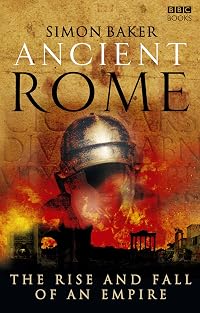
Ancient Rome: The Rise and Fall of An Empire
by Simon Baker
On This Page
Description
This is the story of the greatest empire the world has ever known. Simon Baker charts the rise and fall of the world's first superpower, focusing on six momentous turning points that shaped Roman history. Welcome to Rome as you've never seen it before-awesome and splendid, gritty and squalid. From the conquest of the Mediterranean beginning in the third century BC to the destruction of the Roman Empire at the hands of barbarian invaders some seven centuries later, we discover the most show more critical episodes in Roman history: the spectacular collapse of the "free" republic, the birth of the age of the "Caesars," the violent suppression of the strongest rebellion against Roman power, and the bloody civil war that launched Christianity as a world religion. At the heart of this account are the dynamic, complex, and flawed characters of some of the most powerful rulers in history: men such as Pompey the Great, Julius Caesar, Augustus, Nero, and Constantine. Putting flesh on the bones of these distant, legendary figures, Baker looks beyond the dusty, toga-clad caricatures and explores their real motivations and ambitions. show lessTags
Recommendations






Member Reviews
Telling the history of a civilisation that lasted more than a thousand years is no easy feat, but Simon Baker brilliantly rose up to the challenge. His approach is, actually, quite simple: instead of offering a narrative from the beginning of Rome to its ultimate collapse, he focuses on a few of its major crisis (mostly revolts and revolutions) to demonstrate how Ancient Rome constantly morphed and evolved, through wars and conquests but, also, due to internal struggles.
He retells of the funding myths, the conquest of the Italian peninsula, the birth of the Republic and triumph of the Empire, and, up to the Tetrarchy and ultimate fall of the Western Empire. What's unfolding here is as much the biographies of major characters (Romulus show more and Remus, Sulla, Julius Caesar, Augustus, Nero, Constantine...) as it is of shattering events which came to define Roman history (the Pyrrhic War, the Punic Wars, Jewish wars, various civil wars, the early rise of Christianity...).
Of course, we may question why the author chose to deal with these specific events over others! We may also regret his particular emphasis on the Western Empire and not the Eastern one (here's the history of Rome, but an extra chapter on the fall of Constantinople would have, at least in my opinion, been welcome too...). Let's not be harsh, though, for in the end his angle is as good as any. Readers not knowing anything or so about Ancient Rome will learn a lot about major figures and events, while the more knowledgeable will appreciate how he manages, through such choices, to show not only the constant clashes of ideas within Rome itself (e.g. Optimates vs Populares, the different views of what was the republic supposed to be, and, even, that of liberties themselves...) but, also, how its later evolution will contributes to its downfall. All in all, Simon Baker's choices are everything but irrelevant.
Ancient Rome surely is a romp through a millennia, but easy to read and very informative. One of the best introduction to navigate your way through such a massive period. show less
He retells of the funding myths, the conquest of the Italian peninsula, the birth of the Republic and triumph of the Empire, and, up to the Tetrarchy and ultimate fall of the Western Empire. What's unfolding here is as much the biographies of major characters (Romulus show more and Remus, Sulla, Julius Caesar, Augustus, Nero, Constantine...) as it is of shattering events which came to define Roman history (the Pyrrhic War, the Punic Wars, Jewish wars, various civil wars, the early rise of Christianity...).
Of course, we may question why the author chose to deal with these specific events over others! We may also regret his particular emphasis on the Western Empire and not the Eastern one (here's the history of Rome, but an extra chapter on the fall of Constantinople would have, at least in my opinion, been welcome too...). Let's not be harsh, though, for in the end his angle is as good as any. Readers not knowing anything or so about Ancient Rome will learn a lot about major figures and events, while the more knowledgeable will appreciate how he manages, through such choices, to show not only the constant clashes of ideas within Rome itself (e.g. Optimates vs Populares, the different views of what was the republic supposed to be, and, even, that of liberties themselves...) but, also, how its later evolution will contributes to its downfall. All in all, Simon Baker's choices are everything but irrelevant.
Ancient Rome surely is a romp through a millennia, but easy to read and very informative. One of the best introduction to navigate your way through such a massive period. show less
If you, like me, don't know much about the Roman Republic, the Roman Empire it spawned, or the impact of Roman culture on the subsequent millennia beyond what you saw on television when men in golden breastplates flogged and stapled history's most successful anarchist to a cross of wood between Paul and Jan Crouch's sobs and pleas for money, you could do worse than read this book. Though largely artless, it is not naively so, and proves as unrelenting as any anonymous, sweaty, bloodthirsty beefcake in fish scale bikini briefs in its presentation of the epochal moments that gave form to that lodestar of classical civilization.
Rome, at least mythological Rome, was founded first on murder, and then as a sanctuary for the detritus of other show more societies -- criminals, exiles, refugees, their tired, their poor, their huddled masses. Then these castoffs invited their neighbors to the city, ostensibly in observance of a religious festival, only to steal their womenfolk so they could make babies. Babies that would grow up not to invite neighbors to do anything other than to submit to Rome or be put to the sword. With such violent origins, one is moved to wonder if their hymns would keep time with the Star Spangled Banner.
A popular history from BBC Books, I cannot help but think that author Simon Baker is, at times, addressing the United States in a roundabout fashion. Perhaps this is self-consciously nationalistic of me because the paranoid Puritanical founding of my own country casts such a long shadow. Maybe he has merely succeeded in touching upon the overarching themes native to all civilizations with the conceit to aspire to imperialism. It amounts to the same.
Romans, like Yankees, soon tired of their kings (Etruscan, by the bye, from whom we inherit the word fascism because they would carry a bundle of elm or birch branches bound together with an axe at its center called a fasces), ran them off and founded that most remarkable and fragile of things, a republic. A republic that gave lip service to the political freedom of its citizens, but nevertheless vested the power of the kingship in two elected consuls that would share power for a set period of time and that, in practice, came from the wealthiest two percent of adult Roman males. Yet even so, the memory of one man rule would stay with Romans and, in times of crisis, dictatorial powers would be ceded to that one happy man to do as he saw fit to restore order and preserve the republic.
But Rome would succumb to triumphalism despite its high mindedness. Riding the wave of its economic and military successes -- made almost exclusively on the backs of the middle and lower classes and through the strategic application of pre-emptive wars of self-defense -- Baker notes:
In becoming a superpower, Rome, so it was said, abandoned the very values with which it had won its supremacy. At the pinnacle of its achievement, the virtues that had made the Roman republic so successful failed it and were lost forever.
An idealistic man by the name of Tiberius Sempronius Gracchus, a military hero and the grandson of Scipio Africanus, himself famous for having saved the young republic from the wrathful genius of Carthage's Hannibal, would attempt to redistribute lands he perceived as unjustly taken from the citizen militia who, while fighting Rome's wars of conquest, would see their properties go untended, fall into arrears, and then bought up on the cheap by the aristocracy.
In the first politically motivated murder of the republic, Tiberius would be killed and his mangled body unceremoniously dumped in the Tiber River.
Then would come the Caesars, the obsolescence, the decline, and the monotheistic statism. As I write these last words, my eyes wander to a Roman coin that I purchased some months ago and which I have worked at cleaning nearly daily. The profile of some emperor or other adorns one side; the image of an entire man holding what appears to be a bow, or perhaps even a plough, the other. One day I will set to examining it more closely in the hopes of dating it. Maybe I'll even try to decipher the Latin that haphazardly rings it. However, I will only do these things in the vein of an antiquarian. Our history cannot be found on any coin or written in any book. It can only be found in us, and I sometimes despair that it will never be overcome. show less
Rome, at least mythological Rome, was founded first on murder, and then as a sanctuary for the detritus of other show more societies -- criminals, exiles, refugees, their tired, their poor, their huddled masses. Then these castoffs invited their neighbors to the city, ostensibly in observance of a religious festival, only to steal their womenfolk so they could make babies. Babies that would grow up not to invite neighbors to do anything other than to submit to Rome or be put to the sword. With such violent origins, one is moved to wonder if their hymns would keep time with the Star Spangled Banner.
A popular history from BBC Books, I cannot help but think that author Simon Baker is, at times, addressing the United States in a roundabout fashion. Perhaps this is self-consciously nationalistic of me because the paranoid Puritanical founding of my own country casts such a long shadow. Maybe he has merely succeeded in touching upon the overarching themes native to all civilizations with the conceit to aspire to imperialism. It amounts to the same.
Romans, like Yankees, soon tired of their kings (Etruscan, by the bye, from whom we inherit the word fascism because they would carry a bundle of elm or birch branches bound together with an axe at its center called a fasces), ran them off and founded that most remarkable and fragile of things, a republic. A republic that gave lip service to the political freedom of its citizens, but nevertheless vested the power of the kingship in two elected consuls that would share power for a set period of time and that, in practice, came from the wealthiest two percent of adult Roman males. Yet even so, the memory of one man rule would stay with Romans and, in times of crisis, dictatorial powers would be ceded to that one happy man to do as he saw fit to restore order and preserve the republic.
But Rome would succumb to triumphalism despite its high mindedness. Riding the wave of its economic and military successes -- made almost exclusively on the backs of the middle and lower classes and through the strategic application of pre-emptive wars of self-defense -- Baker notes:
In becoming a superpower, Rome, so it was said, abandoned the very values with which it had won its supremacy. At the pinnacle of its achievement, the virtues that had made the Roman republic so successful failed it and were lost forever.
An idealistic man by the name of Tiberius Sempronius Gracchus, a military hero and the grandson of Scipio Africanus, himself famous for having saved the young republic from the wrathful genius of Carthage's Hannibal, would attempt to redistribute lands he perceived as unjustly taken from the citizen militia who, while fighting Rome's wars of conquest, would see their properties go untended, fall into arrears, and then bought up on the cheap by the aristocracy.
In the first politically motivated murder of the republic, Tiberius would be killed and his mangled body unceremoniously dumped in the Tiber River.
Then would come the Caesars, the obsolescence, the decline, and the monotheistic statism. As I write these last words, my eyes wander to a Roman coin that I purchased some months ago and which I have worked at cleaning nearly daily. The profile of some emperor or other adorns one side; the image of an entire man holding what appears to be a bow, or perhaps even a plough, the other. One day I will set to examining it more closely in the hopes of dating it. Maybe I'll even try to decipher the Latin that haphazardly rings it. However, I will only do these things in the vein of an antiquarian. Our history cannot be found on any coin or written in any book. It can only be found in us, and I sometimes despair that it will never be overcome. show less
An excellent book that keeps the reader fascinated from the foundation of Rome and the Roman empire through the multitude of historical events eventually leading to its descent into disintegration. The vivid style puts you in the middle of the struggles between Senate, emperors and the military. You can look over the shoulders of great figures like Julius Caesar, Augustus or Lucius Domitius Ahenobarbus, better known as Nero. But in the end not a Roman emperor keeps the upper hand, instead the 'barbarian' king Odovacar brings the Western half of the Roman empire to its ultimate conclusion.
There is no way that you are going to get a full history of the Roman Empire in 400 pages but this is a very good introduction that hits on six points in time that were important to said empire. I highly recommend it.
Despite my interest in its subject this book (clearly) didn't hold my interest. The writing was dry and the narrative lacked ... oomph? a hook? cohesion?
An excellent book, very popular amongst students at the university were I work, they told me to read this book.
Ratings
Members
- Recently Added By
Author Information
5 Works 522 Members
Work Relationships
Is an adaptation of
Common Knowledge
- Related movies
- Ancient Rome: The Rise and Fall of an Empire (2006 | IMDb)
- Epigraph*
- Du aber, Römer, gedenke die Völker der Welt zu beherrschen,
- Dedication*
- Für Patsy, James und alle meine Angehörigen
*Some information comes from Common Knowledge in other languages. Click "Edit" for more information.
Classifications
- Genres
- History, Nonfiction, General Nonfiction
- DDC/MDS
- 937.06 — History & geography History of ancient world (to ca. 499) Italian Peninsula to 476 and adjacent territories to 476 Empire 31 B.C.-476 A.D.
- LCC
- DG311 .B34 — History of Europe, Asia, Africa and Oceania City History of Italy Ancient Italy. Rome to 476 History By period Empire, 27 B.C. - 476 A.D. 284-476. Decline and fall
- BISAC
Statistics
- Members
- 434
- Popularity
- 70,807
- Reviews
- 6
- Rating
- (4.10)
- Languages
- English, German, Norwegian (Bokmål)
- Media
- Paper, Audiobook, Ebook
- ISBNs
- 10
- ASINs
- 5