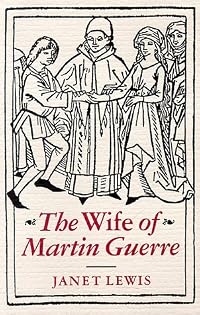
The Wife of Martin Guerre
by Janet Lewis
On This Page
Description
In this new edition of Janet Lewis's classic short novel, The Wife of Martin Guerre, Swallow Press executive editor Kevin Haworth writes that Lewis's story is "a short novel of astonishing depth and resonance, a sharply drawn historical tale that asks contemporary questions about identity and belonging, about men and women, and about an individual's capacity to act within an inflexible system." Originally published in 1941, The Wife of Martin Guerre has earned the respect and admiration of show more critics and readers for over sixty years. Based on a notorious trial in sixteenth-century France, this show lessTags
Recommendations

































Member Recommendations

PuddinTame The Wife of Martin Guerre is a biographical novel of Bertrande de Rols, based on the same case that inspired the movie The Return of Martin Guerre.

PuddinTame The Wife of Martin Guerre by Janet Lewis is a biographical novel about Bertrande de Rols. The Return of Martin Guerre by Natalie Zemon Davis is a nonfiction account of the case.
Member Reviews
I read this novel years ago for school, but I was clicking around Goodreads randomly and I realised that, for some bizarre reason, this book has a lot of positive reviews, so I thought I'd try to counterbalance that a little.
This book made me really angry. For a start, it's just so boring -- you'd think it'd be easy to avoid putting too much padding in a 109-page novella, but no, this book will do such things as devote an entire page to describing a tree, and honestly, I do not care about trees that much. So. That happens.
But worse, I despised the plot. Basically what happens is this: a woman in sixteenth-century France marries this man, Martin Guerre, who is abusive and generally a despicable person. At some point he up and leaves her, show more which would seem to me to be the highlight of their entire marriage, except for the part where this leaves her in a precarious position in sixteenth-century France. Eight years later, Martin Guerre finally deigns to return, only now he's much kinder and warmer, a really nice guy, someone it wouldn't be hell on earth to live with. This means Bertrande (the woman) becomes convinced that he's not really Martin Guerre at all, but an impostor. Most of the rest of the book is then about her struggle to make everyone else realise he's an impostor, even though he's clearly a vast improvement on the man she was married to before, so I personally would be very inclined to bury my doubts.
Then at the end he's proved to be an impostor because the real Martin Guerre actually returns, and promptly abuses Bertrande anew to thank her for making the impostor's life as hard as possible in spite of what a great guy he was. Oh sorry, I mean for "cheating" on him. Because he was definitely entitled to her loyalty after being abusive and abandoning her, after all.
I mean, I do hate novels where characters seem anachronistic, and my teacher at the time gave me a lecture about how I just didn't understand how deep the fear of hell ran in Bertrande's time. But quite honestly, I think this depth of fear of hell would have been equally unusual in Bertrande's time as ours. In the last millennium, Europe has been full of people who had affairs or even, god forbid, sex before marriage - and this is a guy who could quite easily have been Bertrande's true husband, just a bit more mature and with an actual conscience. So fine, Bertrande is part of that small minority of people who actually think remaining loyal to an abusive husband is better than the possibility of eternal damnation. This is not really a segment of society I care to read about. Each to their own, though. show less
This book made me really angry. For a start, it's just so boring -- you'd think it'd be easy to avoid putting too much padding in a 109-page novella, but no, this book will do such things as devote an entire page to describing a tree, and honestly, I do not care about trees that much. So. That happens.
But worse, I despised the plot. Basically what happens is this: a woman in sixteenth-century France marries this man, Martin Guerre, who is abusive and generally a despicable person. At some point he up and leaves her, show more which would seem to me to be the highlight of their entire marriage, except for the part where this leaves her in a precarious position in sixteenth-century France. Eight years later, Martin Guerre finally deigns to return, only now he's much kinder and warmer, a really nice guy, someone it wouldn't be hell on earth to live with. This means Bertrande (the woman) becomes convinced that he's not really Martin Guerre at all, but an impostor. Most of the rest of the book is then about her struggle to make everyone else realise he's an impostor, even though he's clearly a vast improvement on the man she was married to before, so I personally would be very inclined to bury my doubts.
I mean, I do hate novels where characters seem anachronistic, and my teacher at the time gave me a lecture about how I just didn't understand how deep the fear of hell ran in Bertrande's time. But quite honestly, I think this depth of fear of hell would have been equally unusual in Bertrande's time as ours. In the last millennium, Europe has been full of people who had affairs or even, god forbid, sex before marriage - and this is a guy who could quite easily have been Bertrande's true husband, just a bit more mature and with an actual conscience. So fine, Bertrande is part of that small minority of people who actually think remaining loyal to an abusive husband is better than the possibility of eternal damnation. This is not really a segment of society I care to read about. Each to their own, though. show less
True Story, Fictionalised
“A stranger… then her loved husband, then a man who might have been Martin’s ancestor but not young Martin Guerre.”
This novella was written by an American novelist and published in 1941. It is based on a startling court case in 16th century France, that has been told and adapted many times since, including the 1993 film starring Jodie Foster and Richard Gere, Sommersby, which set it in the US Civil War. A decade earlier, Gerard Depardieu starred in Le retour de Martin Guerre. It's quite fun to watch them back to back (though it's many years since I did).
Martin and Bertrande are married young. Shortly after their son, Sanxi, is born, Martin goes away to avoid a dispute with his father, telling Bertrande show more he will be back in a week or so. Years pass. Martin returns, a changed man – changed for the better. Everyone recognises him, even the animals, but he’s kinder, wiser, gentler. Everyone loves him, including Bertrande - more than ever. Another child is born, and Bertrande begins to fear he is an imposter, and thus that she is an adulteress, destined for eternal damnation. She’s not certain. She questions her sanity: “It was like the shadow of a dark wing sweeping suddenly across the room, and then departing swiftly.”
For a while, she puts her fears to one side, regarding them as delusions, “it lent a strange savour to her passion for him”. For a while.
What Would You Do?
The story is about truth, identity, and loyalty. There is courtroom drama. But the real interest is whether and why someone could get away with such a deceit, and if so, why others might go along with it. If there’s the death penalty in this life and you believe in hellfire in the next, matters are even more complex.
Even if she were certain the man is an imposter, what to do, given that she has a child by each man, has come to love the new Martin, and that the estate and all its servants and workers depend on him?
There is no right answer.
Time and Place
Lewis weaves a lush tapestry of the life, beliefs, and customs of “rich peasant families” in mid the 1500s, along with the scenery and seasonal cycles of the Pyrenees and Basque country. The language is slightly old-fashioned, without being obscure.
Quotes
• “His presence should testify for her that the beasts were safe, that the grain was safe… the family was safe… and therefore the whole world was safe and as it should be.”
• “Bertrande was aware of no other sentiment for her husband than a mild gratitude for his leaving her alone.”
• “Gradually Bertrande’s affection for her husband became a deep and joyous passion, growing slowly and naturally as her body grew.”
• “His ugliness was ancestral, and that in itself was good.”
• “He had deserted her in the full beauty of her youth, in the height of her great passion, he had shamed her and wounded her.”
• “The displeasure of Monsieur Guerre had become as necessary and inevitable part of his character as his spine was of his body. When he entered a room that displeasure entered with him.”
• “The more she strove to recollect his appearance, the vaguer grew her memory.”
• “Her sorrow and her new sense of responsibility ennobled her physical charm.”
• “He attached himself to his father’s person, like a small dog who does not mind whether he is noticed or not, provided he is permitted to be present.”
• “The very walls of the kitchen were animated and seemed to tremble in the ruddy glow from the chimney. The copper vessels winked and blazed. The glazed pottery on the dresser also gave back the quivering light, and his father’s armour… was momentarily like the sky of an autumn sunset.”
• “I see the flesh and bones of Martin Guerre, but in them I see dwelling the spirit of another man.”
• “The air alternately misted, showered, and shone in confusing variability.”
• “Bertrande awoke unrefreshed, and felt in the air, as in her mind, the sultriness which paralleled the sullen temper of the men… the evening before.”
See also
• Rebecca West's The Return of the Soldier is an entirely fictional novel that also explores the consequences of a returning soldier. See my 4* review HERE.
• The Return of Martin Guerre - non-fiction that inspired Janet Lewis. show less
“A stranger… then her loved husband, then a man who might have been Martin’s ancestor but not young Martin Guerre.”
This novella was written by an American novelist and published in 1941. It is based on a startling court case in 16th century France, that has been told and adapted many times since, including the 1993 film starring Jodie Foster and Richard Gere, Sommersby, which set it in the US Civil War. A decade earlier, Gerard Depardieu starred in Le retour de Martin Guerre. It's quite fun to watch them back to back (though it's many years since I did).
Martin and Bertrande are married young. Shortly after their son, Sanxi, is born, Martin goes away to avoid a dispute with his father, telling Bertrande show more he will be back in a week or so. Years pass. Martin returns, a changed man – changed for the better. Everyone recognises him, even the animals, but he’s kinder, wiser, gentler. Everyone loves him, including Bertrande - more than ever. Another child is born, and Bertrande begins to fear he is an imposter, and thus that she is an adulteress, destined for eternal damnation. She’s not certain. She questions her sanity: “It was like the shadow of a dark wing sweeping suddenly across the room, and then departing swiftly.”
For a while, she puts her fears to one side, regarding them as delusions, “it lent a strange savour to her passion for him”. For a while.
What Would You Do?
The story is about truth, identity, and loyalty. There is courtroom drama. But the real interest is whether and why someone could get away with such a deceit, and if so, why others might go along with it. If there’s the death penalty in this life and you believe in hellfire in the next, matters are even more complex.
Even if she were certain the man is an imposter, what to do, given that she has a child by each man, has come to love the new Martin, and that the estate and all its servants and workers depend on him?
There is no right answer.
Time and Place
Lewis weaves a lush tapestry of the life, beliefs, and customs of “rich peasant families” in mid the 1500s, along with the scenery and seasonal cycles of the Pyrenees and Basque country. The language is slightly old-fashioned, without being obscure.
Quotes
• “His presence should testify for her that the beasts were safe, that the grain was safe… the family was safe… and therefore the whole world was safe and as it should be.”
• “Bertrande was aware of no other sentiment for her husband than a mild gratitude for his leaving her alone.”
• “Gradually Bertrande’s affection for her husband became a deep and joyous passion, growing slowly and naturally as her body grew.”
• “His ugliness was ancestral, and that in itself was good.”
• “He had deserted her in the full beauty of her youth, in the height of her great passion, he had shamed her and wounded her.”
• “The displeasure of Monsieur Guerre had become as necessary and inevitable part of his character as his spine was of his body. When he entered a room that displeasure entered with him.”
• “The more she strove to recollect his appearance, the vaguer grew her memory.”
• “Her sorrow and her new sense of responsibility ennobled her physical charm.”
• “He attached himself to his father’s person, like a small dog who does not mind whether he is noticed or not, provided he is permitted to be present.”
• “The very walls of the kitchen were animated and seemed to tremble in the ruddy glow from the chimney. The copper vessels winked and blazed. The glazed pottery on the dresser also gave back the quivering light, and his father’s armour… was momentarily like the sky of an autumn sunset.”
• “I see the flesh and bones of Martin Guerre, but in them I see dwelling the spirit of another man.”
• “The air alternately misted, showered, and shone in confusing variability.”
• “Bertrande awoke unrefreshed, and felt in the air, as in her mind, the sultriness which paralleled the sullen temper of the men… the evening before.”
See also
• Rebecca West's The Return of the Soldier is an entirely fictional novel that also explores the consequences of a returning soldier. See my 4* review HERE.
• The Return of Martin Guerre - non-fiction that inspired Janet Lewis. show less
Janet Lewis' short novel The Wife of Martin Guerre examines this classic case of circumstantial evidence, telling the story mainly through the perspective of Guerre's wife, Bertrande de Rols. A readable and lyrical adaptation of the tale, with all its twists, turns, and surprises. Lewis delves deeply into Bertrande's frame of mind as she ultimately concludes that she must confront the man purporting to be her husband, and the powerful ending really speaks to the all-important question of truth versus justice.
http://philobiblos.blogspot.com/2010/03/book-review-wife-of-martin-guerre.html
http://philobiblos.blogspot.com/2010/03/book-review-wife-of-martin-guerre.html
I've wanted to read this book since I saw the movie decades ago, so I immediately checked it out when it showed up on my library feed.
Based on an 1874 legal history, this short novel describes the events leading to a legal dispute in 1539. Martin Guerre is married to Bertrand, and after an argument with his father, with whom he owns and manages a prosperous farm, he takes off for a break. Bertrand expects him to be gone a few months at the most. Instead, he is gone eight years. When he returns, everyone accepts him as Martin Guerre, but after a while Bertrand begins to suspect otherwise--he is too "nice" to be Martin. Bertrand begins legal proceedings to have him declared an imposter.
The focus of the book was on Bertrand's state of show more mind. It did a good job of putting the reader into a 16th century mindset, and the characters were well-developed. Although it might seem fantastical that a woman might not recognize her husband, the story was plausible and well-told.
Recommended.
3 stars show less
Based on an 1874 legal history, this short novel describes the events leading to a legal dispute in 1539. Martin Guerre is married to Bertrand, and after an argument with his father, with whom he owns and manages a prosperous farm, he takes off for a break. Bertrand expects him to be gone a few months at the most. Instead, he is gone eight years. When he returns, everyone accepts him as Martin Guerre, but after a while Bertrand begins to suspect otherwise--he is too "nice" to be Martin. Bertrand begins legal proceedings to have him declared an imposter.
The focus of the book was on Bertrand's state of show more mind. It did a good job of putting the reader into a 16th century mindset, and the characters were well-developed. Although it might seem fantastical that a woman might not recognize her husband, the story was plausible and well-told.
Recommended.
3 stars show less
revisit years read once I locate reading notes; thought of this title today due to name of husband returned from WW II in Natalie Haynes short story in MARPLE
Op een ochtend in januari 1539 werd in het dorp Artigues een bruiloft gevierd.
Aug 16, 2022Dutch
Members
- Recently Added By
Lists

Schwob Nederland
207 works; 2 members
Author Information

23+ Works 598 Members
Janet Lewis was a novelist, poet, and short-story writer whose literary career spanned almost the entire twentieth century. The New York Times has praised her novels as "some of the 20th century's most vividly imagined and finely wrought literature." Born and educated in Chicago, she lived in California for most of her adult life and taught at show more both Stanford University and the University of California at Berkeley. Among her other works are The Trial of Sren Qvist (1947), The Ghost of Monsieur Scarron (1959), Good-Bye, Son and Other Stories (1946), and Poems Old and New (1982). show less
Some Editions
Common Knowledge
- Canonical title
- The Wife of Martin Guerre
- Original title
- The Wife of Martin Guerre
- Original publication date
- 1941
- People/Characters
- Bertrande de Rols; Martin Guerre
- Related movies
- Le retour de Martin Guerre (1982 | IMDb)
- First words
- One morning in January 1539, a wedding was celebrated in the village of Artigues.
- Last words
- (Click to show. Warning: May contain spoilers.)But when hate and love have together exhausted the soul, the body seldom endures for long.
- Original language*
- Engels
*Some information comes from Common Knowledge in other languages. Click "Edit" for more information.
Classifications
- Genres
- Fiction and Literature, General Fiction, Historical Fiction
- DDC/MDS
- 813.52 — Literature & rhetoric American literature in English American fiction in English 1900-1999 1900-1945
- LCC
- PS3523 .E866 .W55 — Language and Literature American literature American literature Individual authors 1900-1960
- BISAC
Statistics
- Members
- 394
- Popularity
- 78,411
- Reviews
- 7
- Rating
- (3.56)
- Languages
- 6 — Catalan, Dutch, English, French, German, Spanish
- Media
- Paper, Audiobook, Ebook
- ISBNs
- 20
- ASINs
- 9