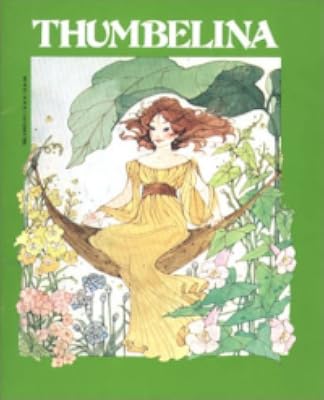
Thumbelina
by Hans Christian Andersen
On This Page
Description
A tiny girl no bigger than a thumb is stolen by a great ugly toad and subsequently has many adventures and makes many animal friends, before finding the perfect mate in a warm and beautiful southern land.Tags
Recommendations










Member Reviews
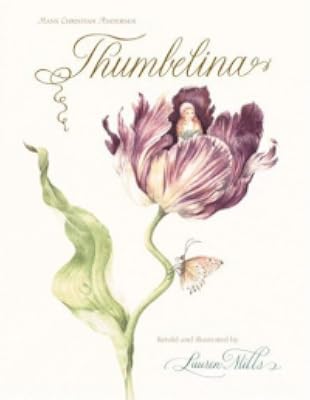
The tenth retelling of Thumbelina that I have read and reviewed in the past year - eleventh if you count Daniel Picouly's brilliant Martiniquais version, Thumbelina of Toulaba - this lovely picture-book bids fair to become one of my favorite adaptations of the tale! Sylvia Long, whose gorgeous artwork helped make An Egg Is Quiet and A Seed Is Sleepy such brilliant books, here turns her attention to Hans Christian Andersen's classic tale of a diminutive maiden who, after many trials and tribulations, finds the proper mate, and the results are delightful!
Although I find Long's human faces a little weak, I thought that the absolute perfection of her flora and fauna, the way in which she captures a sense of the light on the water, or in the show more mouse's home, and her use of a vivid range of colors, all combined to create a landscape with immense appeal. I also really liked the fact that the page orientation changes, from time to time, with particularly tall scenes needing to be viewed vertically, across two pages, and the final scene folding out. All in all, this is a fairy-tale winner, sure to please fans of the genre, and of this tale! show less
Although I find Long's human faces a little weak, I thought that the absolute perfection of her flora and fauna, the way in which she captures a sense of the light on the water, or in the show more mouse's home, and her use of a vivid range of colors, all combined to create a landscape with immense appeal. I also really liked the fact that the page orientation changes, from time to time, with particularly tall scenes needing to be viewed vertically, across two pages, and the final scene folding out. All in all, this is a fairy-tale winner, sure to please fans of the genre, and of this tale! show less
Thumbelina, illustrated by Arlene Graston.
Originally published in 1835, as part of the second booklet of Andersen's Eventyr, fortalte for Børn. Første Samling. (Fairy Tales Told for Children, First Collection), Thumbelina has been interpreted as everything from an allegory of Christian suffering and salvation, to a tale of female masturbation. Needless to say, younger readers will probably just appreciate it as an exciting adventure story, albeit one with a fairly passive heroine.
This edition features the translation of Eric Christian Haugaard - whose 1973 tome, The Complete Fairy Tales and Stories, has become something of a standard in the field - and it reads very well. Arlene Graston's watercolor illustrations are a pleasant show more accompaniment to the tale, although I sometimes found them a little too dark for my taste. I wasn't sure what to make of the subtle mosaic-like pattern she used as a background in her paintings, which sometimes worked very well, and sometimes seemed out of place. Still, despite these qualifications, I found this to be a charming retelling, and while it doesn't quite equal the Lauren Mills Thumbelina in my esteem, it has great narrative and aesthetic appeal. show less
Originally published in 1835, as part of the second booklet of Andersen's Eventyr, fortalte for Børn. Første Samling. (Fairy Tales Told for Children, First Collection), Thumbelina has been interpreted as everything from an allegory of Christian suffering and salvation, to a tale of female masturbation. Needless to say, younger readers will probably just appreciate it as an exciting adventure story, albeit one with a fairly passive heroine.
This edition features the translation of Eric Christian Haugaard - whose 1973 tome, The Complete Fairy Tales and Stories, has become something of a standard in the field - and it reads very well. Arlene Graston's watercolor illustrations are a pleasant show more accompaniment to the tale, although I sometimes found them a little too dark for my taste. I wasn't sure what to make of the subtle mosaic-like pattern she used as a background in her paintings, which sometimes worked very well, and sometimes seemed out of place. Still, despite these qualifications, I found this to be a charming retelling, and while it doesn't quite equal the Lauren Mills Thumbelina in my esteem, it has great narrative and aesthetic appeal. show less
This is the classic tale of Thumbelina being stolen away to be forced into marriage. First a mother toad stole her to marry her son and then a field mouse tried to get her to marry a mole. Thankfully with the help of a kind swallow Thumbelina is able to escape and finds a group of flower spirits. Really reflecting on the fairy tale makes me realize how strange this tale is and how strange it would sound to children that had not grown up with this tale. The illustrations are nice and seem to be watercolor which makes the images seem very soft and gentle like Thumbelina.
Thumbelina, illustrated by Adrienne Adams.
Given my fondness for the work of illustrator Adrienne Adams, whose artwork can be found in many of my favorite children's books by Rumer Godden, I was quite excited to discover that Adams had also illustrated a number of Hans Christian Andersen retellings, amongst them this lovely Thumbelina.
Fairy-tale purists will be pleased to know that this edition contains a full and faithful translation of the original Danish, done by R.P. Keigwin. I can't say the prose "sparkles" (it never does with Keigwin), but the narrative is engaging enough. Adams' artwork is the real draw here, with lovely color and (mostly) black and white spreads. The depiction of Thumbelina's mother, when she first sees her tiny show more daughter, is particularly fine. The sensibility here might be a little old-fashioned, but this is still a wonderful picture-book adaptation of a popular tale. show less
Given my fondness for the work of illustrator Adrienne Adams, whose artwork can be found in many of my favorite children's books by Rumer Godden, I was quite excited to discover that Adams had also illustrated a number of Hans Christian Andersen retellings, amongst them this lovely Thumbelina.
Fairy-tale purists will be pleased to know that this edition contains a full and faithful translation of the original Danish, done by R.P. Keigwin. I can't say the prose "sparkles" (it never does with Keigwin), but the narrative is engaging enough. Adams' artwork is the real draw here, with lovely color and (mostly) black and white spreads. The depiction of Thumbelina's mother, when she first sees her tiny show more daughter, is particularly fine. The sensibility here might be a little old-fashioned, but this is still a wonderful picture-book adaptation of a popular tale. show less
Thumbelina, illustrated by David Johnson.
Part of Rabbit Ears Entertainment's series of fairy-tell retellings, this adaptation of Hans Christian Andersen's Thumbelina is mostly faithful to the original, with one or two minor changes obviously intended to make the heroine less passive. Thumbelina asks the fish to help her escape from the toads, for instance, rather than just weeping on her lily pad. David Johnson's ink and watercolor illustrations are hit or miss, some - like that depicting the Mole entering Mouse's home - felt murky and crowded; while others - such as the full spread depicting Thumbelina, as Sparrow departs for the south - had a lovely and expressive delicacy.
But although this retelling has definite merit, I found show more myself - just as with David Jorgensen's The Steadfast Tin Soldier - wishing that I had access to the accompanying CD, with its music by Mark Isham, and narration by actress Kelly McGillis. I wonder if I would feel this way if I didn't know there was a CD...? In any case, I found this a pretty but mostly unremarkable, adaptation of Thumbelina: the fairy-tale lover can do better. show less
Part of Rabbit Ears Entertainment's series of fairy-tell retellings, this adaptation of Hans Christian Andersen's Thumbelina is mostly faithful to the original, with one or two minor changes obviously intended to make the heroine less passive. Thumbelina asks the fish to help her escape from the toads, for instance, rather than just weeping on her lily pad. David Johnson's ink and watercolor illustrations are hit or miss, some - like that depicting the Mole entering Mouse's home - felt murky and crowded; while others - such as the full spread depicting Thumbelina, as Sparrow departs for the south - had a lovely and expressive delicacy.
But although this retelling has definite merit, I found show more myself - just as with David Jorgensen's The Steadfast Tin Soldier - wishing that I had access to the accompanying CD, with its music by Mark Isham, and narration by actress Kelly McGillis. I wonder if I would feel this way if I didn't know there was a CD...? In any case, I found this a pretty but mostly unremarkable, adaptation of Thumbelina: the fairy-tale lover can do better. show less
Thumbeline, illustrated by Lisbeth Zwerger.
Named Tommelise in the original Danish, the diminutive heroine of Hans Christian Andersen's classic tale has been variously known in English as Little Ellie, Little Totty, Little Maja, Inchelina, Thumbelisa, and - of course - Thumbelina. Anthea Bell's 1980 translation of the story, reprinted earlier this year (2009), features the only appearance - so far as I know - of Thumbeline. Done to distinguish her work from other translations and adaptations? Possibly... But leaving aside this titular diversion, Bell's narrative is immensely faithful to the original, and should be most welcome to readers looking for a complete retelling of the tale.
The illustrations are done by the immensely talented show more Lisbeth Zwerger, whose fairy-tale work has included a number of other Andersen tales, from The Nightingale to The Little Mermaid. Full page paintings are paired with full-page text, and are a little bit darker than many of the other contemporary interpretations I have seen. I was reminded, in some scenes, of Arthur Rackham's illustrations. All in all, a lovely little book, and a fine addition to the many editions of Thumbelina (or Thumbeline) currently available. show less
Named Tommelise in the original Danish, the diminutive heroine of Hans Christian Andersen's classic tale has been variously known in English as Little Ellie, Little Totty, Little Maja, Inchelina, Thumbelisa, and - of course - Thumbelina. Anthea Bell's 1980 translation of the story, reprinted earlier this year (2009), features the only appearance - so far as I know - of Thumbeline. Done to distinguish her work from other translations and adaptations? Possibly... But leaving aside this titular diversion, Bell's narrative is immensely faithful to the original, and should be most welcome to readers looking for a complete retelling of the tale.
The illustrations are done by the immensely talented show more Lisbeth Zwerger, whose fairy-tale work has included a number of other Andersen tales, from The Nightingale to The Little Mermaid. Full page paintings are paired with full-page text, and are a little bit darker than many of the other contemporary interpretations I have seen. I was reminded, in some scenes, of Arthur Rackham's illustrations. All in all, a lovely little book, and a fine addition to the many editions of Thumbelina (or Thumbeline) currently available. show less
Summary: This children's book is about a small thumb-sized girl named Thumbelina who was created in the center of a rose for a woman who could not have children. She was taken away from her home to marry a young toad but was unhappy and eventually escaped. Then she lived on her own in a garden until winter came and a kind mouse took her in. She lived with the mouse and was to marry her neighbor, the mole. In the molehole she comes across an injured swallow whom she nurses back to health. When cured, the swallow takes Thumbelina away from the unhappy place and to a beautiful garden where she meets her prince and lives happily ever after.
Argument: I think this a good traditional story for children to read. I enjoyed the element of nature show more in this book. Every page had to do with flowers, gardens, animals or insects. The setting took place in many aspects of nature. This not only creates an intriguing story but it teaches children about the environment. It teaches them about the parts of a plant, the habitats animals live in, the seasons, and even the elements of a garden. This book allows children to take a tour through nature with Thumbelina and her adventures. The second element of this book I enjoyed was the descriptive language. Every sentence allowed me to create mental images in my mind of Thumbelina's story. This helps children comprehend the book and connect the illustrations to the text. For example, on page 26 it says, "Long vines of purple, green, and white grapes climbed dazzling marble pillars and the air was fragrant with honeysuckle and gardenias". The last element I liked about this book was the format of the pages. Some pages you read left to right and some you had to flip the book upside down and read top to bottom. This engages the reader and adds a little element of surprise and fun to the story. I liked how when the pages were flipped the illustrations were of long beautiful flowers that needed to be shown lengthwise.
The main idea of this book was to treat others the way you wanted to be treated and they would do the same for you. Thumbelina took care of the swallow and in the end the swallow came back to rescue her from the mole. I also think an underlying theme was to address many aspects of nature and teach children about different plants, animals, and habitats. show less
Argument: I think this a good traditional story for children to read. I enjoyed the element of nature show more in this book. Every page had to do with flowers, gardens, animals or insects. The setting took place in many aspects of nature. This not only creates an intriguing story but it teaches children about the environment. It teaches them about the parts of a plant, the habitats animals live in, the seasons, and even the elements of a garden. This book allows children to take a tour through nature with Thumbelina and her adventures. The second element of this book I enjoyed was the descriptive language. Every sentence allowed me to create mental images in my mind of Thumbelina's story. This helps children comprehend the book and connect the illustrations to the text. For example, on page 26 it says, "Long vines of purple, green, and white grapes climbed dazzling marble pillars and the air was fragrant with honeysuckle and gardenias". The last element I liked about this book was the format of the pages. Some pages you read left to right and some you had to flip the book upside down and read top to bottom. This engages the reader and adds a little element of surprise and fun to the story. I liked how when the pages were flipped the illustrations were of long beautiful flowers that needed to be shown lengthwise.
The main idea of this book was to treat others the way you wanted to be treated and they would do the same for you. Thumbelina took care of the swallow and in the end the swallow came back to rescue her from the mole. I also think an underlying theme was to address many aspects of nature and teach children about different plants, animals, and habitats. show less
Members
- Recently Added By
Lists

1001 Children's Books You Must Read Before You Grow Up
774 works; 101 members

Best children's picture books
377 works; 85 members

Miniature, little, tiny characters -- children's/young adult fiction
278 works; 13 members

Favorite Fairy Tales
269 works; 103 members
Author Information

3,952+ Works 54,051 Members
Hans Christian Andersen, one of the best known figures in literature, is best know for combining traditional folk tales with his own great imagination to produce fairy tales known to most children today. The Danish writer was born in the slums of Odense. Although he was raised in poverty, he eventually attended Copenhagen University. Although show more Andersen wrote poems, plays and books, he is best known for his Fairy Tales and Other Stories, written between 1835 and 1872. This work includes such famous tales as The Emperor's New Clothes, Little Ugly Duckling, The Tinderbox, Little Claus and Big Claus, Princess and the Pea, The Snow Queen, The Little Mermaid, The Nightingale, The Story of a Mother and The Swineherd. Andersen's greatest work is still influential today, helping mold some of the works of writers ranging from Charles Dickens to Oscar Wilde and inspiring many of the works of Disney and other motion pictures. Andersen, who traveled greatly during his life, died in his home in Rolighed on August 4, 1875. (Bowker Author Biography) show less
Some Editions
Awards and Honors
Work Relationships
Is contained in
Is retold in
Has the adaptation
Inspired
Has as a student's study guide
Common Knowledge
- Canonical title
- Thumbelina
- Original title
- Tommelise
- Original publication date
- 1835
- People/Characters
- Thumbelina; Mouse; Mole; Swallow; King of the Flower Angels; Toad
- Dedication
- To my grandfather, who demonstrated patience. -- D.J.
- First words
- Once there was a woman who wanted a child more than anything in the world.
- Last words
- (Click to show. Warning: May contain spoilers.)Everyone danced all night, and above them in his nest was the swallow, singing for them his most heartbreaking tune.
Classifications
Statistics
- Members
- 1,095
- Popularity
- 23,279
- Reviews
- 33
- Rating
- (3.86)
- Languages
- 13 — Chinese, Danish, Dutch, English, Estonian, Finnish, French, German, Norwegian (Bokmål), Norwegian, Russian, Spanish, Swedish
- Media
- Paper, Audiobook, Ebook
- ISBNs
- 223
- UPCs
- 1
- ASINs
- 32