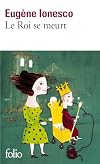
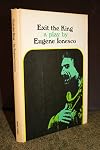
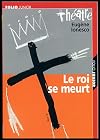
Le Roi se meurt
by Eugène Ionesco
On This Page
Description
A highly stylized, ritualistic death tire, in which a once-great king is shown during his last hours of life, surrounded by his two wives, his physician and a few other members of the decayed court. The third book in Ionesco's "Berenger Cycle."Tags
Recommendations













Member Reviews
It's a good thing I had seen this play before I read it, or I would have believed it was unperformable. The stage directions call for things that would challenge most theatres, but in the end, apparently it can be done. This is the story of a king on his death bed who will not accept he is dying. His kingdom is falling apart, possibly because of his illness. Reading it, I was able to see things in it that I missed when watching it. Like, this feels very much like a Death of God play. The images, the lists of achievements of the king, leave very little doubt that either the people attending him in his last hours are building him up, or he was truly a powerful king. At first it feels like the first, but as I continued to read, it began to show more sound like the last. A truly absurd entry in the canon of one of the all time great absurdists. show less
This a superb meditation on the reality of death seen through the eyes of the King, who stands for the ego. His two wives, the Guard, the Maid and finally the doctor are all aspects of the King's own psyche. Each 'character' guides the King through part of the journey into death.
The conclusion is crushing: when the Kng dies, the Universe ceases to exist. And yet, this pessimism is undercut by the King's own childishness. A bigger picture is implied, but never described.
This is a play which draws the viewer in. It uses wit and words to make beauty in a sombre and dark world.
The conclusion is crushing: when the Kng dies, the Universe ceases to exist. And yet, this pessimism is undercut by the King's own childishness. A bigger picture is implied, but never described.
This is a play which draws the viewer in. It uses wit and words to make beauty in a sombre and dark world.
I thought it was a little heavy-handed on the obvious symbolism at times, but nonetheless a really attractive and intriguing play.
Au lever du rideau, le garde annonce solennellement la cour, le roi Bérenger Ier entre dans la salle du trône suivi des deux reines, Marguerite et Marie, de Juliette et du Médecin. Le froid s’est installé, le chauffage ne fonctionne pas, et les murs du palais se lézardent. La reine Marie qui pleure devant cette dégradation se fait réprimander par la reine Marguerite pour sa frivolité. Il est convenu que le roi doit être informé de cet état et que la fin de son règne est proche, mais la reine Marie refuse de croire à l’irréversibilité des choses. La reine Marguerite insiste : le sol est mou, il n’y a pas d’armée dans le royaume, le roi est malade. C’est assuré par le médecin qui rapporte que les astres sont show more formels, c’est la fin. show less
Jun 26, 2021Portuguese (Portugal)
Ratings
Members
- Recently Added By
Lists

My Play Collection
769 works; 3 members
Author Information

Eugene Ionesco, born in Romania in 1912, is known as the father of the theater of the absurd. He grew up in France and Romania, settling in France in 1939. His first play, The Bald Soprano, satirized the deadliness of life frozen in meaningless formalities. Some of his other important plays include The Lesson, The Chairs, Rhinoceros, and Hunger show more and Thirst. His novel Le Solitaire was the basis for the 1971 film La Vase in which Ionesco played the lead. Eugene Ionesco was elected to the Academie Francaise in 1970. He died in 1994. (Bowker Author Biography) show less
Series
Belongs to Publisher Series
Gallimard, Folio (361)
Work Relationships
Is contained in
Has as a student's study guide
Common Knowledge
- Canonical title*
- Le Roi se meurt
- Original title
- Le roi se meurt
- Original publication date
- 15/12/1962
- Dedication
- A Jacques Mauclair, à Geneviève et Maurice de Gandillac.
- First words
- Salle du trône, vaguement délabrée, vaguement gothique.
LE GARDE, annonçant.
Sa Majesté, le roi Bérenger 1er. Vive le Roi! - Last words
- (Click to show. Warning: May contain spoilers.)Tu peux prendre place.
(Click to show. Warning: May contain spoilers.)Le Roi assis sur son trône doit rester visible quelque temps avant de sombrer dans une sorte de brume. - Original language*
- Français
*Some information comes from Common Knowledge in other languages. Click "Edit" for more information.
Classifications
Statistics
- Members
- 496
- Popularity
- 60,476
- Reviews
- 4
- Rating
- (3.65)
- Languages
- 8 — Czech, Danish, English, Finnish, French, German, Italian, Spanish
- Media
- Paper, Ebook
- ISBNs
- 25
- ASINs
- 22