On This Page
Description
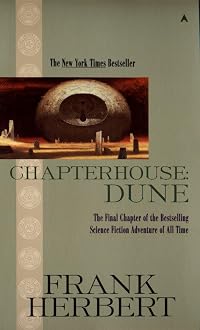
Fifteen thousand years after Leto II's death, the remnants of the Bene Gesserit contend with the ruthless leaders of an alien culture to forge a new civilization and preserve the best of the Old Empire.Tags
Recommendations















Member Reviews
With this book, I have completed my full sequential read of Frank Herbert's Dune novels. It ends on an open note, intimating a further dialectical progression of the transhuman possibilities developed in the books so far. But I am unlikely to read the Brian Herbert and Kevin J. Anderson sequels, even though they were supposedly composed on the basis of Frank Herbert's manuscript notes that intimated the plot of a seventh and final book. (Son Brian's notes in late editions of the earlier books were unimpressive to me.)
I had conjectured during my read of the immediately prior volume Heretics of Dune that these two should form a pair charting the rise and fall of a power within what the Bene Gesserit call the Old Empire, and their new show more rivals the Honored Matres call the Million Planets. If so, that power is Mother Superior Darwi Odrade, who ascended to her position at the end of Heretics and provides the primary viewpoint character for Chapterhouse. Odrade is a transformational leader of the Bene Gesserit, and her perspective certainly differs from that of her predecessor Taraza--even though she benefits from all of Taraza's memory and experience, after the fashion of the Sisterhood.
The ghola/clone regeneration of Miles Teg is only about ten years old in this book, thus establishing the relatively short period of time between the two volumes at the end of the series--most comparable to the gap between the first two Dune books. The rekindling of Teg's consciousness in this immature body establishes something of a recurrent trope in the larger series, with its similarity to the Unheimlichkeit of the child Alia Atreides. It is not the only respect in which Herbert here seems to be developing earlier theses by reiterating them with an alternation of gender.
This work is certainly no standalone, and I suspect that it would be basically unintelligible in the absence of the earlier Dune books. One interesting feature in the frame of the multi-millennial future historical arc composed by Herbert is that the Butlerian Jihad has become a mere ancient footnote. By the time of Chapterhouse, robots have become commonplace, and the integration of biology and technology is unsettling the distinction between machines and humanity. Speculative religious elements in this novel involve not only the forward projection into the Honored Matres, but a historically retrospective element in the recovery of a form of spacefaring crypto-Jewry.
The style of the text continues to use italics for internal reflections, and especially for kibitzing by the Other Memory within Reverend Mothers. Usually, this convention was pretty lucid, but it also made for some slow passages with mentation paralleling conversation, where the voices were difficult to untangle.
Since my read of the full Dune series this year was 2/3 re-read and took place more than forty years after my original read of the first four books, I believe I have reached the end of my Dune reading. (I can think of other sf series on this scale that I am more likely to re-read with the time I have remaining.) Its pioneering imagination regarding ecologies and religious traditions seems on reflection to sit within a keenly Hegelian sensibility. I have enjoyed the full passage through the series, and it definitely stands on a plane above much of the science fiction that has since paid it willing or unwilling homage.
Reflections on the culminated plots:I thought there were sort of three divergent endings to this sixth book.
1) The "Chapterhouse" ending: The Sisterhood and the Matres were being hybridized into a more fearsome society with the powers of both, and much of the Tleilaxu cloning science, but guided by the deep identity of the Bene Gesserit and their Other Memory, with Murbella at the helm. This ending fulfills the plans of Odrade, who had been the main viewpoint character of the book.
2) The "Dune" ending: Sheeana and Duncan kidnapped some worms (and the Tleilaxu Master of Masters, and the super-powered Teg ghola) to go start a new empire or jihad or something, with Sheeana as its messianic leader. Duncan has come into his full powers as a serially-resurrected super-mentat. This ending seems to be the likeliest point of departure for an intended sequel.
3) The "WTF" ending: The old couple in the garden who have appeared momentarily in Duncan's visions are revealed to be the apotheosis of the Face Dancers, who have been absorbing the identities and powers of everyone they can get their hands on, ever since their perfection by the Tleilaxu. Implicitly, they account for the vanishment of the "Scattered" Bene Gesserit during the menace from the Honored Matres. They likely have some measure of every sort of superior mental power--precognition, mentat awareness, Other Memory, etc.--sketched in the books so far. This ending is the one that made me feel like the whole series had actually reached a culmination and a sort of conclusion.
I think it would be easy for any reader to focus on one or two of these and miss the full set. show less
I had conjectured during my read of the immediately prior volume Heretics of Dune that these two should form a pair charting the rise and fall of a power within what the Bene Gesserit call the Old Empire, and their new show more rivals the Honored Matres call the Million Planets. If so, that power is Mother Superior Darwi Odrade, who ascended to her position at the end of Heretics and provides the primary viewpoint character for Chapterhouse. Odrade is a transformational leader of the Bene Gesserit, and her perspective certainly differs from that of her predecessor Taraza--even though she benefits from all of Taraza's memory and experience, after the fashion of the Sisterhood.
The ghola/clone regeneration of Miles Teg is only about ten years old in this book, thus establishing the relatively short period of time between the two volumes at the end of the series--most comparable to the gap between the first two Dune books. The rekindling of Teg's consciousness in this immature body establishes something of a recurrent trope in the larger series, with its similarity to the Unheimlichkeit of the child Alia Atreides. It is not the only respect in which Herbert here seems to be developing earlier theses by reiterating them with an alternation of gender.
This work is certainly no standalone, and I suspect that it would be basically unintelligible in the absence of the earlier Dune books. One interesting feature in the frame of the multi-millennial future historical arc composed by Herbert is that the Butlerian Jihad has become a mere ancient footnote. By the time of Chapterhouse, robots have become commonplace, and the integration of biology and technology is unsettling the distinction between machines and humanity. Speculative religious elements in this novel involve not only the forward projection into the Honored Matres, but a historically retrospective element in the recovery of a form of spacefaring crypto-Jewry.
The style of the text continues to use italics for internal reflections, and especially for kibitzing by the Other Memory within Reverend Mothers. Usually, this convention was pretty lucid, but it also made for some slow passages with mentation paralleling conversation, where the voices were difficult to untangle.
Since my read of the full Dune series this year was 2/3 re-read and took place more than forty years after my original read of the first four books, I believe I have reached the end of my Dune reading. (I can think of other sf series on this scale that I am more likely to re-read with the time I have remaining.) Its pioneering imagination regarding ecologies and religious traditions seems on reflection to sit within a keenly Hegelian sensibility. I have enjoyed the full passage through the series, and it definitely stands on a plane above much of the science fiction that has since paid it willing or unwilling homage.
Reflections on the culminated plots:
1) The "Chapterhouse" ending: The Sisterhood and the Matres were being hybridized into a more fearsome society with the powers of both, and much of the Tleilaxu cloning science, but guided by the deep identity of the Bene Gesserit and their Other Memory, with Murbella at the helm. This ending fulfills the plans of Odrade, who had been the main viewpoint character of the book.
2) The "Dune" ending: Sheeana and Duncan kidnapped some worms (and the Tleilaxu Master of Masters, and the super-powered Teg ghola) to go start a new empire or jihad or something, with Sheeana as its messianic leader. Duncan has come into his full powers as a serially-resurrected super-mentat. This ending seems to be the likeliest point of departure for an intended sequel.
3) The "WTF" ending: The old couple in the garden who have appeared momentarily in Duncan's visions are revealed to be the apotheosis of the Face Dancers, who have been absorbing the identities and powers of everyone they can get their hands on, ever since their perfection by the Tleilaxu. Implicitly, they account for the vanishment of the "Scattered" Bene Gesserit during the menace from the Honored Matres. They likely have some measure of every sort of superior mental power--precognition, mentat awareness, Other Memory, etc.--sketched in the books so far. This ending is the one that made me feel like the whole series had actually reached a culmination and a sort of conclusion.
I think it would be easy for any reader to focus on one or two of these and miss the full set.
Well, that was certainly a book.
Dune: Chapterhouse is mostly empty sand, with a few bits of melange in original thoughts about tradition, power, and survival. The main character is Odrade, Bene Gesserit Mother Superior, who faces the destruction of her order at the hands of the rampaging Honored Matres. Only secrecy, and a Reverend Mother's willingness to die before betraying the order, can buy Odrade precious time to figure out a strategy for survival, a multipronged plan involving a ghola of the Bashar Miles Teg, renegade Honored Matre Murbella, and the ecological transformation of the planet Chapterhouse into another Dune via sandworm.
But here's the thing, a protagonist requires a character arc; a heroic protagonist requires a flaw show more (at least in the classical sense), and the Bene Gesserit in this book provide neither. The are history embodied, through the thousand of other memories that live in the Reverend Mothers. the Honored Matre are a kind of twisted mirror of the Bene Gesserit, all of their vaunted control and power with none of the tempering of wisdom. But what faces Odrade is not barbarians, but what Iain M Banks deemed an 'Outside Context Problem'. What has returned from the vast Scattering of human space and evolution, and how is it beyond the memories of the Bene Gesserit. However, the Bene Gesserit are too unruffled, to serene even in the face of extinction. They're a far cry from the subtle shapers of people and events of Dune, and strangely unaffected by the failure of their 10,000 year program to produce the Kwisatz Haderach, which lead to Muad'Dib and the Tyrant Leto II.
Dune was at its best when it balanced the grand forces beyond human control, the Fremen Jihad, prescient powers, Bene Gesserit plots, etc, with the fact that it mattered that it was these humans, in this time and place, Paul and Jessica and Chani and Stilgar, on Dune, when the power of the Atreides has been broken.
Herbert died before the true conclusion of the series. Duncan foresees an enemy that the Honored Matres are fleeing from, which in perhaps the ultimate example of anti-climaticism, are Face Dancers named Marty and Daniel who have absorbed so many identities they have become super-human.
If Heretics were fragments of a better book, Chapterhouse is those fragments ground to dust. show less
Dune: Chapterhouse is mostly empty sand, with a few bits of melange in original thoughts about tradition, power, and survival. The main character is Odrade, Bene Gesserit Mother Superior, who faces the destruction of her order at the hands of the rampaging Honored Matres. Only secrecy, and a Reverend Mother's willingness to die before betraying the order, can buy Odrade precious time to figure out a strategy for survival, a multipronged plan involving a ghola of the Bashar Miles Teg, renegade Honored Matre Murbella, and the ecological transformation of the planet Chapterhouse into another Dune via sandworm.
But here's the thing, a protagonist requires a character arc; a heroic protagonist requires a flaw show more (at least in the classical sense), and the Bene Gesserit in this book provide neither. The are history embodied, through the thousand of other memories that live in the Reverend Mothers. the Honored Matre are a kind of twisted mirror of the Bene Gesserit, all of their vaunted control and power with none of the tempering of wisdom. But what faces Odrade is not barbarians, but what Iain M Banks deemed an 'Outside Context Problem'. What has returned from the vast Scattering of human space and evolution, and how is it beyond the memories of the Bene Gesserit. However, the Bene Gesserit are too unruffled, to serene even in the face of extinction. They're a far cry from the subtle shapers of people and events of Dune, and strangely unaffected by the failure of their 10,000 year program to produce the Kwisatz Haderach, which lead to Muad'Dib and the Tyrant Leto II.
Dune was at its best when it balanced the grand forces beyond human control, the Fremen Jihad, prescient powers, Bene Gesserit plots, etc, with the fact that it mattered that it was these humans, in this time and place, Paul and Jessica and Chani and Stilgar, on Dune, when the power of the Atreides has been broken.
Herbert died before the true conclusion of the series. Duncan foresees an enemy that the Honored Matres are fleeing from, which in perhaps the ultimate example of anti-climaticism, are Face Dancers named Marty and Daniel who have absorbed so many identities they have become super-human.
If Heretics were fragments of a better book, Chapterhouse is those fragments ground to dust. show less
What a pointless slog of a story. "Dune" has been a part of my life since I was 5 or 6, and to see this part of it end like this is kind of... sad. Ah well. We all grow up.
This book is almost as garbage as "God Emperor of Dune", except more happens in it, so it wins by comparison. Though much of the story is again spent with characters internally debating or debating with each other about maybe doing something eventually. Though they do get around to parts of it. The frequent confusing POV switches were as confusing as ever, and omniscient until they weren't, which was also frustrating.
The constant references to sex magic (which we never actually see) were frustrating. People here and on Reddit call this the weird sex book, and it is, show more but it's all flash and no substance. The most graphic scenes we "see" are a furry/human orgy in the dark, vanilla shower sex, post-coital bed lounging, and the rape of a child, so that's... that. It also contains a ridiculous amount of rightwing griping about taxes and voting, about how ableism is cool, and also one of the weirdest instances of a Christian writing a group of Jews that was at turns stupid and incredibly offensive. We are not just Christians wearing yarmulkes, which is how Herbert writes them.
It's also painfully obvious that although Herbert possibly seemed to grasp that he needed to write more women in this universe, he has no idea how women talk or interact with each other. And it's uncomfortable to read.
None of the characters in this story are appealing. The narrative is miserable. The love "story" isn't compelling. It's a tired retread of the same characters in previous books, but worse. The "philosophy" and politics are pretty dumb. And somehow Herbert took one of my favorite artists - Vincent van Gogh - and made me dread every time his name was brought up.
I will give Herbert this, though: he added furries to the story. That's kind of neat. He didn't go very far with it, but it's amusing that that's in there.
Overall, this was a waste of time for a series that should have ended at least three books prior. People were writing better SF than this in the 80s (and Steven Brust had magic genetics, reincarnation, and past life stuff, too). And they're writing better now. As someone with a soft spot for all the "Dune" adaptations, I hope they never adapt this. show less
The constant references to sex magic (which we never actually see) were frustrating. People here and on Reddit call this the weird sex book, and it is,
It's also painfully obvious that although Herbert possibly seemed to grasp that he needed to write more women in this universe, he has no idea how women talk or interact with each other. And it's uncomfortable to read.
None of the characters in this story are appealing. The narrative is miserable. The love "story" isn't compelling. It's a tired retread of the same characters in previous books, but worse. The "philosophy" and politics are pretty dumb. And somehow Herbert took one of my favorite artists - Vincent van Gogh - and made me dread every time his name was brought up.
I will give Herbert this, though: he added furries to the story. That's kind of neat. He didn't go very far with it, but it's amusing that that's in there.
Overall, this was a waste of time for a series that should have ended at least three books prior. People were writing better SF than this in the 80s (and Steven Brust had magic genetics, reincarnation, and past life stuff, too). And they're writing better now. As someone with a soft spot for all the "Dune" adaptations, I hope they never adapt this. show less
“Those who would repeat the past must control the teaching of history.”
I really enjoyed this one. I think it was the one that felt the closest to Dune out of the entire series. I loved that the focus of this one is really just the two powerful sects of women. We have an intense battle going on between the Honored Matres and the Reverend Mothers. It's this interesting power struggle because each side is handling it vastly differently. The Honored Matres tend to rely on brute strength and the control they hold over everyone around them. They shoot for destruction. The Bene Gesserit and the Reverend Mothers have taken a different approach. They are working to ensure the survival of at least some of the Sisterhood in various different show more ways. Even being willing to bargain with their enemies; of course as we've all learned by this point the Sisterhood always has an angle.
I enjoyed that though we had a slight time jump in this one we still got some familiar characters. I was getting tired of following new characters each book. The political scheming is back in full force in this one and it was interesting to watch how it played out. Odrade had a plan pretty early in the book that we don't fully get until the very end. The spice control dynamic is still super important in this one, with the Bene Gesserit willing to destroy their home in order to control it. I enjoyed the way we illustrated the differences but also the similarities of the two factions of women. I thought it was interesting that the book really focused on the lack of emotions and how this played a role. However, I felt like it was unfinished. It just didn't seem like an all wrapped up series. I was left with lots of questions and it just felt too open. show less
I really enjoyed this one. I think it was the one that felt the closest to Dune out of the entire series. I loved that the focus of this one is really just the two powerful sects of women. We have an intense battle going on between the Honored Matres and the Reverend Mothers. It's this interesting power struggle because each side is handling it vastly differently. The Honored Matres tend to rely on brute strength and the control they hold over everyone around them. They shoot for destruction. The Bene Gesserit and the Reverend Mothers have taken a different approach. They are working to ensure the survival of at least some of the Sisterhood in various different show more ways. Even being willing to bargain with their enemies; of course as we've all learned by this point the Sisterhood always has an angle.
I enjoyed that though we had a slight time jump in this one we still got some familiar characters. I was getting tired of following new characters each book. The political scheming is back in full force in this one and it was interesting to watch how it played out. Odrade had a plan pretty early in the book that we don't fully get until the very end. The spice control dynamic is still super important in this one, with the Bene Gesserit willing to destroy their home in order to control it. I enjoyed the way we illustrated the differences but also the similarities of the two factions of women. I thought it was interesting that the book really focused on the lack of emotions and how this played a role. However, I felt like it was unfinished. It just didn't seem like an all wrapped up series. I was left with lots of questions and it just felt too open. show less
As far as I am concerned, this is the last Dune book (besides the Encyclopedia) and should be considered the end. The disappointing tripe of Hunters and Sandworms of Dune by Brian and Kevin are nothing but poorly written fanfiction.
The consequences of Leto's Golden Path are made apparent in this and its predecessor, Heretics of Dune. Sheeana is a intriguing character and so is Murbella and Odrade, as well as the nth incarnation of Duncan Idaho.
Frank Herbert died before he could write Dune 7, so this book was not supposed to be the end of the Dune series. Unfortunately it is, for we have been denied Herbert's genius after his untimely death.
We can assume that with Leto's Golden Path, Siona's 'no-gene' and the Scattering that humans have show more spread across many galaxies and this would eventually give rise to myriad races and civilizations, which in itself is a more than intriguing thought.
Thank you for sharing this fantastic story with us, Frank Herbert, and may your legacy be always cherished (even if not from Brian and Kevin) We love you. show less
The consequences of Leto's Golden Path are made apparent in this and its predecessor, Heretics of Dune. Sheeana is a intriguing character and so is Murbella and Odrade, as well as the nth incarnation of Duncan Idaho.
Frank Herbert died before he could write Dune 7, so this book was not supposed to be the end of the Dune series. Unfortunately it is, for we have been denied Herbert's genius after his untimely death.
We can assume that with Leto's Golden Path, Siona's 'no-gene' and the Scattering that humans have show more spread across many galaxies and this would eventually give rise to myriad races and civilizations, which in itself is a more than intriguing thought.
Thank you for sharing this fantastic story with us, Frank Herbert, and may your legacy be always cherished (even if not from Brian and Kevin) We love you. show less
Frank Herbert’s Chapterhouse: Dune begins shortly after the events of Heretics of Dune, with the Bene Gerrerit hiding away from the Honored Matres, who seek their destruction. The Duncan Idaho ghola from the previous novel works to train a ghola of Miles Teg, the Bashar who died when the Honored Matres burned Dune in the previous novel. Under the leadership of Mother Superior Darwi Odrade, the Bene Gesserit plan for war while also scattering as many sisters carrying shared memory as possible in order to preserve their order. The Bene Gesserit also keep Murbella, an Honored Matre, as a captive, working to de-program her as they learn more about their enemy from her. Dar also oversees the transformation of Chapterhouse using sandtrout show more from Arrakis in order to create a new Dune.
Herbert’s ecological focus continues to permeate his science fiction, such as in an interaction in which Dar questions the ghola of Miles Teg about whether people own a planet or whether it owns them (pg. 23). Through the Bene Gesserit and their genetic memory, he also examines the nature of history. For example, continuing the practice of beginning chapters with quotes, Herbert uses a quote he attributes to the Bashar Teg: “The writing of history is largely a process of diversion. Most historical accounts distract attention from the secret influences behind great events” (pg. 80). Further, Herbert cautions about the rise of autocracy, “It was a pattern the Sisterhood had long recognized: the inevitable failure of slavery and peonage. You created a reservoir of hate. Implacable enemies. If you had no hope of exterminating all of these enemies, you dared not try. Temper your efforts by the sure awareness that oppression will make your enemies strong. The oppressed will have their day and heaven help the oppressor when that day comes. It was a two-edged blade. The oppressed always turned, the stage was set for another round of revenge and violence – roles reversed. And reversed and reversed ad nauseam” (pg. 160). And, finally, Odrade says, “Many histories are largely worthless because prejudiced, written to please one powerful group or another” (pg. 232).
As he nears Chapterhouse: Dune’s conclusion, Herbert begins introducing radical changes. The Bene Gesserit successfully transform Chapterhouse into a new Dune, brining back the worms (pg. 290). Their desperation in the face of dwindling numbers from the war with the Honored Matres has, however, lead them to “cyborg” those near death, slowly breaking the proscriptions of the Butlerian Jihad (pgs. 295-296). The Honored Matres employ sophisticated machinery of their own that almost certainly involves thinking machines (395-396). And, through Murbella’s undergoing of the spice agony and killing of the Great Honored Matre, the Bene Gesserit blend their leadership with the Honored Matres. Sheeana, Duncan, and a handful of others do not accept this, though, and depart Chapterhouse. Sheeana’s control of the worms promises to open a new threat to Bene Gesserit order, much like Muad’Dib and Leto II did thousands of years prior.
Herbert intended to write a seventh Dune novel to wrap up these plotlines, but he passed away soon after publishing this book. Twenty years later, Brian Herbert worked with Kevin J. Anderson to adapt his notes for Dune 7 as Hunters of Dune and Sandworms of Dune, but this was Frank Herbert’s final entry in the Dune saga. He concludes the book with thoughts he wrote shortly after his wife’s passing, remarking on life and his appreciation for the happy memories. Even though Frank Herbert never finished the saga, his reflections offer a way to appreciate the six Dune novels he shared with the world rather than miss the one he never completed. show less
Herbert’s ecological focus continues to permeate his science fiction, such as in an interaction in which Dar questions the ghola of Miles Teg about whether people own a planet or whether it owns them (pg. 23). Through the Bene Gesserit and their genetic memory, he also examines the nature of history. For example, continuing the practice of beginning chapters with quotes, Herbert uses a quote he attributes to the Bashar Teg: “The writing of history is largely a process of diversion. Most historical accounts distract attention from the secret influences behind great events” (pg. 80). Further, Herbert cautions about the rise of autocracy, “It was a pattern the Sisterhood had long recognized: the inevitable failure of slavery and peonage. You created a reservoir of hate. Implacable enemies. If you had no hope of exterminating all of these enemies, you dared not try. Temper your efforts by the sure awareness that oppression will make your enemies strong. The oppressed will have their day and heaven help the oppressor when that day comes. It was a two-edged blade. The oppressed always turned, the stage was set for another round of revenge and violence – roles reversed. And reversed and reversed ad nauseam” (pg. 160). And, finally, Odrade says, “Many histories are largely worthless because prejudiced, written to please one powerful group or another” (pg. 232).
As he nears Chapterhouse: Dune’s conclusion, Herbert begins introducing radical changes. The Bene Gesserit successfully transform Chapterhouse into a new Dune, brining back the worms (pg. 290). Their desperation in the face of dwindling numbers from the war with the Honored Matres has, however, lead them to “cyborg” those near death, slowly breaking the proscriptions of the Butlerian Jihad (pgs. 295-296). The Honored Matres employ sophisticated machinery of their own that almost certainly involves thinking machines (395-396). And, through Murbella’s undergoing of the spice agony and killing of the Great Honored Matre, the Bene Gesserit blend their leadership with the Honored Matres. Sheeana, Duncan, and a handful of others do not accept this, though, and depart Chapterhouse. Sheeana’s control of the worms promises to open a new threat to Bene Gesserit order, much like Muad’Dib and Leto II did thousands of years prior.
Herbert intended to write a seventh Dune novel to wrap up these plotlines, but he passed away soon after publishing this book. Twenty years later, Brian Herbert worked with Kevin J. Anderson to adapt his notes for Dune 7 as Hunters of Dune and Sandworms of Dune, but this was Frank Herbert’s final entry in the Dune saga. He concludes the book with thoughts he wrote shortly after his wife’s passing, remarking on life and his appreciation for the happy memories. Even though Frank Herbert never finished the saga, his reflections offer a way to appreciate the six Dune novels he shared with the world rather than miss the one he never completed. show less
The last book in the Dune series may very well be the best. Chapterhouse: Dune continues the story of human settlement in the cosmos over three thousand years beyond the original Dune. Herbert demonstrates humanity's capacity to learn and grow, as well as our capacity to lie to ourselves and regress. He continues themes of nothing ever actually ending, the struggle for survival, and the constantly shifting definitions of tribe. Herbert takes the ideas and motivations that drove characters from earlier novels and holds them up as flawed. I really enjoy that the history has not at all treated the heroes of the first four novels well. This is a wonderful book that serves as a fine disengaging point for a truly epic story arc.
Members
- Recently Added By
Published Reviews
ThingScore 100
Chapterhouse: Dune is a worthy addition to this durable and deservedly popular series... Against all odds, the universe of Dune keeps getting richer in texture, more challenging in its moral dilemmas. The only way to appreciate Mr. Herbert's achievement is to start with the first book and work your way through, so that when one character says, ''I love you too much, Murbella. That's my show more Agony,'' you will get the full, shuddery import of that capital A. show less
added by Shortride
Lists

Best Science Fiction Novels
816 works; 430 members

NPRs your picks: top 100 Sci-Fi/Fantasy books
297 works; 80 members

Science fiction novels with a female protagonist
105 works; 30 members
Epic Science Fiction
15 works; 4 members

Speculative Fiction to Read
706 works; 31 members

Unread books
1,063 works; 87 members

Mind Expanding Books by hackerkid
581 works; 8 members
Science Fiction and Fantasy
63 works; 4 members

Books We Loved As Children
603 works; 252 members

The Five Books That Represent Us
391 works; 148 members
Author Information

259+ Works 148,629 Members
Frank Herbert was born Franklin Patrick Herbert, Jr. in Tacoma, Washington on October 8, 1920. He worked originally as a journalist, but then turned to science fiction. His Dune series has had a major impact on that genre. Some critics assert that Herbert is responsible for bringing in a new branch of ecological science fiction. He had a personal show more interest in world ecology, and consulted with the governments of Vietnam and Pakistan about ecological issues. The length of some of Herbert's novels also helped make it acceptable for science fiction authors to write longer books. It is clear that, if the reader is engaged by the story---and Herbert certainly has the ability to engage his readers---length is not important. As is usually the case with popular fiction, it comes down to whether or not the reader is entertained, and Herbert is, above all, an entertaining and often compelling writer. His greatest talent is his ability to create new worlds that are plausible to readers, in spite of their alien nature, such as the planet Arrakis in the Dune series. Frank Herbert died of complications from pancreatic cancer on February, 11, 1986, in Madison, Wisconsin. He was 65. (Bowker Author Biography) show less
Some Editions
Awards and Honors
Awards
Distinctions
Series

Belongs to Publisher Series
Pocket (5387)
Work Relationships
Common Knowledge
- Canonical title
- Chapterhouse: Dune
- Original title
- Chapterhouse Dune
- Alternate titles
- Chapter house, Dune; As Herdeiras de Duna
- Original publication date
- 1985-04 (édition en anglais) (édition en anglais); 1986-09 (édition en français) (édition en français)
- People/Characters
- Darwi Odrade; Duncan Idaho; Miles Teg; Sheeana; Lucilla; Leto Atreides II (mentioned) (show all 19); Taraza; Scytale; Murbella; Paul Atreides (mentioned); the Rabbi; Rebecca; Marty; Dama; Dortujla; Tamalane; Bellonda; Logno; Daniel
- Important places
- Chapterhouse; Arrakis; Dune; Lampadas; Gammu (Giedi Prime); Giedi Prime (Gammu) (show all 8); Buzzell; Desert Watch, Chapterhouse
- Important events
- The Scattering
- Epigraph
- Those who would repeat the past must control the teaching of history
------------------Bene Gesserit Coda - First words
- When the first ghola baby was delivered from the first Bene Gesserit axlotl tank, Mother Superior Darwi Odrade ordered a quiet celebration in her private dining room atop Central.
- Last words
- (Click to show. Warning: May contain spoilers.)"He's welcome to them."
- Original language
- English
- Canonical DDC/MDS
- 813.087625
Classifications
- Genres
- Science Fiction, Fiction and Literature
- DDC/MDS
- 813.087625 — Literature & rhetoric American literature in English American fiction in English By type Genre fiction Adventure fiction Speculative fiction Science fiction Space opera
- LCC
- PS3558 .E63 .C48 — Language and Literature American literature American literature Individual authors 1961-
- BISAC
Statistics
- Members
- 9,407
- Popularity
- 1,118
- Reviews
- 58
- Rating
- (3.70)
- Languages
- 15 — Czech, Dutch, English, Estonian, French, German, Hebrew, Hungarian, Italian, Japanese, Polish, Romanian, Spanish, Turkish, Portuguese (Brazil)
- Media
- Paper, Audiobook, Ebook
- ISBNs
- 103
- UPCs
- 1
- ASINs
- 35