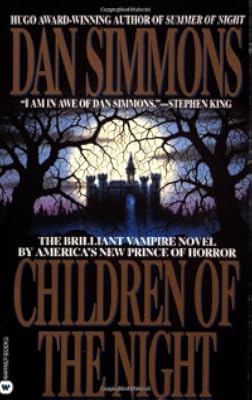
Children of the Night
by Dan Simmons
On This Page
Description
In a desolate orphanage in what remains of post-Communist Romania, a desperately ill infant is given the wrong blood transfusion - and flourishes when he's supposed to die. The discovery of his unique immune system may hold the key to the long-awaited cure for cancer and AIDS. For a dedicated American doctor, he promises the medical breakthrough of a lifetime, as well as a very special love she's never been able to find. But he also conceals a shockingly intimate link to a clan of vampires show more and their legendary leader - the fiend the world calls Vlad Dracula, who, for centuries, has triumphed over countless rival tyrants, including death itself... show lessTags
Recommendations










Member Reviews
This isn't the best book I've read. It's cheesy as hell. It's formulaic. I skip read over long sections of medical descriptions with my mind grinding out 'I don't carrrrre'. Then I skip read overly detailed action scenes because I honestly didn't care about a foot movement or the way that the pinkie finger laid on the bottom of the gun.
Where was the editor for this book? Did no one look at it and say, "Dude. No one cares about this medical shit. Let's talk about Vlad's life in the way back time a little more. That's interesting."
I am grateful that I can skip read. The book should have been good. It should have been a novelette. The main character should have been O'Rourke. He was interesting. Kate wasn't.
Kate was boring and she show more irritated the hell out of me. Her single minded callousness was awful. Especially in the way that she transitioned straight to "He's my son." No. He. Isn't. You took someone else's kid out of his homeland and culture to do medical experiments upon. Stop saying that he's your son. He isn't. Her ethics disturbed the hell out of me.
There's a real life reason that there are so many countries have stopped allowing the US to adopt out kids, no matter how destitute their conditions. Then these real life narcissists expect to be praised as a saviors. So much WTF. This book shows the delusion perfectly even though it wants to do the opposite. show less
Where was the editor for this book? Did no one look at it and say, "Dude. No one cares about this medical shit. Let's talk about Vlad's life in the way back time a little more. That's interesting."
I am grateful that I can skip read. The book should have been good. It should have been a novelette. The main character should have been O'Rourke. He was interesting. Kate wasn't.
Kate was boring and she show more irritated the hell out of me. Her single minded callousness was awful. Especially in the way that she transitioned straight to "He's my son." No. He. Isn't. You took someone else's kid out of his homeland and culture to do medical experiments upon. Stop saying that he's your son. He isn't. Her ethics disturbed the hell out of me.
There's a real life reason that there are so many countries have stopped allowing the US to adopt out kids, no matter how destitute their conditions. Then these real life narcissists expect to be praised as a saviors. So much WTF. This book shows the delusion perfectly even though it wants to do the opposite. show less
Please note: This review may contain spoilers! Read at your discretion.
On a humanitarian mission to aid Romanian orphans in post-Ceaucescu Romania, Kate wants to do more, and adopts one of her young charges. But when she returns to the US, her new son is kidnapped, and she finds herself fighting a centuries old evil.
Stuffed full of vampires and blood, defrocked priests and suitably heroic lady doctors, and loads of bullets and bombs, one can hardly call Children of the Night a boring read. But despite the blockbuster levels of violence and hunt-and-chases, and the inherent spookiness of evil villains with the power to rise from the dead, the most horrifying thing about this story for me was not the vampires. I mean, let’s face it, show more vampires are fictional constructs whereas the horrifying descriptions of living conditions in Romanian orphanages in the late eighties sound all too real.
I vaguely recall watching TV shockumentaries about the appalling conditions in which Romanian orphans often found themselves living, locked in cribs and cots by the hundreds, or sitting in groups of ten or twenty in rooms packed only with dirty mattresses. It seemed almost unimaginable to me that kids could be living in such conditions, unnoticed and unreported for years before the story finally broke. In a lot of ways, the suffering of those kids at the hands of ordinary human beings makes the vampires in this story seem almost insignificant. Why add scary monsters when the people charged with the care of those children, from the wardens and nurses to the government officials in charge of them, seem like monsters in their own right? And what makes it more horrifying is that these people were just ordinary human beings.
One thing I will say for this novel: it definitely made me want to learn more about life in Romania in the late eighties, shortly after Ceaucescu’s abrupt (and all-too-well-deserved, from the sounds of it) removal from office, if only to be able to sort fantasy from fact. Some story elements presented sound both heartless and all too pragmatic — like the refusal of entry to the United States for any adopted orphan/child infected with HIV. From a purely pragmatic standpoint, it sounds sensible: sick children require health care, which costs money. These kids were not born in the U.S. and therefore their health care costs should not the responsibility of the U.S. government. (And I’m using U.S. here because that’s the particular country with which Simmons’ heroine takes issue, not because I think any other relatively rich Western country would necessarily have behaved any better when it comes to the care of these orphans/children). The emotional argument, the fact that these kids are in desperate need of help, is completely overshadowed by the financial costs involved. This is horrifying in its own right, given that conventional wisdom has us mouthing off about how people cannot be valued in monetary terms. Apparently, this only holds true if you’re the right kind of people.
In terms of the story, I did not like the final twist in the tale, which I thought seriously weakened what had gone before. To me, it felt like Simmons had run out of steam when it came to the final act, and realized he still hadn’t dealt fully with various plot elements…so he opted for the simplest twist that might allow him to wrap things up more quickly.
In summary, then: Worth a read, but recommended only for those with strong stomachs and/or those who have an obsession with Dracula. show less
On a humanitarian mission to aid Romanian orphans in post-Ceaucescu Romania, Kate wants to do more, and adopts one of her young charges. But when she returns to the US, her new son is kidnapped, and she finds herself fighting a centuries old evil.
Stuffed full of vampires and blood, defrocked priests and suitably heroic lady doctors, and loads of bullets and bombs, one can hardly call Children of the Night a boring read. But despite the blockbuster levels of violence and hunt-and-chases, and the inherent spookiness of evil villains with the power to rise from the dead, the most horrifying thing about this story for me was not the vampires. I mean, let’s face it, show more vampires are fictional constructs whereas the horrifying descriptions of living conditions in Romanian orphanages in the late eighties sound all too real.
I vaguely recall watching TV shockumentaries about the appalling conditions in which Romanian orphans often found themselves living, locked in cribs and cots by the hundreds, or sitting in groups of ten or twenty in rooms packed only with dirty mattresses. It seemed almost unimaginable to me that kids could be living in such conditions, unnoticed and unreported for years before the story finally broke. In a lot of ways, the suffering of those kids at the hands of ordinary human beings makes the vampires in this story seem almost insignificant. Why add scary monsters when the people charged with the care of those children, from the wardens and nurses to the government officials in charge of them, seem like monsters in their own right? And what makes it more horrifying is that these people were just ordinary human beings.
One thing I will say for this novel: it definitely made me want to learn more about life in Romania in the late eighties, shortly after Ceaucescu’s abrupt (and all-too-well-deserved, from the sounds of it) removal from office, if only to be able to sort fantasy from fact. Some story elements presented sound both heartless and all too pragmatic — like the refusal of entry to the United States for any adopted orphan/child infected with HIV. From a purely pragmatic standpoint, it sounds sensible: sick children require health care, which costs money. These kids were not born in the U.S. and therefore their health care costs should not the responsibility of the U.S. government. (And I’m using U.S. here because that’s the particular country with which Simmons’ heroine takes issue, not because I think any other relatively rich Western country would necessarily have behaved any better when it comes to the care of these orphans/children). The emotional argument, the fact that these kids are in desperate need of help, is completely overshadowed by the financial costs involved. This is horrifying in its own right, given that conventional wisdom has us mouthing off about how people cannot be valued in monetary terms. Apparently, this only holds true if you’re the right kind of people.
In terms of the story, I did not like the final twist in the tale, which I thought seriously weakened what had gone before. To me, it felt like Simmons had run out of steam when it came to the final act, and realized he still hadn’t dealt fully with various plot elements…so he opted for the simplest twist that might allow him to wrap things up more quickly.
In summary, then: Worth a read, but recommended only for those with strong stomachs and/or those who have an obsession with Dracula. show less
Set in post-Ceausescu Romania, this unique take on vampirism was most definitely a yummy read. I have an avid interest in genetics and an even more avid interest in Vampires (notice I capitalize the word, 'cause they're that important!)...unless they sparkle/dazzle. Then I don't love them so much. What I enjoyed most about the book, aside from the obvious - the Vampires - was that it seems Simmons actually did some research. This is the first book by him that I've read, so I'm not certain if he's this thorough in all of his writing, but I was pleased that he didn't just throw a bunch of tripe together and call it good. A scientific explanation, and a believable one at that, for vampirism? Awesome! The characters were incredibly strong, show more well thought out, and admirable. You can relate to them as people, and I always love a book that allows me to like a character, even if I don't -like- the character. That said, though, I feel the ending was just a bit weak. Not weak in a way that left me groaning and rolling my eyes, but certainly not as powerful as the rest of the book. That did not detract from my enjoyment of the novel, however. At any rate...There's orphans, scientists, explosions, love, despair, hope and just a thoroughly engaging plot. Definitely a must read. show less
Dan Simmons is a great writer. Wonderful plots, with engaging characters. But he falls into that category of writer that really needs a stronger editor. His last several novels have all bulged at 700 pages or more, and with the exception of The Terror none of them should have been that long. I had hoped by going back to one of his earlier novels maybe I would get a less verbose and more streamlined book. I didn’t. Children of the Night was a fantastic idea, but one with a few flaws. Simmons crafts a interesting vampire tale set against the back drop of the fall of Ceausescu in Romania in the early 1990’s. He uses the plight of the orphanages (where Romanian children were abandoned in states of utter depravity) to propose two show more theories. First that Vlad Dracula was both still alive, and was somewhere between the historical person and Stoker’s fantasy. Secondly that the “disease” of vampirism is actually passed down as a defective mutation within the family and that its root mutation could actually give us a cure for HIV and other diseases.
But again Simmons needs a stronger editor. There are entire chapters that are clearly not needed and a romantic subplot that is unnecessary and distracting. Simmons also follows that horrible trend that seems to say a heroine, no matter how intelligent and assured, must be a complete idiot about men and fall into bed with just about everyone she meets. And that she must be saved by a man at every peril.
Unfortunately the strongest sections of the book are the chapters he dedicates to the memories of Vlad Dracula. Simmons there does a superb job blending the reality of Vlad with the fantasy of vampirism, offering a chilling yet very human monster. By the end I had wished he had written that book instead. show less
But again Simmons needs a stronger editor. There are entire chapters that are clearly not needed and a romantic subplot that is unnecessary and distracting. Simmons also follows that horrible trend that seems to say a heroine, no matter how intelligent and assured, must be a complete idiot about men and fall into bed with just about everyone she meets. And that she must be saved by a man at every peril.
Unfortunately the strongest sections of the book are the chapters he dedicates to the memories of Vlad Dracula. Simmons there does a superb job blending the reality of Vlad with the fantasy of vampirism, offering a chilling yet very human monster. By the end I had wished he had written that book instead. show less
Children of Night seem to be one of Dan Simmons' most movie-like books. While comparing Dan Simmons and Dan Brown may look like a heresy, the plot and its execution place this work more to the domain of slightly supernatural/slipstream "bronwesque" thrillers than among true horrors. However, where Dan Brown and other similar authors (including Bram Stoker, whom Simmons references both directly and indirectly) ignore facts, geography and history, Dan Simmons does not fail and delivers in a much better researched book.
Here's a book about vampires, in fact, Dracula himself is wandering around, 500 years old and tired of life. It's only third vampire book I can remember reading and it's old enough to have been written before vampire literature had been reduced to a joke by Meyer et al. Like one of the other vampire books I've read, My Name is Legion, vampirism is treated as a disease - in this case a rare genetic disease - not contagious at all. The details are carefully worked out and plausible to this not overly knowledgable-of-biology reader. Hence shelve under SF as well as horror.
Most of that horror comes from the reminiscences of Dracula who is treated as being the real historical Vlad Dracula. These memories come from the known facts of his show more life and are sickening in away that made up horrors aren't - because real people suffered in their thousands.
The book is a competent story, if a little predictable (I guessed most of the twists and revelations) but was slightly disappointing in that I am used to Simmons being much more ambitious. This tale is of the scope of A Winter Haunting rather than Hyperion Cantos, Ilium-Olympos, Drood or The Terror.
Bonus plus point: no spell-breaking lit.crit. essays! show less
Most of that horror comes from the reminiscences of Dracula who is treated as being the real historical Vlad Dracula. These memories come from the known facts of his show more life and are sickening in away that made up horrors aren't - because real people suffered in their thousands.
The book is a competent story, if a little predictable (I guessed most of the twists and revelations) but was slightly disappointing in that I am used to Simmons being much more ambitious. This tale is of the scope of A Winter Haunting rather than Hyperion Cantos, Ilium-Olympos, Drood or The Terror.
Bonus plus point: no spell-breaking lit.crit. essays! show less
George Ralph was the narrator. His abilities to use Eastern European accents such as Romanian, Budapest, etc., were very good, but he would forget during long passages to keep his accent going, and sometimes it would slip away and then come back. Otherwise he was very good.
I’m not exactly sure how this novel works in the three-book series Seasons of Horror, and I was terribly confused at the beginning of this novel because it had nothing to do with the third novel in the series, which I had accidentally read first last month. But it became fascinating as far as using science to describe vampirism and it’s effects on one baby named Joshua, and I was soon enthralled. And this novel kept me interested even with the really scientific show more medical jargon that was way over my head, throughout.
Unfortunately, after finishing this novel is seems that I have read the second novel (this novel) instead of the first, as I had intended. So I guess I’m working my way backwards, and will continue to do so since there is nothing else I can do. And since I’m enjoying them all, I don’t even care.
4 stars, and recommended. show less
I’m not exactly sure how this novel works in the three-book series Seasons of Horror, and I was terribly confused at the beginning of this novel because it had nothing to do with the third novel in the series, which I had accidentally read first last month. But it became fascinating as far as using science to describe vampirism and it’s effects on one baby named Joshua, and I was soon enthralled. And this novel kept me interested even with the really scientific show more medical jargon that was way over my head, throughout.
Unfortunately, after finishing this novel is seems that I have read the second novel (this novel) instead of the first, as I had intended. So I guess I’m working my way backwards, and will continue to do so since there is nothing else I can do. And since I’m enjoying them all, I don’t even care.
4 stars, and recommended. show less
Members
- Recently Added By
Lists

Books Read in 2014
2,343 works; 86 members

KayStJ's to-read list
1,616 works; 11 members

Horror: Creature Features
70 works; 9 members

Kate & Cheyanne's Horror Extravaganza
144 works; 6 members
Best Vampire & Werewolf Fiction
221 works; 146 members
Author Information

133+ Works 69,583 Members
Science fiction writer Dan Simmons was born in East Peoria, Illinois in 1948. He graduated from Wabash College in 1970 and received an M. A. from Washington University the following year. Simmons was an elementary school teacher and worked in the education field for a decade, including working to develop a gifted education program. His first show more successful short story was won a contest and was published in 1982. His first novel, Song of Kali, won a World Fantasy Award, and Simmons has also won a Theodore Sturgeon Award for short fiction, four Bram Stoker Awards, and eight Locus Awards. He is also the author of the Hyperion series, and Simmons and his work have been compared to Herbert's Dune and Asimov's Foundation series. (Bowker Author Biography) show less
Some Editions
Awards and Honors
Common Knowledge
- Canonical title
- Children of the Night
- Original title
- Children of the Night
- Original publication date
- 1992-07-01
- People/Characters
- Dracula; Vlad Dracul; Donna Wexler; Radu Fortuna; Aimslea; Michael O'Rourke (show all 10); Leonard Paxley; Lucien; Kate; Joshua
- Important places
- Transylvania, Romania
- Important events
- AIDS epidemic
- Dedication
- to the children
- First words
- We flew to Bucharest almost as soon as the shooting has stopped, landing at Otopeni Airport just after midnight on December 29, 1989.
- Last words
- (Click to show. Warning: May contain spoilers.)Perhaps I will live forever.
- Blurbers
- King, Stephen; Ellison, Harlan; Wilson, F. Paul
- Disambiguation notice
- Please distinguish between this Work of Dan Simmons' and the same- or similarly- titled works of David Stuart Davies, Gloria Naylor, and Jan Strnad. Thank you.
Classifications
Statistics
- Members
- 1,416
- Popularity
- 16,673
- Reviews
- 26
- Rating
- (3.42)
- Languages
- 10 — Czech, Danish, Dutch, English, Finnish, French, German, Italian, Polish, Swedish
- Media
- Paper, Audiobook, Ebook
- ISBNs
- 41
- ASINs
- 12