On This Page
Description
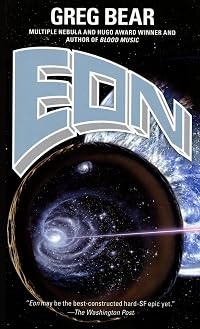
Perhaps it wasn't from our time; perhaps it wasn't even from our universe, but the arrival of the three-hundred-kilometer-long stone was the answer to humanity's desperate plea to end the threat of nuclear war. Inside the deep recesses of the stone lies Thistledown-the remnants of a human society versed in English, Russian, and Chinese. The artifacts of this familiar people foretell a great Death caused by the ravages of war, but the government and scientists are unable to decide how to use show more this knowledge. Deeper still within the stone is the Way. For some, the Way means salvation from death; for others, it is a parallel world where loved ones live again. But, unlike Thistledown, the Way is not entirely dead, and the inhabitants hold the knowledge of a present war, over a million miles away, using weapons far more deadly than any that mankind has ever conceived. show lessTags
Recommendations

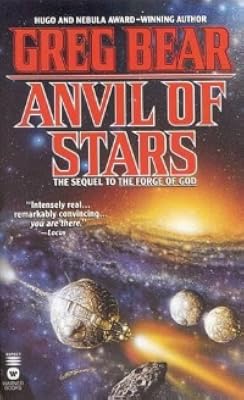
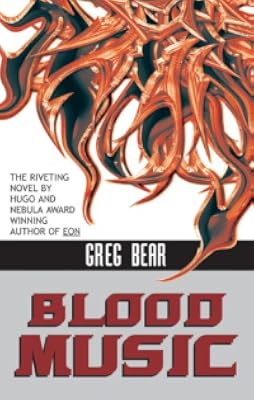
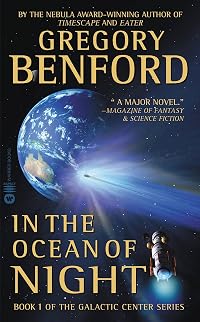
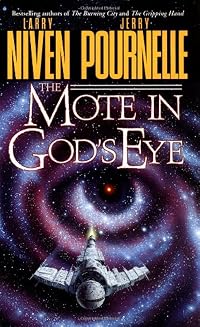

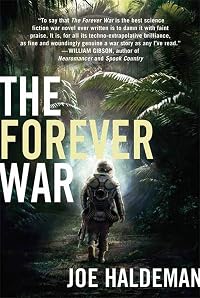
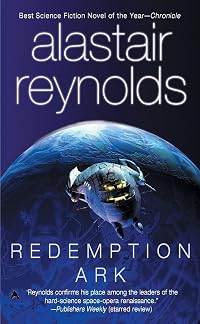
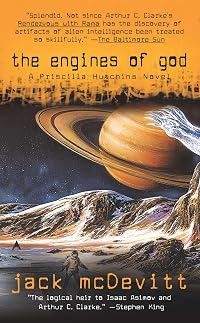
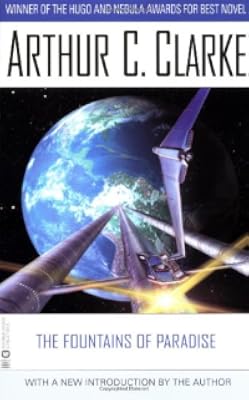
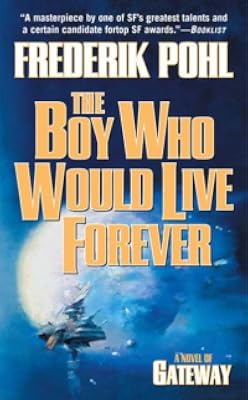
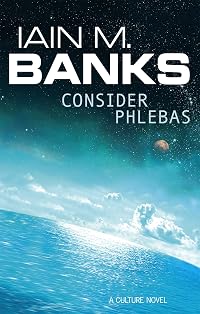
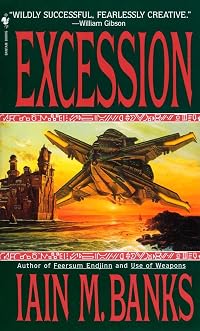
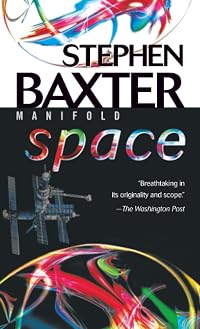

Member Recommendations
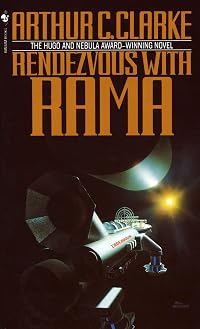
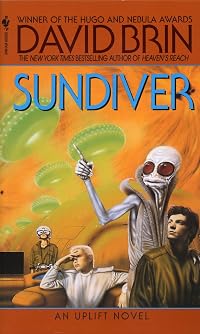
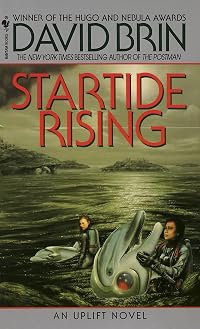
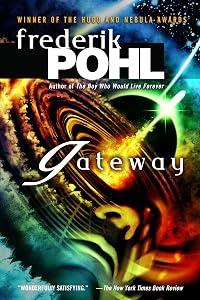
santhony The original, and still the best, of those science fiction tales centered upon huge, inter-stellar habitats.
61
santhony If you enjoy the science fiction genre featuring huge, interstellar habitats, this fits the bill.
31
santhony This behemoth of a trilogy is chock full of original, scientific theory and principles, including huge, sentient, space habitats.
Member Reviews
I love Big Dumb Object stories, and it's hard to resist gateway-to-multiverse passageways; it's no surprise I devoured this book when it first came out. I was in my mid-twenties and it seemed smart hard-SF as a genre was coming of age. The time was ripe for a revisit this summer.
There is a great BDO here, and a fairly rich puzzle-box involving the builders and their potential nature and needs. The set-up prepares the reader for a great trip. But. So, Bear is gifted at conceiving brilliant, large-scale ideas and wrapping them with conceptual breakthroughs; this is fact. But, much like Clarke before him, he paints watercolor characters and anchors to sociopolitical systems of quickly-dated structures and, like Niven, he buries the Sense show more of Wonder he tries to foster with imaginary-but-overexplained technologies and numbing technobabble. "Eon" suffers clearly from these weaknesses: it's difficult to feel for characters that are wireframes with specific job skills, and more words are used to describe devices that don't exist than to the actual motions people are taking within the scenery. While "Eon" really is dated in terms of the Cold War geopolitics and the social organization of the various teams involved, it is perhaps more dated in the advances that have occurred within published SF since 1985. Where characters, plot pacing, and use of language to immerse the reader are concerned, this reads much more like an Asimov novel from the 1950s than it does a comparable SF epic of the current day, like Tchaikovsky's "The Doors of Eden," Martine's "A Memory Called Empire," or Reynolds' "Revelation Space." It's still worth reading, but it's neither fresh nor particularly exciting show less
There is a great BDO here, and a fairly rich puzzle-box involving the builders and their potential nature and needs. The set-up prepares the reader for a great trip. But. So, Bear is gifted at conceiving brilliant, large-scale ideas and wrapping them with conceptual breakthroughs; this is fact. But, much like Clarke before him, he paints watercolor characters and anchors to sociopolitical systems of quickly-dated structures and, like Niven, he buries the Sense show more of Wonder he tries to foster with imaginary-but-overexplained technologies and numbing technobabble. "Eon" suffers clearly from these weaknesses: it's difficult to feel for characters that are wireframes with specific job skills, and more words are used to describe devices that don't exist than to the actual motions people are taking within the scenery. While "Eon" really is dated in terms of the Cold War geopolitics and the social organization of the various teams involved, it is perhaps more dated in the advances that have occurred within published SF since 1985. Where characters, plot pacing, and use of language to immerse the reader are concerned, this reads much more like an Asimov novel from the 1950s than it does a comparable SF epic of the current day, like Tchaikovsky's "The Doors of Eden," Martine's "A Memory Called Empire," or Reynolds' "Revelation Space." It's still worth reading, but it's neither fresh nor particularly exciting show less
In the near future, an immense hollowed-out asteroid has appeared in the solar system, slotting neatly into Earth orbit. The Stone, as it's called by the American explorers, has six habitable chambers in a classic O'Neill configuration, and two alarming mysteries. First, the seventh chamber is larger than the length the asteroid, stretching down an artificial linear singularity to unimaginable distances. Second, the Stone's derelict cities contain libraries with books published centuries ahead, and those histories say that in a few weeks, NATO and the USSR will start a nuclear war that kills billions. Can the explorers of the Stone figure out its mysteries in time to change history?
Bear's answer is a resounding "No". The bombs go off, show more billions die, and our heroes are unable to change fate. There's a great deal of realism as seen through the eyes of our primary heroes, mathematician Patricia Vasquez, the engineer and manager Lanier, and Soviet soldier Mirsky. But as the bombs fall, Deus descends from his machina: The post-human inhabitants of the Stone have moved millions of kilometers down the seventh chamber to Axis city, where they are divided into political camps matching a philosophical split going back to the millennial past (in their timeline) nuclear war, and a present plan to end their own war with the alien Jarts through turning their city into a super-weapon.
There's a lot of cool stuff, and some great retro Cold War paranoia. But I'm not sure the big ideas about the nature of the infinite tubular universe really click. And while I'm not yet in the camp of "Greg Bear can't write women", which some people reviewing Legacy said, the few sex scenes felt obligatory and weirdly fetishistic. show less
Bear's answer is a resounding "No". The bombs go off, show more billions die, and our heroes are unable to change fate. There's a great deal of realism as seen through the eyes of our primary heroes, mathematician Patricia Vasquez, the engineer and manager Lanier, and Soviet soldier Mirsky. But as the bombs fall, Deus descends from his machina: The post-human inhabitants of the Stone have moved millions of kilometers down the seventh chamber to Axis city, where they are divided into political camps matching a philosophical split going back to the millennial past (in their timeline) nuclear war, and a present plan to end their own war with the alien Jarts through turning their city into a super-weapon.
There's a lot of cool stuff, and some great retro Cold War paranoia. But I'm not sure the big ideas about the nature of the infinite tubular universe really click. And while I'm not yet in the camp of "Greg Bear can't write women", which some people reviewing Legacy said, the few sex scenes felt obligatory and weirdly fetishistic. show less
----------------------------------------------
I've been amazed at the number of readers that have been so underwhelmed by Eon. This astounding book was published in 1984 and did not anticipate the end of the Cold War, only half a decade away. Some say, with self-righteousness nurtured by hindsight, that this is a major flaw in this book. But most sleepwalking Americans, at the time, had no clue of the Eurasian (and Eastern European) realities of the times. This is not Greg Bear’s fault. It was, and is, the result of the political propaganda, still alive, fed to the public in large doses.
What is forgotten is that from the Cold War assumptions seen by the average, contemporary, 1984 world citizens--however blind to the evident show more realities of Russian/Soviet internal decay and near collapse—-the times still presented a very, very real global threat of planetary atomic annihilation. Some folks today, still argue that very similar, very real threats of atomic annihilation, fueled by other multi-polar realities (oil shortages, water shortages, cultural chauvinism, etc.), still exist and never really went away. And, for that reason alone, this book is still very contemporary.
In fact, one can intelligently argue that mankind is still very, very close to destroying itself in a number of frighteningly different ways.
The Cold War itself is immaterial to that threat of self-destruction.
The near collapse of mankind, in the very near future, is the premise of this book by Greg Bear.
This "Hard Science" Fiction, or "New Space Opera" speculates along the lines where mathematics and physics intersect with time and alternate realities. Greg Bear is not the superb master of characters and political speculation in which Ursula Le Guin's Left Hand of Darkness excels, nor is he a smooth story teller such as Ray Bradbury. But Greg Bear has followed the more traditional science fiction of Arthur C. Clarke. And on that path he excels.
But in Eon he goes past Arthur C. Clarke. He shows us who this guy, Greg Bear really is.
This book pulls the rug out from under the reader about 25% of the way into the reading; and I will not spoil that reality shift for you.
And then you are taken places you have never been. show less
I've been amazed at the number of readers that have been so underwhelmed by Eon. This astounding book was published in 1984 and did not anticipate the end of the Cold War, only half a decade away. Some say, with self-righteousness nurtured by hindsight, that this is a major flaw in this book. But most sleepwalking Americans, at the time, had no clue of the Eurasian (and Eastern European) realities of the times. This is not Greg Bear’s fault. It was, and is, the result of the political propaganda, still alive, fed to the public in large doses.
What is forgotten is that from the Cold War assumptions seen by the average, contemporary, 1984 world citizens--however blind to the evident show more realities of Russian/Soviet internal decay and near collapse—-the times still presented a very, very real global threat of planetary atomic annihilation. Some folks today, still argue that very similar, very real threats of atomic annihilation, fueled by other multi-polar realities (oil shortages, water shortages, cultural chauvinism, etc.), still exist and never really went away. And, for that reason alone, this book is still very contemporary.
In fact, one can intelligently argue that mankind is still very, very close to destroying itself in a number of frighteningly different ways.
The Cold War itself is immaterial to that threat of self-destruction.
The near collapse of mankind, in the very near future, is the premise of this book by Greg Bear.
This "Hard Science" Fiction, or "New Space Opera" speculates along the lines where mathematics and physics intersect with time and alternate realities. Greg Bear is not the superb master of characters and political speculation in which Ursula Le Guin's Left Hand of Darkness excels, nor is he a smooth story teller such as Ray Bradbury. But Greg Bear has followed the more traditional science fiction of Arthur C. Clarke. And on that path he excels.
But in Eon he goes past Arthur C. Clarke. He shows us who this guy, Greg Bear really is.
This book pulls the rug out from under the reader about 25% of the way into the reading; and I will not spoil that reality shift for you.
And then you are taken places you have never been. show less
The root idea (a Big Dumb Object circling in the vicinity of the Earth) might not be original but, the way Greg Bear deals with it certainly is. Carrying the tensions of the Cold War into space allows for a nice political touch, even if outdated (well, it's been written in 1985!). What's most interesting however is the science behind the Stone, with one of its chambers 'bigger from the inside than the outside'. Such architecture becomes then the main starting point to many plots and subplots unfolding within different kind of 'societies', all facing their own tensions, while revealing even more oddities as we go along. It's clever and packed with great ideas. The problem is, being hard on science and spending a lot of times describing show more the Stone and its-very-difficult-to-grab implications, it can be a burden to read. I am not into maths nor theoretical physics so, I had a lot of trouble sometimes picturing and understanding what was going on (to be fair, most of Bear's characters were as clueless as I was!). It's a nice piece of fiction but, at times far too complicated to be easily digested. show less
Warning: This review contains spoilers; but no worse than my copy of this book, which had a mammoth spoiler in the blurb...
This is a divided novel that sets off in various different directions and ends up in none of them. It is set in the extended Cold War period that never happened, in a future where the USA and the Soviets have extensive assets in low Earth orbit and on the Moon. A previously-unknown near-Earth asteroid is detected that then defies all the laws of physics by decelerating and taking up Earth orbit. It is explored and found to be hollow, and showing evidence of having been built by advanced humans from an alternate universe, who are no longer in residence.
And inside it is a chamber that goes on forever.
The novel follows show more a number of different characters: one of the US officials managing the process of exploring the artifact; a female mathematician who is recruited to the expedition (for what reason she cannot initially understand); a Soviet Spetnaz officer detailed to take part in a mission to seize the asteroid; and one of the inhabitants of the asteroid, embroiled in the politics of the human descendants of the asteroid's builders.
The novel starts out as a Cold War version of Clarke's Rendezvous with Rama; but once the plot reveal has been made, the focus changes and the events and worlds of the space-time corridor known as "the Way" become the major plot drivers, and even the outbreak of thermo-nuclear war on Earth doesn't change the focus very much. (Interestingly, although the novel takes place in a Cold War that never happened, I didn't find this too much of a problem; just as in the novel, the asteroid has come from an alternate reality, so it becomes easy to think of the action taking place in another, different alternate future...)
This is essentially a puzzle book, exploring the ideas behind constructing whole worlds out of the mathematical manipulation of space-time. Even the main characters are subservient to this plot; Patricia Vasquez, the mathematician, finds herself becoming more embroiled in the politics of the asteroid as it turns out that her alternate-reality version wrote the equations that allowed the Way to be brought into existence. The Way can be manipulated to open portals onto other worlds, and her aim is to open a portal in the Way onto an alternate Earth where the nuclear war never happened and her family are still alive. The other primary focus character is Pavel Mirsky, an officer in the Soviet strike force. He is examined in some detail, especially as he adapts to changing situations and has to work through conflict with both the (mainly) Americans occupying the asteroid and his own superiors, in the form not so much of his commanding officers but the Red Army Politruks (political officers) who have very different views to him over what needs to be done.
Oddly, what appears to be the main p.o.v. character, the American bureaucrat Garry Lanier, doesn't really engage with the plot and events in the way the other characters do; he is a sort of lens through which the action of the novel is viewed. And Olmy, the Way inhabitant, spends more of his time explaining the politics and history of the asteroid and his story and journey is not really explored in detail.
The Soviets are not entirely Central Casting Russkies, but they are very definitely split into Bad Russians (the Politruks) and Good Russians (everyone else). The picture of a post-Gorbachev Soviet Union bears little relationship to what we know happened, or even to what ambitions Gorbachev had for his country; but that was still very much a speculative subject when the book was written.
This is certainly a Big Dumb Object novel, but there's enough going on to keep the reader interested. This review is based on a re-reading that I did many years after I first read it; because the novel was spoiled for me on first reading by the spoiler in the blurb. I read the first half waiting to see how the reveal was done, and then rather rushed reading the second half which meant that I didn't really get the rest of it. This time, re-reading at a different pace and with twenty-odd years' more experience of sf, science and life generally, I got on much better with it. Not a book to be rushed.
(PS: I first reviewed this book with a one-sentence comment about the blurb spoiler, in 2008. Some kind soul flagged me for that. This review was written in 2015, so I'd like to think that at some point, it might get unflagged.) (2017: thanks for the unflagging!) show less
This is a divided novel that sets off in various different directions and ends up in none of them. It is set in the extended Cold War period that never happened, in a future where the USA and the Soviets have extensive assets in low Earth orbit and on the Moon. A previously-unknown near-Earth asteroid is detected that then defies all the laws of physics by decelerating and taking up Earth orbit. It is explored and found to be hollow, and showing evidence of having been built by advanced humans from an alternate universe, who are no longer in residence.
And inside it is a chamber that goes on forever.
The novel follows show more a number of different characters: one of the US officials managing the process of exploring the artifact; a female mathematician who is recruited to the expedition (for what reason she cannot initially understand); a Soviet Spetnaz officer detailed to take part in a mission to seize the asteroid; and one of the inhabitants of the asteroid, embroiled in the politics of the human descendants of the asteroid's builders.
The novel starts out as a Cold War version of Clarke's Rendezvous with Rama; but once the plot reveal has been made, the focus changes and the events and worlds of the space-time corridor known as "the Way" become the major plot drivers, and even the outbreak of thermo-nuclear war on Earth doesn't change the focus very much. (Interestingly, although the novel takes place in a Cold War that never happened, I didn't find this too much of a problem; just as in the novel, the asteroid has come from an alternate reality, so it becomes easy to think of the action taking place in another, different alternate future...)
This is essentially a puzzle book, exploring the ideas behind constructing whole worlds out of the mathematical manipulation of space-time. Even the main characters are subservient to this plot; Patricia Vasquez, the mathematician, finds herself becoming more embroiled in the politics of the asteroid as it turns out that her alternate-reality version wrote the equations that allowed the Way to be brought into existence. The Way can be manipulated to open portals onto other worlds, and her aim is to open a portal in the Way onto an alternate Earth where the nuclear war never happened and her family are still alive. The other primary focus character is Pavel Mirsky, an officer in the Soviet strike force. He is examined in some detail, especially as he adapts to changing situations and has to work through conflict with both the (mainly) Americans occupying the asteroid and his own superiors, in the form not so much of his commanding officers but the Red Army Politruks (political officers) who have very different views to him over what needs to be done.
Oddly, what appears to be the main p.o.v. character, the American bureaucrat Garry Lanier, doesn't really engage with the plot and events in the way the other characters do; he is a sort of lens through which the action of the novel is viewed. And Olmy, the Way inhabitant, spends more of his time explaining the politics and history of the asteroid and his story and journey is not really explored in detail.
The Soviets are not entirely Central Casting Russkies, but they are very definitely split into Bad Russians (the Politruks) and Good Russians (everyone else). The picture of a post-Gorbachev Soviet Union bears little relationship to what we know happened, or even to what ambitions Gorbachev had for his country; but that was still very much a speculative subject when the book was written.
This is certainly a Big Dumb Object novel, but there's enough going on to keep the reader interested. This review is based on a re-reading that I did many years after I first read it; because the novel was spoiled for me on first reading by the spoiler in the blurb. I read the first half waiting to see how the reveal was done, and then rather rushed reading the second half which meant that I didn't really get the rest of it. This time, re-reading at a different pace and with twenty-odd years' more experience of sf, science and life generally, I got on much better with it. Not a book to be rushed.
(PS: I first reviewed this book with a one-sentence comment about the blurb spoiler, in 2008. Some kind soul flagged me for that. This review was written in 2015, so I'd like to think that at some point, it might get unflagged.) (2017: thanks for the unflagging!) show less
A wild hard-science-fiction adventure in the mold of the old masters of the form, Bradbury, Asimov, Clarke, etc. It can be a bit difficult to get into the flow of a third-person omniscient point of view which is increasingly rare. There are some quibbles with some of the unexpected character motivations, obligatory 80s sci-fi unnecessary sex scenes that include some of the most awkwardly written passages I've read, and a plot that feels like two halves that are deeply disjointed. Once the human characters meet up with the inhabitants of the space ship they find themselves in, the novel changes gears abruptly, and the concerns of those characters you've been following and the direction you thought this novel of exploration and wonder show more would take all evaporate in the presence of a new protagonist and the world they inhabit. The ending is not a happy one, in general, but it felt earned. show less
The first few chapters had a good setup going, I was interested. Then as the book progressed it unraveled a little at a time. I am a hard sci fi fan, but not when the author gets so into explaining the science that you lose the story. The characters seemed pretty vanilla and because I could really care less about what happened to them what should of been a roller coaster was more like going through a stamp collecting museum.
Members
- Recently Added By
Lists

S.F. Masterworks (Complete)
229 works; 15 members

Arthur C. Clarke Award Winners and Shortlisted Books
219 works; 14 members

Schisms in transhumanity - SF
34 works; 1 member

SF Masterworks
193 works; 8 members
Talk Discussions
Past Discussions
SiFi, portal, two symultaneous earth futures in Name that Book (June 2013)
Author Information

141+ Works 47,171 Members
Greg Bear was born in San Diego, California, on August 20, 1951. He received a Bachelor of Arts degree from San Diego State University in 1973. At age 14, he began submitting pieces to magazines and at 15 he sold his first story to Robert Lowndes' Famous Science Fiction. It would be five years before he sold another piece, but by 23 he was selling show more stories regularly. He has written more than 30 science fiction and fantasy books and has won numerous awards for his work. In 1984, Hardfought and Blood Music won the Nebula Awards for best novella and novelette; Blood Music went on to win the Hugo Award. The novel version of that story, also called Blood Music, won the Prix Apollo in France. In 1987, Tangents won the Hugo and Nebula awards for best short story. He also won a Nebula in 1994 for Moving Mars and in 2001 for Darwin's Radio. Both Dinosaur Summer and Darwin's Radio have been awarded the Endeavour for best novel published by a Northwest science fiction author. He is also an illustrator and his work has appeared in Galaxy, Fantasy and Science Fiction, and Vertex, and in both hardcover and paperback books. He was a founding member of ASFA, the Association of Science Fiction Artists. His works include City at the End of Time, Hull Zero Three, The Mongoliad, Mariposa, Halo: Cryptum, Halo: Primordium and Halo: Silentium. (Bowker Author Biography) show less
Some Editions
Awards and Honors
Awards
Series


Belongs to Publisher Series
Work Relationships
Is contained in
Common Knowledge
- Canonical title
- Eon
- Original title
- Eon
- Original publication date
- 1985-08
- People/Characters
- Patricia Vasquez; Ralph Nader
- Important places
- Thistledown; The Way; Axis City; New York, New York, USA; Podlipki Airfield, Moscow, USSR; Santa Barbara, California, USA
- Important events
- The Death
- Epigraph
- L'envoi: "Unless you know where you are, you don't know who you are." --Wendell Barry
- Dedication
- For Poul and Karen with much appreciation and love.
- First words
- "It's going into a wide elliptical Earth orbit," Judith Hoffman said.
- Last words
- (Click to show. Warning: May contain spoilers.)"How wonderful..."
- Original language
- English
Classifications
Statistics
- Members
- 4,397
- Popularity
- 3,386
- Reviews
- 68
- Rating
- (3.68)
- Languages
- 13 — Czech, Dutch, English, Finnish, French, German, Italian, Lithuanian, Polish, Romanian, Croatian, Spanish, Swedish
- Media
- Paper, Audiobook, Ebook
- ISBNs
- 41
- ASINs
- 20