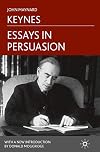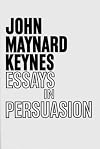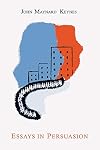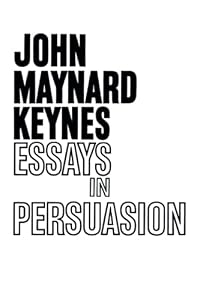
Essays in Persuasion
by John Maynard Keynes
On This Page
Description
This reissue of the authoritative Royal Economic Society edition of Essays in Persuasion features a new introduction by Donald Moggridge, which discusses the significance of this definitive work. The essays in this volume show Keynes' attempts to influence the course of events by public persuasion over the period of 1919-40.Tags
Recommendations










Member Reviews
A series of thirty-odd essays on economics. Topics range from the gold standard to how bad the Versailles treaty was to the first cogent explanations of deficit spending and the multiplier effect. Keynes' essays are also very clear, precise, and even witty, a rare breed in economics.
Although these positions are now some eighty years old, it is remarkable to see how many of them hold up - most notably, criticism of austerity after the Great Depression. If people are more inclined to save, then less money is spent. The less money is spent, the less products and services are demanded. Not to mention social nets and massive economic losses for the unemployed.
Although these positions are now some eighty years old, it is remarkable to see how many of them hold up - most notably, criticism of austerity after the Great Depression. If people are more inclined to save, then less money is spent. The less money is spent, the less products and services are demanded. Not to mention social nets and massive economic losses for the unemployed.
Peter Keller, president of polling company YouGov has chosen to discuss John Maynard Keynes's Essays in Persuasion, on FiveBooks as one of the top five on his subject - British Democracy, saying that:
"Every essay is readable and compelling. This volume spans the aftermath of the First World War and his assault on the Versailles Treaty and the damage it was going to cause – as it did, because in humiliating Germany it led, arguably, to Germany choosing Adolf Hitler – right through to the 1920s and 30s and the arguments over the gold standard, through some of the essays he wrote in preparation for his General Theory, right to his writing on how to pay for the Second World War.”
The full interview is available here: show more target="_top">http://five-books.com/interviews/Peter-Kellner show less
"Every essay is readable and compelling. This volume spans the aftermath of the First World War and his assault on the Versailles Treaty and the damage it was going to cause – as it did, because in humiliating Germany it led, arguably, to Germany choosing Adolf Hitler – right through to the 1920s and 30s and the arguments over the gold standard, through some of the essays he wrote in preparation for his General Theory, right to his writing on how to pay for the Second World War.”
The full interview is available here: show more target="_top">http://five-books.com/interviews/Peter-Kellner show less
Ratings
Members
- Recently Added By
Lists

Books cited in Progress by Samuel McDonald
160 works; 1 member
Author Information

97+ Works 4,035 Members
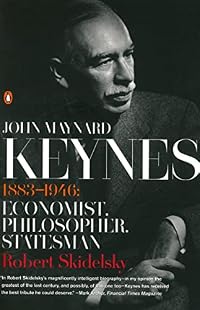
John Maynard Keynes, an English economist, is regarded as the most important and influential economist of the twentieth century, if not of all time. A brilliant child, he wrestled with the economic meaning of interest before he was 5 years old. He excelled both as a student and as a member of the debating team at Eton. His reputation at King's show more College at Cambridge University was such that he was invited to weekly breakfasts with economist A. C. Pigou, and even Alfred Marshall begged him to become a professional economist. He was elected president of the Union, the most important nongovernmental debating society in the world, and his close friends included the intellectual members of the Bloomsbury group. Keynes was described as a phenomenon---and all of this took place before he graduated from Cambridge. After graduating in 1905, Keynes took a civil service post in India. Bored with his job, he resigned and returned to Cambridge to teach. In 1912 he assumed the editorship of the Economic Journal, the leading journal in Britain at the time, continuing in the post for 33 years. His first major book, Indian Currency and Finance (1913), was an immediate success. He took part in the Paris Peace Conference as a representative of the Treasury. Later he held several other government advisory posts, served as a director of the Bank of England, and was president of an insurance company. In addition, Keynes was a noted patron of the arts and married the most beautiful and popular ballerina of his era. As if this weren't enough, he managed to amass a small fortune by investing in stocks and foreign currencies in his spare time. At the Paris Peace Conference, Keynes became so dismayed by the harsh terms imposed on Germany in the Treaty of Versailles that he resigned in anger several days before the treaty was signed. He then wrote The Economic Consequences of the Peace (1919), which outlined the folly of the treaty. Being a man of many interests, Keynes next took a brief break from economics to publish A Treatise on Probability (1921), which Bertrand Russell (see Vols. 4 and 5) described as "impossible to praise too highly." Keynes's A Tract on Monetary Reform (1923) was a rather technical book that questioned the value of the gold standard over a managed paper currency. A Treatise on Money (1930), which explored the business cycle, was followed by Essays in Persuasion (1931) and Essays in Biography (1933). The General Theory of Employment, Interest and Money, published in 1936, was Keynes's crowning achievement, and it took the world by storm. According to Keynes, the economy could be thought of as being divided into consumer, investment (or business), government, and foreign sectors. This was hardly a novel idea, but Keynes went on to postulate the exact nature of expenditures in each sector, especially the spending patterns of the consumer sector, which he portrayed by using a graph he called a "consumption function." He reasoned that fluctuations in total economic activity could be traced to instability in the business sector, which had a multiplier effect on the rest of the economy. The relationship specified in The General Theory were tantalizing to economists, because they could be tested and empirically verified. Subsequent research largely confirmed Keynes's propositions. Soon governments, including that of the United States, began to develop a set of national income accounts to provide estimates of gross national product and national income. The General Theory was also popular because it offered policy prescriptions to help deal with the problems of depression, recession, and unemployment. Today the term "Keynesian" is used to describe individuals or policies that use taxation and government spending to affect aggregate economic performance. (Bowker Author Biography) show less
Series
Belongs to Publisher Series
Common Knowledge
- Canonical title
- Essays in Persuasion
- Alternate titles
- The Collected Writings of John Maynard Keynes: Vol.9, Essays in Persuasion
Classifications
- Genres
- Economics, Nonfiction, General Nonfiction, History, Business
- DDC/MDS
- 330.904 — Society, Government, and Culture Economics Jobs & Careers Economic geography and history Standard subdivisions and By Period 20th Century
- LCC
- HC57 .K45 — Social sciences Economic history and conditions Economic history and conditions
- BISAC
Statistics
- Members
- 318
- Popularity
- 99,879
- Reviews
- 2
- Rating
- (3.97)
- Languages
- English, French, Italian, Spanish
- Media
- Paper, Ebook
- ISBNs
- 30
- ASINs
- 9