On This Page
Description
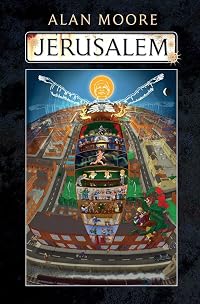
Fierce in its imagining and stupefying in its scope, Jerusalem is the tale of everything, told from a vanished gutter. In the epic novel Jerusalem, Alan Moore channels both the ecstatic visions of William Blake and the theoretical physics of Albert Einstein through the hardscrabble streets and alleys of his hometown of Northampton, UK. In the half a square mile of decay and demolition that was England's Saxon capital, eternity is loitering between the firetrap housing projects. Embedded in show more the grubby amber of the district's narrative among its saints, kings, prostitutes, and derelicts, a different kind of human time is happening, a soiled simultaneity that does not differentiate between the petrol-colored puddles and the fractured dreams of those who navigate them. Employing, a kaleidoscope of literary forms and styles that ranges from brutal social realism to extravagant children's fantasy, from the modern stage drama to the extremes of science fiction, Jerusalem's dizzyingly rich cast of characters includes the living, the dead, the celestial, and the infernal in an intricately woven tapestry that presents a vision of an absolute and timeless human reality in all of its exquisite, comical, and heartbreaking splendor. In these pages lurk demons from the second-century Book of Tobit and angels with golden blood who reduce fate to a snooker tournament. Vagrants, prostitutes, and ghosts rub shoulders with Oliver Cromwell, Samuel Beckett, James Joyce's tragic daughter Lucia, and Buffalo Bill, among many others. There is a conversation in the thunderstruck dome of St. Paul's Cathedral, childbirth on the cobblestones of Lambeth Walk, an estranged couple sitting all night on the cold steps of a Gothic church front, and an infant choking on a cough drop for eleven chapters. An art exhibition is in preparation, and above the world a naked old man and a beautiful dead baby race along the Attics of the Breath toward the heat death of the universe. An opulent mythology for those without a pot to piss in, through the labyrinthine streets and pages of Jerusalem tread ghosts that sing of wealth, poverty, and our threadbare millennium. They discuss English as a visionary language from John Bunyan to James Joyce, hold forth on the illusion of mortality post-Einstein, and insist upon the meanest slum as Blake's eternal holy city.. show less
Tags
Recommendations


Member Reviews
Alan Moore's new novel - only his second "real" novel, if you discount things like Watchmen, V For Vendetta, From Hell and all those things that are Just Comic Books - is 1266 pages long, in three volumes, and took him ten years to write. It spans from the ice age to the end of the world. It has dozens, maybe hundreds, of POV characters, fictional or real, living or dead. It switches styles with almost every chapter and jumps from highbrow literary games to furious politics, from kitchen-sink realism to pure fantasy, and more than once all of those at the same time.
Alan Moore's new novel takes place over two days - 26 and 27 May 2006 - in what remains of Northampton's old working-class quarters after the demolitions in the sixties, a show more community reduced to hopelessness, where a man is going to an exhibit of paintings his sisters based on something he may have dreamed as a kid, while a young crack whore in one of the other houses is about to finally lose her grip on life once and for all. They're the POV characters.
Yes, in some of its many, many dimensions, Jerusalem is a simple story, a love letter to Moore's home town and a raised middle finger to everything it's put up with since the Romans, but he takes the scenic route there. James Joyce once said that if Dublin were destroyed, you could recreate it based on the detail in Ulysses. Moore took that to heart, except he's not happy with just capturing Northampton on that one day; cities are living creatures, and people, buildings and ideas that disappeared ages ago still leave traces. So he has to tell the story in four dimensions, time and space, reality and dreams. He has to pull in angels (sorry, angles - four dimensions, remember?) and devils, fires and invasions, New Labour and theodicy, creativity and madness, moral responsibility in a world without free will ("Did you miss it?"), death and immortality until he's included EVERYTHING. And all these stories that he weaves together, like a giant snooker game where every ricochet changes the whole game and every ball is worth just as many points. This long line of characters from all ages and situations, who at first have nothing in common but the fact that they happen to live (or not, as the case may be) in The Boroughs, the oldest part of the old Saxon capital, which nobody (at least according to Moore) gives two shits about as long as they don't bother the people outside.
Her point is that despite the very real continuing abuses born of anti-Semitism, born of racism and sexism and homophobia, there are MPs and leaders who are female, Jewish, black or gay. There are none who are poor. There never have been, and there never will be. Every decade since society’s inception has been witness to a holocaust of paupers, so enormous and perpetual that it has become wallpaper, unnoticed, unreported.
And man, he does it so well. He pulls in real people from Oliver Cromwell to Charlie Chaplin to his own friends and family and mix them up with his own ideas. He writes in paraphrases, palimpsests, tesseracts. He spins on his heels from slapstick to essays. He commandeers other books and surfs on the backs of Milton, Blake, Clare, Carroll, Joyce, Beckett and forces them to go where he wants them to. He switches POV and time period in almost every chapter, and yet every chapter somehow builds on the previous one, takes up its ideas and gives them another twist. He challenges his readers with half-chapter infodumps and trilingual puns, but he never forgets to reward them for it. The most extreme case being "Round the Bend", the chapter told from the POV of James Joyce's schizophrenic daughter Lucia, living out her life trapped both in a mental hospital and in her beloved father's genius, communicating in Finnegasque:
Mighnd knot awer canseeusness hedself, uniffable ter sceeintestic scrupiny, beau a fairnuminon o’ far timersions datas foundedself contrained wittin a merdel blody end um werlt doutwit a’peer ta hove baret’ree?
Lucia penders willshe skirps alonge. Perhopes fearsum afuss, owr foursomality is consciantly outtempting to expierce itsolve inalys farfoold glarey, esperever luccinfer thort beond, thort quarner iff ourrizen dattiset wrytangles wideehighther fhree. Theos ophus howcan nevagaet disctern succinctfully wellbe estymdust bairds ound purwits, waile daiz aveers huer nit sloadroept undare taclin un meanoeuthert’ing illbe consigndered luciatics ar slimpery faals. A’curse, dorados eywool bay parcived as buth pohetic an dewrenched.
That whole chapter is an incredible feat, with a language that tells at least two or three stories at the same time while still developing and furthering the story at large, even if those 50 pages take me a whole week to get through. And he compensates by turning all of book 2 into basically one long YA fantasy story about a gang of kids (albeit undead kids with centuries of experience) travelling through time hunting a secret, and if he'd published those chapters on their own he'd have made Neil Gaiman weep blood.
And yet no part of this stands stronger on its own than together, because it's all parts of a whole. It all matters, which turns the book into its own metaphor. Sure, I'm not going to deny that there are the occasional longeurs in all those pages, and sure, his use of sexual violence for character development is a bit... comic book-y, and sure, it's hard to shake the feeling that more than one or two characters here are basically Moore himself. But fuck all that, because Jerusalem is such a magnificently total novel. There's ridiculous amounts of detail, but he uses it all - if someone sees a dog turd on page 300 you can be sure someone will have dogshit on their shoes 800 pages later, and that it'll matter. There many styles, but he can handle them. There are many characters, but they all get their space. It's a book borne by holy wrath but is so playful, so imaginative, so full of ideas and humanity that even after almost 1,300 pages I'm still pretty sure it still has stories to tell. show less
Alan Moore's new novel takes place over two days - 26 and 27 May 2006 - in what remains of Northampton's old working-class quarters after the demolitions in the sixties, a show more community reduced to hopelessness, where a man is going to an exhibit of paintings his sisters based on something he may have dreamed as a kid, while a young crack whore in one of the other houses is about to finally lose her grip on life once and for all. They're the POV characters.
Yes, in some of its many, many dimensions, Jerusalem is a simple story, a love letter to Moore's home town and a raised middle finger to everything it's put up with since the Romans, but he takes the scenic route there. James Joyce once said that if Dublin were destroyed, you could recreate it based on the detail in Ulysses. Moore took that to heart, except he's not happy with just capturing Northampton on that one day; cities are living creatures, and people, buildings and ideas that disappeared ages ago still leave traces. So he has to tell the story in four dimensions, time and space, reality and dreams. He has to pull in angels (sorry, angles - four dimensions, remember?) and devils, fires and invasions, New Labour and theodicy, creativity and madness, moral responsibility in a world without free will ("Did you miss it?"), death and immortality until he's included EVERYTHING. And all these stories that he weaves together, like a giant snooker game where every ricochet changes the whole game and every ball is worth just as many points. This long line of characters from all ages and situations, who at first have nothing in common but the fact that they happen to live (or not, as the case may be) in The Boroughs, the oldest part of the old Saxon capital, which nobody (at least according to Moore) gives two shits about as long as they don't bother the people outside.
Her point is that despite the very real continuing abuses born of anti-Semitism, born of racism and sexism and homophobia, there are MPs and leaders who are female, Jewish, black or gay. There are none who are poor. There never have been, and there never will be. Every decade since society’s inception has been witness to a holocaust of paupers, so enormous and perpetual that it has become wallpaper, unnoticed, unreported.
And man, he does it so well. He pulls in real people from Oliver Cromwell to Charlie Chaplin to his own friends and family and mix them up with his own ideas. He writes in paraphrases, palimpsests, tesseracts. He spins on his heels from slapstick to essays. He commandeers other books and surfs on the backs of Milton, Blake, Clare, Carroll, Joyce, Beckett and forces them to go where he wants them to. He switches POV and time period in almost every chapter, and yet every chapter somehow builds on the previous one, takes up its ideas and gives them another twist. He challenges his readers with half-chapter infodumps and trilingual puns, but he never forgets to reward them for it. The most extreme case being "Round the Bend", the chapter told from the POV of James Joyce's schizophrenic daughter Lucia, living out her life trapped both in a mental hospital and in her beloved father's genius, communicating in Finnegasque:
Mighnd knot awer canseeusness hedself, uniffable ter sceeintestic scrupiny, beau a fairnuminon o’ far timersions datas foundedself contrained wittin a merdel blody end um werlt doutwit a’peer ta hove baret’ree?
Lucia penders willshe skirps alonge. Perhopes fearsum afuss, owr foursomality is consciantly outtempting to expierce itsolve inalys farfoold glarey, esperever luccinfer thort beond, thort quarner iff ourrizen dattiset wrytangles wideehighther fhree. Theos ophus howcan nevagaet disctern succinctfully wellbe estymdust bairds ound purwits, waile daiz aveers huer nit sloadroept undare taclin un meanoeuthert’ing illbe consigndered luciatics ar slimpery faals. A’curse, dorados eywool bay parcived as buth pohetic an dewrenched.
That whole chapter is an incredible feat, with a language that tells at least two or three stories at the same time while still developing and furthering the story at large, even if those 50 pages take me a whole week to get through. And he compensates by turning all of book 2 into basically one long YA fantasy story about a gang of kids (albeit undead kids with centuries of experience) travelling through time hunting a secret, and if he'd published those chapters on their own he'd have made Neil Gaiman weep blood.
And yet no part of this stands stronger on its own than together, because it's all parts of a whole. It all matters, which turns the book into its own metaphor. Sure, I'm not going to deny that there are the occasional longeurs in all those pages, and sure, his use of sexual violence for character development is a bit... comic book-y, and sure, it's hard to shake the feeling that more than one or two characters here are basically Moore himself. But fuck all that, because Jerusalem is such a magnificently total novel. There's ridiculous amounts of detail, but he uses it all - if someone sees a dog turd on page 300 you can be sure someone will have dogshit on their shoes 800 pages later, and that it'll matter. There many styles, but he can handle them. There are many characters, but they all get their space. It's a book borne by holy wrath but is so playful, so imaginative, so full of ideas and humanity that even after almost 1,300 pages I'm still pretty sure it still has stories to tell. show less
Three-quarters of the way into Alan Moore's 1,266-page novel Jerusalem, where Moore unveils his Grand Theory of Life, Death, Time, the Universe, and the History of Albion, and I just don’t know what else Moore can do to top this. Moore’s place in the literary canon (notice I didn’t write “graphic novel canon”) is, for me, unassailable, but a book like Watchmen only hints at the sheer intellectual excess and ambition of Jerusalem. From Hell (my favorite), Promethea, and Voice of the Fire, Jerusalem’s clearest predecessor, come the closest.
Jerusalem is a monument to Moore’s mindbogglingly prodigious imagination, whether he’s describing “history” or creating a new world. (I put “history” in quotation marks for a show more reason.) Indeed, it’s Jerusalem's anchoring in historical reality (or, an existing philosophical / religious framework — think of Promethea's Sophie Bangs and her exploration of the Major Arcana and the Kabbalah) that paradoxically makes the novel even more believable. The wealth of research allows the reader to better imagine this fantastical universe "on top" of the “real” one. (I put “on top” and “real” in quotation marks for a reason too, but I need to stop.)
Bunyan, Milton, Blake, Edward Abbott's Flatland, the Lesser Key of Solomon, The Wire, and the history of England (specifically Northampton): they’re all part of the blizzard of references Moore throws at you. But on my phone I can easily look up the Battle of Naseby, or Charlie Chaplin’s bio — and people unknown to me (or most ordinary readers?) like John Clare, Philip Doddridge, John Newton, or Ogden Whitney — and discover that some of the liberties that Alan Moore takes aren’t so far-fetched after all. Well, maybe except what he does with Dusty Springfield. (It’s easy to get sidetracked when reading, but I think Moore would have annotated this thing if he could, but that would add another hundred pages.)
And the detail isn't just historical, it even describes current reality: You can follow the characters’ wanderings around Northampton on Google Street View and actually see the very details of the buildings he’s describing — including, yes, THAT DOOR. (Just go up Chalk Lane and click one or two times and turn to your right facing the Castle Hill United Reformed Church.)
And by god, these chapters. There’s a chapter in verse. There’s a chapter that’s written as a play, a little riff on Waiting for Godot — but with more characters, including Samuel Beckett and Thomas Becket. There’s a chapter that’s written in noirish purple prose, from the perspective of a failed actor who imagines himself as a gumshoe as he digs through a library. (An aside to historians: this chapter wonderfully captures the thrill of digging through the archives such as this chapter, which in essence is a history of the Gothic to goth, from obscure Northampton clergyman James Hervey to David J from Bauhaus. You just need to trust Moore on this one.)
There’s even a chapter ("Rough Sleepers") I had to read three times to figure out what was going on — the second because I had to stop halfway and re-read because of some small revelation, then a third because of yet another clue that made me reinterpret what I had just read. (You only begin to understand for sure about 300 pages later.) My favorite chapter involves shuttling back and forth between a fitful sleeper wandering inside his head and — to quote the press release, "a naked old man and a beautiful dead baby” — on a journey to the end of the universe. And almost all of it is rendered in glorious prose; there are delightful turns of phrase on every page.
And then, on page 884, just when you think you’re in the homestretch, Moore smacks you with a chapter told from the perspective of an asylum patient, Lucia Joyce (daughter of James and Nora Barnacle), and the whole thing is straight out of Finnegans Wake, a dream-like pastiche of all multilingual puns and portmanteaus, riverrunning past Eve and Adam’s for almost 50 freaking pages and
[Three weeks later]
Well, it was a busy time, and the US elections also happened. But those were surely the longest 50 pages I’d ever read — it’s a slog, it’s a sympathetic portrait, it’s hilarious, and it’s filthy and disturbing in all sorts of ways.
The stylistic variations are part of showmanship, certainly — but not in a David Foster Wallace trawl through the OED-sort of way where footnotes have footnotes. Jerusalem features more of a goofily overwritten and playful kind of virtuosity.
There are, however, some more barriers to entry, other than the nagging feeling you'd appreciate the book more if you'd read in advance Bunyan, Milton, Blake, etc., and it’s also why I can’t just give the book a wholehearted five stars. Some reasons, small and large, below:
Trivial, but still: The tiny, tiny print to accommodate over 600,000 words. I can’t imagine Alan Moore, who’s almost two decades older than me, can actually read his own book. And if eyestrain wasn’t enough, I hope the readers who buy the hardcover version — because it looks great on a bookshelf, naturally — do their bicep curls before they tackle this book. They certainly wouldn’t want it to fall on their faces if they read lying down in bed.
W.W. Norton’s blurb for the book talks about how “an infant choking on a cough drop for eleven chapters,” which is quite inaccurate. (That’s like saying Breaking Bad is about a high-school chemistry teacher dying of cancer for 62 episodes.) But I’ve read less mention of the fact there’s a sickeningly explicit scene of sexual violence that goes on for pages, not counting the various humiliations Joyce experiences in her chapter. Dammit, Alan Moore — I know it’s supposed to be horrifying, but it’s one small reason why I can’t give your book five stars.
Narrative. At page 200-something, Moore is still introducing characters, with little semblance of narrative propulsion; people come and go and it’s not clear if they’ll ever return. I started to flag at this point. Remember how A Game of Thrones begins, with chapters and chapters of new characters and families and allegiances and you can barely catch up? I at least had faith they’d all meet up, or would at least be aware of each other’s existence, but that’s not the case with Jerusalem. I wondered if this was going to be a novel of linked stories instead. The chapters are indeed linked, other than the setting, but merely through hints, or slipped references to non-events that occurred hundreds of pages earlier. Yes, it’s hard to keep track.
Indeed, the plot doesn't really get rolling until page 380-something, involving an almost entirely different cast of characters -- but holy cow does Moore kick it into high gear. The long, superb middle section is itself reminiscent of an Enid Blyton Famous Five children’s book, where every episode is a Case or an Adventure, but juggling several time periods, sometimes within a paragraph.
This isn’t really a problem — I loved all those whale chapters in Moby-Dick that seemed to stop the story dead — but your experience might vary.
Structure. Like Mark E. Smith (not from Northampton), I dig repetition, but a bunch of the chapters employ the same framework: characters walking across (or above, or through) the same streets, at different points in time (sometimes within the same paragraph!), and musing about the changes in the neighborhood. (Moore uses this peripatetic structure to frame different philosophical and historical debates in From Hell.) Cumulatively the result is a comprehensive and detailed portrait of the Boroughs and its denizens across / through / along the centuries, but these chapters don’t hide the fact that the narrative isn’t really pushed forward, despite all the walking. (I’m tempted to see if the different chapters are somehow roughly analogous to the eighteen chapters of Ulysses, but I see myself falling into a rabbit hole.)
Voice. His characters are necessarily alive and human (be patient with me here): they wake up, they fart, they piss, they roll spliffs, they wave hello, they dodge dog turds in the street. But good lord, Moore’s cranky philosophizing voice keeps bursting through. It’s one thing if it’s a grouchy community activist musing about the 2008 financial crisis and the history of money in England (a great chapter, by the way), or a middle-aged artist puttering about in her studio, but another if it's a 10-year old girl. I suppose they’re all stand-ins for Moore in one way or another, but at times their function as mere vehicles for scholarly arguments, or Moore’s musings on gentrification become a little too obvious.
To boil down Jerusalem to a summary of the narrative would be to spoil the delicious confusion in which the reader finds herself for dozens, if not hundreds, of pages, so I won’t. If I were to provide a single image that serves as a key, it’s the moment in From Hell when Sir William Withey Gull, walking through Victorian London, turns a corner and — well, I’ll just call it a collision with modernity. I can think of no other moment in all my graphic novel reading that knocked me back like that one — and Jerusalem is in essence an exploration of that moment.
It’s an historical treatise, a ghost story, an urban travelogue, a children's adventure book. It’s science fiction, it’s fantasy, it’s a philosophical disquisition on the nature of time, free will, and the purpose of art. It’s all of the above. It’s also maddening and indulgent and brilliant and possibly insane. show less
Jerusalem is a monument to Moore’s mindbogglingly prodigious imagination, whether he’s describing “history” or creating a new world. (I put “history” in quotation marks for a show more reason.) Indeed, it’s Jerusalem's anchoring in historical reality (or, an existing philosophical / religious framework — think of Promethea's Sophie Bangs and her exploration of the Major Arcana and the Kabbalah) that paradoxically makes the novel even more believable. The wealth of research allows the reader to better imagine this fantastical universe "on top" of the “real” one. (I put “on top” and “real” in quotation marks for a reason too, but I need to stop.)
Bunyan, Milton, Blake, Edward Abbott's Flatland, the Lesser Key of Solomon, The Wire, and the history of England (specifically Northampton): they’re all part of the blizzard of references Moore throws at you. But on my phone I can easily look up the Battle of Naseby, or Charlie Chaplin’s bio — and people unknown to me (or most ordinary readers?) like John Clare, Philip Doddridge, John Newton, or Ogden Whitney — and discover that some of the liberties that Alan Moore takes aren’t so far-fetched after all. Well, maybe except what he does with Dusty Springfield. (It’s easy to get sidetracked when reading, but I think Moore would have annotated this thing if he could, but that would add another hundred pages.)
And the detail isn't just historical, it even describes current reality: You can follow the characters’ wanderings around Northampton on Google Street View and actually see the very details of the buildings he’s describing — including, yes, THAT DOOR. (Just go up Chalk Lane and click one or two times and turn to your right facing the Castle Hill United Reformed Church.)
And by god, these chapters. There’s a chapter in verse. There’s a chapter that’s written as a play, a little riff on Waiting for Godot — but with more characters, including Samuel Beckett and Thomas Becket. There’s a chapter that’s written in noirish purple prose, from the perspective of a failed actor who imagines himself as a gumshoe as he digs through a library. (An aside to historians: this chapter wonderfully captures the thrill of digging through the archives such as this chapter, which in essence is a history of the Gothic to goth, from obscure Northampton clergyman James Hervey to David J from Bauhaus. You just need to trust Moore on this one.)
There’s even a chapter ("Rough Sleepers") I had to read three times to figure out what was going on — the second because I had to stop halfway and re-read because of some small revelation, then a third because of yet another clue that made me reinterpret what I had just read. (You only begin to understand for sure about 300 pages later.) My favorite chapter involves shuttling back and forth between a fitful sleeper wandering inside his head and — to quote the press release, "a naked old man and a beautiful dead baby” — on a journey to the end of the universe. And almost all of it is rendered in glorious prose; there are delightful turns of phrase on every page.
And then, on page 884, just when you think you’re in the homestretch, Moore smacks you with a chapter told from the perspective of an asylum patient, Lucia Joyce (daughter of James and Nora Barnacle), and the whole thing is straight out of Finnegans Wake, a dream-like pastiche of all multilingual puns and portmanteaus, riverrunning past Eve and Adam’s for almost 50 freaking pages and
[Three weeks later]
Well, it was a busy time, and the US elections also happened. But those were surely the longest 50 pages I’d ever read — it’s a slog, it’s a sympathetic portrait, it’s hilarious, and it’s filthy and disturbing in all sorts of ways.
The stylistic variations are part of showmanship, certainly — but not in a David Foster Wallace trawl through the OED-sort of way where footnotes have footnotes. Jerusalem features more of a goofily overwritten and playful kind of virtuosity.
There are, however, some more barriers to entry, other than the nagging feeling you'd appreciate the book more if you'd read in advance Bunyan, Milton, Blake, etc., and it’s also why I can’t just give the book a wholehearted five stars. Some reasons, small and large, below:
Trivial, but still: The tiny, tiny print to accommodate over 600,000 words. I can’t imagine Alan Moore, who’s almost two decades older than me, can actually read his own book. And if eyestrain wasn’t enough, I hope the readers who buy the hardcover version — because it looks great on a bookshelf, naturally — do their bicep curls before they tackle this book. They certainly wouldn’t want it to fall on their faces if they read lying down in bed.
W.W. Norton’s blurb for the book talks about how “an infant choking on a cough drop for eleven chapters,” which is quite inaccurate. (That’s like saying Breaking Bad is about a high-school chemistry teacher dying of cancer for 62 episodes.) But I’ve read less mention of the fact there’s a sickeningly explicit scene of sexual violence that goes on for pages, not counting the various humiliations Joyce experiences in her chapter. Dammit, Alan Moore — I know it’s supposed to be horrifying, but it’s one small reason why I can’t give your book five stars.
Narrative. At page 200-something, Moore is still introducing characters, with little semblance of narrative propulsion; people come and go and it’s not clear if they’ll ever return. I started to flag at this point. Remember how A Game of Thrones begins, with chapters and chapters of new characters and families and allegiances and you can barely catch up? I at least had faith they’d all meet up, or would at least be aware of each other’s existence, but that’s not the case with Jerusalem. I wondered if this was going to be a novel of linked stories instead. The chapters are indeed linked, other than the setting, but merely through hints, or slipped references to non-events that occurred hundreds of pages earlier. Yes, it’s hard to keep track.
Indeed, the plot doesn't really get rolling until page 380-something, involving an almost entirely different cast of characters -- but holy cow does Moore kick it into high gear. The long, superb middle section is itself reminiscent of an Enid Blyton Famous Five children’s book, where every episode is a Case or an Adventure, but juggling several time periods, sometimes within a paragraph.
This isn’t really a problem — I loved all those whale chapters in Moby-Dick that seemed to stop the story dead — but your experience might vary.
Structure. Like Mark E. Smith (not from Northampton), I dig repetition, but a bunch of the chapters employ the same framework: characters walking across (or above, or through) the same streets, at different points in time (sometimes within the same paragraph!), and musing about the changes in the neighborhood. (Moore uses this peripatetic structure to frame different philosophical and historical debates in From Hell.) Cumulatively the result is a comprehensive and detailed portrait of the Boroughs and its denizens across / through / along the centuries, but these chapters don’t hide the fact that the narrative isn’t really pushed forward, despite all the walking. (I’m tempted to see if the different chapters are somehow roughly analogous to the eighteen chapters of Ulysses, but I see myself falling into a rabbit hole.)
Voice. His characters are necessarily alive and human (be patient with me here): they wake up, they fart, they piss, they roll spliffs, they wave hello, they dodge dog turds in the street. But good lord, Moore’s cranky philosophizing voice keeps bursting through. It’s one thing if it’s a grouchy community activist musing about the 2008 financial crisis and the history of money in England (a great chapter, by the way), or a middle-aged artist puttering about in her studio, but another if it's a 10-year old girl. I suppose they’re all stand-ins for Moore in one way or another, but at times their function as mere vehicles for scholarly arguments, or Moore’s musings on gentrification become a little too obvious.
To boil down Jerusalem to a summary of the narrative would be to spoil the delicious confusion in which the reader finds herself for dozens, if not hundreds, of pages, so I won’t. If I were to provide a single image that serves as a key, it’s the moment in From Hell when Sir William Withey Gull, walking through Victorian London, turns a corner and — well, I’ll just call it a collision with modernity. I can think of no other moment in all my graphic novel reading that knocked me back like that one — and Jerusalem is in essence an exploration of that moment.
It’s an historical treatise, a ghost story, an urban travelogue, a children's adventure book. It’s science fiction, it’s fantasy, it’s a philosophical disquisition on the nature of time, free will, and the purpose of art. It’s all of the above. It’s also maddening and indulgent and brilliant and possibly insane. show less
The greatest challenge about reviewing Jerusalem by Alan Moore is summarizing what it's about. This isn't a traditional novel and it doesn't deliver a normal story. The plot is meandering, almost vestigial in some sections. Setting is paramount—language, tone, atmosphere, characters: all of these matter far more than mere plot.
I've come to think of this book as being akin to the Bayeux Tapestry—a sprawling and artistically audacious account of a place and its people. It's a love letter to a neighborhood as only Moore can write it.
In general terms, it's a quasi-fictional history of the Boroughs—the poverty-stricken Northampton neighborhood in England where Alan Moore was born, raised, and still lives—from ancient times through show more the near future, not told in chronological order, and actively eschewing the concept of linear narrative. It's the story of a unique family who lives there through several generations, and various persons associated with them. It's a story of the afterlife and eternity and the Universe. It's a story about life and death, art and work, obligation and free will, ghosts and angles and builders and demons. Visions and dreams are as real in this world as reality.
If I had to categorize this book, I'd probably call it fantastical realism. Everyone is going to shelve it in their SF sections. But it's more than just these—it's philosophical, historical, political, religious.
It's holy and profane, poetic and pedestrian, beautiful and gritty. It's deeply human. It's hard to explain. You really need to read it.
Alan Moore is famous as one of the most accomplished and lauded comic book writers in history. As much as anyone, he elevated illustrated storytelling formats to the level of robust literature.
Graphic novels and comic books present some severe restrictions for a writer: you're fundamentally limited in the number of words you can fit in a panel and on the page. Words must leave room for images, and both must work together to reveal the characters and tell the story. A good comic book writer must be economical and disciplined.
Novels, by contrast, present far fewer structural restrictions to a writer. Clearly, the shackles are off in this book and Moore revels in the freedom.
His writing is frequently rather indulgent—he clearly loves words and uses a lot of them. At times, there’s a strong temptation to adjudicate it as undisciplined. But when you consider how carefully he crafted the structure of the work; his facility with changing voice, tone, and style, and how appropriately; and the sheer dedication and effort demanded of creating a work like this—the thought that any aspect of it might be undisciplined becomes laughable. Florid and prolix, yes, but intentional and specifically crafted.
The writing in Jerusalem is breathtaking. I can't overstate how gorgeous it is. I have to use all the overblown descriptors I can think of to describe it: it soars, it wallows, it trudges, it gallops, it sings and shrieks and shouts and cries and grunts and moans and groans and howls and speaks in tongues. It's astounding.
I had no idea Moore could write like this. Nothing in his graphic works prepared me for the sheer mastery of language on display here. It's a stunning accomplishment. This may actually be a literary work for the ages.
The scope of the work is boggling: not merely in terms of length and word count, but the timeline and setting, as well. It covers all of history, and explodes a narrow British neighborhood into a diorama of the whole Universe and eternity. Moore's knowledge of history is deep and he draws connections between things that many of us miss. The concepts at play here are inventive: his vision of the afterlife is unlike any I've come across.
It's well informed and hugely imaginative. This work is best described as visionary.
Moore's character development, as always, is stellar. All of the people in this book are individual and believable, all possess a tremendous depth of detail, and all ground the world of the novel in the reality of human existence. He has inherent compassion for the characters he writes and that makes it easy for the reader to step into their shoes, to experience the story through their perspectives, and understand what it's like to live in the world of this book.
Jerusalem is brilliant. It's powerful. I think it might even be important.
Which is why it's odd that I really didn't like it at first.
It's clear early on that this book is masterfully written but I found it difficult to get into. The first third of it slid past without anything that hooked me. The language is beautiful but none of it stuck, the characters are relatable but I felt no passion for any of them. I kept looking for a story and not finding one. I would read a sentence, a paragraph, a page or two or three, and realize that none of it had registered with me. The ink on the pages hit my eyes but didn't land in my consciousness, and I'd have to go back and reread passages—sometimes more than once—before they finally stayed put in my head.
The first part of the novel didn't capture me the way Moore's comics always did. I didn't care about it the way I always cared about the characters and stories in his graphic works. That threw me off, as I came to this novel expecting to care.
I wondered if by casting off the restrictions of the graphic format, Moore was over-indulging in the freedom of the novel. At first, it seemed like a lack of discipline and I wondered if this meant that he lost something essential as a storyteller.
It made for quite a frustrating reading experience. Between the density of the text and me not caring all that much, I could only manage a pace of 50 pages every couple of hours, and only a couple of hours reading the book each day. Progress was slow and I frequently questioned whether it was worth this much work. It demands a great deal of effort and I found myself resenting that—I didn't see that it gave me enough rewards to warrant such demands. I came **this** close to giving up several times.
I'm glad I didn't give up on it. Because after I slogged through the first half of the novel, a switch flipped in my head and the experience transformed. All at once, reading it became a deeply rewarding experience. All at once, the work became genuinely important to me. It took over 600 pages, but I learned to love this book.
It begins with a Prelude, which... honestly, left me very confused as to what this book was trying to do. It's dissociative, difficult to navigate, and somewhat frustrating. That being said, it's also exceptionally well written and compellingly atmospheric. It does the important work of introducing the two central characters, who are unique and fascinating people, and establishing the setting and tone.
Book One presents a series of semi-related vignettes—chapters which function like short stories—focusing on a variety of individuals in the Boroughs and which jump randomly between different time periods. Not all of these vignettes relate to each other in obvious ways, and not all are about members of the family most central to the book as a whole. This section felt unfocused, tossing the reader around too much, and I still couldn't tell what Moore was trying to accomplish. Again, his stylistic mastery is obvious and impressive, especially the way he changes his voice in each chapter to fit the character, the time period, the setting. He displays a tremendous range and command of language.
The middle section of the novel (Book Two, which occupies most of the book) is a coherent sequential narrative, focusing on a single group of characters as they proceed through a single story thread. It's the only part of the book which functions more-or-less as you expect a novel to function. It's in this section that Moore's larger purpose begins to reveal itself, as all the bits and pieces from Book One's vignettes come together to form a general body of knowledge necessary to understand the world and events of the middle section. It unfolds much of what the Prelude only hints at.
The fourth section (Book Three) returns to the semi-random, semi-related vignette structure that characterized Book One, only with far more stylistic variation: one chapter has no punctuation, one is written in verse, one is written as a stage play, etc. If Book One is where Moore lays his foundation, and Book two is where he tells the important story, Book Three is where he indulges his desire to play with language. This time it was easier for me to handle—knowing how Book One related to Book Two, I could see how each chapter in Book Three fit with the rest of the work. It also echoes the structure of Book One and thus bookends the novel nicely. Mostly, though, I was conditioned by this point to believe that any frustrations and challenges would be worth the effort.
The Afterlude... doesn't really tie things up as one might expect or want. On the other hand, a neat and tidy tying up of all the plot threads would undermine the depth and substance of this work—simply put, that's not the point and far too pedestrian to suit Moore's taste. The Afterlude summarizes everything that came before through a unique lens and reveals the result of what was set up in the Prelude. As a summary, it's a bit on-the-nose and not as profound as the rest of the work. As a bookend with the Prelude, however, it's entirely appropriate.
The whole book is built on the concept of structural mirroring but it's done subtly, ultimately generating a sense of balance without calling attention to itself until such attention serves a good purpose. Like every aspect of this work, it testifies to Moore's mastery and command.
As odd as this structure is, each and every piece of this book contributes something necessary to the tale—whether it's to establish setting, mood, or tone; to introduce characters and concepts; to propel the momentum of the narrative; or to tie characters, events, and places together—many of the stories presented throughout the novel feature the same characters passing through them, or cover the same events from different characters' perspectives. There's nothing extraneous here, although the role of each section isn't always clear as you read it. It all works together to weave a tapestry of a place and people across time.
There's a section in the first chapter of Book Three ("Clouds Unfold", on page 840 in the ARC I read) in which a first-person narrator describes what it's like for a reader to read a strange and unique book. It's uncanny in how well this passage describes my experience of reading Jerusalem up to that point. It's one of a few such self-referential sections which testify to how masterful this novel is. My mind boggles at how much work he put into the structure of this tale. Moore understands exactly how every part functions and it all works exactly as he intends.
It's not a novel which functions the way a reader expects it to, however. It needs time to work itself into your consciousness, to stew in your subconscious until it's ready to let you see its true heart. To fully appreciate what it's doing, you need to change what you expect of it, alter how your mind relates to it. You need to surrender your attempts to control the reading process and let the book take over. It slowly reprograms your understanding, recalibrates your thought patterns—it turns you into the kind of reader it needs you to be, without you even being aware of it. This process takes time and you don't realize it's happening until it's done.
The danger with this kind of work is that, for a good portion of its length, the book feels like too much work for too little reward. The one criticism I would level is that this process takes too long.
But once that switch flips, it's a grand and glorious experience.
And then, just when everything is smooth sailing, when you've been in a comfortable groove with the text for a couple of hundred pages...
Moore decides to frustrate you all over again. You work so hard to get through Books One and Two, to get to the point where you finally understand how to read this book properly, and he rewards you with the third chapter of Book Three, "Round the Bend", which ranks as one of the single most challenging pieces of writing I've read in my entire life. It's akin to a runner finally hitting their stride on a long and grueling course, only to then come onto a muddy, slippery expanse of steep slopes and tight corners and trip hazards. It makes you want to throw the book across the room and curse his name. I won't tell you why it's so frustrating, which might be mean of me, but I think Moore intended for it to hit you this way and I don't want to spoil that effect.
The "Round the Bend" chapter is 48 pages long in the ARC I read. In total, it took me between four and five hours to read it. It is readable—just very, very challenging. I almost gave up on it no fewer than three separate times, I wanted so badly to skip this chapter entirely.
I forced myself to get through the first ten or so pages of "Round the Bend" and then I had to set the book down and walk away from it. I was too frustrated to keep going. I didn't come back to it for a month and half. I finally gave myself a full weekend to finish it, and finish it I did.
It's beautiful. It's the most transcendent and uplifting section of the entire opus.
The "Round the Bend" chapter of Book Three is an excellent microcosm of Jerusalem as a whole: It's challenging and frustrating and it demands far too much effort from the reader than it has a right to ask. But if you stick with it, there's a moment about halfway through when something clicks in your head, when you get the trick of reading it, and the rest flows along almost like normal. Once you get that trick, the language unfolds and blossoms in your understanding, and reveals itself to be lush and immensely rewarding.
Like Jerusalem as a whole, it boggles my mind to consider the sheer amount of work that went into writing "Round the Bend". It's masterful to a degree that's stunning. As much effort as Moore demands of the reader, he clearly demanded far more of himself to craft a chapter like this, a book like this.
Jerusalem isn't forgiving. It's not easy and it's not necessarily fun. Even after the switch flips and you finally figure out how to read it properly, even after you finally find a flow, Moore still trips you up and throws you for a loop. This novel is confounding and frustrating. You have to trust that all the pieces of it will come together in their own time—and that trust is often challenged.
It's worth it. This book demands a lot of work, but that work is fully rewarded. It just takes an act of faith to get to the point where the rewards begin to reveal themselves.
Put that way, it's entirely appropriate and yet another example of how deeply masterful this work is. In their review, Library Journal concluded that Jerusalem is "[m]ore of a work of art than a novel". I think that's the best summary possible. show less
I've come to think of this book as being akin to the Bayeux Tapestry—a sprawling and artistically audacious account of a place and its people. It's a love letter to a neighborhood as only Moore can write it.
In general terms, it's a quasi-fictional history of the Boroughs—the poverty-stricken Northampton neighborhood in England where Alan Moore was born, raised, and still lives—from ancient times through show more the near future, not told in chronological order, and actively eschewing the concept of linear narrative. It's the story of a unique family who lives there through several generations, and various persons associated with them. It's a story of the afterlife and eternity and the Universe. It's a story about life and death, art and work, obligation and free will, ghosts and angles and builders and demons. Visions and dreams are as real in this world as reality.
If I had to categorize this book, I'd probably call it fantastical realism. Everyone is going to shelve it in their SF sections. But it's more than just these—it's philosophical, historical, political, religious.
It's holy and profane, poetic and pedestrian, beautiful and gritty. It's deeply human. It's hard to explain. You really need to read it.
Alan Moore is famous as one of the most accomplished and lauded comic book writers in history. As much as anyone, he elevated illustrated storytelling formats to the level of robust literature.
Graphic novels and comic books present some severe restrictions for a writer: you're fundamentally limited in the number of words you can fit in a panel and on the page. Words must leave room for images, and both must work together to reveal the characters and tell the story. A good comic book writer must be economical and disciplined.
Novels, by contrast, present far fewer structural restrictions to a writer. Clearly, the shackles are off in this book and Moore revels in the freedom.
His writing is frequently rather indulgent—he clearly loves words and uses a lot of them. At times, there’s a strong temptation to adjudicate it as undisciplined. But when you consider how carefully he crafted the structure of the work; his facility with changing voice, tone, and style, and how appropriately; and the sheer dedication and effort demanded of creating a work like this—the thought that any aspect of it might be undisciplined becomes laughable. Florid and prolix, yes, but intentional and specifically crafted.
The writing in Jerusalem is breathtaking. I can't overstate how gorgeous it is. I have to use all the overblown descriptors I can think of to describe it: it soars, it wallows, it trudges, it gallops, it sings and shrieks and shouts and cries and grunts and moans and groans and howls and speaks in tongues. It's astounding.
I had no idea Moore could write like this. Nothing in his graphic works prepared me for the sheer mastery of language on display here. It's a stunning accomplishment. This may actually be a literary work for the ages.
The scope of the work is boggling: not merely in terms of length and word count, but the timeline and setting, as well. It covers all of history, and explodes a narrow British neighborhood into a diorama of the whole Universe and eternity. Moore's knowledge of history is deep and he draws connections between things that many of us miss. The concepts at play here are inventive: his vision of the afterlife is unlike any I've come across.
It's well informed and hugely imaginative. This work is best described as visionary.
Moore's character development, as always, is stellar. All of the people in this book are individual and believable, all possess a tremendous depth of detail, and all ground the world of the novel in the reality of human existence. He has inherent compassion for the characters he writes and that makes it easy for the reader to step into their shoes, to experience the story through their perspectives, and understand what it's like to live in the world of this book.
Jerusalem is brilliant. It's powerful. I think it might even be important.
Which is why it's odd that I really didn't like it at first.
It's clear early on that this book is masterfully written but I found it difficult to get into. The first third of it slid past without anything that hooked me. The language is beautiful but none of it stuck, the characters are relatable but I felt no passion for any of them. I kept looking for a story and not finding one. I would read a sentence, a paragraph, a page or two or three, and realize that none of it had registered with me. The ink on the pages hit my eyes but didn't land in my consciousness, and I'd have to go back and reread passages—sometimes more than once—before they finally stayed put in my head.
The first part of the novel didn't capture me the way Moore's comics always did. I didn't care about it the way I always cared about the characters and stories in his graphic works. That threw me off, as I came to this novel expecting to care.
I wondered if by casting off the restrictions of the graphic format, Moore was over-indulging in the freedom of the novel. At first, it seemed like a lack of discipline and I wondered if this meant that he lost something essential as a storyteller.
It made for quite a frustrating reading experience. Between the density of the text and me not caring all that much, I could only manage a pace of 50 pages every couple of hours, and only a couple of hours reading the book each day. Progress was slow and I frequently questioned whether it was worth this much work. It demands a great deal of effort and I found myself resenting that—I didn't see that it gave me enough rewards to warrant such demands. I came **this** close to giving up several times.
I'm glad I didn't give up on it. Because after I slogged through the first half of the novel, a switch flipped in my head and the experience transformed. All at once, reading it became a deeply rewarding experience. All at once, the work became genuinely important to me. It took over 600 pages, but I learned to love this book.
It begins with a Prelude, which... honestly, left me very confused as to what this book was trying to do. It's dissociative, difficult to navigate, and somewhat frustrating. That being said, it's also exceptionally well written and compellingly atmospheric. It does the important work of introducing the two central characters, who are unique and fascinating people, and establishing the setting and tone.
Book One presents a series of semi-related vignettes—chapters which function like short stories—focusing on a variety of individuals in the Boroughs and which jump randomly between different time periods. Not all of these vignettes relate to each other in obvious ways, and not all are about members of the family most central to the book as a whole. This section felt unfocused, tossing the reader around too much, and I still couldn't tell what Moore was trying to accomplish. Again, his stylistic mastery is obvious and impressive, especially the way he changes his voice in each chapter to fit the character, the time period, the setting. He displays a tremendous range and command of language.
The middle section of the novel (Book Two, which occupies most of the book) is a coherent sequential narrative, focusing on a single group of characters as they proceed through a single story thread. It's the only part of the book which functions more-or-less as you expect a novel to function. It's in this section that Moore's larger purpose begins to reveal itself, as all the bits and pieces from Book One's vignettes come together to form a general body of knowledge necessary to understand the world and events of the middle section. It unfolds much of what the Prelude only hints at.
The fourth section (Book Three) returns to the semi-random, semi-related vignette structure that characterized Book One, only with far more stylistic variation: one chapter has no punctuation, one is written in verse, one is written as a stage play, etc. If Book One is where Moore lays his foundation, and Book two is where he tells the important story, Book Three is where he indulges his desire to play with language. This time it was easier for me to handle—knowing how Book One related to Book Two, I could see how each chapter in Book Three fit with the rest of the work. It also echoes the structure of Book One and thus bookends the novel nicely. Mostly, though, I was conditioned by this point to believe that any frustrations and challenges would be worth the effort.
The Afterlude... doesn't really tie things up as one might expect or want. On the other hand, a neat and tidy tying up of all the plot threads would undermine the depth and substance of this work—simply put, that's not the point and far too pedestrian to suit Moore's taste. The Afterlude summarizes everything that came before through a unique lens and reveals the result of what was set up in the Prelude. As a summary, it's a bit on-the-nose and not as profound as the rest of the work. As a bookend with the Prelude, however, it's entirely appropriate.
The whole book is built on the concept of structural mirroring but it's done subtly, ultimately generating a sense of balance without calling attention to itself until such attention serves a good purpose. Like every aspect of this work, it testifies to Moore's mastery and command.
As odd as this structure is, each and every piece of this book contributes something necessary to the tale—whether it's to establish setting, mood, or tone; to introduce characters and concepts; to propel the momentum of the narrative; or to tie characters, events, and places together—many of the stories presented throughout the novel feature the same characters passing through them, or cover the same events from different characters' perspectives. There's nothing extraneous here, although the role of each section isn't always clear as you read it. It all works together to weave a tapestry of a place and people across time.
There's a section in the first chapter of Book Three ("Clouds Unfold", on page 840 in the ARC I read) in which a first-person narrator describes what it's like for a reader to read a strange and unique book. It's uncanny in how well this passage describes my experience of reading Jerusalem up to that point. It's one of a few such self-referential sections which testify to how masterful this novel is. My mind boggles at how much work he put into the structure of this tale. Moore understands exactly how every part functions and it all works exactly as he intends.
It's not a novel which functions the way a reader expects it to, however. It needs time to work itself into your consciousness, to stew in your subconscious until it's ready to let you see its true heart. To fully appreciate what it's doing, you need to change what you expect of it, alter how your mind relates to it. You need to surrender your attempts to control the reading process and let the book take over. It slowly reprograms your understanding, recalibrates your thought patterns—it turns you into the kind of reader it needs you to be, without you even being aware of it. This process takes time and you don't realize it's happening until it's done.
The danger with this kind of work is that, for a good portion of its length, the book feels like too much work for too little reward. The one criticism I would level is that this process takes too long.
But once that switch flips, it's a grand and glorious experience.
And then, just when everything is smooth sailing, when you've been in a comfortable groove with the text for a couple of hundred pages...
Moore decides to frustrate you all over again. You work so hard to get through Books One and Two, to get to the point where you finally understand how to read this book properly, and he rewards you with the third chapter of Book Three, "Round the Bend", which ranks as one of the single most challenging pieces of writing I've read in my entire life. It's akin to a runner finally hitting their stride on a long and grueling course, only to then come onto a muddy, slippery expanse of steep slopes and tight corners and trip hazards. It makes you want to throw the book across the room and curse his name. I won't tell you why it's so frustrating, which might be mean of me, but I think Moore intended for it to hit you this way and I don't want to spoil that effect.
The "Round the Bend" chapter is 48 pages long in the ARC I read. In total, it took me between four and five hours to read it. It is readable—just very, very challenging. I almost gave up on it no fewer than three separate times, I wanted so badly to skip this chapter entirely.
I forced myself to get through the first ten or so pages of "Round the Bend" and then I had to set the book down and walk away from it. I was too frustrated to keep going. I didn't come back to it for a month and half. I finally gave myself a full weekend to finish it, and finish it I did.
It's beautiful. It's the most transcendent and uplifting section of the entire opus.
The "Round the Bend" chapter of Book Three is an excellent microcosm of Jerusalem as a whole: It's challenging and frustrating and it demands far too much effort from the reader than it has a right to ask. But if you stick with it, there's a moment about halfway through when something clicks in your head, when you get the trick of reading it, and the rest flows along almost like normal. Once you get that trick, the language unfolds and blossoms in your understanding, and reveals itself to be lush and immensely rewarding.
Like Jerusalem as a whole, it boggles my mind to consider the sheer amount of work that went into writing "Round the Bend". It's masterful to a degree that's stunning. As much effort as Moore demands of the reader, he clearly demanded far more of himself to craft a chapter like this, a book like this.
Jerusalem isn't forgiving. It's not easy and it's not necessarily fun. Even after the switch flips and you finally figure out how to read it properly, even after you finally find a flow, Moore still trips you up and throws you for a loop. This novel is confounding and frustrating. You have to trust that all the pieces of it will come together in their own time—and that trust is often challenged.
It's worth it. This book demands a lot of work, but that work is fully rewarded. It just takes an act of faith to get to the point where the rewards begin to reveal themselves.
Put that way, it's entirely appropriate and yet another example of how deeply masterful this work is. In their review, Library Journal concluded that Jerusalem is "[m]ore of a work of art than a novel". I think that's the best summary possible. show less
This being from the mind of Alan Moore, there are no moralities dished out in regards to sex, God, culture, and politics, but there is, however, strong elements of graphic novels, fables, Anarchy, sexuality, lingual twists and reactions against boredom.
Where language is concerned, Moore makes it clear from the start that this novel will take some turns, which he's not unleashed in graphic novels. If he did, it'd have been weird. For example this sentence:
"On the street’s far side a gnome-like woman in a headscarf walked along beside the Upper Cross Street maisonettes with circulation-dodging fingers hooked about the handles of her plastic shopping bag."
After reading this long book, you get into the lull of parts of the language; even show more though my own sentence there may seem contrived, I'll show what I mean: first, there's the re-use of some words, such as "effervesce", "scintillate", and "terpsichorean".
Then, we have a completely different take on language:
Moore delves high and low, and yet manages to swerve throughout boredom and despair, as I felt it; there were a couple of times where I thought of giving up the book, but somewhere around page 50 I found the story about the angel to be utterly charming and beautiful:
I most fervently felt I had to abandon the book when the stories around the children popped up, even though they weren't delved in mirth which most are; however, Moore is more intelligent than that, and it went to show that one did good with just pushing through it all.
At times, I must confess, I skimmed part of the book, especially the chapters where poetry flailed and almost the entire chapter of made-up lingo is concerned. However, there are plenty of times where Moore's language itself filled me up, made me think of the book as a wholly new thing, akin to how Proust and Joyce turned shit on its head in their majestic tomes of weirdness, whispered clamour and wondrous tales of the everyday.
For everyday this is, even though it's thinly veiled by different realities, sprawling through a lot of different dimensions; it's no wonder that Moore both mentions Wittgenstein and Einstein in this book, without wanting to sound clever. Or he could be. If he is, I think he's doing a shit job at it.
Anyway, this book isn't all roses. I think it suffers some, from Moore having worked so much with writing massive and hugely influential graphic novels which all claim his language, and storytelling regime. I can believe—without actually knowing—that he really wanted to write this book without just escaping the graphic novel realm. He has the money to do fuck-all and just worship Glycon, but he made this, and we're the better for it.
For now, it'll be a little while until I head into something like this again though, out of sheer exhaustion. The many forms and twists that this book took during its turn are enough to make a shy, bald, Buddhist reflect, and plan a mass murder. In a lot of good ways. show less
Where language is concerned, Moore makes it clear from the start that this novel will take some turns, which he's not unleashed in graphic novels. If he did, it'd have been weird. For example this sentence:
"On the street’s far side a gnome-like woman in a headscarf walked along beside the Upper Cross Street maisonettes with circulation-dodging fingers hooked about the handles of her plastic shopping bag."
After reading this long book, you get into the lull of parts of the language; even show more though my own sentence there may seem contrived, I'll show what I mean: first, there's the re-use of some words, such as "effervesce", "scintillate", and "terpsichorean".
Then, we have a completely different take on language:
She concides to fellow the headvoice of her deportly salvia and triter murke her why beckento deylight, certing off betune the tries with their liminous feary-luc womencrustations, hymming washy thinks white mince have been a Bleatles’ camposition, jester keep her spillits up. She fictures hersylph in a beat on a raver with dangerin tease and murmurlate spies, which is a cheeryher propersituation dunder lunardecked asilent weirdlands which in surreality she caughtusly atemps to flinder path amist.
Moore delves high and low, and yet manages to swerve throughout boredom and despair, as I felt it; there were a couple of times where I thought of giving up the book, but somewhere around page 50 I found the story about the angel to be utterly charming and beautiful:
His circumstances were so wholly unbelievable he didn’t even have the wits to scream but took another step back with one hand clapped tight across his gaping maw. At the far edges of the figure’s epic mouth, also migrated up and to the left now, dimpled cracks of mingled Ivory Black and crimson crinkled into being as the pale, foot-long lips parted and the painted angel spoke. “Theis whille beye veery haerdt foure yew” it said, sounding concerned. The ‘is’ or the essential being of this coming while as, from your viewpoint, it apparently goes by will be a sudden and extreme veer in the pathway of your heart with things that you have heard concerning a fourth angle of existence causing difficulties to arise within your mortal life, that is concluded in a graveyard where the yew trees flourish, and this will be very hard for you. Ern understood this complicated message, understood that it was somehow all squeezed down into just seven mostly unfamiliar words that had unfolded and unpacked themselves inside his thoughts, like the unwrapping of a children’s paper puzzle or a Chinese poem. Even as he struggled to absorb the content bound in this exploded sentence, the mere noise of it unravelled him. It had a fullness and dimension to its sound, compared to a whole orchestra performing in a concert hall, such as the latter might have in comparison with a tin whistle blown inside an insulated cupboard. Every note of it seemed to be spiralling away in countless fainter and more distant repetitions, the same tones at an increasingly diminished scale until these split into a myriad still smaller echoes, eddying minuscule whirlwinds made of sound that spun off into the persistent background thunderclaps and disappeared. Now that it had completed that first startling quarter turn the table-sized face seemed almost to settle down into its new configuration. Only at its edges and around the mobile mouth and eyes were particles still creeping, dots of pigment skittering in little sand-slides round the fresco’s curvature and making small adjustments to accommodate the slight and natural movements of the figure’s head, the shift of gleam and shadow on its opening and closing lips.
I most fervently felt I had to abandon the book when the stories around the children popped up, even though they weren't delved in mirth which most are; however, Moore is more intelligent than that, and it went to show that one did good with just pushing through it all.
At times, I must confess, I skimmed part of the book, especially the chapters where poetry flailed and almost the entire chapter of made-up lingo is concerned. However, there are plenty of times where Moore's language itself filled me up, made me think of the book as a wholly new thing, akin to how Proust and Joyce turned shit on its head in their majestic tomes of weirdness, whispered clamour and wondrous tales of the everyday.
For everyday this is, even though it's thinly veiled by different realities, sprawling through a lot of different dimensions; it's no wonder that Moore both mentions Wittgenstein and Einstein in this book, without wanting to sound clever. Or he could be. If he is, I think he's doing a shit job at it.
Anyway, this book isn't all roses. I think it suffers some, from Moore having worked so much with writing massive and hugely influential graphic novels which all claim his language, and storytelling regime. I can believe—without actually knowing—that he really wanted to write this book without just escaping the graphic novel realm. He has the money to do fuck-all and just worship Glycon, but he made this, and we're the better for it.
For now, it'll be a little while until I head into something like this again though, out of sheer exhaustion. The many forms and twists that this book took during its turn are enough to make a shy, bald, Buddhist reflect, and plan a mass murder. In a lot of good ways. show less
It took me ten days to read.
60 hours for an audiobook. Nearly 1300 pages.
Still, it took me ten days to read this. I'm shocked.
I'm also quite amazed at the brilliance of this book.
I'm thinking of also getting a bound copy of this book to open up at random whenever I want my mind blown and just stick my finger in it and osmose the hell out of it. It's that kind of dense, crazy book.
The only book that comes close to it is [b:Infinite Jest|6759|Infinite Jest|David Foster Wallace|http://images.gr-assets.com/books/1446876799s/6759.jpg|3271542], and I like [b:Jerusalem|13069874|Jerusalem|Alan Moore|http://images.gr-assets.com/books/1469206373s/13069874.jpg|18236017] a hell of a lot more. It has an enormous sharp cast of misfits, crazies, show more poets, junkies, whores, and dead kids... but wait! It also has the builders of reality, demons, nagas, and a little corner of Northampton called the Burroughs that is the nexus of all freaking reality and all the dead can travel up the street to the future or back down the street to the past and have a blast.
Seriously, the first load of the novel had me wondering if I was just reading a literary fiction like Infinite Jest with a ton of outcasts and thankfully interesting normals as they screwed, did drugs, or whatnot. All the while, I learned more and more and more about this little 'burb, it's history... sooooo much history... and then we started getting characters out of our modern setting in full glorious detail and imagining. The history is starting to get applied, practically. But still, I'm not totally impressed. After all, I came at this knowing that Moore can blow my mind as with the later volumes of Swamp Thing and V for Vendetta and Watchmen. I wanted SF or Fantasy or both.
And then a funny thing happened deep into the text.
A little kid choked on a cough drop for 11 freaking chapters.
WTF? Right? Realize something here: this is an author who grew up on all the greats of literature, and I see a ton of James Joyce right here. In fact, James Joyce shows up here. So does Samuel Beckett, Thomas Beckett, Cromwell, and even William Blake! :) Tons of poets and writers who are dead, along with this little kid, show up and travel all space and time. Mostly it's just the Dead Dead Gang, a group of 7 year olds who pit themselves against eternal demons and save the newly-dead kid from a deal with a really big-deal devil, take him under their wing, and travel up and down the streets of afterlife Burroughs where we REALLY get a taste of all that history that Moore has been giving us.
Pretty awesomely, in fact. :)
And then the "normal" characters keep poking their heads in on us in strange and unusual ways as we see below the fabric of reality and see in the fourth dimension and get the idea that "crazy" on our side is really just "saint" on the other. Things get really strange in a big way.
And even crack whores can be "Innocent" and "pivotal" in the salvation of the universe. :) Which hangs on a billard game being waged by the Builders, the angels and demons in this very *differently* imagined afterlife/4th dimensional landscape that's in so many ways so much better than Christopher Priest's [b:The Inverted World|142181|The Inverted World|Christopher Priest|http://images.gr-assets.com/books/1245646253s/142181.jpg|2226603] and a hell of a lot more interesting and vivid, too. After all, we get to go 3 billion years in the future with a beautiful dead baby on a man's back to see the death of stars, too. :)
But the really big question that gets raised in this tome is the nature of predestination. Is everything set in stone? It's one hell of a clunker of a theme, and we get everything from crack whores to tons of poets to dead children to angels and demons asking this same question. And if the crux of the universe is this run-down barrow of a shithole and the second coming of christ is a 3-year-old who reaches brain-death before miraculously coming back to lead a normal life, we have to ask ourselves a lot of deep questions that's not strictly religious in nature.
And the language? Oh my god. Alan Moore writes a huge tract of poetry here. Think pre-dictionary middle-English poetry firmly ensconced in modern day sex scenes, science, and art, written floridly and gorgeously even when we're talking about flying sperm. It's not for the faint of heart, but it is certainly cray-cray and ambitious and we as readers can't take ANYTHING for granted. Are these characters simply well-drawn vehicles for an enormous showdown between the builders of the universe? Or is this also a subtle and not-so-subtle satire on literature, too? Both, I think.
I know one thing for sure. It's an amazing feat of literature. It's not easy and it's not meant to be, either, but it flows and everything is drawn to amazing limits and it's DEFINITELY NOT NORMAL. You want a challenge? You want ENORMOUS traditional literature, poetry, religious thinking, epic space/time travels, ghosts, historical persons, gritty neo-realism, and a major discourse on WHAT IS ART? Look no further. :)
Let's say we could write a book on this book. Or perhaps, someday, there will be whole courses on this massive tome like there is for James Joyce's [b:Ulysses|338798|Ulysses|James Joyce|http://images.gr-assets.com/books/1428891345s/338798.jpg|2368224]. You can plumb these depths for years and still find hidden gems. I'm certain of it. One read is definitely not enough. And if you publish your dissertation on his novel and get your PHD on his coattails, then congratulations! :)
I can totally understand if it daunts most people. I'm also intimidated. And I actually KNOW most of the artists and *some* of the history. And yet, I remain DAUNTED, too. :)
But it's so worth it. :) show less
60 hours for an audiobook. Nearly 1300 pages.
Still, it took me ten days to read this. I'm shocked.
I'm also quite amazed at the brilliance of this book.
I'm thinking of also getting a bound copy of this book to open up at random whenever I want my mind blown and just stick my finger in it and osmose the hell out of it. It's that kind of dense, crazy book.
The only book that comes close to it is [b:Infinite Jest|6759|Infinite Jest|David Foster Wallace|http://images.gr-assets.com/books/1446876799s/6759.jpg|3271542], and I like [b:Jerusalem|13069874|Jerusalem|Alan Moore|http://images.gr-assets.com/books/1469206373s/13069874.jpg|18236017] a hell of a lot more. It has an enormous sharp cast of misfits, crazies, show more poets, junkies, whores, and dead kids... but wait! It also has the builders of reality, demons, nagas, and a little corner of Northampton called the Burroughs that is the nexus of all freaking reality and all the dead can travel up the street to the future or back down the street to the past and have a blast.
Seriously, the first load of the novel had me wondering if I was just reading a literary fiction like Infinite Jest with a ton of outcasts and thankfully interesting normals as they screwed, did drugs, or whatnot. All the while, I learned more and more and more about this little 'burb, it's history... sooooo much history... and then we started getting characters out of our modern setting in full glorious detail and imagining. The history is starting to get applied, practically. But still, I'm not totally impressed. After all, I came at this knowing that Moore can blow my mind as with the later volumes of Swamp Thing and V for Vendetta and Watchmen. I wanted SF or Fantasy or both.
And then a funny thing happened deep into the text.
A little kid choked on a cough drop for 11 freaking chapters.
WTF? Right? Realize something here: this is an author who grew up on all the greats of literature, and I see a ton of James Joyce right here. In fact, James Joyce shows up here. So does Samuel Beckett, Thomas Beckett, Cromwell, and even William Blake! :) Tons of poets and writers who are dead, along with this little kid, show up and travel all space and time. Mostly it's just the Dead Dead Gang, a group of 7 year olds who pit themselves against eternal demons and save the newly-dead kid from a deal with a really big-deal devil, take him under their wing, and travel up and down the streets of afterlife Burroughs where we REALLY get a taste of all that history that Moore has been giving us.
Pretty awesomely, in fact. :)
And then the "normal" characters keep poking their heads in on us in strange and unusual ways as we see below the fabric of reality and see in the fourth dimension and get the idea that "crazy" on our side is really just "saint" on the other. Things get really strange in a big way.
And even crack whores can be "Innocent" and "pivotal" in the salvation of the universe. :) Which hangs on a billard game being waged by the Builders, the angels and demons in this very *differently* imagined afterlife/4th dimensional landscape that's in so many ways so much better than Christopher Priest's [b:The Inverted World|142181|The Inverted World|Christopher Priest|http://images.gr-assets.com/books/1245646253s/142181.jpg|2226603] and a hell of a lot more interesting and vivid, too. After all, we get to go 3 billion years in the future with a beautiful dead baby on a man's back to see the death of stars, too. :)
But the really big question that gets raised in this tome is the nature of predestination. Is everything set in stone? It's one hell of a clunker of a theme, and we get everything from crack whores to tons of poets to dead children to angels and demons asking this same question. And if the crux of the universe is this run-down barrow of a shithole and the second coming of christ is a 3-year-old who reaches brain-death before miraculously coming back to lead a normal life, we have to ask ourselves a lot of deep questions that's not strictly religious in nature.
And the language? Oh my god. Alan Moore writes a huge tract of poetry here. Think pre-dictionary middle-English poetry firmly ensconced in modern day sex scenes, science, and art, written floridly and gorgeously even when we're talking about flying sperm. It's not for the faint of heart, but it is certainly cray-cray and ambitious and we as readers can't take ANYTHING for granted. Are these characters simply well-drawn vehicles for an enormous showdown between the builders of the universe? Or is this also a subtle and not-so-subtle satire on literature, too? Both, I think.
I know one thing for sure. It's an amazing feat of literature. It's not easy and it's not meant to be, either, but it flows and everything is drawn to amazing limits and it's DEFINITELY NOT NORMAL. You want a challenge? You want ENORMOUS traditional literature, poetry, religious thinking, epic space/time travels, ghosts, historical persons, gritty neo-realism, and a major discourse on WHAT IS ART? Look no further. :)
Let's say we could write a book on this book. Or perhaps, someday, there will be whole courses on this massive tome like there is for James Joyce's [b:Ulysses|338798|Ulysses|James Joyce|http://images.gr-assets.com/books/1428891345s/338798.jpg|2368224]. You can plumb these depths for years and still find hidden gems. I'm certain of it. One read is definitely not enough. And if you publish your dissertation on his novel and get your PHD on his coattails, then congratulations! :)
I can totally understand if it daunts most people. I'm also intimidated. And I actually KNOW most of the artists and *some* of the history. And yet, I remain DAUNTED, too. :)
But it's so worth it. :) show less
Reading a book this long can be a daunting endeavor, and certainly requires a commitment on behalf of the reader, along with a level of trust in the writer. Moore is best known for his graphic novels, which I haven't read, but this novel sounded interesting enough to give it a shot. I'm glad I did, as it's quite impressive. And don't be scared by the length, it's broken up into manageable sections that make it feel more like a related series of stories than a ponderous tome.
At its heart, the book is an homage to the author's hometown of Northampton, specifically the neighbourhood known as The Burroughs. A lot of it takes place on May 26, 2006, with slice of life vignettes told from the perspective of several characters. It's also a show more multi-generational historical fiction of a single family, starting from the late 19th century up to the present (2016, when the book was published). There are lengthy sections in 1959, and also some in 1645, 1897, the 8th century, 2025 (the near future), and the far far future. There's a LOT of history, but also politics, economics, philosophy, literary criticism, and half a dozen other topics. Plus a whole fantasy element that provides the basis for the whole middle part, with a group of time traveling ghosts and some supernatural entities.
The writing is generally fantastic, very British but extremely creative, with lush imagery, witty wordplay, and a variety of voices that really bring the characters to life. Some parts are quite esoteric, and sometimes it's not clear how a section relates to the main story, but overall the pieces all come together to paint a vivid picture of life and death and afterlife and finding common meaning through community.
Overall, despite a few rough spots this is a true masterpiece, and while it may not be everyone's cup of tea, is getting a coveted spot on the Favourites shelf.
Also, the audiobook is tremendous, with a tour de force performance by Simon Vance as he masterfully and effortlessly covers the range of polysyllabic vocabulary, variety of dialects, difficult subject matter, ineffable angelic utterances, nonsensical rantings, and everything in between. show less
At its heart, the book is an homage to the author's hometown of Northampton, specifically the neighbourhood known as The Burroughs. A lot of it takes place on May 26, 2006, with slice of life vignettes told from the perspective of several characters. It's also a show more multi-generational historical fiction of a single family, starting from the late 19th century up to the present (2016, when the book was published). There are lengthy sections in 1959, and also some in 1645, 1897, the 8th century, 2025 (the near future), and the far far future. There's a LOT of history, but also politics, economics, philosophy, literary criticism, and half a dozen other topics. Plus a whole fantasy element that provides the basis for the whole middle part, with a group of time traveling ghosts and some supernatural entities.
The writing is generally fantastic, very British but extremely creative, with lush imagery, witty wordplay, and a variety of voices that really bring the characters to life. Some parts are quite esoteric, and sometimes it's not clear how a section relates to the main story, but overall the pieces all come together to paint a vivid picture of life and death and afterlife and finding common meaning through community.
Overall, despite a few rough spots this is a true masterpiece, and while it may not be everyone's cup of tea, is getting a coveted spot on the Favourites shelf.
Also, the audiobook is tremendous, with a tour de force performance by Simon Vance as he masterfully and effortlessly covers the range of polysyllabic vocabulary, variety of dialects, difficult subject matter, ineffable angelic utterances, nonsensical rantings, and everything in between. show less
When Alan Moore was asked why he had made his book so gigantically long, he gave the magisterial reply, ‘So that only the strongest might review me.’ Faced with the prospect of nearly a million words about Northampton – a chav-haunted and rather neglected old market town like dozens of others in the UK – reserves of strength certainly seem called for. And the book's longueurs are especially frustrating in this case because it quickly becomes clear that they're getting in the way of that rare thing – a really tight thousand-page novel. As it is, despite the book's many delights, not all of its slower passages can really be justified.
The meganovel is divided into three novel-sized books, so let's look at these one by one. The show more first consists of several day-in-the-life narratives of various people wandering through Northampton at different points in its history, from the first century AD to now. It's during this section, before the novel's themes or its structure have become apparent, that patience will most be required. Moore has an unfortunate tendency to narrate every tiny action in meticulous detail; I tried, but it's hard not to see this as an artefact of a comics writer being overwhelmed by the possibilities of working only in text. Whatever the cause, the effect is to give many passages the claustrophobic feel of a film shot all in extreme close-up:
Mick nodded, fumbling in his jacket for the brand new pack of fags he'd picked up half an hour back on the way down Barrack Road. He peeled the cuticle of cellophane that held the packet's plastic wrap in place down to its quick, shucked off the wrapper's top and tugged the foil away that hid the tight-pressed and cork-Busbied ranks beneath, the crinkled see-through wrapping and unwanted silver paper crushed to an amalgam and shoved carelessly into Mick's trouser pocket. Taking one himself he aimed the flip-top package at the grateful teenager in offer and lit up for both of them using his punch-drunk Zippo with the stutter in its flame. As they both blew writhing, translucent Gila monsters made of blue-brown vapour up into the Boroughs air the boy relaxed a little, letting Mick resume his pep-talk.
This pause in conversation should be half a sentence, a line at most, and it's the sort of paragraph that any editor would put a red line through on a first pass. But Moore's complete rejection of any editing advice is staring up at you from every page, and in a good light, if you squint a bit, it's possible to see these moments of outrageous overwriting as part of the book's charm. (At other times, the repetitions and unnecessary detail may have you pulling your hair out.)
What does impress during these early chapters is the fantastic variety in voices that we are offered – an American freedman in the nineteenth century, a homeless kid, Charlie Chaplin on an early tour, and of course Moore himself, appearing here in drag as ‘Alma Warren’ but otherwise unmistakable. These sections are narrated in third-person but adopting the voice and tone of the central character, and Moore is a surprisingly convincing mimic – here he is channelling a mixed-race teenage prostitute:
It was like, three, four months ago when Keith was seeing to it that she got more work. There'd been, what, two or three nights, five nights at the very most when she'd brought punters round the flat. Not even late, only like two o'clock or that, and fucking Wayne and Linda Roberts on their fucking doorstep every fucking time and banging on at her about the noise, giving it this about their fucking baby, all this with her punters looking on and listening while she got called every cunt under the sun and is it any wonder she'd had a go back? Five fucking times. Six times at most, and then they'd had them put the ASBO on her.
(This from a chapter called ‘ASBOs of Desire’, in one of many running, punning references to Blake's hymn.) He jumps from this wonderful and completely unexploitative appropriation to the voice of an eighth-century Saxon priest returning from pilgrimage to the Holy Land:
On his return, from the white cliffs he'd walked the Roman road or bumped along on carts where he should be so fortunate. He'd seen a row of hanging-trees like fishing poles set out beside a river, heavy with their catch. He'd seen a great red horse of straw on fire across a murky field, and an agreeable amount of naked teats when herlots mocked him from an inn near London. At another inn a dragon was exhibited, caught in a mud-hole where it sulked, a kind of armoured snake that had been flattened, having dreadful teeth and eyes but legs no longer than a footstool's. He had seen a narrow river dammed by skeletons. He'd seen a parliament of rooks a hundred strong fall on and kill one of their number in amongst the nodding barley rows, and had been shown a yew that had the face of Jesus in its bark.
By now we are three or four hundred pages in and there is still no real plot in sight, but not many books will give you such a range of voices and viewpoints to live through. Things start to change, though, in Book Two, which in real terms covers about six minutes in the subjective world of a three-year-old boy choking to death on a Tune. In this section, Alan Moore lays out his grand theory of metaphysics, and we realise that the entirety of the first book was just a kind of series of footnotes to the real narrative he's proposing.
Taking his cue from Einstein, Moore argues that if time is a fourth dimension, then the past has just as much solid reality as the present, only shifted into a direction along which we cannot travel. This ‘eternalism’ is something he's been talking about since at least Watchmen (where Dr Manhattan discusses it), and it also plays a large part in Vonnegut's Slaughterhouse 5. In such a block universe (which scientifically speaking is quite defensible, I believe), death is ‘no more than a geometric term’, ‘an illusion of perspective that afflicts the third dimension’. Free will is also an illusion, and everything we do or feel has been inevitable since the Big Bang.
The primal detonation is still going on, is here, is now, is everyone, is this. We are all bang, and all the thoughts and doings of our lives are but ballistics. There are neither sins nor virtues, only the contingencies of shrapnel.
In Jerusalem, we travel to the metadimensional world that overlays our own – or at least, that overlays the Spring Boroughs area of Northampton which is Moore's primary concern. Here, the dead mix with the angels (rebranded in Moore's cosmology as ‘angles’), peering down into the individual slices of time which, frozen as though in amber, or blending together, make up our own experience of the world.
Looking west down the raised highway, Michael saw Northampton Castle being built by Normans and their labourers, while being pulled down in accordance with the will of Charles the Second fifteen hundred years thereafter. A few centuries of grass and ruins coexisted with the bubbling growth and fluctuations of the railway station. 1920s porters, speeded up into a silent comedy, pushed luggage-laden trolleys through a Saxon hunting party. Women in ridiculously tiny skirts superimposed themselves unwittingly on Roundhead puritans, briefly becoming composites with fishnet tights and pikestaffs. Horses' heads grew from the roofs of cars and all the while the castle was constructed and demolished, rising, falling, rising, falling, like a great grey lung of history that breathed crusades, saints, revolutions and electric trains.
It is a refreshingly working-class view of the afterlife (referred to in one verse chapter as a ‘higher mathematic space / Of proletarian eternity’), where the main supernatural beings are called Builders, rolling their sleeves up and supporting reality with good honest manual labour, or playing for people's lives with a cosmic version of snooker called trilliards. These Builders/angles speak a rather fascinating compound language, whose brief utterances ‘unroll…inside the listener's head into a long speech full of thunderous and ringing phrases’, so that for instance the exclamation ‘Iyeexieesst’ is said to mean:
Yes! Yes! Yes, it is I! Yes, I exist! Yes, it is here in this place of excess that with a cross the centre shall be marked. Yes, it is here where is the exit of your journey, where both ye and I are come together. Yes, yes, yes, unto the very limits of existence, yes!
The Builders' experience of the world is sublimely described by Moore in one of the book's most beautiful and mind-expanding chapters.
Of course we dance on pins and level cities. We deliver up the Jews from Egypt, unto Buchenwald. We flutter tender in the first kiss, flap in agony above the last row in a draughty kitchen. We know what fellatio tastes like and how childbirth feels. We climb upon each other's backs in shower cubicles to flee the fumes. We are in the serene molecular indifference of the Zyklon and the dull heart of the man who turns the wheel to open up the ducts. We are forever standing on those bank steps in Hiroshima as the reality surrounding us collapses into an atomic hell. That moment when you reach your orgasm together and it is the sweetest, the most perfect instant that you ever live through, we are both of you. We keep slaves, and we write Amazing Grace.
This is from Book Three, where the natural and the supernatural come together, and where Moore produces his most experimental and exhilarating writing. This includes, famously, a chapter about Lucia Anna Joyce (who was confined in a Northampton asylum) written in the style of Finnegans Wake. As a Wake fan, I expected to find this trite and annoying, but I didn't, I thought it was great. The language is well motivated by the fragile mental state of Lucia (‘the flamous rider's cross-i, dot-t doubter’) and full of thoughtful polysemantic puns, and the chapter ends with LAJ sixty-nining Dusty Springfield, which is really not where you expect a book to take you.
(Among the other delights of Book Three is a wonderful chapter told from the point of view of obscure character actor Robert Goodman, who, apparently in the throes of a minor breakdown, is imagining himself to be some hardboiled noir detective.)
The crucial thing about Jerusalem, and the aspect that made me personally feel increasingly moved and excited by it, is that the flights of metaphysical fancy are always firmly anchored to the worm's-eye realities of daily life in Northampton's Boroughs district. This historical centre is now a fairly grim collection of ‘stack-a-prole’ council estates, ‘nappy-flagged back yards’, FOR SALE signs, boarded-up windows and bookies shops, ‘up in the top two per cent of UK deprivation. Simply living here takes ten years off your life.’ Moore's book positively throbs with sympathy and protectiveness for the people here, and anger at the public officials who have seen the poor as ‘problems of cost and mathematics that could be resolved by tower-block proposals or by columns in a balance-book’.
As Alma Warren, Moore allows himself to vent his fury over this stuff, and the passion is searing:
Her point is that despite the very real continuing abuses born of anti-Semitism, born of racism and sexism and homophobia, there are MPs and leaders who are female, Jewish, black or gay. There are none who are poor. There never have been, and there never will be. Every decade since society's inception has been witness to a holocaust of paupers, so enormous and perpetual that it has become wallpaper, unnoticed, unreported. The mass graves at Dachau and Auschwitz are, rightly, remembered and repeatedly deplored, but what about the one in Bunhill Fields that William Blake and his beloved Catherine were shovelled into? What about the one under the car park in Chalk Lane, across the road from Doddridge Church? What about the countless generations that have lived poor and have in one way or other died of that condition, uncommemorated and anonymous? Where are their fucking monuments and special ringed dates on the calendar?
Northampton town centre looks like many another run-down English city, and in fact one of the great things about Jerusalem is the way it makes you realise that a similar epic could be written about the neglected history and inhabitants of Gainsborough, Hastings, Luton, Hull. I am pleased that Alan Moore is angry about it. Northampton was one of those areas that was gradually being reinvested in thanks to the EU's Structural and Investment Fund, which pumped €598 million into the East Midlands for the 2014-2020 period. Northampton voted 59 percent for Brexit. (Moore has said that ‘I hadn’t realised how surrounded by idiots I was,’ although, as an anarchist, he did not vote himself.)
It's this area, neglected, apparently unimportant, that Moore positions at the heart of his Brobdingnagian legendarium, his Midlands Misrulysses, and all his wordplay and explorations of language, history and atomic physics are there to provide a monumental apotheosis for Northampton. I found that very moving.
Jerusalem in some ways feels like it's not come out of the Western literary tradition at all – it's like looking at some huge nativist canvas whose solecisms and errors are not errors, but the features of a parallel tradition with different priorities and sensibilities. That may sound unduly generous, but that's what happens with a book this size – it starts to reprogram you. Alan Moore has done something insane, and glorious: he's taken a tiny working-class district of Northampton, and convinced you that it can be made the centre of the universe – the heart of England's green and pleasant land, and also, at the same time, the very essence of its dark Satanic mills.
ENVOI
Say, maiden; wilt thou go with me
In this strange death of life to be,
To live in death and be the same,
Without this life or home or name,
At once to be and not to be—
That was and is not – yet to see
Things pass like shadows, and the sky
Above, below, around us lie?
from John Clare, ‘An Invite, to Eternity’ show less
The meganovel is divided into three novel-sized books, so let's look at these one by one. The show more first consists of several day-in-the-life narratives of various people wandering through Northampton at different points in its history, from the first century AD to now. It's during this section, before the novel's themes or its structure have become apparent, that patience will most be required. Moore has an unfortunate tendency to narrate every tiny action in meticulous detail; I tried, but it's hard not to see this as an artefact of a comics writer being overwhelmed by the possibilities of working only in text. Whatever the cause, the effect is to give many passages the claustrophobic feel of a film shot all in extreme close-up:
Mick nodded, fumbling in his jacket for the brand new pack of fags he'd picked up half an hour back on the way down Barrack Road. He peeled the cuticle of cellophane that held the packet's plastic wrap in place down to its quick, shucked off the wrapper's top and tugged the foil away that hid the tight-pressed and cork-Busbied ranks beneath, the crinkled see-through wrapping and unwanted silver paper crushed to an amalgam and shoved carelessly into Mick's trouser pocket. Taking one himself he aimed the flip-top package at the grateful teenager in offer and lit up for both of them using his punch-drunk Zippo with the stutter in its flame. As they both blew writhing, translucent Gila monsters made of blue-brown vapour up into the Boroughs air the boy relaxed a little, letting Mick resume his pep-talk.
This pause in conversation should be half a sentence, a line at most, and it's the sort of paragraph that any editor would put a red line through on a first pass. But Moore's complete rejection of any editing advice is staring up at you from every page, and in a good light, if you squint a bit, it's possible to see these moments of outrageous overwriting as part of the book's charm. (At other times, the repetitions and unnecessary detail may have you pulling your hair out.)
What does impress during these early chapters is the fantastic variety in voices that we are offered – an American freedman in the nineteenth century, a homeless kid, Charlie Chaplin on an early tour, and of course Moore himself, appearing here in drag as ‘Alma Warren’ but otherwise unmistakable. These sections are narrated in third-person but adopting the voice and tone of the central character, and Moore is a surprisingly convincing mimic – here he is channelling a mixed-race teenage prostitute:
It was like, three, four months ago when Keith was seeing to it that she got more work. There'd been, what, two or three nights, five nights at the very most when she'd brought punters round the flat. Not even late, only like two o'clock or that, and fucking Wayne and Linda Roberts on their fucking doorstep every fucking time and banging on at her about the noise, giving it this about their fucking baby, all this with her punters looking on and listening while she got called every cunt under the sun and is it any wonder she'd had a go back? Five fucking times. Six times at most, and then they'd had them put the ASBO on her.
(This from a chapter called ‘ASBOs of Desire’, in one of many running, punning references to Blake's hymn.) He jumps from this wonderful and completely unexploitative appropriation to the voice of an eighth-century Saxon priest returning from pilgrimage to the Holy Land:
On his return, from the white cliffs he'd walked the Roman road or bumped along on carts where he should be so fortunate. He'd seen a row of hanging-trees like fishing poles set out beside a river, heavy with their catch. He'd seen a great red horse of straw on fire across a murky field, and an agreeable amount of naked teats when herlots mocked him from an inn near London. At another inn a dragon was exhibited, caught in a mud-hole where it sulked, a kind of armoured snake that had been flattened, having dreadful teeth and eyes but legs no longer than a footstool's. He had seen a narrow river dammed by skeletons. He'd seen a parliament of rooks a hundred strong fall on and kill one of their number in amongst the nodding barley rows, and had been shown a yew that had the face of Jesus in its bark.
By now we are three or four hundred pages in and there is still no real plot in sight, but not many books will give you such a range of voices and viewpoints to live through. Things start to change, though, in Book Two, which in real terms covers about six minutes in the subjective world of a three-year-old boy choking to death on a Tune. In this section, Alan Moore lays out his grand theory of metaphysics, and we realise that the entirety of the first book was just a kind of series of footnotes to the real narrative he's proposing.
Taking his cue from Einstein, Moore argues that if time is a fourth dimension, then the past has just as much solid reality as the present, only shifted into a direction along which we cannot travel. This ‘eternalism’ is something he's been talking about since at least Watchmen (where Dr Manhattan discusses it), and it also plays a large part in Vonnegut's Slaughterhouse 5. In such a block universe (which scientifically speaking is quite defensible, I believe), death is ‘no more than a geometric term’, ‘an illusion of perspective that afflicts the third dimension’. Free will is also an illusion, and everything we do or feel has been inevitable since the Big Bang.
The primal detonation is still going on, is here, is now, is everyone, is this. We are all bang, and all the thoughts and doings of our lives are but ballistics. There are neither sins nor virtues, only the contingencies of shrapnel.
In Jerusalem, we travel to the metadimensional world that overlays our own – or at least, that overlays the Spring Boroughs area of Northampton which is Moore's primary concern. Here, the dead mix with the angels (rebranded in Moore's cosmology as ‘angles’), peering down into the individual slices of time which, frozen as though in amber, or blending together, make up our own experience of the world.
Looking west down the raised highway, Michael saw Northampton Castle being built by Normans and their labourers, while being pulled down in accordance with the will of Charles the Second fifteen hundred years thereafter. A few centuries of grass and ruins coexisted with the bubbling growth and fluctuations of the railway station. 1920s porters, speeded up into a silent comedy, pushed luggage-laden trolleys through a Saxon hunting party. Women in ridiculously tiny skirts superimposed themselves unwittingly on Roundhead puritans, briefly becoming composites with fishnet tights and pikestaffs. Horses' heads grew from the roofs of cars and all the while the castle was constructed and demolished, rising, falling, rising, falling, like a great grey lung of history that breathed crusades, saints, revolutions and electric trains.
It is a refreshingly working-class view of the afterlife (referred to in one verse chapter as a ‘higher mathematic space / Of proletarian eternity’), where the main supernatural beings are called Builders, rolling their sleeves up and supporting reality with good honest manual labour, or playing for people's lives with a cosmic version of snooker called trilliards. These Builders/angles speak a rather fascinating compound language, whose brief utterances ‘unroll…inside the listener's head into a long speech full of thunderous and ringing phrases’, so that for instance the exclamation ‘Iyeexieesst’ is said to mean:
Yes! Yes! Yes, it is I! Yes, I exist! Yes, it is here in this place of excess that with a cross the centre shall be marked. Yes, it is here where is the exit of your journey, where both ye and I are come together. Yes, yes, yes, unto the very limits of existence, yes!
The Builders' experience of the world is sublimely described by Moore in one of the book's most beautiful and mind-expanding chapters.
Of course we dance on pins and level cities. We deliver up the Jews from Egypt, unto Buchenwald. We flutter tender in the first kiss, flap in agony above the last row in a draughty kitchen. We know what fellatio tastes like and how childbirth feels. We climb upon each other's backs in shower cubicles to flee the fumes. We are in the serene molecular indifference of the Zyklon and the dull heart of the man who turns the wheel to open up the ducts. We are forever standing on those bank steps in Hiroshima as the reality surrounding us collapses into an atomic hell. That moment when you reach your orgasm together and it is the sweetest, the most perfect instant that you ever live through, we are both of you. We keep slaves, and we write Amazing Grace.
This is from Book Three, where the natural and the supernatural come together, and where Moore produces his most experimental and exhilarating writing. This includes, famously, a chapter about Lucia Anna Joyce (who was confined in a Northampton asylum) written in the style of Finnegans Wake. As a Wake fan, I expected to find this trite and annoying, but I didn't, I thought it was great. The language is well motivated by the fragile mental state of Lucia (‘the flamous rider's cross-i, dot-t doubter’) and full of thoughtful polysemantic puns, and the chapter ends with LAJ sixty-nining Dusty Springfield, which is really not where you expect a book to take you.
(Among the other delights of Book Three is a wonderful chapter told from the point of view of obscure character actor Robert Goodman, who, apparently in the throes of a minor breakdown, is imagining himself to be some hardboiled noir detective.)
The crucial thing about Jerusalem, and the aspect that made me personally feel increasingly moved and excited by it, is that the flights of metaphysical fancy are always firmly anchored to the worm's-eye realities of daily life in Northampton's Boroughs district. This historical centre is now a fairly grim collection of ‘stack-a-prole’ council estates, ‘nappy-flagged back yards’, FOR SALE signs, boarded-up windows and bookies shops, ‘up in the top two per cent of UK deprivation. Simply living here takes ten years off your life.’ Moore's book positively throbs with sympathy and protectiveness for the people here, and anger at the public officials who have seen the poor as ‘problems of cost and mathematics that could be resolved by tower-block proposals or by columns in a balance-book’.
As Alma Warren, Moore allows himself to vent his fury over this stuff, and the passion is searing:
Her point is that despite the very real continuing abuses born of anti-Semitism, born of racism and sexism and homophobia, there are MPs and leaders who are female, Jewish, black or gay. There are none who are poor. There never have been, and there never will be. Every decade since society's inception has been witness to a holocaust of paupers, so enormous and perpetual that it has become wallpaper, unnoticed, unreported. The mass graves at Dachau and Auschwitz are, rightly, remembered and repeatedly deplored, but what about the one in Bunhill Fields that William Blake and his beloved Catherine were shovelled into? What about the one under the car park in Chalk Lane, across the road from Doddridge Church? What about the countless generations that have lived poor and have in one way or other died of that condition, uncommemorated and anonymous? Where are their fucking monuments and special ringed dates on the calendar?
Northampton town centre looks like many another run-down English city, and in fact one of the great things about Jerusalem is the way it makes you realise that a similar epic could be written about the neglected history and inhabitants of Gainsborough, Hastings, Luton, Hull. I am pleased that Alan Moore is angry about it. Northampton was one of those areas that was gradually being reinvested in thanks to the EU's Structural and Investment Fund, which pumped €598 million into the East Midlands for the 2014-2020 period. Northampton voted 59 percent for Brexit. (Moore has said that ‘I hadn’t realised how surrounded by idiots I was,’ although, as an anarchist, he did not vote himself.)
It's this area, neglected, apparently unimportant, that Moore positions at the heart of his Brobdingnagian legendarium, his Midlands Misrulysses, and all his wordplay and explorations of language, history and atomic physics are there to provide a monumental apotheosis for Northampton. I found that very moving.
Jerusalem in some ways feels like it's not come out of the Western literary tradition at all – it's like looking at some huge nativist canvas whose solecisms and errors are not errors, but the features of a parallel tradition with different priorities and sensibilities. That may sound unduly generous, but that's what happens with a book this size – it starts to reprogram you. Alan Moore has done something insane, and glorious: he's taken a tiny working-class district of Northampton, and convinced you that it can be made the centre of the universe – the heart of England's green and pleasant land, and also, at the same time, the very essence of its dark Satanic mills.
ENVOI
Say, maiden; wilt thou go with me
In this strange death of life to be,
To live in death and be the same,
Without this life or home or name,
At once to be and not to be—
That was and is not – yet to see
Things pass like shadows, and the sky
Above, below, around us lie?
from John Clare, ‘An Invite, to Eternity’ show less
Members
- Recently Added By
Lists

Top Five Books of 2020
982 works; 348 members

Greatest Books
40 works; 3 members

2017 Hugo Eligible Novels
145 works; 14 members

Top Five Books of 2023
767 works; 317 members

Juggernauts (fiction)
21 works; 3 members

el
1,139 works; 1 member
Author Information

1,124+ Works 96,689 Members
Multiple award-winning author Alan Moore is universally considered the best writer of graphic novels in the medium's history. Among his many awards are the Hugo Award, the Bram Stoker Award, the Eisner Award, and the International Horror Guild Award
Some Editions
Awards and Honors
Awards
Distinctions
Notable Lists
Series

Work Relationships
Common Knowledge
- Canonical title
- Jerusalem
- Original title
- Jerusalem
- Original publication date
- 2016-09-13
- Important places
- Northampton, Northamptonshire, England, UK; Northamptonshire, England, UK; England, UK
- Dedication
- For my family, for the people of the Boroughs, for Aubrey Vernon, the best piano- accordionist our cracked lanes ever knew.
- First words
- Alma Warren, five years old, thought they'd probably been shopping, her, her brother Michael in his pushchair and their Mom, Doreen.
- Last words
- (Click to show. Warning: May contain spoilers.)Somewhere upslope behind and right on schedule, sirens were approaching through the stopped streets of a broken heaven.
- Original language
- English
Classifications
Statistics
- Members
- 1,180
- Popularity
- 21,211
- Reviews
- 30
- Rating
- (3.90)
- Languages
- 5 — English, French, German, Italian, Spanish
- Media
- Paper, Audiobook, Ebook
- ISBNs
- 25
- ASINs
- 10