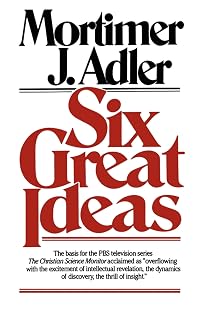
Six Great Ideas
by Mortimer J. Adler
On This Page
Description
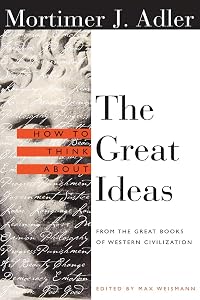
Each summer, Mortimer J. Adler conducts a seminar at the Aspen Institute in Colorado. At the 1981 seminar, leaders from the worlds of business, literature, education, and the arts joined him in an in-depth consideration of the six great ideas that are the subject of this book: Truth, Goodness, and Beauty - the ideas we judge by; and Liberty, Equality and Justice - the ideas we act on. The group discussions and conversations between Dr. Adler and journalist Bill Moyers were filmed for show more broadcast on public television, and thousands of people followed their exploration of these important ideas. Discarding the jargon of academia, Dr. Adler dispels the myth that philosophy is the exclusive province of the specialist. He argues that "philosophy is everybody's business," and that a better understanding of these fundamental concepts is essential if we are to cope with the political, moral, and social issues that confront us daily. --From publisher's description. show lessTags
Recommendations
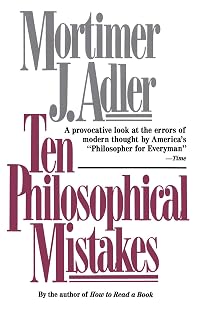
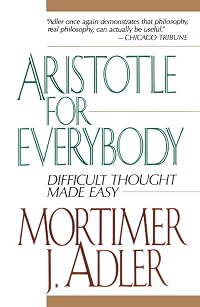




















Member Reviews
What Mortimer J. Adler has done is to write a book on six of the greatest of the great ideas yet conceived by humankind, a book that is free from the "in" vocabulary usually employed in philosophy and other specialized fields. It is invitingly accessible to everyone who ever thrilled to, or puzzled or agonized over, these ideas. This is why the book fulfills the democratic criterion implied in its very first sentence: "It cannot be too often repeated that philosophy is everybody's business."
The six great ideas form a pair of trios. Liberty, equality, and justice define the social sphere of our existence. Truth, goodness, and beauty define how our minds relate to everything outside of us. It is this distinction that leads Dr. Adler to show more characterize the trios as the engines of two different vehicles of human behavior. Truth, goodness, and beauty--which he calls the more fundamental trio--are the ideas we judge by. Liberty, equality, and justice are the ideas we live by and act on.
Written in the same near-conversational style as his earlier works, this one will renew the reader's pleasure in discovering that philosophizing can be as enjoyable as it is rewarding. show less
The six great ideas form a pair of trios. Liberty, equality, and justice define the social sphere of our existence. Truth, goodness, and beauty define how our minds relate to everything outside of us. It is this distinction that leads Dr. Adler to show more characterize the trios as the engines of two different vehicles of human behavior. Truth, goodness, and beauty--which he calls the more fundamental trio--are the ideas we judge by. Liberty, equality, and justice are the ideas we live by and act on.
Written in the same near-conversational style as his earlier works, this one will renew the reader's pleasure in discovering that philosophizing can be as enjoyable as it is rewarding. show less
An accessible introduction to modern philosophy, suitable for the student who isn't quite ready to attack primary sources.
truth, goodness, beauty, liberty, equality, justice
truth, goodness, beauty, liberty, etc
Ratings
Members
- Recently Added By
Author Information

338+ Works 24,755 Members
Born in New York, Mortimer Adler was educated at Columbia University. Later as a philosophy instructor there, he taught in a program focused on the intellectual foundations of Western civilization. Called to the University of Chicago in 1927 by President Robert Maynard Hutchins, Adler played a major role in renovating the undergraduate curriculum show more to center on the "great books." His philosophical interests committed to the dialectical method crystallized in a defense of neo-Thomism, but he never strayed far from concerns with education and other vital public issues. From 1942 to 1945, Adler was director of the Institute for Philosophical Research, based in San Francisco, California. Beginning in 1945 he served as associate editor of Great Books of the Western World series, and in 1952 he published Syntopicon, an analytic index of the great ideas in the great books. In 1966 he became director of the editorial planning for the fifteen edition of the Encyclopaedia Britannica, and in 1974, chairman of its editorial board. Adler has been devoted in recent years to expounding his interpretations of selected great ideas and to advocating his Paideia Proposal. That proposal would require that all students receive the same quantity and quality of education, which would concentrate on the study of the great ideas expressed in the great books, a study conducted by means of the dialectical method. Mortimer J. Adler died June 28, 2001 at his home in San Mateo, California at the age of 98. (Bowker Author Biography) show less
Common Knowledge
- Original title
- Six great ideas.
- Original publication date
- 1981
- Dedication
- To the benefactors and trustees of the institute for Philosophical Research.
- First words
- It cannot be too often repeated that philosophy is everybody's business.
Classifications
- Genres
- Philosophy, Nonfiction, General Nonfiction
- DDC/MDS
- 111.8 — Philosophy & psychology Metaphysics (existence, purpose, and the nature of reality) Ontology Properties of being
- LCC
- BD171 .A24 — Philosophy, Psychology and Religion Speculative philosophy Speculative philosophy Epistemology. Theory of knowledge
- BISAC
Statistics
- Members
- 657
- Popularity
- 44,193
- Reviews
- 4
- Rating
- (3.38)
- Languages
- English, Spanish
- Media
- Paper, Audiobook, Ebook
- ISBNs
- 6
- ASINs
- 3