
The Oregon Trail
by Francis Parkman
On This Page
Description
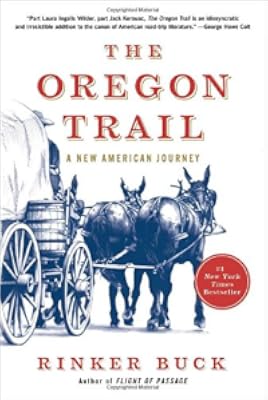
Take a trip back in time on the Oregon Trail. This series of non-fiction essays from Francis Parkman details life on the nineteenth-century American frontier, detailing the summer a young Parkman traveled through Nebraska, Wyoming, Colorado and Kansas. Along the way, the author spent time hunting and fishing, as well as participating in a buffalo hunt led by members of the Native American tribe, the Oglala Sioux.Tags
Recommendations

















Member Reviews
This narrative describes 23-year-old Parkman's travels west in with fellow Boston Brahmin Quincy Adams Shaw. Together they travel with settlers adventurers through the future states of of Nebraska, Wyoming, Colorado, and Kansas (the title is a misnomer as they never go to Oregon), and spend three weeks hunting buffalo with the Ogala Sioux. It's a well-written narrative that captures the flora and fauna of the prairies, the lives of settlers, soldiers, and Native Americans, and the uncertainty of so much change happening in the region at one time.
Unfortunately, the huge problem is that Parkman is deeply prejudice against the native peoples, which yes is a characteristic of the time, but there were more sympathetic contemporary white show more American writers of the time as well. Parkman also is dismissive of a number of white settlers he encounters. I kind of imagine that Parkman and Shaw were like Charles Emerson Winchester haughtily looking down on those around them. So, yes, this is a terrific descriptive narrative, but there are a lot of aspects that will be hard to stomach for modern readers. show less
Unfortunately, the huge problem is that Parkman is deeply prejudice against the native peoples, which yes is a characteristic of the time, but there were more sympathetic contemporary white show more American writers of the time as well. Parkman also is dismissive of a number of white settlers he encounters. I kind of imagine that Parkman and Shaw were like Charles Emerson Winchester haughtily looking down on those around them. So, yes, this is a terrific descriptive narrative, but there are a lot of aspects that will be hard to stomach for modern readers. show less
I had never had any interest in this type of book, but found it captivating in its language and descriptions of Indians and life in the West in the 1850's.
Have you ever wondered what it would be like to see the frontier, as a well-educated young Eastern man, in the days when you really would need to worry about Indians taking your scalp, and there were no showers or electricity back home to miss? This book pretty much shows you.
The author is a twenty-something Harvard educated man - think of John Adams or Robert Gould Shaw here - in the 1840s, who enthusiastically roams the world in search of adventure and edification and things to write home about. He lies to his mother and tells her he's taking the safe route to Fort Bridger, all he knows about Mormons is that they're really religious and people in Missouri hate them, and his attitude towards hunting buffalo can be summed up with: show more "they're stupid, you can kill a million of the males and not hurt the species since Indians kill only cows, they're stupid, we're hungry, they're stupid, when they're all dead the Indians will die off too, they're really, really stupid, and killing is fun, whee!" He also, by the way, is really ill for most of his adventures - he details many weeks of lying on the ground unable to function, trying to ride a horse without falling into unconsciousness, and taking drugs he suspects will poison him just because there was a chance it'd make him feel better.
The author is judgmental and, from our perspective, remarkably unkind. He's also brutally honest, especially considering that the insults and criticism of fellow Easterners was always written for publication. Later in life, he went back and changed a lot of the things he said in this book - that was after the Civil War, after polygamy scandals and the invention of the telegraph, after he was respected and married and so forth. The Oxford World's Classics edition is pretty much what he first wrote, so it's rougher and there's a lot more "look how smart I am, quoting ancient Latin poetry from memory" silliness than are found in other editions. He became one of the most famous and influential Western historians in the later 19th century.
I definitely recommend it for people who are interested in the period, especially since it's first person. Someday everything you write today will be 160 years old; a certain amount of sympathy and understanding will, I promise you, take you a long way.
(about the buffalo: no buffalo dies before page 220 or so, that wasn't killed for a good reason and put to the best usage it could be; some of the later stuff is gross and beyond excessive from a 21st century standpoint, but seriously, guys, this was the 1840s, and there were no grocery stores on the plains.) show less
The author is a twenty-something Harvard educated man - think of John Adams or Robert Gould Shaw here - in the 1840s, who enthusiastically roams the world in search of adventure and edification and things to write home about. He lies to his mother and tells her he's taking the safe route to Fort Bridger, all he knows about Mormons is that they're really religious and people in Missouri hate them, and his attitude towards hunting buffalo can be summed up with: show more "they're stupid, you can kill a million of the males and not hurt the species since Indians kill only cows, they're stupid, we're hungry, they're stupid, when they're all dead the Indians will die off too, they're really, really stupid, and killing is fun, whee!" He also, by the way, is really ill for most of his adventures - he details many weeks of lying on the ground unable to function, trying to ride a horse without falling into unconsciousness, and taking drugs he suspects will poison him just because there was a chance it'd make him feel better.
The author is judgmental and, from our perspective, remarkably unkind. He's also brutally honest, especially considering that the insults and criticism of fellow Easterners was always written for publication. Later in life, he went back and changed a lot of the things he said in this book - that was after the Civil War, after polygamy scandals and the invention of the telegraph, after he was respected and married and so forth. The Oxford World's Classics edition is pretty much what he first wrote, so it's rougher and there's a lot more "look how smart I am, quoting ancient Latin poetry from memory" silliness than are found in other editions. He became one of the most famous and influential Western historians in the later 19th century.
I definitely recommend it for people who are interested in the period, especially since it's first person. Someday everything you write today will be 160 years old; a certain amount of sympathy and understanding will, I promise you, take you a long way.
(about the buffalo: no buffalo dies before page 220 or so, that wasn't killed for a good reason and put to the best usage it could be; some of the later stuff is gross and beyond excessive from a 21st century standpoint, but seriously, guys, this was the 1840s, and there were no grocery stores on the plains.) show less
A very interesting and illuminating journal of sorts, written by a 23 year old man looking for adventure in the American West of the 1840s. While one might not agree with his analysis about the native societies, his observations appear valid, and his prose paints a clear picture of his time. Occasionally his narrative timeline was muddled, and I had to turn back a page or two to get my bearings, but the chapters flow well for the most part. The attitude of the author and his companions are sometimes upsetting, but should be viewed in the context of the time and the age of the people involved. Definitely recommended.
I was really looking forward to reading a book about the trip on the Oregon Trail (my kids used to love that computer game very much!), but this was not what this book was about. The author (obviously very well-to-do and East Coast) thought it would be a great adventure to see how the savages live out West. He thought they all were sub-standard and ugly and dirty. He never even made it into the Rocky Mountains and just circled around like a lost sheep before making it back home. He is one of the reasons that the buffaloes almost were extinct.... because there obviously is no greater fun than shooting them, just so you can say that you shot lots of them.
4169 The Oregon Trail, by Francis Parkman (read 2 June 2006) Back when I was a freshman in high school I started this book first published in 1849, and for some forgotten reason stopped reading at page 60. When I saw a copy at a rummage sale for a dime, I bought it and now have read it. It tells of Parkman's trip in 1846 on a part of and in the locale of the Oregon Trail--he never got to Oregon itself--and tells of his time with Indians and of his hunting. I was repelled by the senseless killing of buffalo by all concerned. Parkman and the others seemed to think buffaloes were there to be killed, even if the carcass was not used. The book is pretty dry, and I never felt eager to read more. But I usually finish a book I start and this show more book lived in my memory all these years and now I have finished it. So there. show less
While not currently favored by historians, this is one good read. Keep in mind the conceits, prejudices, etc. of the man and his period and all will be well. Sometimes the language is a little too flowery (sp?) but other times you will be captured by the descriptions. Try not to get too upset about the buffalo carnage but again keep in mind the historical times that these people inhabited. The illustrations, mostly early american western painters is up to the usual folio society standards - that is to say excellent.
Members
- Recently Added By
Lists

Folio Society
831 works; 53 members

Merrill's English Texts
59 works; 3 members

CCE 1000 Good Books List
1,033 works; 12 members

W. S. Maugham's Reading Suggestions for Spiritual Enrichment: American
13 works; 4 members

Harold Bloom - The Western Canon: C. The Democratic Age
336 works; 15 members

Trinity College Booklist (1951): Class Four, History
120 works; 2 members

Publisher's Weekly Bestsellers Prior to 1895 in Chronological Order
95 works; 6 members

Books Read in 2025
4,128 works; 98 members
Author Information

69+ Works 5,830 Members
Early in his youth, this Boston-born historian was infected with what he called (in language offensive to today's readers) "Injuns on the brain." For the rest of his life, he dedicated himself to writing what he had called at the age of 18 "a history of the American forest." In 1846, following the completion of his studies at Harvard College, he show more set out in company with a cousin on an expedition from St. Louis over the Oregon Trail to Fort Laramie, Wyoming, a journey that brought him into close contact with the Lakota Indians. Back in Boston, he turned the journal that he had kept on the trail into a series of sketches that were published in the Knickerbocker Magazine and afterwards as a book, The California and Oregon Trail, Being Sketches of Prairie and Rocky Mountain Life (1849), now better known by the abbreviated title of a later revised edition, The Oregon Trail. By this time, Parkman had well underway the historical work that would occupy him during the rest of his life, an account of the French and English in North America, the first installment of which was his History of the Conspiracy of Pontiac and the War of the North American Tribes against the English Colonies, published in 1851. (Bowker Author Biography) show less
Some Editions
Awards and Honors
Series
Belongs to Publisher Series
Work Relationships
Is contained in
Has the adaptation
Is abridged in
Has as a supplement
Has as a student's study guide
Common Knowledge
- Canonical title*
- The Oregon Trail : Sketches of Prairie and Rocky Mountain Life
- Original title
- The California and Oregon Trail (orig pub 1849) (orig pub 1849)
- Original publication date
- 1849
- Important places
- Oregon Trail, USA
- Dedication
- TO
The comrade of summer and
the friend of a lifetime
QUINCY ADAMS SHAW - First words
- Last spring, 1846, was a busy season in the city of St. Louis.
- Last words
- (Click to show. Warning: May contain spoilers.)On the next morning we left town, and after a fortnight of railroads, coaches, and steamboats saw once more the familiar features of home.
*Some information comes from Common Knowledge in other languages. Click "Edit" for more information.
Classifications
Statistics
- Members
- 2,393
- Popularity
- 8,195
- Reviews
- 21
- Rating
- (3.54)
- Languages
- 7 — Czech, Dutch, English, French, German, Russian, Spanish
- Media
- Paper, Audiobook, Ebook
- ISBNs
- 153
- UPCs
- 2
- ASINs
- 189