
A. B. Guthrie, Jr. (1901–1991)
Author of The Big Sky
About the Author
A. B. Guthrie, Jr., is one of America's most celebrated writers of western literature. He received the 1950 Pulitzer Prize in fiction for "The Way West". Guthrie died in 1991. (Bowker Author Biography)
Series
Works by A. B. Guthrie, Jr.
Los Premios Pulitzer de Novela (Vol. VIII): Margaret Ayer Barnes, A. B. Guthrie Jr., Katherine Ann Porter, Bernard Malamud (1982) — Contributor — 5 copies
Fifty Years after The Big Sky (pb): New Perspectives on the Fiction and Films of A.B. Guthrie, Jr. (2001) 3 copies
Dolce, dolce terra 1 copy
The Way West [abridged] 1 copy
Four miles from Ear Mountain 1 copy
These Thousand Hills.[Settlement of the Montana ranch country in the 1880's]. *Author's 3rd book! 1 copy
Retour de bâtons 1 copy
Guthrie Alfred Bertram 1 copy
arrive 1 copy
Associated Works
Reader's Digest Best of the West: A Treasury of Western Adventure Volumes 1 & 2 (1976) — Contributor — 38 copies
Reader's Digest Best of the West: A Treasury of Western Adventure Volume 1 (1975) — Contributor — 12 copies
Reader's Digest Condensed Books: The Lion • Collision Course • September Moon • The Way West (1949) — Contributor — 4 copies
These Thousand Hills [1959 film] — Original book — 4 copies
Reader's Digest Condensed Books, 1956, Vol. 1: The Way West • My Cousin Rachel • The Cry and the Covenant (1956) — Author — 4 copies
The Ethnic Image in Modern American Literature, 1900-1950, Volumes 1-2 (1984) — Contributor — 1 copy
Tagged
Common Knowledge
- Canonical name
- Guthrie, A. B., Jr.
- Legal name
- Guthrie, Alfred Bertram, Jr.
- Other names
- Guthrie, Bud
- Birthdate
- 1901-01-13
- Date of death
- 1991-04-26
- Gender
- male
- Education
- Harvard University (Nieman Fellowship)
University of Montana (BA|1923) - Occupations
- journalist
editor
novelist
screenwriter
historian - Organizations
- Lexington Leader
University of Kentucky - Awards and honors
- Pulitzer Prize (1950)
Saddleman Award (1978)
Western Literature Association's Distinguished Achievement Award (1972)
Montana Cowboy Hall of Fame (2015) - Nationality
- USA
- Birthplace
- Bedford, Indiana, USA
- Places of residence
- Bedford, Indiana, USA
Ontario, California, USA
Choteau, Montana, USA
Lexington, Kentucky, USA - Place of death
- Choteau, Montana, USA
- Burial location
- ashes scattered on Ear Mountain, Montana, USA
- Associated Place (for map)
- USA
Members
Reviews
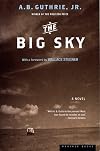
"This was the way to live, free and easy, with time all a man's own and none to say no to him." (pg. 201)
The Big Sky is a book that demands to be taken slow. Prose and plot have a loping gait that mirrors the mountain men it brings to life, and if this seems irregular to a modern reader conditioned to pace and pandering, it is all the better for that. Taken slow, the book grounds the reader, and its quiet confidence vindicates author A. B. Guthrie's singular approach.
The prose is excellent show more – Hemingway was an admirer – and a good thing too, for the book must succeed or fail based on its evocation of the untapped American West of the 1830s and 40s, the 'big sky' of the title. Guthrie paints these scenes astonishingly well, evoking not only the sights and sounds and the harsh beauty of the land, but the sense of freedom it brings to the main characters, and the sense of loss and wanderlust that serve as counterpoint to that freedom. The sentences are simple but rich, in the manner of the afore-mentioned Hemingway, providing all the room Guthrie needs to let his mountain men, and the reader, roam at will. The prose, like the western land it evokes, is "country a man could get his breath in" (pg. 21).
But the book is more than just weather and landscape and country; these fine traits are allied to strong characterization and many well-taken dramatic scenes. The mechanics of the storytelling are quietly strong, with every scene and setting providing texture to Guthrie's purpose without being consciously literary. All three of the main characters – Boone Caudill, Jim Deakins and Dick Summers – stay with you, and even those readers who don't want to engage with the deeper textures of the story will still enjoy their adventure.
That said, it is the American West itself which stirs the reader most profoundly, and when it is said of the solitary, taciturn Boone Caudill that it was "as if he talked to the country for company, and the country talked to him" (pg. 185), we can believe it, for the reader is experiencing that too. "There was the sky above, blue as paint, and the brown earth rolling underneath, and himself between them with a free, wild feeling in his chest" (pg. 123). This book shines with my soul. show less
The Big Sky is a book that demands to be taken slow. Prose and plot have a loping gait that mirrors the mountain men it brings to life, and if this seems irregular to a modern reader conditioned to pace and pandering, it is all the better for that. Taken slow, the book grounds the reader, and its quiet confidence vindicates author A. B. Guthrie's singular approach.
The prose is excellent show more – Hemingway was an admirer – and a good thing too, for the book must succeed or fail based on its evocation of the untapped American West of the 1830s and 40s, the 'big sky' of the title. Guthrie paints these scenes astonishingly well, evoking not only the sights and sounds and the harsh beauty of the land, but the sense of freedom it brings to the main characters, and the sense of loss and wanderlust that serve as counterpoint to that freedom. The sentences are simple but rich, in the manner of the afore-mentioned Hemingway, providing all the room Guthrie needs to let his mountain men, and the reader, roam at will. The prose, like the western land it evokes, is "country a man could get his breath in" (pg. 21).
But the book is more than just weather and landscape and country; these fine traits are allied to strong characterization and many well-taken dramatic scenes. The mechanics of the storytelling are quietly strong, with every scene and setting providing texture to Guthrie's purpose without being consciously literary. All three of the main characters – Boone Caudill, Jim Deakins and Dick Summers – stay with you, and even those readers who don't want to engage with the deeper textures of the story will still enjoy their adventure.
That said, it is the American West itself which stirs the reader most profoundly, and when it is said of the solitary, taciturn Boone Caudill that it was "as if he talked to the country for company, and the country talked to him" (pg. 185), we can believe it, for the reader is experiencing that too. "There was the sky above, blue as paint, and the brown earth rolling underneath, and himself between them with a free, wild feeling in his chest" (pg. 123). This book shines with my soul. show less
This is a wonderful book full of winds, savagery, unsullied nature, friendship, hard men, and loss. When I was young there were men who sat beneath a tree at the bottom of our garden, watching the world go by. WW2 had left them to fend for themselves. Some of them were hard men: men who said little, who had something about the set of jaw and lips that signaled pain, loss, and the toll of life. Set in the mid-1800s, Guthrie's hard men are mountain men; who are quiet, keenly observant, more show more at ease in open space than indoors, men who have known hardship, and men who remain calm in crisis.
The narrative arc follows Boone who is bold, too quick to anger, and instinctive; not just in his search for a better life, but in his single-minded quest for the girl/woman, Teal Eye. But living instinctively has its difficulties. Guthrie writes with a sparse precision and his use of backwoods dialogue is masterful, not only in its economy of expression but in its richness:
The narrative arc follows Boone who is bold, too quick to anger, and instinctive; not just in his search for a better life, but in his single-minded quest for the girl/woman, Teal Eye. But living instinctively has its difficulties. Guthrie writes with a sparse precision and his use of backwoods dialogue is masterful, not only in its economy of expression but in its richness:
A dog that was all hair and bark ran from behind the house and yipped at Blue. Blue winked one eye and let a low growl out of his Phlegmy throat, and the small dog backed up, still yipping. Then he lifted his leg against a bush and scratched the ground afterwards and trotted away with his head held high as if he had made a good out of it. p 370.The Big Sky has rhythms where we rest between passages of extreme tension, such as the theft of a horse at night, with closely observed evocations of landscape and the natural world inhabiting it. If the allegorical trajectory of the novel is the steady progression of Boone becoming part of that world as theystruggle up-stream. it is also the steady destruction of it and the over-riding sense of inevitable loss as Boone staggers towards internal and external confrontation at the very end. Summers shows us another side as he faulters in old-age. In many respects this is such a well observed book that I can also read it as the struggle today between the vanishing values of the analogue world as they are subsumed by the digital.
Summers couldn't see anything among the willows, not so much as a branch bent out of shape or the grass trampled where a man might have gone through, but he knew the Sioux were there. He brought his head back, still slowly, and turned about, to see an Indian screened in the brush only an arm's length away. Two black stripes ran down the Indian's cheeks. They pulled downward as the Indian caught his movement. There was one still instant, - a flash of seeing, in which nothing moved or sounded - and then the Indian jerked up his battle axe. (p. 119)show less

"Had he held it once, not knowing? Did it flutter there in his hand in those gone days… Where beaver swam in every stream, and a trapper knew his foot was first on the land and he walked with the gods of the world?" (pg. 62)
The third book, chronologically speaking, in A. B. Guthrie's Big Sky series, Fair Land, Fair Land was the last to be written and published. Alas, something seems to have been lost in the 30+ year gap since the publication of its predecessor, The Way West. Nevertheless, show more a book that doesn't reach the heights of those two earlier books is still scaling a significant altitude, and Fair Land, Fair Land remains a rewarding read.
The biggest surprise in Fair Land was its impatience. The greatest quality in The Big Sky and The Way West was the way they went along at their own loping gait; both pace and prose took their time and this was of great reward to those readers who were willing to treat with them on their own terms. Fair Land, however, opts for a more streamlined text. There is little of the introspection or the descriptive passages that were so beautiful in the previous two books, and we don't get the sense of the land that we got there.
The heart doesn't swell as it did before, and while this makes sense somewhat – considering the characters' unspoiled West is now being settled and disrupted – it doesn't explain why plot points are cooked to a similar short-order. The coincidental way Summers meets up with Teal Eye lacks storytelling grace, and given the build-up I expected the encounter with Boone Caudill to be of greater substance. The couple of pages he is given, without much in the way of reflection, is disappointing considering he was the protagonist of The Big Sky. The way this particular plot point was resolved left me feeling a bit short-changed. The reluctance to dig deep wells is understandable, given that such things require stamina and Guthrie was by the time of Fair Land more than 80 years old, but it doesn't change the taste. There is little of the simmering that makes a soup.
That said, Fair Land, Fair Land is still plenty rewarding. The best part is being back with the main character Dick Summers, the quintessential mountain man "at home in the world" (pg. 24), as he talks with others with an "easy smile and gray eyes and all-around competence" (pg. 18). The book retains the sharp but unintrusive dialogue of its predecessors, and much of the book's grace comes from being in the company of Summers. The return of Teal Eye (from The Big Sky) and Higgins (a promising but relegated character in The Way West) are also enjoyable.
The book as a whole is enjoyable, but it carries with it a sense of obligation. This time period (1845-1870) was a blank patch in Guthrie's career-defining Western tapestry, and he's here to tie off the loose ends of Dick Summers, Boone Caudill and Teal Eye – for posterity. And so when Summers sets off from the west coast to go back east, putting "the promised land… behind them" (pg. 38) to re-tread old ground, there seems to be a sort of metatextual acceptance on Guthrie's part – as on Summers' – that it won't match up to what came before.
Fortunately, alongside its sense of obligation, Fair Land, Fair Land also carries with it great characters, pathos, and that unmatchable landscape. The story and its telling may not be on par with its two predecessors, but Guthrie can still move us considerably. "Give [me] a far reach of eye," Dick Summers asks on page 4, "the grasses rippling, the small streams talking, buttes swimming clear a hundred miles away". And sure enough he gets it, or at least enough of it to satisfy a man who knows he's reaching the end of his story. Guthrie gives it to us too, and we too are satisfied. show less
The third book, chronologically speaking, in A. B. Guthrie's Big Sky series, Fair Land, Fair Land was the last to be written and published. Alas, something seems to have been lost in the 30+ year gap since the publication of its predecessor, The Way West. Nevertheless, show more a book that doesn't reach the heights of those two earlier books is still scaling a significant altitude, and Fair Land, Fair Land remains a rewarding read.
The biggest surprise in Fair Land was its impatience. The greatest quality in The Big Sky and The Way West was the way they went along at their own loping gait; both pace and prose took their time and this was of great reward to those readers who were willing to treat with them on their own terms. Fair Land, however, opts for a more streamlined text. There is little of the introspection or the descriptive passages that were so beautiful in the previous two books, and we don't get the sense of the land that we got there.
The heart doesn't swell as it did before, and while this makes sense somewhat – considering the characters' unspoiled West is now being settled and disrupted – it doesn't explain why plot points are cooked to a similar short-order. The coincidental way Summers meets up with Teal Eye lacks storytelling grace, and given the build-up I expected the encounter with Boone Caudill to be of greater substance. The couple of pages he is given, without much in the way of reflection, is disappointing considering he was the protagonist of The Big Sky. The way this particular plot point was resolved left me feeling a bit short-changed. The reluctance to dig deep wells is understandable, given that such things require stamina and Guthrie was by the time of Fair Land more than 80 years old, but it doesn't change the taste. There is little of the simmering that makes a soup.
That said, Fair Land, Fair Land is still plenty rewarding. The best part is being back with the main character Dick Summers, the quintessential mountain man "at home in the world" (pg. 24), as he talks with others with an "easy smile and gray eyes and all-around competence" (pg. 18). The book retains the sharp but unintrusive dialogue of its predecessors, and much of the book's grace comes from being in the company of Summers. The return of Teal Eye (from The Big Sky) and Higgins (a promising but relegated character in The Way West) are also enjoyable.
The book as a whole is enjoyable, but it carries with it a sense of obligation. This time period (1845-1870) was a blank patch in Guthrie's career-defining Western tapestry, and he's here to tie off the loose ends of Dick Summers, Boone Caudill and Teal Eye – for posterity. And so when Summers sets off from the west coast to go back east, putting "the promised land… behind them" (pg. 38) to re-tread old ground, there seems to be a sort of metatextual acceptance on Guthrie's part – as on Summers' – that it won't match up to what came before.
Fortunately, alongside its sense of obligation, Fair Land, Fair Land also carries with it great characters, pathos, and that unmatchable landscape. The story and its telling may not be on par with its two predecessors, but Guthrie can still move us considerably. "Give [me] a far reach of eye," Dick Summers asks on page 4, "the grasses rippling, the small streams talking, buttes swimming clear a hundred miles away". And sure enough he gets it, or at least enough of it to satisfy a man who knows he's reaching the end of his story. Guthrie gives it to us too, and we too are satisfied. show less

"What a person wondered was, were other people like him underneath or, more likely, solider and properer and not moved by crazy notions? He wouldn't want to tell about how it was with him, not even about the way his chest filled sometimes when he came to a rise and looked over the country or how his heart turned just at the smell of camp smoke…" (pp95-96)
Despite being a Pulitzer Prize winner, back when that really meant something, and a successor to one of my favourite recent reads, The show more Big Sky, there were times when I wasn't sure if I loved The Way West, or saw it as a great book. I enjoyed it throughout, but there were moments when something on the path A. B. Guthrie had laid out would wobble underfoot and make me unsure of my place. But then, there's a scene where the mountain man Dick Summers (the only character to return from The Big Sky) recognises that he made the right choice in coming out West again and taking in the glorious country. One of the other characters asks him why he's smiling, and Dick replies, "Was I smilin'? Just feelin' good, I reckon" (pg. 225). It's a warm moment and I realised that, for all its minor wobbles, I too had been smiling throughout.
Those wobbles were legitimate; stones come loose from the path. The Big Sky was a slow book and The Way West is too, but more happened in The Big Sky. It seems strange to say that, as it often seemed like not much happened and the book was all landscape and thought. But though The Way West has more characters – it follows the members of a wagon train on the famous Oregon Trail – they don't sit as deeply in the memory as characters from the first book, even minor ones, sat. They do just fine, and better than most novels, but a "captain ought to know his company down to the last pup" (pg. 132), and by the end too many of the characters remain strangers. Of those who are more prominent, Higgins becomes forgotten despite having some point-of-view chapters earlier on in the book. Brownie, the teenage boy, is one that seems set up to grow into a man, but his waxing confidence ("he was more like Dick Summers all the time" (pg. 97)) is less show than tell, and by the end he remains in a bit-part role and seems to have reverted into boyishness. Furthermore, though there are storms, river crossings, hardships, conflicts within the group and encounters with Indians, we never feel as though the wagon train is in great peril. There's very little circling of the wagons.
All that said, Guthrie's path is still a sturdy one even after some of those stones have come loose. The prose style is a good example of this; there are moments when I thought some of the sentences were strangled or overcooked, and others where I had to re-read a paragraph to get the sense of it, but then every time I thought this, Guthrie would go on to produce some astonishing piece of writing or touching dialogue between characters or some well-staged scene, and I would forgive the moment where things had drifted slightly. It's as though Guthrie is a prize-fighter who has feinted with his left hand, the better to knock you down with his right.
As in The Big Sky, the great redeemer in The Way West is the American landscape, and the thoughts it evokes in the characters and in the reader. I wrote in my review of The Big Sky that the book demanded you take it slow, and The Way West is the same in that it rewards those who are willing to treat with it on its own terms. The prose, like the West's prairie air, has "a taste to it" (pg. 126), and oftentimes you can tell Guthrie is writing a character towards an outcrop or a stream, solely to provide them a moment of solitude so they can paint the land they see with their eyes and Guthrie can deliver his potent inner monologue on how it makes them feel. In a lesser book, this would seem manipulative or writerly, but in The Way West you can easily imagine these characters wanting to steal away for a moment and look out on the mountains or the plains or the stars or the mighty rivers. Like them, the reader gets the wanderlust where he just wants to say 'goddamn', or moments where he "felt he couldn't speak for the crowding in his chest" (pg. 318). Guthrie's ability to do this is unmatched and it's the most compelling reason to invest in one of his books.
I began to value this all the more highly as it is rare, particularly nowadays, to find a book which does its own thing rather than pandering to a target audience. In fact, I don't know of many books which grant themselves this extent of license, and like the unbroken Western landscape our characters traverse, we're sometimes overwhelmed by its extent but grateful for the sense of freedom such space provides. Like one character realises at the very end, for all the tough moments, the "hardships, sorrows, partings… the heart [was] still ready to beat high" (pg. 340). Wagh! show less
Despite being a Pulitzer Prize winner, back when that really meant something, and a successor to one of my favourite recent reads, The show more Big Sky, there were times when I wasn't sure if I loved The Way West, or saw it as a great book. I enjoyed it throughout, but there were moments when something on the path A. B. Guthrie had laid out would wobble underfoot and make me unsure of my place. But then, there's a scene where the mountain man Dick Summers (the only character to return from The Big Sky) recognises that he made the right choice in coming out West again and taking in the glorious country. One of the other characters asks him why he's smiling, and Dick replies, "Was I smilin'? Just feelin' good, I reckon" (pg. 225). It's a warm moment and I realised that, for all its minor wobbles, I too had been smiling throughout.
Those wobbles were legitimate; stones come loose from the path. The Big Sky was a slow book and The Way West is too, but more happened in The Big Sky. It seems strange to say that, as it often seemed like not much happened and the book was all landscape and thought. But though The Way West has more characters – it follows the members of a wagon train on the famous Oregon Trail – they don't sit as deeply in the memory as characters from the first book, even minor ones, sat. They do just fine, and better than most novels, but a "captain ought to know his company down to the last pup" (pg. 132), and by the end too many of the characters remain strangers. Of those who are more prominent, Higgins becomes forgotten despite having some point-of-view chapters earlier on in the book. Brownie, the teenage boy, is one that seems set up to grow into a man, but his waxing confidence ("he was more like Dick Summers all the time" (pg. 97)) is less show than tell, and by the end he remains in a bit-part role and seems to have reverted into boyishness. Furthermore, though there are storms, river crossings, hardships, conflicts within the group and encounters with Indians, we never feel as though the wagon train is in great peril. There's very little circling of the wagons.
All that said, Guthrie's path is still a sturdy one even after some of those stones have come loose. The prose style is a good example of this; there are moments when I thought some of the sentences were strangled or overcooked, and others where I had to re-read a paragraph to get the sense of it, but then every time I thought this, Guthrie would go on to produce some astonishing piece of writing or touching dialogue between characters or some well-staged scene, and I would forgive the moment where things had drifted slightly. It's as though Guthrie is a prize-fighter who has feinted with his left hand, the better to knock you down with his right.
As in The Big Sky, the great redeemer in The Way West is the American landscape, and the thoughts it evokes in the characters and in the reader. I wrote in my review of The Big Sky that the book demanded you take it slow, and The Way West is the same in that it rewards those who are willing to treat with it on its own terms. The prose, like the West's prairie air, has "a taste to it" (pg. 126), and oftentimes you can tell Guthrie is writing a character towards an outcrop or a stream, solely to provide them a moment of solitude so they can paint the land they see with their eyes and Guthrie can deliver his potent inner monologue on how it makes them feel. In a lesser book, this would seem manipulative or writerly, but in The Way West you can easily imagine these characters wanting to steal away for a moment and look out on the mountains or the plains or the stars or the mighty rivers. Like them, the reader gets the wanderlust where he just wants to say 'goddamn', or moments where he "felt he couldn't speak for the crowding in his chest" (pg. 318). Guthrie's ability to do this is unmatched and it's the most compelling reason to invest in one of his books.
I began to value this all the more highly as it is rare, particularly nowadays, to find a book which does its own thing rather than pandering to a target audience. In fact, I don't know of many books which grant themselves this extent of license, and like the unbroken Western landscape our characters traverse, we're sometimes overwhelmed by its extent but grateful for the sense of freedom such space provides. Like one character realises at the very end, for all the tough moments, the "hardships, sorrows, partings… the heart [was] still ready to beat high" (pg. 340). Wagh! show less
Lists
Awards


You May Also Like


Associated Authors
Statistics
- Works
- 41
- Also by
- 24
- Members
- 3,155
- Popularity
- #8,097
- Rating
- 3.6
- Reviews
- 81
- ISBNs
- 160
- Languages
- 7
- Favorited
- 5