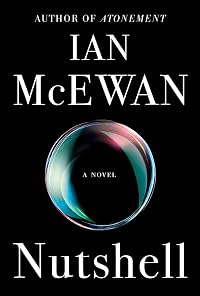
Nutshell
by Ian McEwan
On This Page
Description
"Trudy has betrayed her husband, John. She's still in the marital home--a dilapidated, priceless London townhouse--but John's not here. Instead, she's with his brother, the profoundly banal Claude, and the two of them have a plan. But there is a witness to their plot: the inquisitive, nine-month-old resident of Trudy's womb. Told from a perspective unlike any other, Nutshell is a classic tale of murder and deceit from one of the world's master storytellers"--Tags
Recommendations




Member Reviews
The reviews will tell you this is a modern retelling of Hamlet; ignore these. They are true but knowing it adds nothing to your enjoyment of Ian McEwan at the height of his powers. For this tale of deceit, murder and mistrust McEwan chooses a unique point of view; the point of view of an unborn but sophisticated and loquacious foetus. As his mother, Trudy, and her lover, his appalling uncle Claudius, sorry Claude, plot the demise of his father John, the unnamed foetus narrates the half baked plans, the too clever by half alibis, the mutual suspicion and mistrust of the lovers, and brings into sharp relief the character of his poetic, but rather pathetic father.
Its great - an afternoon with a master at work that you won't regret show more spending.
On a secondary point, I am always interested when authors use the names of well known historical or fictional characters in their work. For example - what was John Mortimer thinking when he named one of the protagonists in his last Rumpole story "Honoria Glossop". Had he been reading Wodehouse and the name just stuck in his subconscious? In which case, why didn't his editors pick it up? Can they be so illiterate? Or was something broader meant? In which case, what? In this case, Ian McEwan names his potential plot victim "John Cairncross"; as many will know John Cairncross is the name of a Soviet double agent, and alleged member, with Philby, Burgess, Maclean and Blunt, of the Cambridge Five. This is something that McEwan, who has written about espionage (for example in Sweet Tooth and The Innocent) could hardly not be aware of. What then is meant by this? It doesn't add to or detract from, enjoyment of the work at hand, but it interests me show less
Its great - an afternoon with a master at work that you won't regret show more spending.
On a secondary point, I am always interested when authors use the names of well known historical or fictional characters in their work. For example - what was John Mortimer thinking when he named one of the protagonists in his last Rumpole story "Honoria Glossop". Had he been reading Wodehouse and the name just stuck in his subconscious? In which case, why didn't his editors pick it up? Can they be so illiterate? Or was something broader meant? In which case, what? In this case, Ian McEwan names his potential plot victim "John Cairncross"; as many will know John Cairncross is the name of a Soviet double agent, and alleged member, with Philby, Burgess, Maclean and Blunt, of the Cambridge Five. This is something that McEwan, who has written about espionage (for example in Sweet Tooth and The Innocent) could hardly not be aware of. What then is meant by this? It doesn't add to or detract from, enjoyment of the work at hand, but it interests me show less
This is unexpected and very very good.
The outline of the story is that of Hamlet, with John's wife Trude having an affair with his brother, Claude. Instead of an angst ridden 20 something, our narrator is the late term foetus that Trude is carrying, John's son. The yet to be born child can hear and feel but not see and so infers a great deal about the outside world. He listens to Trude's body as well as what is being said outside and this includes Claude and Trude plotting John's murder.
It is a very novel idea and, once you get over the surprise that an unborn child sounds a lot like a 40 year old, it works remarkably well. The idea that the foetus has agency is appealing, the kicks delivered at various times almost hurt with the show more vigorousness of their application (in triplicate!).
There are echoes of Hamlet in the way that the brothers are contrasted, the ideal John, the bumbling and jealous Claude. Even the title is taken from a quote from Hamlet. I'm sure there are other references I missed, the book feel littered with them.
This is very inventive as an idea and I felt it really worked well. I listened to it on audio book, Rory Kinnear narrated and did a good job of reflecting the different voices the unborn child hears without resorting to caricature. show less
The outline of the story is that of Hamlet, with John's wife Trude having an affair with his brother, Claude. Instead of an angst ridden 20 something, our narrator is the late term foetus that Trude is carrying, John's son. The yet to be born child can hear and feel but not see and so infers a great deal about the outside world. He listens to Trude's body as well as what is being said outside and this includes Claude and Trude plotting John's murder.
It is a very novel idea and, once you get over the surprise that an unborn child sounds a lot like a 40 year old, it works remarkably well. The idea that the foetus has agency is appealing, the kicks delivered at various times almost hurt with the show more vigorousness of their application (in triplicate!).
There are echoes of Hamlet in the way that the brothers are contrasted, the ideal John, the bumbling and jealous Claude. Even the title is taken from a quote from Hamlet. I'm sure there are other references I missed, the book feel littered with them.
This is very inventive as an idea and I felt it really worked well. I listened to it on audio book, Rory Kinnear narrated and did a good job of reflecting the different voices the unborn child hears without resorting to caricature. show less
Odd
When my book club pals suggested we read Nutshell, the selling point was "you won't believe the point of view." Our club has read books that tell stories from the point of view of a dog, a dead girl, a drunk, and a madman, so sure, I was game to read this book. The other selling point was the author was Ian McEwan whom we love with a deep readers' passion for his elegant, breathtakingly beautiful story Atonement. We were all in for the ride.
I suspect the point of view for Nutshell was decided on a dare from other writers, over drinks. "Bet ya can't find a new point of view no one has ever done before." And McEwan, being the talented award-winning author he is, said, "Hold my beer." He tells a story of marital discord from the point show more of view of a fetus. Yes, a fetus. He has done far more with this story than readers might expect simply because he is a masterful storyteller. There are a few cheats, places in the story in which the main character knows things he could not. And this fetus has McEwan's vocabulary. I had to look up the meaning of lambent (glowing), cludgie (bathroom), and exequy (funeral rites). Thanks for that. But as a book lover, I had to suspend my disbelief with both hands, high overhead, page by page to the bitter end.
This is my least favorite McEwan book. The literary critics will no doubt hail it as brilliant, groundbreaking, mind-expanding prose. Which will inevitably lead to imitators, heaven protect us. Just as Anne Rice revived interest in vampire stories, should we expect more stories told from in utero? Or will the millennial authors go one step further with stories told from the perspective of inanimate objects, possibly a murder weapon or a pen? Please, no more explorations of life from a womb. Let's all agree it's been done and move on.
I admire McEwan's talent so much I will read his next book, and try to forget about this one for reminding me with every page that the writer was at work. show less
When my book club pals suggested we read Nutshell, the selling point was "you won't believe the point of view." Our club has read books that tell stories from the point of view of a dog, a dead girl, a drunk, and a madman, so sure, I was game to read this book. The other selling point was the author was Ian McEwan whom we love with a deep readers' passion for his elegant, breathtakingly beautiful story Atonement. We were all in for the ride.
I suspect the point of view for Nutshell was decided on a dare from other writers, over drinks. "Bet ya can't find a new point of view no one has ever done before." And McEwan, being the talented award-winning author he is, said, "Hold my beer." He tells a story of marital discord from the point show more of view of a fetus. Yes, a fetus. He has done far more with this story than readers might expect simply because he is a masterful storyteller. There are a few cheats, places in the story in which the main character knows things he could not. And this fetus has McEwan's vocabulary. I had to look up the meaning of lambent (glowing), cludgie (bathroom), and exequy (funeral rites). Thanks for that. But as a book lover, I had to suspend my disbelief with both hands, high overhead, page by page to the bitter end.
This is my least favorite McEwan book. The literary critics will no doubt hail it as brilliant, groundbreaking, mind-expanding prose. Which will inevitably lead to imitators, heaven protect us. Just as Anne Rice revived interest in vampire stories, should we expect more stories told from in utero? Or will the millennial authors go one step further with stories told from the perspective of inanimate objects, possibly a murder weapon or a pen? Please, no more explorations of life from a womb. Let's all agree it's been done and move on.
I admire McEwan's talent so much I will read his next book, and try to forget about this one for reminding me with every page that the writer was at work. show less
This book is an inspired take-off on Hamlet, with nods to other Shakespeare plays, from the point of view of an unborn child. Set in London in 2015, the unnamed narrator hears his mother, Trudy, and uncle, Claude, plotting to kill his father, John Cairncross, a poet. The story follows these nefarious plans and their denouement, while the narrator tries to figure out how to prevent the murder.
Trudy and Claude are despicable villains. They do not care one whit for the unborn child – they drink and engage in sex about twice an hour (I exaggerate only slightly). The narrator worries what will happen to him after birth. He is articulate and knowledgeable about the world. He engages in philosophical musing and witty observations. The show more author parodies the “typical” murder mystery.
The wordplay in this book is delightful: “I’ve no taste for comedy, no inclination to exercise, even if I had the space, no delight in fire or earth, in words that once revealed a golden world of majestical stars, the beauty of poetic apprehension, the infinite joy of reason. These admirable radio talks and bulletins, the excellent podcasts that moved me, seem at best hot air, at worst a vaporous stench. The brave polity I’m soon to join, the noble congregation of humanity, its customs, gods and angels, its fiery ideas and brilliant ferment, no longer thrill me. A weight bears down heavily on the canopy that wraps my little frame. There’s hardly enough of me to form one small animal, still less to express a man.”
I have to love a protagonist who has been listening to poetry, classic literature, news, and podcasts in utero. It is obviously not for anyone looking for a realistic story, but if you enjoy Shakespeare, you will find something to appreciate here. I found it clever and creative. show less
Trudy and Claude are despicable villains. They do not care one whit for the unborn child – they drink and engage in sex about twice an hour (I exaggerate only slightly). The narrator worries what will happen to him after birth. He is articulate and knowledgeable about the world. He engages in philosophical musing and witty observations. The show more author parodies the “typical” murder mystery.
The wordplay in this book is delightful: “I’ve no taste for comedy, no inclination to exercise, even if I had the space, no delight in fire or earth, in words that once revealed a golden world of majestical stars, the beauty of poetic apprehension, the infinite joy of reason. These admirable radio talks and bulletins, the excellent podcasts that moved me, seem at best hot air, at worst a vaporous stench. The brave polity I’m soon to join, the noble congregation of humanity, its customs, gods and angels, its fiery ideas and brilliant ferment, no longer thrill me. A weight bears down heavily on the canopy that wraps my little frame. There’s hardly enough of me to form one small animal, still less to express a man.”
I have to love a protagonist who has been listening to poetry, classic literature, news, and podcasts in utero. It is obviously not for anyone looking for a realistic story, but if you enjoy Shakespeare, you will find something to appreciate here. I found it clever and creative. show less
This book is an inspired take-off on Hamlet, with nods to other Shakespeare plays, from the point of view of an unborn child. Set in London in 2015, the unnamed narrator hears his mother, Trudy, and uncle, Claude, plotting to kill his father, John Cairncross, a poet. The story follows these nefarious plans and their denouement, while the narrator tries to figure out how to prevent the murder.
Trudy and Claude are despicable villains. They do not care one whit for the unborn child – they drink and engage in sex about twice an hour (I exaggerate only slightly). The narrator worries what will happen to him after birth. He is articulate and knowledgeable about the world. He engages in philosophical musing and witty observations. The show more author parodies the “typical” murder mystery.
The wordplay in this book is delightful: “I’ve no taste for comedy, no inclination to exercise, even if I had the space, no delight in fire or earth, in words that once revealed a golden world of majestical stars, the beauty of poetic apprehension, the infinite joy of reason. These admirable radio talks and bulletins, the excellent podcasts that moved me, seem at best hot air, at worst a vaporous stench. The brave polity I’m soon to join, the noble congregation of humanity, its customs, gods and angels, its fiery ideas and brilliant ferment, no longer thrill me. A weight bears down heavily on the canopy that wraps my little frame. There’s hardly enough of me to form one small animal, still less to express a man.”
I have to love a protagonist who has been listening to poetry, classic literature, news, and podcasts in utero. It is obviously not for anyone looking for a realistic story, but if you enjoy Shakespeare, you will find something to appreciate here. I found it clever and creative. show less
Trudy and Claude are despicable villains. They do not care one whit for the unborn child – they drink and engage in sex about twice an hour (I exaggerate only slightly). The narrator worries what will happen to him after birth. He is articulate and knowledgeable about the world. He engages in philosophical musing and witty observations. The show more author parodies the “typical” murder mystery.
The wordplay in this book is delightful: “I’ve no taste for comedy, no inclination to exercise, even if I had the space, no delight in fire or earth, in words that once revealed a golden world of majestical stars, the beauty of poetic apprehension, the infinite joy of reason. These admirable radio talks and bulletins, the excellent podcasts that moved me, seem at best hot air, at worst a vaporous stench. The brave polity I’m soon to join, the noble congregation of humanity, its customs, gods and angels, its fiery ideas and brilliant ferment, no longer thrill me. A weight bears down heavily on the canopy that wraps my little frame. There’s hardly enough of me to form one small animal, still less to express a man.”
I have to love a protagonist who has been listening to poetry, classic literature, news, and podcasts in utero. It is obviously not for anyone looking for a realistic story, but if you enjoy Shakespeare, you will find something to appreciate here. I found it clever and creative. show less
A man (Claude) sleeping with his brother’s wife (Trudy) and conspiring with her to murder her husband, his brother, (John), all whilst a precociously self-aware foetus looks on (well, not exactly looks, more like listens, feels, intuits) bound in the increasingly cramped space of his murderous, adulterous, yet adorable (mother love!) mother’s womb, helpless, inert (at least almost), unable but also unwilling to act. In a nutshell, it’s Hamlet.
Ian McEwan once again displays his ferocious talent for control of word and line and tension and plot. His unborn first-person narrator has learned much through BBC Radio 4 dramas and innumerable podcasts piped through earbuds to his mother’s cranium and by a sort of osmosis down to him. So show more he has a sense of the world even if he doesn’t know what it looks like or at least what colours look like. For him the world is much like a radio play. His imagination fills in the gaps — needs must — sometimes piercing through the veil of deceit cast by others, at other times deceiving himself. It’s a tour de force if ever there was one.
But, as ever with McEwan’s later works, there is something unsettling about the clinical nature of the prose. Perhaps it is the lack of fellow feeling with the characters. Perhaps it is the fact that the only ‘person’ McEwan draws us close to is no person at all (depending on which theory of consciousness you adhere to). Inevitably it all seems a bit too much like an exercise. Yet it makes you wonder what is the point of exercise — health, fitness, body-grooming? Can an author ever be too much into himself?
Recommended, for the sheer chutzpah of the effort, but not wholeheartedly, because I think it lacks heart. show less
Ian McEwan once again displays his ferocious talent for control of word and line and tension and plot. His unborn first-person narrator has learned much through BBC Radio 4 dramas and innumerable podcasts piped through earbuds to his mother’s cranium and by a sort of osmosis down to him. So show more he has a sense of the world even if he doesn’t know what it looks like or at least what colours look like. For him the world is much like a radio play. His imagination fills in the gaps — needs must — sometimes piercing through the veil of deceit cast by others, at other times deceiving himself. It’s a tour de force if ever there was one.
But, as ever with McEwan’s later works, there is something unsettling about the clinical nature of the prose. Perhaps it is the lack of fellow feeling with the characters. Perhaps it is the fact that the only ‘person’ McEwan draws us close to is no person at all (depending on which theory of consciousness you adhere to). Inevitably it all seems a bit too much like an exercise. Yet it makes you wonder what is the point of exercise — health, fitness, body-grooming? Can an author ever be too much into himself?
Recommended, for the sheer chutzpah of the effort, but not wholeheartedly, because I think it lacks heart. show less
In my opinion, McEwan has written one of the most imaginative narratives I've read in quite some time. It is amazing how a story can be both humorous and heartbreaking and have it be told from the viewpoint of a precocious wine snob fetus. From his little and unseen world he tries desperately to save his outside, future world. The prose is sometimes absolute poetry and at a short 200ish pages is well worth your time or listen to the audio as I did and you will be entranced.
Members
- Recently Added By
Published Reviews
ThingScore 56
...clever and skilful though it may be, as a fictional voice, this one fails completely. Misconceived, alas.
added by charl08
...an orb, a Venetian glass paperweight, of a book; a place where – and be warned, it puts you in the quoting mood – Larkin’s “any-angled light” may “congregate endlessly”.
added by charl08
I was moved to ask a friend halfway through whether he had ever read a book and been unable to decide whether it was utterly ridiculous or rather brilliant.
added by charl08
Lists

Pleasant Surprises: Books That Exceeded Our Expectations
418 works; 143 members

Top Five Books of 2016
795 works; 229 members

Top Five Books of 2015
811 works; 241 members

Books Read in 2017
4,249 works; 130 members

To Read
617 works; 7 members

Books Read in 2019
4,052 works; 110 members

Books Read in 2024
4,623 works; 126 members

Llibres que he llegit el 2025
81 works; 2 members

Books whose title names an object usually found in the kitchen
171 works; 14 members
Author Information

77+ Works 100,221 Members
Ian McEwan was born in Aldershot, England on June 21, 1948. He received a B.A. in English Literature from the University of Sussex and an M.A. in English Literature from the University of East Anglia. He writes novels, plays, and collections of short stories including In Between the Sheets, The Cement Garden, The Comfort of Strangers, The show more Innocent, Black Dogs, The Daydreamer, Enduring Love, Sweet Tooth, The Children Act and Nutshell. He has won numerous awards including the 1976 Somerset Maugham Award for First Love, Last Rites; the 1987 Whitbread Novel Award and the 1993 Prix Fémina Etranger for The Child in Time; the 1998 Booker Prize for Fiction for Amserdam; the 2002 W. H. Smith Literary Award, the 2003 National Book Critics' Circle Fiction Award, the 2003 Los Angeles Times Prize for Fiction, and the 2004 Santiago Prize for the European Novel for Atonement; and the 2006 James Tait Black Memorial Prize for Saturday. (Bowker Author Biography) show less
Some Editions
Awards and Honors
Awards
Distinctions
Notable Lists
Series
Belongs to Publisher Series
Llibres Anagrama (33)
Otavan kirjasto (261)
Rainbow pocketboeken (1329)
Gallimard, Folio (6611)
detebe (24415)
Work Relationships
Is a retelling of
Common Knowledge
- Canonical title
- Nutshell
- Original title
- Nutshell
- Original publication date
- 2016; 2016 (Nederlands) (Nederlands)
- People/Characters
- Fetus Cairncross; Trudy Cairncross; John Cairncross; Claude Cairncross
- Important places
- London, England, UK
- Epigraph
- Oh God, I could be bounded in a nutshell and count myself a king of infinite space - were it not that I have bad dreams. Shakespeare, Hamlet
- Dedication
- To Rosie and Sophie
- First words
- So here I am, upside down in a woman.
- Quotations*
- Come è possibile che io, neppure giovane, neppure nato ieri, sappia già quanto basta per sbagliarmi su tante cose?
… se piove molto, gli scarichi, come istituti bancari affidabili, restituiscono il deposito con gli interessi; …
… flosce bustine di tè, come minuscoli sacchi di granaglie buoni per un magazzino da elfi o topolini.
Se l'unico prezzo da pagare per una vita borghese è l'ipocrisia, io me la compro e non la trovo neanche cara.
È che in questa zangola di stati d'animo, il bisogno si traduce in amore, come il latte in burro.
Trudy si riprende e ribatte pacata: «In questo caso mi farai da levatrice». «Non è mio il bambino». «Non è mai della levatrice, infatti». - Last words
- (Click to show. Warning: May contain spoilers.)The rest is chaos.
- Original language
- English
*Some information comes from Common Knowledge in other languages. Click "Edit" for more information.
Classifications
Statistics
- Members
- 2,329
- Popularity
- 8,495
- Reviews
- 140
- Rating
- (3.73)
- Languages
- 15 — Catalan, Chinese, Dutch, English, Finnish, French, German, Greek, Italian, Polish, Portuguese, Romanian, Spanish, Swedish, Turkish
- Media
- Paper, Audiobook, Ebook
- ISBNs
- 68
- UPCs
- 1
- ASINs
- 19