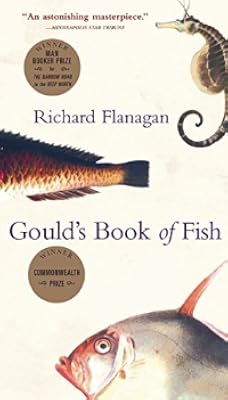
Gould's Book of Fish
by Richard Flanagan
On This Page
Description
Once upon a time that was called 1828, before all the living things on the land and the fishes in the sea were destroyed, there was a man named William Buelow Gould, a convict in Van Dieman's Land who fell in love with a black woman and discovered too late that to love is not safe. Silly Billy Gould, invader of Australia, liar, murderer, forger, fantasist, condemned to live in the most brutal penal colony in the British Empire, and there ordered to paint a book of fish. Once upon a time, show more miraculous things happened... show lessTags
Recommendations

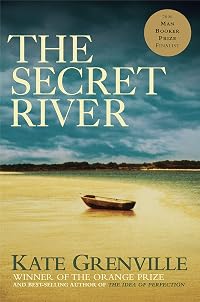
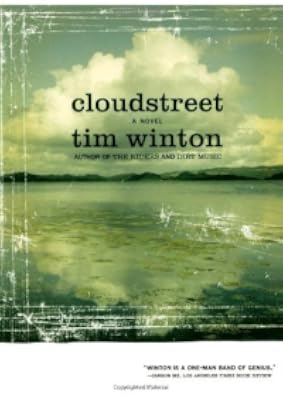


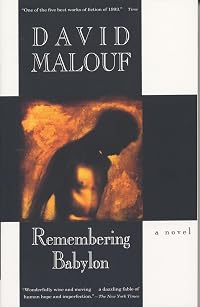
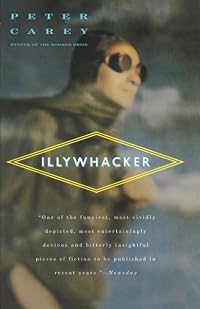
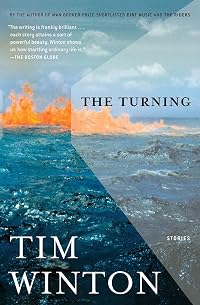
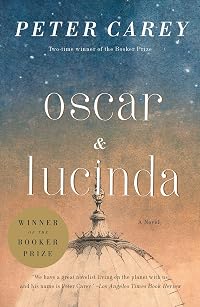
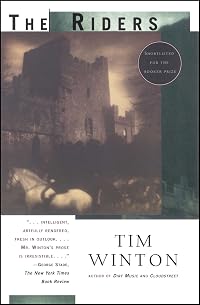
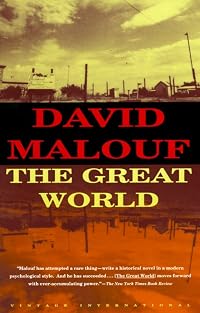
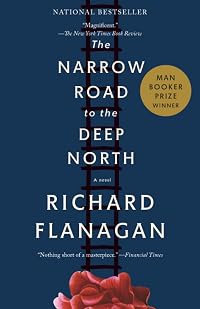














Member Recommendations

Member Reviews
Gould is possibly the most untrustworthy narrator ever created, but he is all we have, and he is so damn compelling that we just make do. He has been exiled to Australia for at least one of a variety of real or mistaken crimes (including forgery, murder, sexing up the wrong people, and disrespecting the flag). And when he eventually is sentenced to the worst and most isolated prison on the rough west coast of Tasmania, he is mistaken by the prison surgeon as an artist, and commissioned to paint realistic drawings of the fish that are brought up in the colony nets for a scientific project in England. Even though he is not really an artist, he likes the small perks that come with the position, and goes with it. At first hating the fish, show more then loving them, and eventually merging with them completely.
This book has a Tristram Shandyness about it, mixed with a huge dose of colonialism and fishy philosophy. The narrative is at once loose and unconventional, and tightly constructed and satisfying. Absolutely worth checking out.
[full review here: http://spacebeer.blogspot.com/2009/10/goulds-book-of-fish-2001.html ] show less
This book has a Tristram Shandyness about it, mixed with a huge dose of colonialism and fishy philosophy. The narrative is at once loose and unconventional, and tightly constructed and satisfying. Absolutely worth checking out.
[full review here: http://spacebeer.blogspot.com/2009/10/goulds-book-of-fish-2001.html ] show less
A sprawling and grotesque post-modern masterpiece that's like a cross between Dickens, Joyce and Iain Banks. It's set in a fictional and often baroque magic realist version of Nineteenth Century Tasmania/Van Diemen's Land, with a combination of historical characters, allegorical figures and fantasy versions of real people. Tough going and not for the faint-hearted, but brilliant.
Flanagan at his most willfully difficult with prose that's both fine-grained and gnarled.
Flanagan at his most willfully difficult with prose that's both fine-grained and gnarled.
This is a tragicomic, grotesque, fantasmagoric story of a convict in an early 19th century prison colony on Sarah Island in Van Diemen's Land (now Tasmania). It's an effective approach for showing the horror of the genocide of the native population, the rape of the land, and the lunacy of Rabelaisian-like British characters untethered from the (relative) sanity of their home society, without making readers want to kill themselves after reading it.
If I saw this description before reading the book, I'd never have picked it up, but I'm glad I did. What kept me reading was the genius of the writing. It's hard to pick one sample, but here's one that speaks to the nature of the book itself:
Because, you see, it sometimes seems so elusive, show more this book, a series of veils, each of which must be lifted and parted to reveal only another of its kind, to arrive finally at emptiness, a lack of words, at the sound of the sea, of the great Indian Ocean through which I see in my mind's eye Gould now advancing towards Sarah Island, now receding; that sound, that sight, slowly pulsing in and out, in and out.
. show less
If I saw this description before reading the book, I'd never have picked it up, but I'm glad I did. What kept me reading was the genius of the writing. It's hard to pick one sample, but here's one that speaks to the nature of the book itself:
Because, you see, it sometimes seems so elusive, show more this book, a series of veils, each of which must be lifted and parted to reveal only another of its kind, to arrive finally at emptiness, a lack of words, at the sound of the sea, of the great Indian Ocean through which I see in my mind's eye Gould now advancing towards Sarah Island, now receding; that sound, that sight, slowly pulsing in and out, in and out.
. show less
Six-word review: Elaborately realized fantasy of self-emancipation.
Extended review:
When I see that a book is good, meaning well written and (according to my best understanding) successful in accomplishing what it set out to do, but I just don't happen to like it very much, I have a hard time writing a review. I've had that problem a few times lately, and here it is again.
It's hard to say why this novel didn't appeal to me. The subject matter is not at all pretty, consisting as it does primarily of the narrator's account of life in a brutal prison environment peopled by some remarkable characters: the Surgeon, the Commandant, Twopenny Sal. Yet there is a strange beauty in the language of Flanagan's descriptions, fluid and brilliant as show more painted fish. A filmy veil of delusion or hallucination seems to overlay the storyline, giving it a dreamlike quality even as the horrific details nail it in reality like spikes in flesh. In most cases (and for me The Enchanted is a recent five-star example) this level of authorial skill is enough to trump any revulsion at subject matter, just as so many paintings of tortured saints rank with great art.
Yet something simply didn't work for me here; or perhaps I was after all not quite receptive enough. I can't say that I was put off by the colored ink of the body text, but it did sound a gimmick alarm in my mind; instead of enhancing the effect, for me, it became something of a distraction that I had to overcome.
There is a stratum of historical fact underlying this extraordinary work of fiction. The paintings that head each chapter are the actual work of one William Buelow Gould, convict, whose imprisonment in an island penal colony in Tasmania in the mid-nineteenth century is a matter of record. If anything, that factual basis and surrounding documentary detail make this product of artistic imagination seem even more fantastic than it would if it had been sheer invention.
The very notion of wrapping a complex surrealistic narrative around a series of fish paintings would tax the inventive powers of some authors to the limit, but for Flanagan it's only the beginning. It is a sure credit to the author's seductive storytelling that the leap at the end carries us with him across another dimension.
The narrator quotes Erasmus (page 252): "The reality of things depends solely on opinion." This is the faceted crystal that reflects in rainbows throughout the text.
It's for books like this that I try to maintain a clear separation in my mind between "I like it" and "it's good" (a distinction that also leaves me free to dote on things that aren't terribly excellent), even though I don't think it's possible to achieve objectivity in judging a creative work. I'll call this book very good and leave the loving of it to others. show less
Extended review:
When I see that a book is good, meaning well written and (according to my best understanding) successful in accomplishing what it set out to do, but I just don't happen to like it very much, I have a hard time writing a review. I've had that problem a few times lately, and here it is again.
It's hard to say why this novel didn't appeal to me. The subject matter is not at all pretty, consisting as it does primarily of the narrator's account of life in a brutal prison environment peopled by some remarkable characters: the Surgeon, the Commandant, Twopenny Sal. Yet there is a strange beauty in the language of Flanagan's descriptions, fluid and brilliant as show more painted fish. A filmy veil of delusion or hallucination seems to overlay the storyline, giving it a dreamlike quality even as the horrific details nail it in reality like spikes in flesh. In most cases (and for me The Enchanted is a recent five-star example) this level of authorial skill is enough to trump any revulsion at subject matter, just as so many paintings of tortured saints rank with great art.
Yet something simply didn't work for me here; or perhaps I was after all not quite receptive enough. I can't say that I was put off by the colored ink of the body text, but it did sound a gimmick alarm in my mind; instead of enhancing the effect, for me, it became something of a distraction that I had to overcome.
There is a stratum of historical fact underlying this extraordinary work of fiction. The paintings that head each chapter are the actual work of one William Buelow Gould, convict, whose imprisonment in an island penal colony in Tasmania in the mid-nineteenth century is a matter of record. If anything, that factual basis and surrounding documentary detail make this product of artistic imagination seem even more fantastic than it would if it had been sheer invention.
The very notion of wrapping a complex surrealistic narrative around a series of fish paintings would tax the inventive powers of some authors to the limit, but for Flanagan it's only the beginning. It is a sure credit to the author's seductive storytelling that the leap at the end carries us with him across another dimension.
The narrator quotes Erasmus (page 252): "The reality of things depends solely on opinion." This is the faceted crystal that reflects in rainbows throughout the text.
It's for books like this that I try to maintain a clear separation in my mind between "I like it" and "it's good" (a distinction that also leaves me free to dote on things that aren't terribly excellent), even though I don't think it's possible to achieve objectivity in judging a creative work. I'll call this book very good and leave the loving of it to others. show less
Sometimes the buzz surrounding a book crashes through my everyday. Such is the case with "Gould's Book of Fish," a story ultimately about the brutal strength of empire and the truly callous way science applied itself in the service of accepted wisdom in the 19th century.
The prison surgeon, an obese, self-absorbed, and manically ambitious individual, assigns Billy Gould, a small-time forger and crook, the job of painting the various species of fish caught by the surgeon and others. Additionally, the camp's commandant, himself an impostor wearing a gold mask, is skimming funds from the government to build a new city-state in this island off the coast of Tasmania. Well, the surgeon, who wanted to advance the art of Enlightenment show more classification, is killed and eaten by his pet pig and becomes "the largest pig turd on the planet." The commandant, too, comes to an appropriately ghastly end. But these plot particulars do not begin to inform you about this remarkable, outrageous outlier of a book. Flanagan blesses his reader with a very healthy dose of the outlandish, the impossible. There is an ultimate metamorphosis in the book which I will not spoil. The triumph of the book for the author is in its unbelievably inventive plot devices and prose. The triumph for the reader and the main character is the final transcendence over the Enlightenment's compunction to classify everything (including aboriginals as sub-human), and the madness of Britain's imperial and penal systems.
Oh my gosh! If you've missed this one so far, you should definitely open it up. Its plot elements may not be for everyone, but the theme of man's inhumanity etc. etc. is universal.
http://bassoprofundo1.blogspot.com/2010/07/goulds-book-of-fish-novel-in-twelve.h... show less
The prison surgeon, an obese, self-absorbed, and manically ambitious individual, assigns Billy Gould, a small-time forger and crook, the job of painting the various species of fish caught by the surgeon and others. Additionally, the camp's commandant, himself an impostor wearing a gold mask, is skimming funds from the government to build a new city-state in this island off the coast of Tasmania. Well, the surgeon, who wanted to advance the art of Enlightenment show more classification, is killed and eaten by his pet pig and becomes "the largest pig turd on the planet." The commandant, too, comes to an appropriately ghastly end. But these plot particulars do not begin to inform you about this remarkable, outrageous outlier of a book. Flanagan blesses his reader with a very healthy dose of the outlandish, the impossible. There is an ultimate metamorphosis in the book which I will not spoil. The triumph of the book for the author is in its unbelievably inventive plot devices and prose. The triumph for the reader and the main character is the final transcendence over the Enlightenment's compunction to classify everything (including aboriginals as sub-human), and the madness of Britain's imperial and penal systems.
Oh my gosh! If you've missed this one so far, you should definitely open it up. Its plot elements may not be for everyone, but the theme of man's inhumanity etc. etc. is universal.
http://bassoprofundo1.blogspot.com/2010/07/goulds-book-of-fish-novel-in-twelve.h... show less
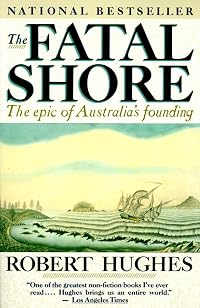
Dear reader, if you decide you want to read this book, I have one burning hot tip for you: don't read The Fatal Shore immediately before it. Friends and wife told me this book was dark, disturbing etc... which it certainly would have been had I *not* been reading FS at the same time. But I was. So many of the dark incidents in Flanagan's novel are taken almost verbatim from Hughes' history that I couldn't really take them seriously the second time round.
This points to a larger problem for Gould's, for me at least: the book is so obviously built from other books. The Fatal Shore is the most obvious, but also, for instance, Ulysses, Heart of Darkness, Moby Dick, the poems of Rilke, Buddhist texts (definitely) and, possibly, Blood show more Meridian. So my reading experience consisted almost entirely in train-spotting of a fairly uninteresting variety.
That said, I'm still an academic at heart, so:
* Like Ulysses, Gould's is overly structured. Each chapter has at the very least a governing fish, a governing character, a governing characters and, to some degree, a governing style. Do you find this kind of thing interesting? I do so decreasingly.
* Like Rilke and various Buddhist texts, there's a lot of stuff here about escaping from being human, searching for immediate experience and essentially just wanting to be a rock, because rocks don't do anything (or, at the very least, don't do anything wrong). (Also, there are *direct quotes from Rilke*. The anachronisms aren't crippling, but the tiresomeness of writing from the perspective of a non-literary type who is obsessed by Wordsworth and Rilke... well, just write from the perspective of a literary type if you want to do that).
* Like every other book you've ever read, Gould's involves a lot of stuff about how love will save us all blah blah blah. Odd that it never works, even in books. Almost as if love wasn't actually enough to save anyone, but that the thought that it were is enough to salve the consciences of wealthy Westerners.
* Like Moby Dick in the USA, Gould's is an allegory of Australian history. This is more my style. Less my style are the magical realist elements, but I accept that that is just subjective opinion. If you like magical realism, you'll probably like this--it's the Australian version: these aspects of Australian history (so the story goes) are unspoken, and (the book implies) can best be brought to the surface by allegorical/surrealist style. The fact that the book retells much of the story of the Fatal Shore kind of puts a dent in this, but for an Australian at least, it's fun to imagine that our history is important enough to require literary attention.
* Like every postmodern book you've ever read, there's lots of recursiveness here. I don't find that particularly interesting in this case--the novel stands without it, and it adds nothing other than the obligatory "oh, literature, it's so unreliable" garbage (really? because I thought literature was a scientific observation of sub-molecular reality!), but perhaps you will.
But I'm in quite a bind, because what I think is most valuable about the book is its willingness to deal with major intellectual and historical questions. The style is a bit tour-de-forcish, rather than being really enjoyable; the structure, as I said, is externally imposed and adds little. But the ideas are well worth thinking through.
I was worried, I confess, when we got the dull "oh, I'm just a character in a book, I have to destroy the book because words and art are just so constricting of my natural immediate experience" stuff. And I was very upset when this was somehow combined with the "love will save us all" stuff.
But then, so close to intellectual disaster, Flanagan saves his novel in the last few pages: Gould admits that these two positions are completely contradictory--that love is fundamentally human and cultural, not natural. And yet Gould *feels* them both. That's interesting.
So, I'm not sure this is the masterpiece so many people claim, but I am sure it was well worth reading, and I'm excited by Flanagan's ambition. From what I can tell, his recent award winner is, well, not so ambitious. show less
This points to a larger problem for Gould's, for me at least: the book is so obviously built from other books. The Fatal Shore is the most obvious, but also, for instance, Ulysses, Heart of Darkness, Moby Dick, the poems of Rilke, Buddhist texts (definitely) and, possibly, Blood show more Meridian. So my reading experience consisted almost entirely in train-spotting of a fairly uninteresting variety.
That said, I'm still an academic at heart, so:
* Like Ulysses, Gould's is overly structured. Each chapter has at the very least a governing fish, a governing character, a governing characters and, to some degree, a governing style. Do you find this kind of thing interesting? I do so decreasingly.
* Like Rilke and various Buddhist texts, there's a lot of stuff here about escaping from being human, searching for immediate experience and essentially just wanting to be a rock, because rocks don't do anything (or, at the very least, don't do anything wrong). (Also, there are *direct quotes from Rilke*. The anachronisms aren't crippling, but the tiresomeness of writing from the perspective of a non-literary type who is obsessed by Wordsworth and Rilke... well, just write from the perspective of a literary type if you want to do that).
* Like every other book you've ever read, Gould's involves a lot of stuff about how love will save us all blah blah blah. Odd that it never works, even in books. Almost as if love wasn't actually enough to save anyone, but that the thought that it were is enough to salve the consciences of wealthy Westerners.
* Like Moby Dick in the USA, Gould's is an allegory of Australian history. This is more my style. Less my style are the magical realist elements, but I accept that that is just subjective opinion. If you like magical realism, you'll probably like this--it's the Australian version: these aspects of Australian history (so the story goes) are unspoken, and (the book implies) can best be brought to the surface by allegorical/surrealist style. The fact that the book retells much of the story of the Fatal Shore kind of puts a dent in this, but for an Australian at least, it's fun to imagine that our history is important enough to require literary attention.
* Like every postmodern book you've ever read, there's lots of recursiveness here. I don't find that particularly interesting in this case--the novel stands without it, and it adds nothing other than the obligatory "oh, literature, it's so unreliable" garbage (really? because I thought literature was a scientific observation of sub-molecular reality!), but perhaps you will.
But I'm in quite a bind, because what I think is most valuable about the book is its willingness to deal with major intellectual and historical questions. The style is a bit tour-de-forcish, rather than being really enjoyable; the structure, as I said, is externally imposed and adds little. But the ideas are well worth thinking through.
I was worried, I confess, when we got the dull "oh, I'm just a character in a book, I have to destroy the book because words and art are just so constricting of my natural immediate experience" stuff. And I was very upset when this was somehow combined with the "love will save us all" stuff.
But then, so close to intellectual disaster, Flanagan saves his novel in the last few pages: Gould admits that these two positions are completely contradictory--that love is fundamentally human and cultural, not natural. And yet Gould *feels* them both. That's interesting.
So, I'm not sure this is the masterpiece so many people claim, but I am sure it was well worth reading, and I'm excited by Flanagan's ambition. From what I can tell, his recent award winner is, well, not so ambitious. show less
William Bulow Gould - con-man, rogue and convict in Tasmania's brutal prison system of the 19th century. As the tiny world around him descends into madness, Gould saw the worst of the Van Diemen's Land convict system - a place where outcasts and dreamers were sent. He finds purpose and identity as a fraudulent artist, and slowly loses his mind over the course of his surreal and incredulous incarceration. A classic book of imaginative historical fiction from a Booker Prize winning author.
Members
- Recently Added By
Published Reviews
ThingScore 100
Richard Flanagan schreef een sublieme roman die voor de eretitel in aanmerking komt en die de verbeelding inzet tegen de misdaden van de geschiedenis.
Gould's Book of Fish van Richard Flanagan, is echter alles wat een Great Australian Novel kan zijn, en nog veel meer.
Gould's Book of Fish is een verhaal dat Rabelais, Sterne, García Márquez, Swift, Dickens, Joyce, Melville, Walt Whitman en nog show more heel wat andere schrijvers in herinnering brengt, in zijn uitbundigheid, humor, archaïsche verteltrant en ouderwetse horror. show less
Gould's Book of Fish van Richard Flanagan, is echter alles wat een Great Australian Novel kan zijn, en nog veel meer.
Gould's Book of Fish is een verhaal dat Rabelais, Sterne, García Márquez, Swift, Dickens, Joyce, Melville, Walt Whitman en nog show more heel wat andere schrijvers in herinnering brengt, in zijn uitbundigheid, humor, archaïsche verteltrant en ouderwetse horror. show less
added by sneuper
Of the many extraordinary aspects of this novel, the most immediately obvious is its appearance.
In its persistent concern with transformations, melding and minglings, and their opposites - fixity, category and class - Gould's Book of Fish is reminiscent of Lewis Carroll's Alice books, with their endless transmogrifications, their portmanteau creatures and their jumps of scale and size.
What show more makes Gould's Book of Fish remarkable is its reconciliation of metafictionality with humanity. For while it is pervasively self-conscious, it is also a humanly troubled book: ferocious in its anger, grotesque, sexy, funny, violent, startlingly beautiful and, perhaps above all, heartbreakingly sad.
Flanagan has written a book whose uniqueness mirrors its principal theme - the dangers of classification. I urge you to read it. show less
In its persistent concern with transformations, melding and minglings, and their opposites - fixity, category and class - Gould's Book of Fish is reminiscent of Lewis Carroll's Alice books, with their endless transmogrifications, their portmanteau creatures and their jumps of scale and size.
What show more makes Gould's Book of Fish remarkable is its reconciliation of metafictionality with humanity. For while it is pervasively self-conscious, it is also a humanly troubled book: ferocious in its anger, grotesque, sexy, funny, violent, startlingly beautiful and, perhaps above all, heartbreakingly sad.
Flanagan has written a book whose uniqueness mirrors its principal theme - the dangers of classification. I urge you to read it. show less
added by sneuper
Lists

Best Historical Fiction
620 works; 257 members

Best books about books
209 works; 106 members

Unread books
1,063 works; 85 members

Animals in the Title
498 works; 11 members

Biggest Disappointments
606 works; 168 members

Most Popular Books Tagged Australia
35 works; 5 members

Allie's Wishlist
217 works; 2 members

Most Frequently Tagged "Read in 2015"
70 works; 1 member

Booktopia's 50 Must Read Australian Novels
50 works; 5 members

Books whose title names an object usually found in the kitchen
171 works; 14 members
Author Information

21+ Works 9,947 Members
Richard Flanagan was born in Longford, Tasmania, in 1961. He received a Master of Letters degree from Oxford University. His first novel, Death of a River Guide, won Australia's National Fiction Award. His works include The Sound of One Hand Clapping, The Unknown Terrorist, and four history books. He has received numerous awards including the show more Commonwealth Writers Prize for Gould's Book of Fish, the 2011 Tasmania Book Prize for Wanting, and the 2014 Man Booker Prize for The Narrow Road to the Deep North. He directed a feature film version of The Sound of One Hand Clapping. He was also shortlisted for the UK Indie Booksellers Award with The Narrow Road to the Deep North. This same title was won the Margaret Scott Prize for best book by a Tasmanian writer 2015. In 2018, The Narrow Road to the Deep North will be made into an international television series. The University of Melbourne has appointed him as the Boisbouvier Founding Chair in Australian Literature at the University of Melbourne, a new professorship to 'advance the teaching, understanding and public appreciation of Australian literature'. (Bowker Author Biography) show less
Some Editions
Awards and Honors
Awards
Notable Lists
Series
Belongs to Publisher Series
Common Knowledge
- Canonical title*
- La vita sommersa di Gould
- Original title
- Gould's Book of Fish
- Original publication date
- 2001
- People/Characters*
- William Buelow Gould; Der Kommandant; Sid Hammett; Dr. Lempriere; Sally Twopence
- Important places
- Tasmania, Australia
- Epigraph
- My mother is a fish.
~ William Faulkner - First words
- My wonder upon discovering the Book of Fish remains with me yet, luminous as the phosphorescent marbling that seized my eyes that strange morning; glittering as those eerie swirls that coloured my mind and enchanted my... (show all) soul--which there and then began the process of unravelling my heart and, worse still, my life into the poor, scraggy skein that is this story you are about to read.
- Last words
- (Click to show. Warning: May contain spoilers.)Who am I? he can no longer ask & I--my punishment perfect for one who has taken a life but not gained another in return--can only wish for the certainty to answer: I am William Buelow Gould & my name is a song which will be sung, click-clack--rat-a-tat-a-tat, a penny a painting, silly Billy Gould riding a seahorse to Banbury Cross. . .
*Some information comes from Common Knowledge in other languages. Click "Edit" for more information.
Classifications
- Genres
- General Fiction, Fiction and Literature, Historical Fiction
- DDC/MDS
- 823.914 — Literature & rhetoric English & Old English literatures English fiction 1900- 1901-1999 1945-1999
- LCC
- PR9619.3 .F525 .G68 — Language and Literature English English Literature English literature: Provincial, local, etc.
- BISAC
Statistics
- Members
- 1,835
- Popularity
- 11,817
- Reviews
- 46
- Rating
- (3.66)
- Languages
- 14 — Armenian, Danish, Dutch, English, French, German, Italian, Lithuanian, Norwegian (Bokmål), Polish, Portuguese, Romanian, Spanish, Swedish
- Media
- Paper, Audiobook, Ebook
- ISBNs
- 55
- ASINs
- 15