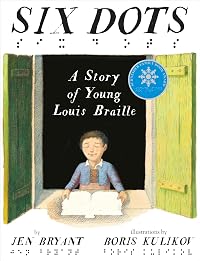
Six Dots: A Story of Young Louis Braille
by Jen Bryant
On This Page
Description
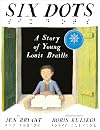
Louis Braille was just five years old when he lost his sight. He was a clever boy, determined to live like everyone else, and what he wanted more than anything was to be able to read. Even at the school for the blind in Paris, there were no books for him. And so he invented his own alphabet -- a whole new system for writing that could be read by touch. A system so ingenious that it is still used by the blind community today.Tags
Recommendations









Member Reviews
Author Jen Bryant and illustrator Boris Kulikov explore the childhood of Louis Braille in this lovely picture-book, describing how he came to be blind at a young age, and how he struggled with the fact that there were no books for him to read. Eventually sent to the Royal School for the Blind in Paris, he was inspired by a code of raised dots used for nighttime battle communication to create braille writing. A revolutionary system, one that has been adopted in many countries, this raised dot alphabet allowed blind students to read and write easily for the first time, and was an astonishing creation, given Louis Braille's mere fifteen years of age, at the time of invention. The book concludes with an afterword that gives more information show more about braille and its inventor, and that provides a list of reading ideas and resources...
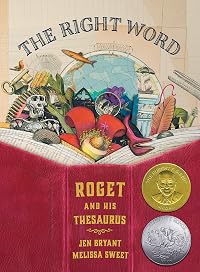
Six Dots: A Story of Young Louis Braille is the fourth picture-book biography I have read from Bryant, following upon The Right Word: Roget and His Thesaurus, A Splash of Red: The Life and Art of Horace Pippin and A River of Words: The Story of William Carlos Williams, all of which were illustrated by Melissa Sweet. Kulikov has a very different style to Sweet, but I found his artwork engaging, and thought it well-suited to the narrative. I particularly appreciated the use of a black background in those scenes in which Louis attempts to make sense of the world around him without his sight, as this gives visual emphasis to his different perceptual experiences, compared to his family and the people in his village. This isn't the story of Braille's entire life, but of his youth and the process whereby he invented braille writing. As Bryant explains in her afterword, it is an attempt to explore how he must have felt, losing his sight, and then struggling to find a way to read and learn. Recommended to picture-book readers who enjoy biographies, or who are interested in braille writing and/or the experiences of the blind.
Addendum: I don't often address other reviews in my own responses, but I am somewhat surprised and dismayed to see that a number of people have panned this one, because the braille writing system isn't represented here in braille. I find this rather puzzling, as these fellow readers must be aware that the book is intended for sighted children. After all, none of them seem to be objecting to the presence of artwork, which requires sight in order to appreciate. While I do think it would have been a nice touch, and quite educational, if a page of braille had been included, I do understand that it is costly to produce, and that the publisher may not have been able to include it. Disappointment at the absence of braille may be understandable - I think it's a missed opportunity myself - but to give the book one star as a result, or to say that it cannot be recommended, strikes me as ludicrously unreasonable. show less
Six Dots: A Story of Young Louis Braille is the fourth picture-book biography I have read from Bryant, following upon The Right Word: Roget and His Thesaurus, A Splash of Red: The Life and Art of Horace Pippin and A River of Words: The Story of William Carlos Williams, all of which were illustrated by Melissa Sweet. Kulikov has a very different style to Sweet, but I found his artwork engaging, and thought it well-suited to the narrative. I particularly appreciated the use of a black background in those scenes in which Louis attempts to make sense of the world around him without his sight, as this gives visual emphasis to his different perceptual experiences, compared to his family and the people in his village. This isn't the story of Braille's entire life, but of his youth and the process whereby he invented braille writing. As Bryant explains in her afterword, it is an attempt to explore how he must have felt, losing his sight, and then struggling to find a way to read and learn. Recommended to picture-book readers who enjoy biographies, or who are interested in braille writing and/or the experiences of the blind.
Addendum: I don't often address other reviews in my own responses, but I am somewhat surprised and dismayed to see that a number of people have panned this one, because the braille writing system isn't represented here in braille. I find this rather puzzling, as these fellow readers must be aware that the book is intended for sighted children. After all, none of them seem to be objecting to the presence of artwork, which requires sight in order to appreciate. While I do think it would have been a nice touch, and quite educational, if a page of braille had been included, I do understand that it is costly to produce, and that the publisher may not have been able to include it. Disappointment at the absence of braille may be understandable - I think it's a missed opportunity myself - but to give the book one star as a result, or to say that it cannot be recommended, strikes me as ludicrously unreasonable. show less
Just wow!
The artwork evokes a childlike wonder almost feels like stepping into a fable,but nothing sinister is lurking around the corner. While the language is simplistic it conveys such depth,empathy and understanding for blind children and disable children on a humanistic fundamental level that makes it quite universal for whomever the reader might be. It really touched my heart in an unexpected way. I also enjoyed the q&a portion at the end of the book,in addition to the Braille alphabet. What a lovely/unexpected surprise. I think books like this could teach kids a lot about empathy and civil duty. It would be a nice addition to those reading corners for kids.
The artwork evokes a childlike wonder almost feels like stepping into a fable,but nothing sinister is lurking around the corner. While the language is simplistic it conveys such depth,empathy and understanding for blind children and disable children on a humanistic fundamental level that makes it quite universal for whomever the reader might be. It really touched my heart in an unexpected way. I also enjoyed the q&a portion at the end of the book,in addition to the Braille alphabet. What a lovely/unexpected surprise. I think books like this could teach kids a lot about empathy and civil duty. It would be a nice addition to those reading corners for kids.
I really wanted to like this book more than I did. I loved the idea behind it and the subject matter - it made me want to do a deep dive to learn more about Louis Braille. However, something felt off for me. I wasn't a fan of the illustrations and it was an odd choice of many details that were highlighted in the story. With such a rich subject matter, there was so much that could have been done with the book's presentation, be it incorporating braille along with text or other ways of interacting with the story. It seemed like a missed opportunity. That said, I appreciate seeing a nonfiction picture book covering this topic.
I had no idea Louis Braille invented his reading system as a teenager! Bryant tells Louis Braille's story in the first person, giving readers a sense of immediacy and empathy. Backmatter includes more historical information and resources. Follow up a reading with some actual Braille to explore or show video of someone reading Braille.
I read this book while standing in line at the children's desk in my local library. I knew nothing about Louis Braille, so it was all news to me. Very interesting, very sad, but also quite inspiring to hear how a young, blind, man could achieve so much. This illustrations are excellent. Poor Louis' injury and subsequent blindness are horrible and distressing.
Louis is blinded at a young age. He is smart and hungry for knowledge, but there are no books for blind children. He finally goes to a school for the blind, but the books are impractical and can't fit very much information. He ultimately invents a way of writing for the blind taken from a military code.
This story was, at times, gruesome and hard to read, but realistic and when Louis ultimately perseveres the reader feels for him. I liked the illustrations and especially loved how Louis world becomes black and white drawn in chalk after he is blinded.
This story was, at times, gruesome and hard to read, but realistic and when Louis ultimately perseveres the reader feels for him. I liked the illustrations and especially loved how Louis world becomes black and white drawn in chalk after he is blinded.
This book, which tells the story of Louis Braille, begins by showing the Braille Alphabet on the end papers, followed by a pronunciation guide for the French names and phrases that appear in the ensuing text.
The story came out of the author’s curiosity over what it would have been like to have been Louis Braille, the blind inventor of a system of reading and writing for the sight-impaired still in use today.
Louis went blind when he was three years old following an accident in his father’s harness workshop. When he was ten, he got a scholarship to a school for the blind in Paris, but the students had to read by tracing raised letters, and it was a very long and tedious process.
Then the headmaster announced that they would try using show more the same code the army employed to send secret messages during battle. That code used twelve raised dots, but at the age of sixteen, Louis revised the system to be much easier, using only six dots, and published the first-ever book using the “Braille” method at age twenty.
An Author’s Note following the book tells more of Braille’s accomplishments. For example, with the help of a friend, he developed raphigraphy, allowing blind and sighted people to write to each other. He even invented a typewriter-like machine for raphigraphy.
Louis mastered the cello and the organ, and tuned pianos. He developed a system of musical notation for visually impaired musicians. He went on to become a professor at the Royal Institute for Blind Youth and taught history, grammar, geography, and math. He died of tuberculosis two days after his forty-third birthday. The author reports that on the one hundredth anniversary of his death in 1952, his body was placed in the Pantheon in Paris, “the final resting place of France’s greatest men and women.”
As Bryant notes in her Afterword, Helen Keller compared Braille to Gutenberg, the inventor of the printing press: “Before Braille, the blind were shut off from reading and writing. The Braille system changed all that.” She also notes that the support of Louis’s family for him was unusual at the time: “Blind, deaf, or otherwise physically challenged children were often abandoned or given over to a traveling ‘master’, who taught them to sing, dance, or perform tricks for money, much like circus animals.” Both Louis and the world were lucky his parents were different.
The author includes a list of books and websites for additional information.
The illustrations are by Boris Kulikov, who worked as a set and costume designer after graduating from the Institute of Theater, Music, and Cinema in St. Petersburg. Kulikov uses an interesting blend of mixed-media, adding chalk on a black background at times, that helps convey the difference of Braille’s internal reality.
Evaluation: This is a story that will inspire all ages. Braille not only overcame adversity with pluck and ingenuity, but did so in a way that made the world a better place for millions. Today Braille is celebrated around the world. show less
The story came out of the author’s curiosity over what it would have been like to have been Louis Braille, the blind inventor of a system of reading and writing for the sight-impaired still in use today.
Louis went blind when he was three years old following an accident in his father’s harness workshop. When he was ten, he got a scholarship to a school for the blind in Paris, but the students had to read by tracing raised letters, and it was a very long and tedious process.
Then the headmaster announced that they would try using show more the same code the army employed to send secret messages during battle. That code used twelve raised dots, but at the age of sixteen, Louis revised the system to be much easier, using only six dots, and published the first-ever book using the “Braille” method at age twenty.
An Author’s Note following the book tells more of Braille’s accomplishments. For example, with the help of a friend, he developed raphigraphy, allowing blind and sighted people to write to each other. He even invented a typewriter-like machine for raphigraphy.
Louis mastered the cello and the organ, and tuned pianos. He developed a system of musical notation for visually impaired musicians. He went on to become a professor at the Royal Institute for Blind Youth and taught history, grammar, geography, and math. He died of tuberculosis two days after his forty-third birthday. The author reports that on the one hundredth anniversary of his death in 1952, his body was placed in the Pantheon in Paris, “the final resting place of France’s greatest men and women.”
As Bryant notes in her Afterword, Helen Keller compared Braille to Gutenberg, the inventor of the printing press: “Before Braille, the blind were shut off from reading and writing. The Braille system changed all that.” She also notes that the support of Louis’s family for him was unusual at the time: “Blind, deaf, or otherwise physically challenged children were often abandoned or given over to a traveling ‘master’, who taught them to sing, dance, or perform tricks for money, much like circus animals.” Both Louis and the world were lucky his parents were different.
The author includes a list of books and websites for additional information.
The illustrations are by Boris Kulikov, who worked as a set and costume designer after graduating from the Institute of Theater, Music, and Cinema in St. Petersburg. Kulikov uses an interesting blend of mixed-media, adding chalk on a black background at times, that helps convey the difference of Braille’s internal reality.
Evaluation: This is a story that will inspire all ages. Braille not only overcame adversity with pluck and ingenuity, but did so in a way that made the world a better place for millions. Today Braille is celebrated around the world. show less
Members
- Recently Added By
Lists

Youth: Personal Values
252 works; 1 member
Author Information

27+ Works 4,296 Members
All Editions
Awards and Honors
Awards
Distinctions
Notable Lists
Common Knowledge
- People/Characters
- Louis Braille
Classifications
- DDC/MDS
- 686.2 — Applied science & technology Manufacture for specific uses Printing and related activities Printing
- LCC
- HV1624 .B65 .B793 — Social sciences Social pathology. Social and public welfare. Criminology Social pathology. Social and public welfare. Protection, assistance and relief Special classes People with disabilities
- BISAC
Statistics
- Members
- 523
- Popularity
- 57,463
- Reviews
- 41
- Rating
- (4.17)
- Languages
- Chinese, English
- Media
- Paper, Ebook
- ISBNs
- 9
- UPCs
- 1
- ASINs
- 1