In the Shape of a Boar
by Lawrence Norfolk
On This Page
Description
The hunt for the great boar of Kalydon is re-enacted in the last days of World War II, only this time an SS officer is the quarry and Greek partisans the hunters. Their witness is a young Romanian Jew, finding refuge in the Greek mountains, who is inspired to re-write the story as a poem.Tags
Recommendations

















Member Reviews
I think this a book that defies explanation. In some ways the way the story unfolds is ambiguous and I think the reader has to work hard to understand all the layers and strands that Norfolk brings to his tale. The first part is reasonably straightforward a rewriting of an ancient Greek myth - the hunt for the Boar of Kalydon. Though even here things are not quite what they seem and his heavy use of footnotes of primary sources made heavy reading at time and as the story progresses the footnotes expand to provide more information. The second part consists of the memories of Solomon Memel, mainly dealing with his wartime experiences and his later success as a poet. The time is the 1970's and an old friend is creating a film of his most show more famous poem - a blending of the ancient Greek myth and his own time in Greece.
This is a story of ambiguity; the fallibility of memory and the need for mythology ... and the creation and hunting of the "beast". Norfolk does not make life easy for the reader but, in my opinion, this was well worth the time and is definitely thought provoking. show less
This is a story of ambiguity; the fallibility of memory and the need for mythology ... and the creation and hunting of the "beast". Norfolk does not make life easy for the reader but, in my opinion, this was well worth the time and is definitely thought provoking. show less
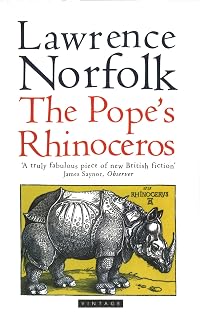
This was Lawrence Norfolk's third novel, and though it is no longer in print it is not too hard to find affordable second hand copies. It is a lot shorter than [b:Lemprière’s Dictionary|288460|Lemprière’s Dictionary|Lawrence Norfolk|https://i.gr-assets.com/images/S/compressed.photo.goodreads.com/books/1320388539l/288460._SY75_.jpg|969711] or [b:The Pope's Rhinoceros|1424596|The Pope's Rhinoceros|Lawrence Norfolk|https://i.gr-assets.com/images/S/compressed.photo.goodreads.com/books/1356471284l/1424596._SY75_.jpg|1768519], but no less ambitious, indeed had the Goldsmiths Prize been around at the time it would have been a contender.
The book has a complicated structure. The first third is a retelling/interpolation of various Greek show more myths involving the hunt for the boar of Kalydon, told in modern prose with plenty of academic footnotes which seem excessive (there are plenty of pages in which there are more footnote than text) but gain significance later. The hunt culminates in darkness, in a cave in a volcanic crater that is almost inaccessible.
The remainder alternates between Romania and Greece just before and during the Second World War, and Paris some years later. Its main protogonist is Sol(omon) Memel, a Jew from Romania who somehow escapes from the ghetto on foot and finds his way to the Greek mountains, where he falls into a state of exhausted delirium and finds a place that matches the description of the boar's cave, where he is rescued by Greek partisan fighters. The modern part of the story sees Sol as the writer of an epic poem inspired by his experiences in Greece, and concerns his involvement in its filming by Ruth, Sol's childhood friend from Romania. The later story parallels both the ancient one and the plot of Sol's epic poem, but towards the end of both parts a more sceptical questioning tone starts to dominate, and Sol is forced to admit that his real wartime experience was a little less heroic than the poem.
I found it an absorbing and enjoyable read, and it must have been a considerable technical feat to research and write it. show less
The book has a complicated structure. The first third is a retelling/interpolation of various Greek show more myths involving the hunt for the boar of Kalydon, told in modern prose with plenty of academic footnotes which seem excessive (there are plenty of pages in which there are more footnote than text) but gain significance later. The hunt culminates in darkness, in a cave in a volcanic crater that is almost inaccessible.
The remainder alternates between Romania and Greece just before and during the Second World War, and Paris some years later. Its main protogonist is Sol(omon) Memel, a Jew from Romania who somehow escapes from the ghetto on foot and finds his way to the Greek mountains, where he falls into a state of exhausted delirium and finds a place that matches the description of the boar's cave, where he is rescued by Greek partisan fighters. The modern part of the story sees Sol as the writer of an epic poem inspired by his experiences in Greece, and concerns his involvement in its filming by Ruth, Sol's childhood friend from Romania. The later story parallels both the ancient one and the plot of Sol's epic poem, but towards the end of both parts a more sceptical questioning tone starts to dominate, and Sol is forced to admit that his real wartime experience was a little less heroic than the poem.
I found it an absorbing and enjoyable read, and it must have been a considerable technical feat to research and write it. show less
An exploration of the myth of the Caledonian boar; an interesting effort, but comes up short.
Unlike all his other books, this one sucks.
Lawrence Norfolk's In the Shape of a Boar is a juggernaut of a novel, an epic tour de force of love and betrayal, ancient myths and modern horrors.
Oct 8, 2021Spanish
Ratings
Members
- Recently Added By
Author Information

Awards and Honors
Classifications
Statistics
- Members
- 272
- Popularity
- 119,447
- Reviews
- 5
- Rating
- (3.20)
- Languages
- 9 — Danish, Dutch, English, German, Hungarian, Italian, Portuguese, Croatian, Spanish
- Media
- Paper, Ebook
- ISBNs
- 17
- ASINs
- 2