On This Page
Description
A collection of the well-known stories, including "How the Whale Got His Throat," "The Elephant's Child," and "The Butterfly that Stamped."Tags
Recommendations













Member Recommendations

Member Reviews
This is one of the most imaginative, playful, writerly books I have ever read. And re-read. Twenty-nine year-old Kipling wrote this collection of twelve stories in collaboration with his young daughter, Josephine. It is a series of fantastical accounts of creation and re-creation within the animal kingdom. For instance, it explains: "in the "squoggy marshy country somewhere in Africa," and "on the great grey-green, greasy Limpopo River," the elephant got its long trunk when a crocodile got hold of his original "bulgy nose."
I include this collection in the grand storytelling tradition of Fables Choisies and Aesop's Fables. And this particular edition is a gem because it includes the original illustrations, with which none other show more compare.
As a writer, if ever I run short on words or inspiration, I need only re-visit one of these stories and the ideas start gushing.
As a mother, I think this is one of the best books I ever read to my son. It shows children the value of words and artful play, and gives license to the unlimited scope of imagination. show less
I include this collection in the grand storytelling tradition of Fables Choisies and Aesop's Fables. And this particular edition is a gem because it includes the original illustrations, with which none other show more compare.
As a writer, if ever I run short on words or inspiration, I need only re-visit one of these stories and the ideas start gushing.
As a mother, I think this is one of the best books I ever read to my son. It shows children the value of words and artful play, and gives license to the unlimited scope of imagination. show less
I had never read any Kipling so thought I would start with this children's book and well, it wasn't what I expected. I get that these were written in 1902 and like other famous authors contain racist passages, I just don't like it so blatant in my children's literature. Plus I didn't think these stories were as clever or stood the test of time the way other great children's literature like A.A. Milne's Winnie the Pooh has. (Yes, I know that was published in 1926 which is a bit later.) So, look at Beatrix Potter's books - those are much more clever as well and have easily stood the test of time and Peter Rabbit was first published in 1901.
If you're reading these for yourself and their historical value, sure go ahead. If you're looking show more for something to read to your child - honestly there are so many better choices out there. show less
If you're reading these for yourself and their historical value, sure go ahead. If you're looking show more for something to read to your child - honestly there are so many better choices out there. show less
Setting aside the problematic aspects of Kipling's tainted world views, this is in itself a light and enjoyable read of a fictional mythos of the world. The obvious historical rascism in some of the stories would need a open discussion with any children looking to read this, as although in its original context was highly normative, it has now aged poorly.
The mythos surrounding the stories are still enjoyable, albeit one must be aware of the imbedded orentalism.
The mythos surrounding the stories are still enjoyable, albeit one must be aware of the imbedded orentalism.
This is one of those books you'd wish you'd read as a child...so you could, in turn, read to your OWN child. I would LOVE to have read this to PJ as a baby. The stories are enchanting and written very much as if Kipling were speaking to his own daughter, and each is more fascinating than the last, presenting fanciful explanations for commonplace questions, like, how the Camel got his hump. Or how the first letter was written. Or my favorite, what happened when the butterfly stamped his foot. Brilliant stuff, this, and it should be a part of every library...and on your list of books to read to YOUR child!
eBook
I've never read Kipling, but I thought I had a pretty good idea of what to expect.
I'm not sure where I got that idea, because it was wrongwrongwrong. He is so ... flippant? Insouciant? Sassy?
This book was a delight to read, and as charming as it is, I was also surprised by its brutality. It's very subtle, but almost all these stories revolve around moments of terrible physical peril. This was most notable and most threatening in "How the First Letter Was Written" as we watch the little girl put the stranger in great jeopardy simply by drawing a few ambiguous pictures. In most of the other stories, the threat seems a little more innocent (possibly because it involves animals rather than people), but it's always there, looming.
I've never read Kipling, but I thought I had a pretty good idea of what to expect.
I'm not sure where I got that idea, because it was wrongwrongwrong. He is so ... flippant? Insouciant? Sassy?
This book was a delight to read, and as charming as it is, I was also surprised by its brutality. It's very subtle, but almost all these stories revolve around moments of terrible physical peril. This was most notable and most threatening in "How the First Letter Was Written" as we watch the little girl put the stranger in great jeopardy simply by drawing a few ambiguous pictures. In most of the other stories, the threat seems a little more innocent (possibly because it involves animals rather than people), but it's always there, looming.
Rudyard Kipling's collection of fairy tales and fables formed the majority of my childhood literary diet.
I can't tell you how much I was fascinated by his (maybe somewhat secondhand) myths of a primordial world, where men and animals competed and coexisted in more than one sense, where ancient untold wonders and unspoken secrets abound, and where a man helps his daughter design the English alphabet.
Don't let my rose-colored glasses fool you - it's really an amazing work. Stop reading this review and pick up a copy.
I can't tell you how much I was fascinated by his (maybe somewhat secondhand) myths of a primordial world, where men and animals competed and coexisted in more than one sense, where ancient untold wonders and unspoken secrets abound, and where a man helps his daughter design the English alphabet.
Don't let my rose-colored glasses fool you - it's really an amazing work. Stop reading this review and pick up a copy.
Wowzas! I can't remember a book that started out so delightful and deteriorated into such a mess of Imperialist racism and misogeny. The trouble starts when humans start appearing in the stories. Before that, the stylistic elements and amusing tales are wonderful.
Members
- Recently Added By
Published Reviews
ThingScore 90
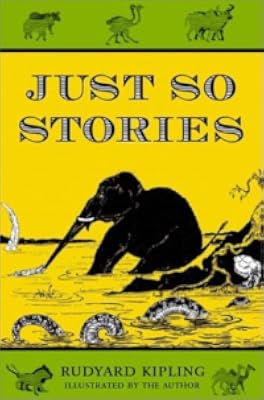
My copy of Just So Stories, in it's brick-red cover with the Elephant's Child straining away with all his might to escape the jaws of the Crocodile on the banks of "the great grey-green, greasy Limpopo River", the Bi-Coloured-Python-Rock-Snake in close attendance was the first book I truly loved. ... Kipling has an Aesopian understanding of animals, our dealings with them and our curious show more interrelatedness, interdependence, how we can learn about our own strange behaviour, our vanities and our foolishness through them and through our relationship with them. show less
added by Cynfelyn
Han skriver med lätt hand och bitvis är det i bästa brittiska nonsenstradition, men i sin helhet förstås långt bort från Lewis Carrolls självklara genialitet. Barnen roas med vilda påhitt, verser, upprepningar och konstigheter.
added by andejons
I god sagoanda förväntar man sig att landa mjukt i sensmoralens klokskap. Men hos Kipling landar man hårt. När den lilla elefantungen som ständigt blir bestraffad för sin frågvishet tillägnar sig sin snabel, då är det för att ge igen för den misshandel han utstått.
added by andejons
Lists

Favorite Childhood Books
1,646 works; 518 members

Favorite Animal Fiction
359 works; 156 members

501 Must-Read Books
529 works; 72 members

Childhood Favorites
427 works; 23 members

1900s (Decade, not century)
73 works; 17 members

Sonlight Books
1,487 works; 25 members

1,000 Good Books of John Senior
36 works; 6 members

Satori Smiles Children's Book List
262 works; 7 members

2013-2014 Homeschool Book Log
2 works; 1 member

Folio Society
831 works; 53 members

4th Grade Books
312 works; 5 members

Romalda Spalding's Writing Road To Reading
213 works; 3 members

A Child's Book Tour of India
71 works; 3 members

Puffin Books 70th anniversary handbook recommendations
537 works; 10 members

Inkworld Trilogy Books
14 works; 1 member

Geek Dad Read to Your Kids Additions List
66 works; 4 members
Children's Literature 1900 - 1950 in order
413 works; 8 members

Mustich's 1000 Books to Read Before You Die: A Life Changing List
1,001 works; 19 members

The Story of the World: Activity Book Four: The Modern Age
333 works; 2 members

Books Read in 2016
110 works; 1 member

Books Read in 2020
4,379 works; 123 members

Before Austen Comes Aesop
318 works; 9 members

AR Level 6 in cloudLibrary
77 works; 1 member

Written and Illustrated By
805 works; 1 member

Books We Loved As Children
603 works; 252 members

Unread books
1,063 works; 82 members

Books Read in 2019
4,052 works; 108 members

Nobel Price Winners
222 works; 20 members

Asia
178 works; 7 members

Books Read in 2017
4,249 works; 129 members

Stories Featuring Reptiles
22 works; 5 members
Books to Reread Someday
53 works; 7 members

20th Century Literature
1,161 works; 55 members

Best Books About Animals
143 works; 48 members

HMS: Make Your Child a Lover of Books, Ages 5-7
17 works; 2 members
Honey For a Child's Heart
1,152 works; 25 members

CCE 1000 Good Books List
1,033 works; 12 members
Ambleside Books
459 works; 18 members

Literature of Honor for Boys
91 works; 3 members
Talk Discussions
Past Discussions
the illustrators of the "Just So Stories" in Tattered but still lovely (August 2017)
Author Information

Kipling, who as a novelist dramatized the ambivalence of the British colonial experience, was born of English parents in Bombay and as a child knew Hindustani better than English. He spent an unhappy period of exile from his parents (and the Indian heat) with a harsh aunt in England, followed by the public schooling that inspired his "Stalky" show more stories. He returned to India at 18 to work on the staff of the Lahore Civil and Military Gazette and rapidly became a prolific writer. His mildly satirical work won him a reputation in England, and he returned there in 1889. Shortly after, his first novel, The Light That Failed (1890) was published, but it was not altogether successful. In the early 1890s, Kipling met and married Caroline Balestier and moved with her to her family's estate in Brattleboro, Vermont. While there he wrote Many Inventions (1893), The Jungle Book (1894-95), and Captains Courageous (1897). He became dissatisfied with life in America, however, and moved back to England, returning to America only when his daughter died of pneumonia. Kipling never again returned to the United States, despite his great popularity there. Short stories form the greater portion of Kipling's work and are of several distinct types. Some of his best are stories of the supernatural, the eerie and unearthly, such as "The Phantom Rickshaw," "The Brushwood Boy," and "They." His tales of gruesome horror include "The Mark of the Beast" and "The Return of Imray." "William the Conqueror" and "The Head of the District" are among his political tales of English rule in India. The "Soldiers Three" group deals with Kipling's three musketeers: an Irishman, a Cockney, and a Yorkshireman. The Anglo-Indian Tales, of social life in Simla, make up the larger part of his first four books. Kipling wrote equally well for children and adults. His best-known children's books are Just So Stories (1902), The Jungle Books (1894-95), and Kim (1901). His short stories, although their understanding of the Indian is often moving, became minor hymns to the glory of Queen Victoria's empire and the civil servants and soldiers who staffed her outposts. Kim, an Irish boy in India who becomes the companion of a Tibetan lama, at length joins the British Secret Service, without, says Wilson, any sense of the betrayal of his friend this actually meant. Nevertheless, Kipling has left a vivid panorama of the India of his day. In 1907, Kipling became England's first Nobel Prize winner in literature and the only nineteenth-century English poet to win the Prize. He won not only on the basis of his short stories, which more closely mirror the ambiguities of the declining Edwardian world than has commonly been recognized, but also on the basis of his tremendous ability as a popular poet. His reputation was first made with Barrack Room Ballads (1892), and in "Recessional" he captured a side of Queen Victoria's final jubilee that no one else dared to address. (Bowker Author Biography) show less

Rudyard Kipling has a Legacy Library. Legacy libraries are the personal libraries of famous readers, entered by LibraryThing members from the Legacy Libraries group.
Some Editions
Awards and Honors
Awards
Notable Lists
Series

Belongs to Publisher Series
Fabel Pocket (3)
Airmont Classics (123)
Corticelli [Mursia] (140)
Work Relationships
Is contained in
Contains
Has the adaptation
Is abridged in
Has as a commentary on the text
Common Knowledge
- Canonical title
- Just So Stories
- Original title
- Just so Stories
- Original publication date
- 1902
- First words
- In the sea, once upon a time, O my Best Beloved, there was a Whale, and he ate fishes.
- Quotations
- on the banks of the great grey-green greasy Limpopo river
"'Son, son!' said his mother ever so many times, graciously waving her tail..." - Last words
- (Click to show. Warning: May contain spoilers.)When they took their walks abroad !
- Original language
- English
- Disambiguation notice*
- A la parution en 1902, le recueil contient 12 nouvelles en anglais. Seule 11 ont été traduites chez Delagrave en 1963, la 12e - le chameau et sa bosse - étant jugée intraduisible.
L' évolution du langage a permis une ... (show all)première traduction en français de cette nouvelle. Elle a été faite chez Gallimard par Pierre Gripari en 1979
*Some information comes from Common Knowledge in other languages. Click "Edit" for more information.
Classifications
Statistics
- Members
- 11,134
- Popularity
- 828
- Reviews
- 85
- Rating
- (3.97)
- Languages
- 14 — Czech, Danish, English, Finnish, French, German, Greek, Italian, Norwegian, Portuguese, Russian, Spanish, Swedish, Thai
- Media
- Paper, Audiobook, Ebook
- ISBNs
- 553
- UPCs
- 5
- ASINs
- 226